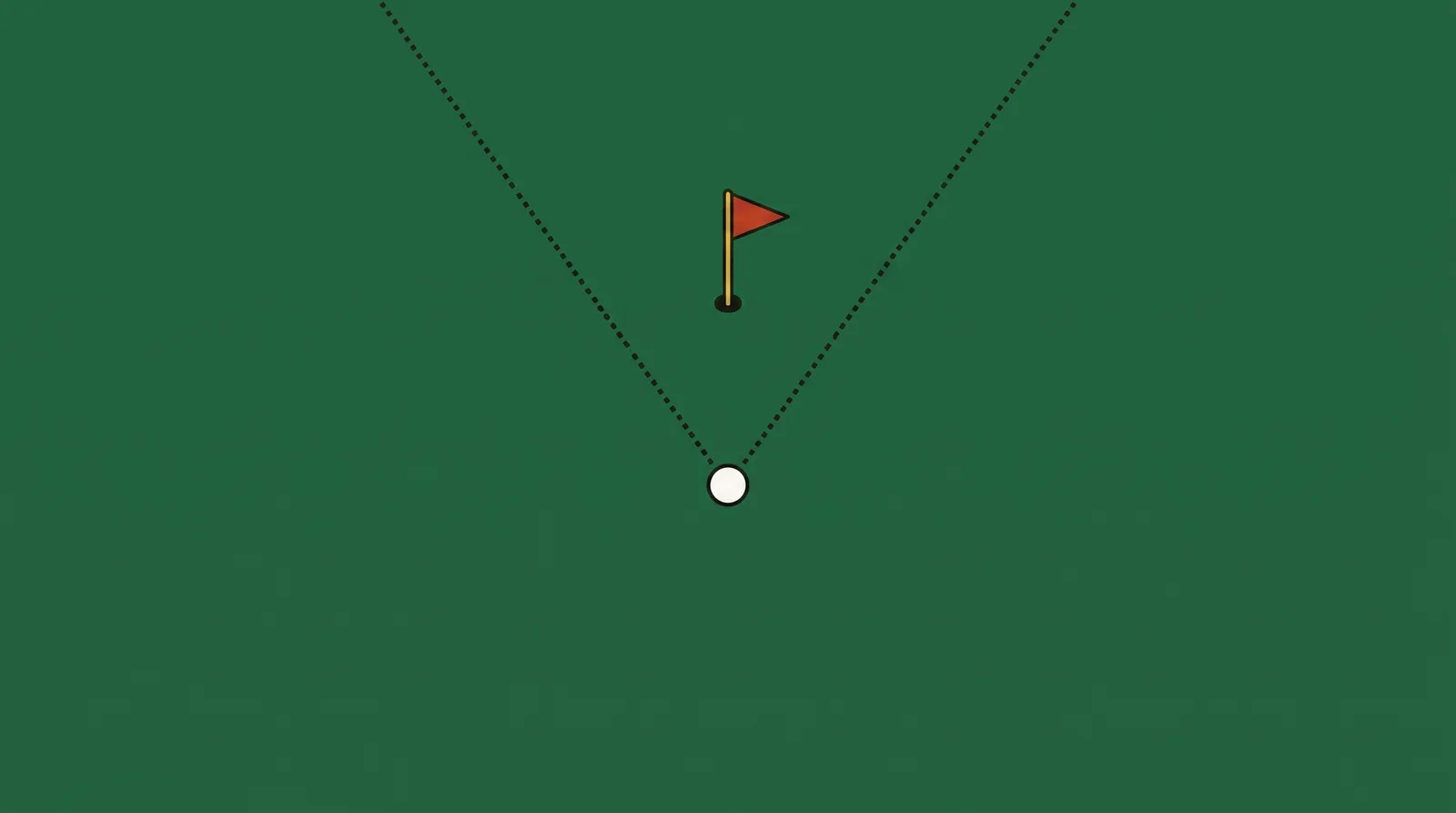
You struck it out of the middle. The strike felt pure, the flight was flat and straight, and the ball finished 30 yards right of the green. A push and a pull are the two misses with no curve on them, which is why they survive every tip written for slicers and hookers. This guide covers what they actually are, how to tell which one is yours, and the order to fix them in.
What a push and a pull actually are
Two numbers decide where the ball goes: where the clubface points at impact, and the direction the club is travelling through impact. TrackMan's guide to launch data puts the face at roughly 85% of the starting direction with a driver, with the path taking the rest.
Curve comes from the gap between those two numbers. Close the gap to zero and the ball flies dead straight. That is exactly what a push and a pull are: face and path in agreement, both aimed somewhere other than the target.
A pull is the same picture flipped. The path travels left across the ball, the face points left with it, and the ball never curves back.
| Shape | Starts | Curves | Face vs path | Where it comes from |
|---|---|---|---|---|
| Push | Right | No | Matched, both right | Path too far in to out, body stalls |
| Pull | Left | No | Matched, both left | Path too far out to in, shoulders open |
| Push slice | Right | Right | Face open to path | A different fault, see the slice guide |
| Pull hook | Left | Left | Face closed to path | A different fault, see the hook guide |
The two right-hand rows matter because golfers mix them up constantly. If your ball starts offline and then curves further offline, you do not have a push or a pull. You have a slice or a hook that happens to start on the wrong line, and those need different work. Everything below assumes the flight is genuinely straight.
Left and right in this guide are written for a right-handed golfer. Left-handers, swap them throughout.
How to tell which one you have in two minutes
Set a club on the ground pointing at your target and film three shots from directly behind, down that line. You are watching one thing only: the first 30 yards.
If the ball leaves right of the club on the ground and holds that line, it is a push. Left and holding, it is a pull. Anything that bends after the first 30 yards belongs in a different guide.
Do this with a 7 iron, not a driver. The driver exaggerates everything and gives you a noisier answer.
Where a push comes from
Three causes, in the order they show up.
Your path is swinging too far out to the right. The club drops too far behind you on the downswing, arrives from well inside the target line, and never gets back. The face squares to that path, so the ball leaves right and stays there.
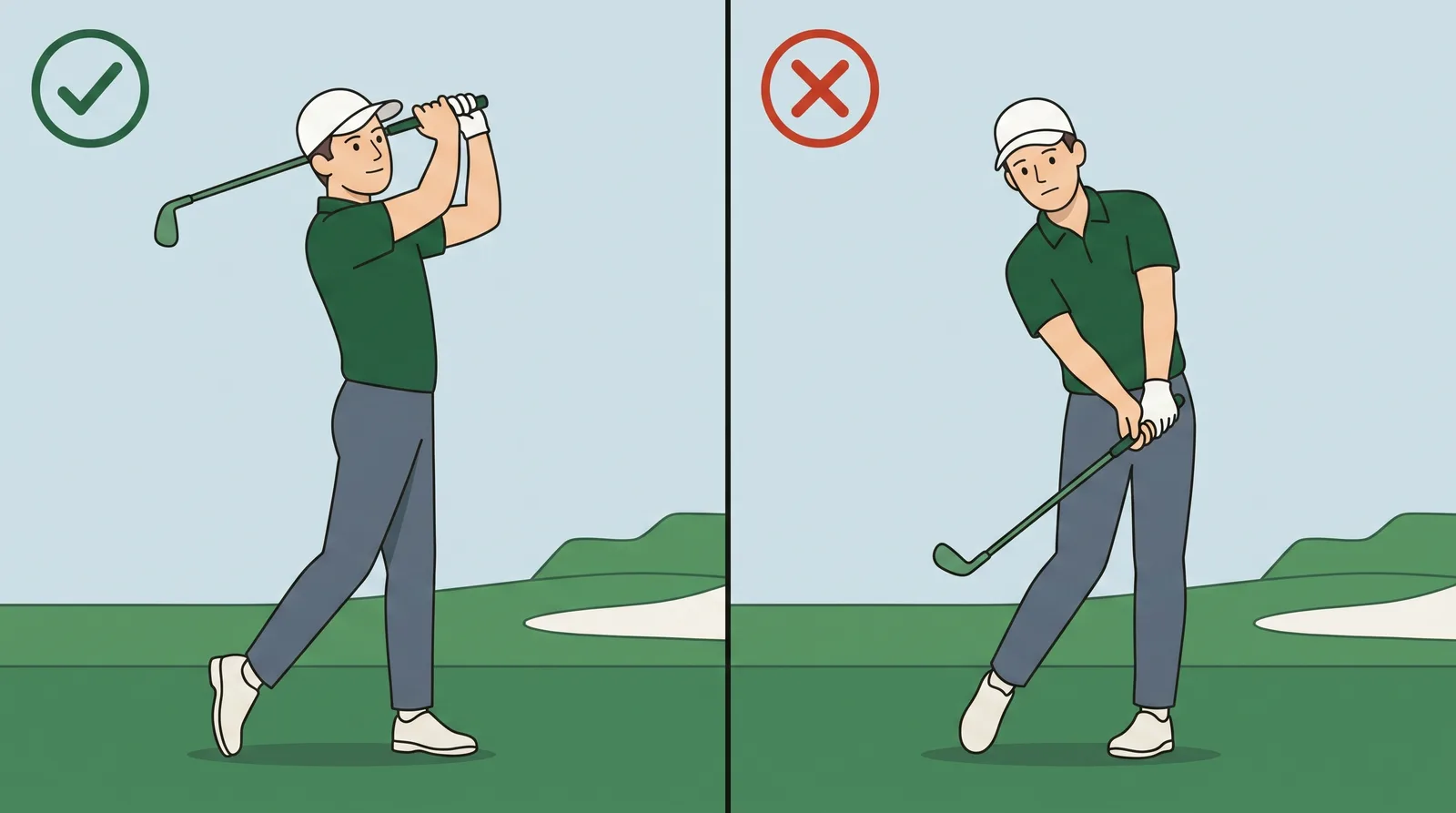
Your body stalls through impact. The hips and chest stop turning, the arms keep going, and the club releases out to the right. This one is easy to spot because the finish position gives it away. A body that keeps rotating finishes tall with the hands high and the chest facing the target. A body that stalls leaves the hands low and the chest still pointing right of target.
You are aimed right without knowing it. This is the most common one and the least believed. If your feet, hips and shoulders are set 8 degrees right of where you think, a perfectly neutral swing produces a push every time.
Where a pull comes from
The same three causes, mirrored.
Your path is swinging left across the ball. The upper body starts the downswing, the club is thrown outside the target line, and the face matches. If this is severe you usually get a pull slice instead, which is covered under coming over the top. A clean pull means the face is keeping up.
Your ball position has crept forward. With the ball too far forward in the stance, the club has already passed its low point and started travelling left by the time it reaches the ball. The strike still feels fine. Our guide to golf ball position has the reference points for every club.
Your shoulders are open at address. Feet parallel to the target line, shoulders 15 degrees left of it. The club follows the shoulders, not the feet.
Fix one: prove your aim before you touch your swing
Aim is the cause in more push and pull cases than swing mechanics, and it is the only cause you can eliminate in a single session.
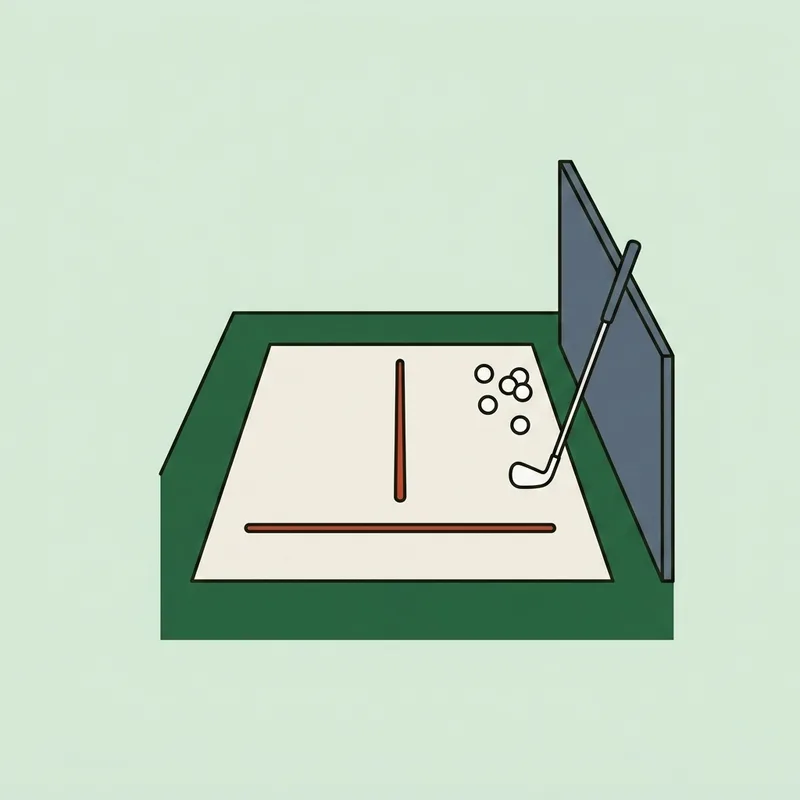
- Lay one club on the ground pointing at your target and set your feet parallel to it.
- Lay a second club across the front of your thighs. It should match the first.
- Lay it across the front of your shoulders. This is the one that is usually wrong.
- Have someone photograph you from directly behind, standing on the target line, not off to the side.
- Adjust until all three lines agree, then hit ten shots without moving the clubs.
Most golfers who push are aimed right at step three. Most who pull are aimed left. Both will tell you the new position feels absurd, because years of compensating have made crooked feel square. Our full checklist is in the golf alignment guide, and a set of dedicated sticks makes this a 20 second job rather than a fiddle with spare irons.
Fix two: put the ball back where it belongs
Ball position drifts without anyone noticing, and it moves the low point of the swing, which moves the direction the club is travelling at contact.
| Club | Ball position | What happens if it drifts forward |
|---|---|---|
| Wedges | Centre of stance | Path starts travelling left, pull appears |
| Mid irons | One ball forward of centre | Thin contact plus a pull |
| Long irons and hybrids | Two balls forward of centre | Pull, and the strike moves toward the toe |
| Driver | Opposite the lead heel | Pull, and often a high weak flight |
Set it with a club on the ground pointing at your lead heel. Check it every session for a fortnight. It moves back on its own the moment you stop looking.
Fix three: keep the body turning
If aim and ball position are clean and the shot is still there, the cause is rotation, and this is where the push and the pull separate.
Both drills are asking for the same thing from different directions: the lower body starting the downswing and the arms arriving last. The golf downswing guide breaks that sequence into checkpoints if you want the detail behind the drill.
Why this is worth fixing rather than playing around
Golfers make a deal with a push or a pull. They aim off, accept the shot, and get on with it. It works until the hole shape stops allowing it, and it quietly costs strokes long before that.
The other cost is that aiming off is unstable. It works on a flat range mat and stops working the moment the tee box points somewhere unhelpful, which is most of them.
Once the ball starts and finishes on line, the same two numbers let you shape it deliberately. A face slightly closed to a slightly in to out path is a draw, and the mirror of that is a fade.
Key takeaways
- A push and a pull have no curve, because the clubface and swing path are pointing the same way as each other.
- Both are aim and rotation faults, not face control faults. Your face control is already working.
- Watch the first 30 yards of flight. If it bends, you have a slice or a hook, not a push or a pull.
- Check shoulder alignment, not just feet. Shoulders are where the club actually goes.
- Ball position drifting forward produces a pull and moves the strike toward the toe.
- A stalled body sends the club out to the right. The height of your finish shows whether it stalled.
- Aiming off to compensate works on the range and fails on the course.
Common questions
What is the difference between a push and a slice?
A push flies straight right with no curve. A slice starts somewhere and then bends right in the air. The difference is whether the clubface agrees with the swing path or is open to it. A push means they agree, a slice means they do not.
Why do I push the golf ball right?
Your clubface and your swing path are both pointing right of the target at impact. That comes from a path swinging too far in to out, a body that stops rotating through impact, or an address position aimed right without you realising. Check the aim first, because it is the quickest to prove.
Why do I pull the golf ball left?
Face and path are both pointing left. Usually that is open shoulders at address, a ball position that has crept too far forward, or an upper body that starts the downswing and throws the club across the line. Film yourself from behind and check the shoulder line before changing anything in the swing.
Is a pull the same as a hook?
No. A pull starts left and stays left with no curve. A hook curves left in the air, and can start right, straight or left before it does. A pull hook does both, starting left and curving further left, and that needs the hook fix rather than this one.
Can ball position alone cause a push or a pull?
Yes, and it happens constantly. The club travels on an arc, so it is moving right of target early and left of target late. Moving the ball forward or back in the stance changes where in that arc you make contact, which changes the direction the club is travelling with no swing change at all.
Why do I only push my irons and not my driver?
The driver is played further forward in the stance, which catches the club later in its arc when it is already travelling left. That masks an in to out path. The same push is in your driver swing, it is just being cancelled by the ball position.
Should I aim left to fix my push?
No. Aiming left makes the body work harder to hold the path right, which usually deepens the fault, and it removes your only reliable reference for whether the fix is working. Aim at the target and change what the club is doing.
How long does it take to fix a push or a pull?
An aim-related one can be gone in a week of consistent checking. A rotation-related one takes about six weeks of three sessions a week before it holds under pressure. It is a faster fix than a slice because the clubface is already behaving.
Do I need a launch monitor to fix this?
No. A phone camera on the ground behind you, filming down the target line, shows the starting direction clearly, and starting direction is the only measurement this fault needs. A launch monitor tells you the exact path and face numbers, which is useful but not necessary here.
Why does my push get worse when I try to hit it harder?
Extra effort usually comes from the upper body and the arms, which either throws the club outside the line or causes the lower body to outrun the arms and stall. Both directions widen the fault. Swing at about 80% while you are working on this and let the strike do the distance.
Can the wrong shaft cause a push?
It contributes rather than causes. A shaft too stiff for your speed tends to leave the face slightly open and the club slightly behind, which fits the push pattern. It will not create a push in a well-aimed swing, but it makes one harder to shift. Our golf shaft flex guide covers how to check yours.
On this page
- What a push and a pull actually are
- How to tell which one you have in two minutes
- Where a push comes from
- Where a pull comes from
- Fix one: prove your aim before you touch your swing
- Fix two: put the ball back where it belongs
- Fix three: keep the body turning
- Why this is worth fixing rather than playing around
Tom Ashworth
Tom Ashworth is a PGA Professional who has taught golf since 2012, working mainly with beginners and mid-handicappers at club level in Surrey. He reviews the instruction guides on Learn Golf for technical accuracy before they publish.
Most of his teaching is with players in their first three years of the game, and most arrive having been told too much: six swing thoughts collected from videos, half of them contradicting each other. His approach is to check the grip and the alignment before touching the swing, on the basis that most bad ball flight is decided at address.