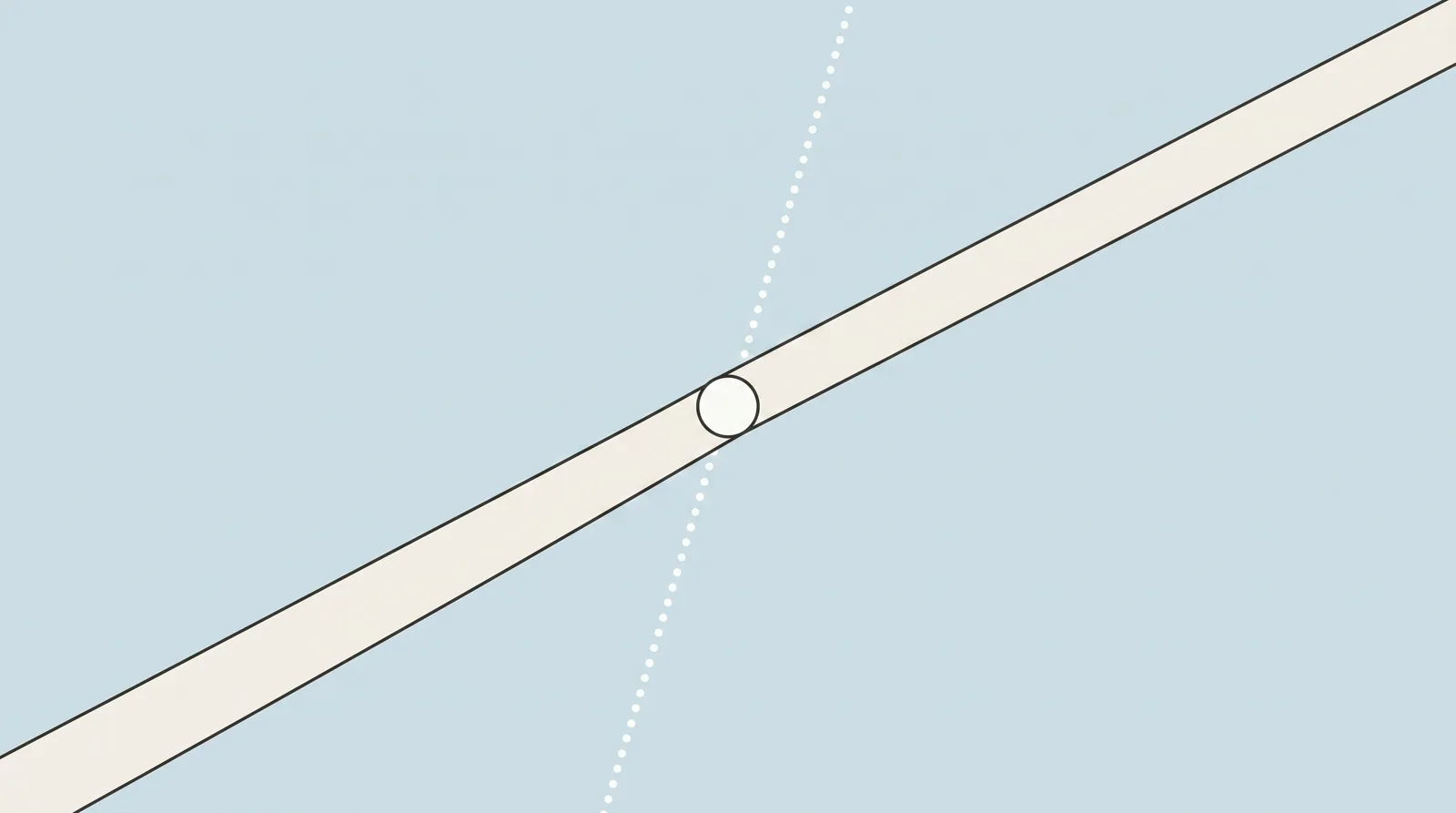
The club goes back on a decent plane, and then something happens at the top that nobody can feel and everybody can see on video: the whole thing moves outward and comes down across the ball. This guide covers what the transition is actually doing, why the move feels like power rather than a fault, the order that replaces it, and the drills that change it.
What is actually happening at the top
The club reaches the top of the backswing sitting on a plane. Coming over the top means that in the first fraction of a second of the downswing, before the club has travelled anywhere, the whole assembly of shoulders, arms and club moves away from the body and onto a steeper, more outward line. Everything after that is a consequence.
From there the club can only arrive at the ball from outside the target line, and it has to travel across the ball to get back. The Titleist Performance Institute describes the move as perhaps the most common swing fault among high handicap golfers, caused by an overuse of the upper body on the downswing, and notes that it produces a pull when the face is square to that path and a slice when the face is open to it.
Two words often used alongside it are worth separating. Casting is the wrist angle being released early, which is about when the club unhinges. Coming over the top is about where the club goes. They usually turn up together because the same instinct produces both, but they are different faults and a golfer can have either without the other. The wrist angle side of it belongs in lag in the golf swing.
Why it feels like the right thing to do
Nobody comes over the top by accident. It is what a body does when it is asked to hit something hard with an object held in both hands, and it is the same pattern that makes a beginner chop at an axe or swing a bat with the shoulders.
The trouble is that a golf swing gets its speed from a sequence rather than from effort. TPI's work on the kinematic sequence describes efficient swings as ones where the hips accelerate first and then slow down, passing energy up to the torso, which does the same for the arms, which do the same for the club. Each segment gives its speed to the next. Start with the shoulders and there is nothing below them to hand energy on from, so the sequence has already peaked before the club is halfway down.
What the move actually costs you
The lost distance is the part golfers notice least and it is the largest.
| What you see | What it tells you |
|---|---|
| Straight pulls that fly on line and finish left | The path is out to in and the face is square to it |
| High weak shots that fall right | Same path, face open to it, most of the loft wasted on spin |
| Deep divots and heavy contact | The club is arriving steeply as well as outward |
| Ballooning irons and low driver flight | Attack angle too steep on both, for opposite reasons |
| A finish with weight still on the back foot | Nothing shifted, so the shoulders had to do the work |
Path direction is what sets the curve, and it is one of the two numbers that decide every shot, as TrackMan sets out in its explanation of club path. But a steep, outward delivery also costs speed and strike quality, which is why fixing it changes iron contact and driver distance at the same time as it changes direction.
Five causes, in the order worth checking
Work down this list rather than starting with the swing itself. The first two are setup faults that make an out-to-in path almost unavoidable, and they cost nothing to correct.
Your shoulders are aiming left. This is the most common starting point and the hardest to spot, because the feet usually look correct. Lay a club across the front of your shoulders at address and check where it points. Full detail is in golf alignment.
The ball is too far forward. A ball placed well forward in the stance is reached at a point where the club is already travelling left, so a perfectly good swing produces an out-to-in strike. The reference points for each club are in golf ball position.
Nothing moves onto the lead foot. If pressure stays on the trail side through the downswing, the body has no way to clear and the shoulders take over by default. That is the subject of weight shift in the golf swing.
The hips and shoulders turn as one unit. Separation between the two is what creates the stretch that fires the downswing in the right order. Without it there is nothing for the upper body to wait for, and the guide to hip rotation covers how to build it.
You are trying to hit hard from the top. The commonest cause of all, and the one no drill fixes on its own. A golfer swinging at maximum effort will always recruit the shoulders first, because that is where the strength is.
The quickest way to check which of these applies to you is to stop and hold your finish for three seconds after every shot for a whole practice session. A body that sequenced correctly ends up somewhere very specific, and a body that did not cannot fake it.
The fix is an order, not a position
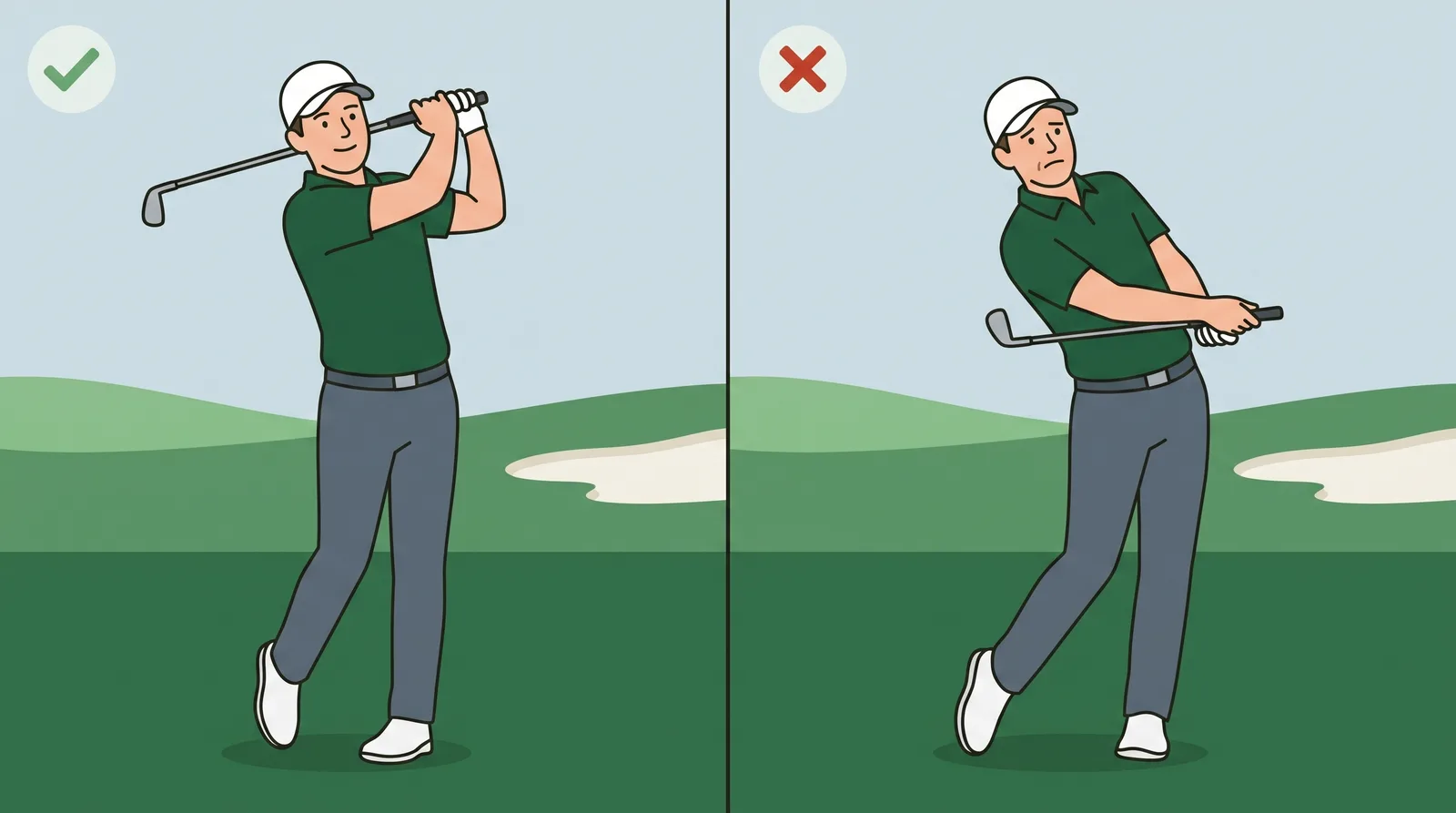
The change is small and it happens in about a tenth of a second. Rehearse it slowly, many times, before trying to hit anything with it.
- Complete the backswing. Most over-the-top swings start down before the club has finished going back, so the first fix is simply arriving at the top.
- Move pressure into the lead foot while the club is still going back or has just stopped. Nothing else moves.
- Let the lead hip turn and clear. The chest is still closed at this point, which is what the whole thing depends on.
- Let the chest follow the hips, and let the arms follow the chest.
- Do nothing with the hands at all. The club arrives on its own if the three steps above happen in that order.
Steps two and three are the swing change. Everything else is a consequence of getting them right, which is why the checkpoint-by-checkpoint version in the downswing guide is worth reading alongside this. The plane the club travels on is an outcome of the sequence rather than something to steer directly, and the wider picture of that is in golf swing plane.
What changes, and when
The first thing to change is usually the strike, not the direction. Divots get shallower and iron contact feels less like a collision, because a club arriving less steeply is doing less damage to the turf. If your misses have included heavy contact, the diagnosis in how to stop hitting fat shots covers the same steep delivery from the other side.
Direction changes second, and it goes through an awkward stage. Shots that used to pull left start going straight or slightly right, because the path has moved and the face has not caught up yet. Some golfers pass briefly through a period of heel contact while the club finds its new route to the ball, which is worth knowing about before it panics you, and is why how to fix a shank is a useful page to have read.
Speed changes last, and it is the part nobody predicts. A swing that sequences properly delivers the club faster at the same effort, which is why golfers who fix this often report the ball going further while feeling as though they are swinging more slowly.
Give it six weeks of three short sessions a week. Rehearsals without a ball count for more than balls hit, because the change is a timing pattern and the ball introduces the urge to hit. Ten slow rehearsals in a doorway at home are worth more than fifty balls struck at the range in a hurry.
Key takeaways
- Coming over the top is the club moving outside its backswing plane during the transition, before it has travelled anywhere.
- It is a sequencing fault. The arms move first because the lower body has not started.
- TPI calls it perhaps the most common swing fault among high handicap golfers, caused by an overuse of the upper body.
- An efficient swing accelerates the hips first, then the torso, then the arms, with each segment passing speed to the next.
- The result is a pull when the face matches the path and a curve to the right when it does not.
- It also delivers the club steeply, which costs strike quality and distance as well as direction.
- Check the shoulder line and ball position before changing anything in the swing itself.
- The fix is pressure into the lead foot, then the lead hip clearing, then the chest, with the arms last.
- Trying to swing out to the right instead usually produces a block or a hook and leaves the sequence untouched.
- Expect the strike to improve before the direction does, and expect about six weeks before the pattern holds under pressure.
Common questions
What does coming over the top mean in golf?
It means the club moves outside its backswing plane at the start of the downswing, so it approaches the ball from outside the target line and travels across it. The result is a pull if the clubface is square to that path and a shot that curves right if the face is open to it.
What causes an over the top swing?
The upper body starting the downswing before the lower body. When the shoulders and arms move first, the club is thrown outward and there is no way back onto plane. Open shoulders at address, a ball position too far forward, and no weight shift onto the lead foot all make it more likely.
Is coming over the top the same as slicing?
No. Coming over the top is a swing path fault; a slice is a curve produced by the clubface and the path disagreeing. It is one of the common causes of a slice, but you can come over the top and hit a dead straight pull, and you can slice a ball without coming over the top at all.
Is coming over the top the same as casting?
No, though they usually appear together. Casting is releasing the wrist angle too early, which is about when the club unhinges. Coming over the top is about where the club goes in transition. The same instinct to hit from the top produces both.
How do I start the downswing correctly?
Move pressure into the lead foot while the club is still finishing its backswing, then let the lead hip turn and clear before the chest follows. The arms and hands should do nothing deliberate. If you can feel the lower body starting while the club is still going up, the order is right.
Why does swinging correctly feel weaker?
Because the effort has moved from the shoulders, which are strong and easy to feel, to a sequence that produces speed later and lower down. The sensation of doing less is the change working. Speed measured on a launch monitor usually goes up while the swing feels slower.
Should I try to swing more from the inside?
Not consciously. Deliberately swinging out to the right normally keeps the same faulty body sequence and drops the club too far behind you, which produces blocks and hooks instead. Change the order of the downswing and the path corrects itself.
Why do I hit the ground behind the ball when I come over the top?
Because the same move that sends the club outward also sends it downward more steeply, so the low point of the swing arrives early. Deep divots and heavy contact are usually the first symptom to appear and the first to disappear once the sequence changes.
What drill fixes coming over the top fastest?
The step-through drill, because it makes the fault physically impossible rather than asking you to avoid it. Start with your feet together, step onto the lead foot as the club reaches the top, then swing. Expect poor contact for the first couple of sessions.
Does coming over the top cost distance?
Yes, in two ways. The sequence peaks too early so the club is no longer accelerating at the ball, and the steep delivery adds spin and reduces the efficiency of the strike. Golfers who fix it commonly find the ball goes further while the swing feels easier.
How long does it take to stop coming over the top?
Roughly six weeks of three short sessions a week, and it moves more slowly than a grip or alignment change because it is a timing pattern rather than a position. Rehearsals without a ball count for more than balls hit, since the ball is what triggers the urge to hit from the top.
Tom Ashworth
Tom Ashworth is a PGA Professional who has taught golf since 2012, working mainly with beginners and mid-handicappers at club level in Surrey. He reviews the instruction guides on Learn Golf for technical accuracy before they publish.
Most of his teaching is with players in their first three years of the game, and most arrive having been told too much: six swing thoughts collected from videos, half of them contradicting each other. His approach is to check the grip and the alignment before touching the swing, on the basis that most bad ball flight is decided at address.