Most golfers learn the swing as a list of positions and then spend years trying to hit them all at once. It does not work, because the positions are the result of the motion rather than the cause of it. This guide starts with what the club has to do at the ball, then works backwards through the six checkpoints that make it possible, the sequence that produces speed, and the faults each part creates when it goes wrong.
Every left and right below assumes a right-handed golfer. If you play left-handed, reverse them and everything else holds.
What the swing has to do, in one paragraph
The club has to arrive at the ball travelling in roughly the right direction, with the face pointing roughly where you want the ball to start, moving fast enough to matter, and striking the ball before it strikes the ground. That is the whole job. Everything else in this guide exists to make those four things happen repeatably.
Two of them decide direction. The clubface controls where the ball sets off, and the difference between where the face points and where the club is travelling is what makes the ball curve. TrackMan's guide to launch data calls face angle the most important number for determining the starting direction of the shot, because the ball launches very close to where the face is aimed.
This matters more than any position in the swing, because it means a straight shot has nothing to do with looking good. Plenty of unusual-looking swings deliver a square face on a neutral path, and plenty of textbook-looking swings do not. The full relationship is covered in ball flight laws, and it is worth reading before you change anything.
If you are entirely new to the game and have not yet settled on clubs, tees or a practice routine, start with our complete guide for beginners and come back here once you are making contact.
Before the club moves
Roughly half the faults blamed on the swing were built at address. The setup costs nothing athletically and it decides what the swing is allowed to do.
The grip decides what the clubface can do, because the hands are the only connection between you and the club. Hold it in the fingers of the lead hand rather than the palm, close the hand until two or three knuckles are visible, and add the trail hand so its lifeline sits over the lead thumb. A grip that is too weak leaves the face open no matter how well you swing. The detail sits in how to grip a golf club.
Posture is the second piece. Tilt forward from the hips rather than rounding the upper back, add a small knee flex, and let the arms hang. That hanging position is not a style choice: it puts the arms in the place they will naturally return to at speed, which is why the club can find the ball without a mid-swing correction. Our golf posture guide covers the checkpoints, and golf stance covers width and foot flare.
Aim is the one almost nobody checks. Most golfers set their feet parallel to the target line and assume the rest of them followed. It usually did not.
Lay one club on the ground pointing at your target and set your feet parallel to it. Then hold a second club across the front of your shoulders and check that it points the same way. If the shoulder line is aiming left, the swing will travel left across the ball whatever your feet are doing.
The six checkpoints
Positions are a way of describing the motion, not a set of poses to hit. Read them as a shape, then stop thinking about them and swing.
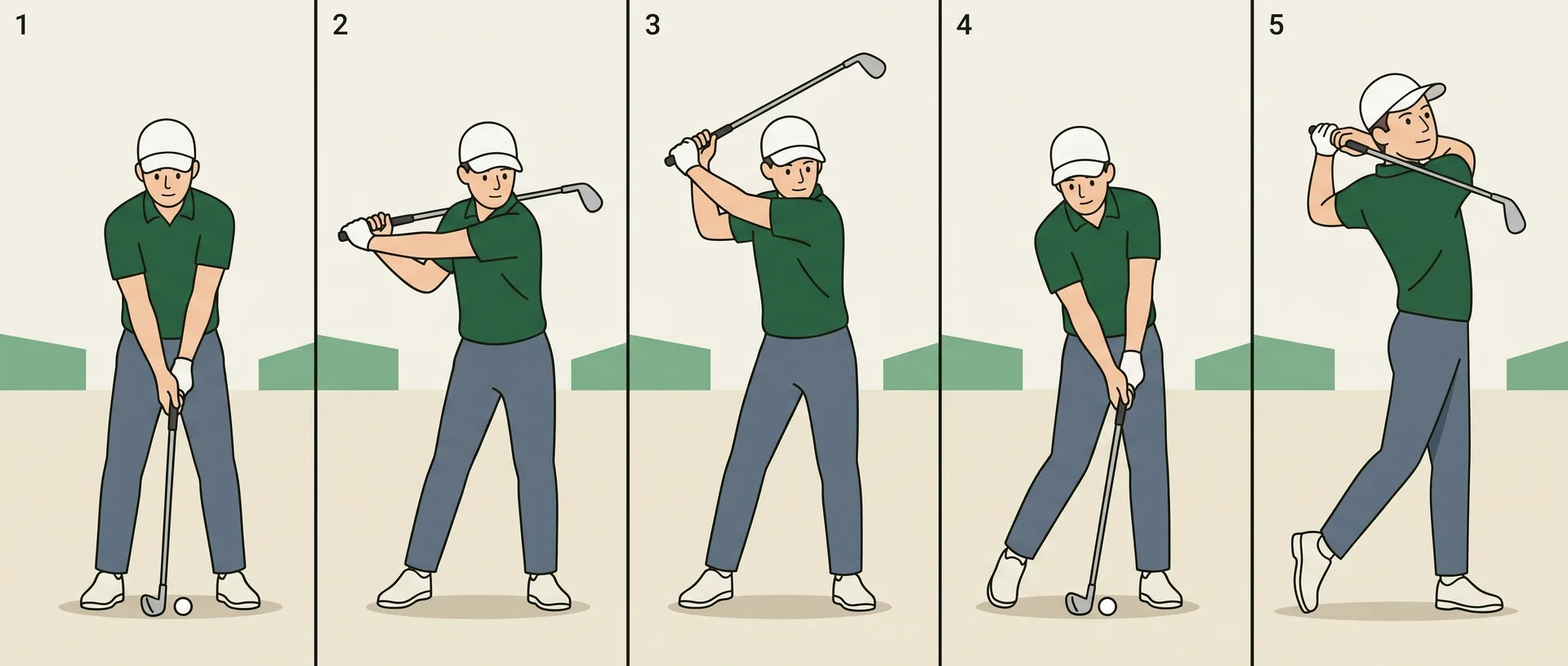
| Checkpoint | What it looks like | What it is doing |
|---|---|---|
| Address | Tilted from the hips, arms hanging, weight even | Setting what the swing can reach |
| Halfway back | Shaft parallel to the ground, hands in front of the trail hip | Turning rather than lifting |
| Top | Lead arm across the chest, back facing the target | Storing the turn, not the arm swing |
| Transition | Lower body starting forward while the club is still going back | Sequencing the release |
| Impact | Hands ahead of the club head with an iron, weight forward | Delivering loft and strike |
| Finish | Chest facing the target, weight on the lead foot, balanced | Proof the sequence happened |
Nobody hits all six consciously. What you can do is check one of them at a time in a mirror, at half speed, and let the others follow.
The backswing: turn, do not lift
The backswing has one purpose, which is to move the club away without moving your body out of position. That is it. It does not create power on its own and it cannot be too slow.
The takeaway is where it usually breaks. The club, hands, arms and chest should move away together for the first foot or so, with the hands staying in front of the chest rather than running away behind the body. If the hands snatch the club inside immediately, the arms have to lift to compensate, and now the club is behind you and above you at the same time.
Four checkpoints describe the whole thing, and each has one characteristic miss.
| Checkpoint | What to look for | The common miss |
|---|---|---|
| First foot of the takeaway | Club, hands, arms and chest move away together | The hands snatch the club inside while the chest stays still |
| Halfway back | Shaft horizontal, hands in front of the trail hip | The club is lifted by the arms and the hands run behind the body |
| Three-quarters | Lead arm across the chest, wrists setting on their own | Wrists hinged early and deliberately, club arriving steep |
| Top | Back facing the target, lead heel still on the ground | The heel lifts and the lead arm collapses to buy extra length |
Wrist hinge happens on the way back and mostly happens by itself. The weight of the club head plus the change of direction sets the angle without you doing anything deliberate. Golfers who consciously hinge early tend to end up with the club steep and disconnected from the chest, which is a harder problem to solve than a shallow backswing.
How far back is genuinely contested. Some coaches want the club parallel to the ground at the top; others regard that as far more than most amateurs can control. Our view is that the length of your backswing should be whatever you can reach without the lead heel lifting off the ground or the lead arm collapsing, which for most people is noticeably shorter than they currently swing. The takeaway, the halfway-back position and the top are broken down individually in the golf backswing.
The transition, and the move that separates golfers
The change of direction is where good swings and bad swings actually diverge, and it happens in about a fifth of a second.
In a well-sequenced swing the lower body starts moving towards the target while the club is still finishing its backswing. That overlap is not an optical illusion. The Titleist Performance Institute's work on the kinematic sequence found that elite ball strikers all accelerate in the same order, lower body first, then torso, then arms, then club, with each segment slowing down as the next one speeds up. Their finding is that all great ball strikers share this sequence regardless of how different their swings look.
Beginners reverse it. The arms go first from the top, the shoulders spin open, and the club is thrown outwards and downwards. The club then arrives at the ball from outside the target line with nothing left in it, which produces the weak left-to-right shot most new golfers recognise immediately.
The full breakdown of the sequence, including what starts it and what it feels like at full speed, is in the golf downswing.
Impact: the only position that scores
Everything before this is preparation. Impact is the only moment the club and the ball interact, and it lasts about half a millisecond.
With an iron, the club should still be travelling downwards when it reaches the ball. The ball is struck first, then the turf, and the divot starts on the target side of where the ball was sitting. This is counter-intuitive to almost every beginner, who assumes you have to help the ball into the air. You do not. The loft on the face does that, and trying to assist it is what produces thin and fat shots in equal measure.
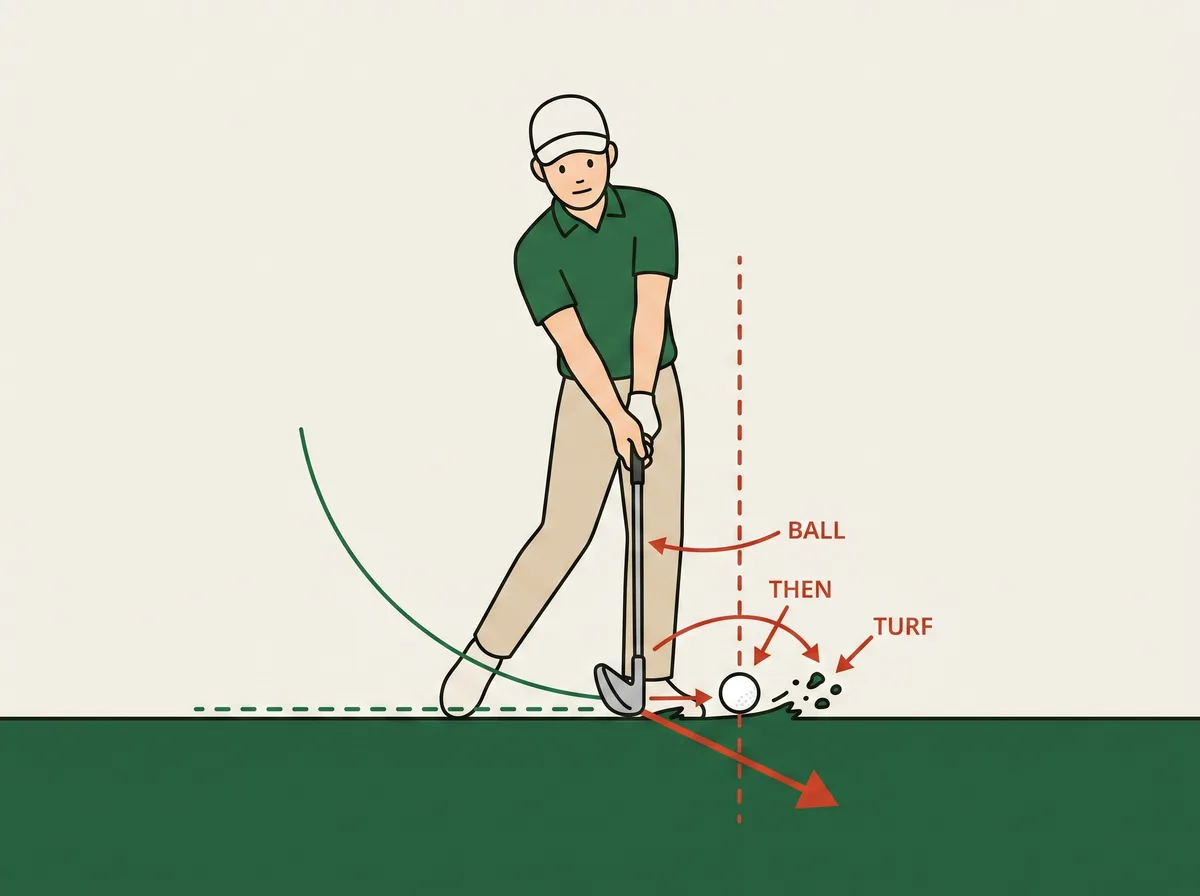
Three things describe a good impact position, and they arrive together or not at all. The hands are ahead of the club head. The weight has moved onto the lead foot. The chest is beginning to open towards the target rather than still facing the ball. Golfers who hang back on the trail foot get none of the three.
The detail on shaft lean, compression and the drills that actually transfer is in golf impact position.
The finish, and why it is evidence
The finish does not affect the ball. It has already gone. What the finish does is tell you what happened before it, which makes it the cheapest diagnostic in golf.
A balanced finish with the chest facing the target, the weight on the lead foot and the trail toe down means the body rotated and the weight moved. If you fall backwards, the weight never transferred. If you stagger forwards, you slid rather than turned. If you cannot hold the finish for three seconds, you swung faster than you can control.
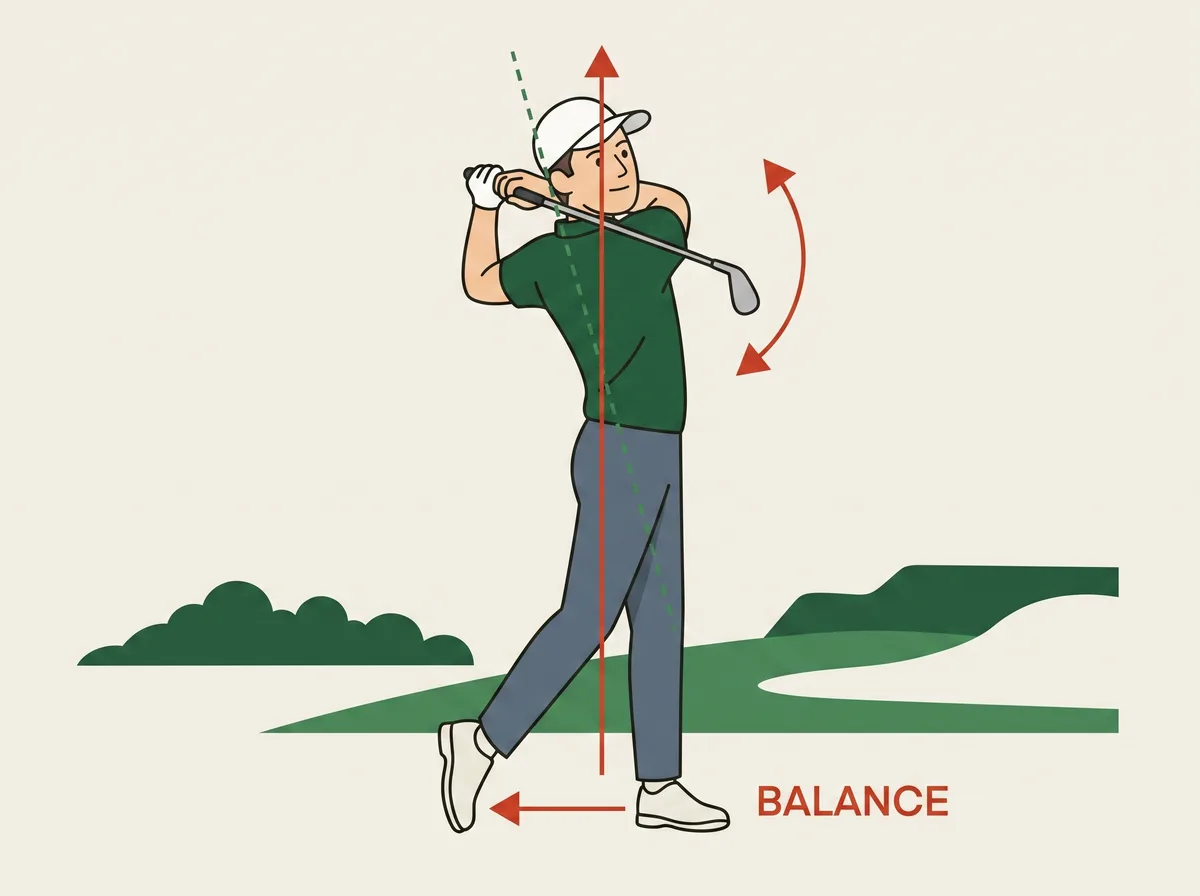
Hold every finish for a count of three during practice. It changes nothing about the swing directly, and it exposes almost every sequencing fault you have. Golfers who cannot do it are almost always swinging at a speed they have not earned yet, and the fix is to swing at about 80% until the finish is repeatable.
Tempo and sequence
Tempo is the ratio between the backswing and the downswing, and it is more consistent among good players than almost any other measurement. The backswing takes roughly three times as long as the downswing for most tour players, and amateurs vary far more, usually by rushing the change of direction rather than by swinging the club faster.
That distinction is worth sitting with, because it explains why two golfers with completely different-looking swings can both strike the ball well. Tempo is not about how quickly the club moves. It is about the two halves of the swing keeping a stable relationship with each other, so the club arrives at the same point at the same moment every time.
The practical version does not require a device. Count "one, two" going back and "three" coming down, out loud at the range, on every shot for a full session. Most golfers discover their downswing count arrives well before the club has finished going back, which is the rushed transition made audible.
Where speed actually comes from
Speed is a sequencing outcome, not a strength outcome, at least until you are already sequencing well.
Some context on what the numbers look like. TrackMan's club speed data puts the average male amateur, around a 14.5 handicap, at 94 mph with a driver, a 10 handicap at 95 mph and a scratch player at 110 mph. The PGA Tour average is 115 mph, and the LPGA Tour average is 96 mph.
| Player | Driver club speed |
|---|---|
| Male amateur, average (14.5 handicap) | 94 mph |
| Male amateur, 5 handicap | 101 mph |
| Male amateur, scratch or better | 110 mph |
| Female amateur, 10 handicap | 83 mph |
| LPGA Tour average | 96 mph |
| PGA Tour average | 115 mph |
The gap between an average amateur and a scratch player is around 16 mph, which is real but smaller than most people assume. The far bigger difference is what happens to that speed at the ball. TrackMan's explanation of smash factor, the ratio of ball speed to club speed, gives 1.50 as the driver target and reports 1.49 as the PGA and LPGA Tour average. Amateurs routinely deliver less, which means a large share of the speed they generate never reaches the ball at all.
Strike quality, not effort, is where most amateurs find speed. A centre strike with an unhurried swing beats a heel strike with a violent one, every time.
What each fault tells you
Ball flight is feedback, and it is more reliable than how the swing felt. Use it as a diagnostic rather than a verdict.
| What the ball does | Most likely cause | Where to start |
|---|---|---|
| Starts left, curves hard right | Path across the ball, face open to it | Grip and shoulder alignment |
| Starts right, keeps going right | Face open to target and path | Grip |
| Starts right, curves hard left | Path swinging right, face closed to it | Alignment, then release timing |
| Thin, low, no divot | Weight hanging back, trying to lift the ball | Weight forward at impact |
| Fat, divot before the ball | Low point behind the ball, usually a slide | Sequence and ball position |
| Weak and high with an iron | Adding loft through impact | Hands ahead at impact |
The left-to-right miss is by far the most common in amateur golf, and it has its own guide in how to fix a slice. If you have overcorrected and the ball now dives left, that is covered in how to fix a hook.
One caveat on the table. Ball flight tells you what the club did, not why. Two golfers can produce the same slice from opposite causes, so treat these as starting points rather than diagnoses.
What to work on first, and in what order
The order matters more than the content. Working on the downswing while your grip is leaving the face open produces a golfer who has two problems instead of one, and cannot tell which is which.
| Order | What to work on | Roughly how long | You are done when |
|---|---|---|---|
| 1 | Grip and aim | 2 to 3 weeks | You can set both without thinking, and a club across your shoulders points parallel to the target line |
| 2 | Posture and ball position | 2 weeks, alongside the above | Your arms hang rather than reach, and the ball position is consistent shot to shot |
| 3 | Contact: ball before turf | 3 to 4 weeks | Seven clean strikes out of ten on half swings with a 7 iron |
| 4 | Turn rather than lift | 3 weeks | The lead arm stays across the chest at the top without effort |
| 5 | Sequence and transition | 4 weeks or more | You can hold a balanced finish on almost every full swing |
That is roughly four months of once-a-week practice, which is a realistic timeframe rather than a pessimistic one. The temptation is to skip to stage five because it is the interesting one. Golfers who do that end up with a well-sequenced swing delivering an open face, which curves the ball just as badly as a poorly sequenced one.
There is one exception worth naming. If you are already making solid contact and the ball is going roughly where you aim, none of this is urgent, and you will get more out of a session on the practice green than another hour hitting 7 irons.
How to practise the swing
Practice that changes a swing looks nothing like practice that feels productive. Hitting 80 balls with a driver feels like work and changes almost nothing, because there is no feedback loop and no repetition of a single idea.
Three rules make range time transfer. Work on one thing per session, not three. Use a target for every shot, not a general direction. And hit at least a third of your balls at half speed, because a swing change only sticks if it can be repeated slowly first.
Give any change three weeks of consistent work before you judge it. A new motion feels wrong precisely because it is different, and the discomfort is not evidence that it is incorrect.
Does the swing change from club to club?
Barely, and the parts that do change are all at address rather than in the motion.
The grip is identical from driver to wedge. The sequence is identical. What changes is ball position, which moves forward for longer clubs, stance width, which narrows for shorter clubs, and swing length, which shortens naturally as the club gets shorter.
The driver is the one genuine exception, and only because the ball is teed. With an iron the club is still descending at impact; with a driver you want it travelling slightly upwards, which comes from the ball being forward in the stance and the upper body tilted slightly away from the target at address. Same swing, different setup.
Key takeaways
- The club has four jobs at impact: direction, face angle, speed, and striking the ball before the turf.
- The face decides where the ball starts, and the gap between face and path decides how much it curves.
- Around half of all swing faults are built at address, before the club moves.
- Aim the clubface at the target and the body parallel to the target line, not at the flag.
- The backswing turns the chest; it does not lift the arms.
- Good ball strikers all sequence in the same order: lower body, torso, arms, club.
- With an iron, the ball is struck first and the divot begins past it.
- The finish is a diagnostic. If you cannot hold it for three seconds, you swung too hard.
- Change one thing per session and give it three weeks before judging it.
Common questions
How do I swing a golf club as a beginner?
Set up with the arms hanging and the club reaching the ball comfortably, turn your chest away from the target while the arms stay in front of you, then start down with the lower body and let the arms follow. Aim to strike the ball before the turf, and finish balanced with your chest facing the target.
What is the correct golf swing sequence?
Lower body first, then torso, then arms, then club. Each segment accelerates and then slows as the next one speeds up. Research on elite ball strikers finds this order is shared across players whose swings look nothing alike, which makes it the closest thing to a universal in golf technique.
Should I keep my head down during the golf swing?
No, and it is one of the most damaging pieces of common advice. Forcing the head down locks the neck and prevents the chest from rotating through impact. Keep your eyes on the ball and let the head turn naturally as the body rotates through.
Why do I keep hitting the ground before the ball?
Your low point is behind the ball, usually because your weight stayed on the trail foot or you slid towards the target instead of rotating. Check that your weight is on the lead foot at impact, and that the ball is not too far forward in your stance.
How far back should my backswing go?
As far as you can turn without the lead heel lifting or the lead arm collapsing, which for most amateurs is shorter than they currently swing. A controlled three-quarter backswing usually delivers more speed at the ball than a full one built by lifting the arms.
Is a golf swing supposed to feel powerful?
No. A well-sequenced swing feels unhurried, and the speed arrives at the ball rather than at the top. Golfers who feel powerful are usually accelerating the arms early, which means the club is already slowing down by the time it reaches impact.
Does the golf swing change for each club?
The motion does not. Ball position, stance width and swing length change with the club, and the driver is set up to be struck slightly on the upswing because the ball is teed. The grip and the sequence stay identical from driver to wedge.
How long does it take to build a repeatable golf swing?
Expect three weeks of consistent practice before a single change feels normal, and several months before the whole motion holds up under pressure on a course. Progress arrives in steps rather than smoothly, and changes often feel worse before they feel better.
Why does my ball curve to the right?
The clubface is open relative to the direction the club is travelling through impact. The most common cause is a grip too weak to square the face in time, often combined with shoulders aiming left, which sends the club across the ball.
What is a good swing speed for an average golfer?
TrackMan puts the average male amateur at about 94 mph with a driver and a scratch player at 110 mph, with LPGA Tour players averaging 96 mph. Strike quality matters more than raw speed for most amateurs, because a large share of the speed generated never reaches the ball.
Should I take lessons or learn the swing myself?
A few lessons early are worth far more than the same money spent on equipment, because a coach fixes grip, aim and posture in one session and those three silently create most swing faults. After that, self-directed practice with clear feedback works well.
On this page
- What the swing has to do, in one paragraph
- Before the club moves
- The six checkpoints
- The backswing: turn, do not lift
- The transition, and the move that separates golfers
- Impact: the only position that scores
- The finish, and why it is evidence
- Tempo and sequence
- Where speed actually comes from
- What each fault tells you
- What to work on first, and in what order
- How to practise the swing
- Does the swing change from club to club?
Tom Ashworth
Tom Ashworth is a PGA Professional who has taught golf since 2012, working mainly with beginners and mid-handicappers at club level in Surrey. He reviews the instruction guides on Learn Golf for technical accuracy before they publish.
Most of his teaching is with players in their first three years of the game, and most arrive having been told too much: six swing thoughts collected from videos, half of them contradicting each other. His approach is to check the grip and the alignment before touching the swing, on the basis that most bad ball flight is decided at address.