Flex is printed on the shaft as a single letter, which makes it look like a size. It is not. A stiff shaft from one manufacturer can measure softer than a regular from another, and the letter on your driver was almost certainly chosen by whoever built the club rather than by anything about your swing. Here is what flex actually does and how to work out which one you need.
What flex actually is
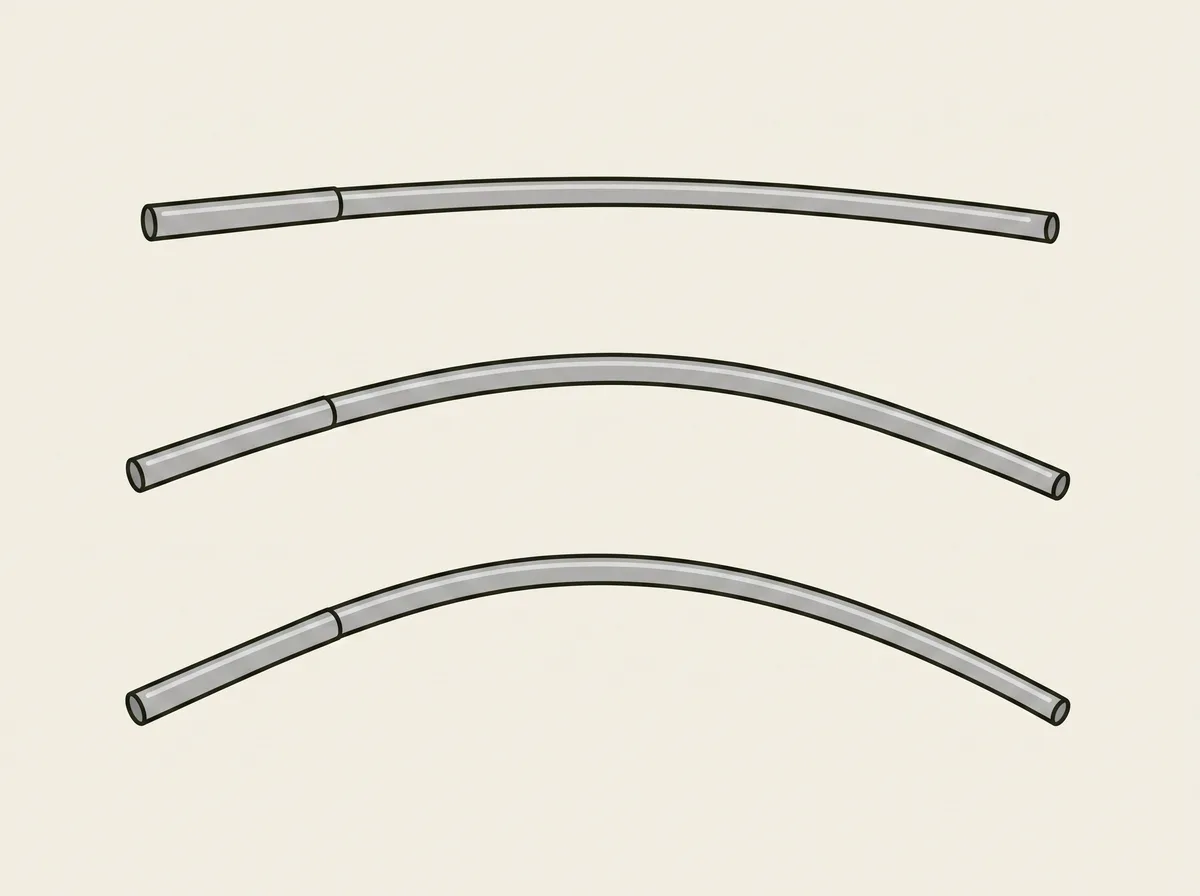
A golf shaft bends during the swing. It loads on the way down as the head lags behind your hands, then unloads through impact as the head catches up and passes them. Flex describes how much it bends for a given force.
That unloading is the part that matters. A shaft matched to your swing arrives at the ball having straightened out at roughly the right moment. One that is too stiff for you never fully loads, so it delivers less speed and tends to hold the face open. One that is too soft loads early and unloads early, which adds loft and spin at impact and makes the face harder to control.
Both of those are tendencies rather than laws, and this is one of the places where good fitters genuinely disagree about how much difference flex makes on its own. What almost nobody disputes is that shaft weight matters more, which is covered further down.
The letters and what they are worth
| Letter | Name | Usually described as |
|---|---|---|
| L | Ladies | Softest commonly stocked flex |
| A or M | Senior, sometimes amateur | Between ladies and regular |
| R | Regular | The most common flex sold |
| S | Stiff | The second most common |
| X | Extra stiff | Fastest swings only |
There is no industry standard behind any of those letters. Each manufacturer sets its own scale, so a regular in one model can measure stiffer than a stiff in another, and two shafts with the same letter can differ in weight by 20 grams. The letter is a rough sorting mechanism inside one product line and nothing more.
Working out your swing speed without a launch monitor
The honest answer is to get it measured. Most golf shops, driving ranges and fitting studios will do it in ten minutes, often free, and how to measure swing speed covers the options including the cheap ones.
Failing that, carry distance is a reasonable proxy, because ball speed and carry both scale with clubhead speed. TrackMan's published averages put the PGA Tour at 282 yards of driver carry and the LPGA Tour at 223. Set against their club speed figures of 115 mph and 96 mph, that works out at roughly 2.3 to 2.4 yards of carry per mph of clubhead speed.
So a golfer whose best drives carry 200 yards is swinging somewhere around 87 mph. That estimate is deliberately conservative: tour players convert speed into distance more efficiently than amateurs do, so if your strike is less clean than theirs, your actual speed is a little higher than the sum suggests. Treat it as a floor.
Two warnings before you use it. Carry is not total distance, and the number you want is a normal drive rather than the best one you hit last summer.
Where your speed probably sits
TrackMan's benchmark figures are the most useful reference point available, because they are broken down by handicap rather than by aspiration.
| Player | Driver clubhead speed |
|---|---|
| PGA Tour | 115 mph |
| Scratch or better, male amateur | 110 mph |
| 5 handicap, male amateur | 101 mph |
| LPGA Tour | 96 mph |
| 10 handicap, male amateur | 95 mph |
| Average male amateur, 14.5 handicap | 94 mph |
| Bogey golfer, male amateur | 92 mph |
| Scratch or better, female amateur | 90 mph |
| 10 handicap, female amateur | 83 mph |
| 15 handicap, female amateur | 79 mph |
The gap between a bogey golfer and a 10 handicap is three miles per hour. The gap between a 10 handicap and a scratch player is fifteen. Almost every male club golfer sits inside a ten mph band, which is why almost every male club golfer ends up in regular or stiff and why the argument between them matters less than the shop makes it sound.
The chart, and how much to trust it
| Driver clubhead speed | Rough driver carry | Flex to start from |
|---|---|---|
| Under 75 mph | Under 175 yards | Ladies |
| 75 to 85 mph | 175 to 195 yards | Senior |
| 85 to 95 mph | 195 to 220 yards | Regular |
| 95 to 105 mph | 220 to 245 yards | Stiff |
| Over 105 mph | Over 245 yards | Extra stiff |
Those bands are the fitting trade's working convention rather than a measured dataset, and the carry column is derived from the TrackMan ratio above. They tell you which flex to try first. They do not tell you which flex you end up in, because tempo changes the answer as much as speed does: a golfer who loads the club hard from the top needs more stiffness at the same speed than one with a smooth transition.
Set against real distances, that band structure puts most club golfers in regular. Shot Scope's benchmark data has a golfer who shoots in the 90s averaging 225 yards off the tee and a golfer in the 100s at 204, both measured on the course rather than on a launch monitor. Neither of those is a stiff shaft.
Weight is the specification that does more
If you change one thing about a shaft, change its weight rather than its letter.
Stock driver shafts now ship as light as 49 grams, and stock graphite iron shafts as light as 38, against 85 to 110 grams for steel. That range is enormous next to the difference between a regular and a stiff in the same model, and every gram is mass you have to accelerate. For a golfer short of speed, a lighter build is the single change most likely to produce more of it.
Weight and flex also interact, which is why they should be chosen together. A light shaft in a stiff flex is a different club from a heavy shaft in a regular, and the two are not interchangeable however similar the numbers look.
Steel or graphite
Steel is heavier, cheaper, and slightly more consistent from shaft to shaft. Graphite is lighter, damps vibration, and is available in a far wider range of weights and profiles. Neither is more accurate than the other, which is the claim you will hear most often and the one with the least behind it.
The useful version of the decision is speed. If your driver carries under about 200 yards, graphite in your irons will almost certainly help, because the weight you are not accelerating is speed you get to keep. If you have plenty of speed and lose control of the club at the top, steel gives you something to swing against.
Graphite is also the default for anyone with wrist, elbow or shoulder trouble, since it transmits noticeably less shock at impact.
Torque, kick point, and the rest of the spec sheet
Two more numbers appear on shaft listings and both are worth understanding before you pay for them.
Torque measures how much the shaft twists along its length, in degrees. Lower torque resists twisting more, which usually feels firmer. It matters most for fast swings, and the range across commonly sold shafts is small enough that it is rarely the thing holding a golfer back.
Kick point, or bend profile, describes where along the shaft most of the bending happens. A low kick point is generally sold as higher launching and a high kick point as lower. The effect is real and modest, and it is comfortably outranked by loft, which changes launch far more directly. Which driver loft to play covers that side of it.
When to check it again
Flex is not a decision you make once. Clubhead speed changes with age, fitness, injury and swing changes, and a shaft that fitted at 40 may not at 55.
The signals worth acting on are consistent: the ball flight getting lower and weaker with no change in strike, the face feeling like it arrives late, or a stiff shaft that suddenly feels like a fence post. Any of those is worth ten minutes with a launch monitor before it is worth a lesson.
If speed is what you are missing rather than the shaft, how to increase swing speed works through what actually moves the number, and average driver distance puts realistic figures around what that speed is worth. If you would rather have the whole bag measured properly, what a club fitting covers sets out what happens in the bay and what it costs.
For golfers at the slower end, the shaft is most of the purchase rather than a detail of it. Drivers built for slower swings works through the specifications that matter, and the head is not the first of them.
Where flex sits against everything else in the bag is worth keeping in proportion too. What each club is for covers the families and the jobs they do, and our club distance chart sets out what tracked amateur data says each one actually travels. A correctly specified shaft moves those numbers a little. It does not move them a category.
Key takeaways
- Flex describes how much a shaft bends under load. Too stiff loses speed and holds the face open, too soft adds loft and spin and costs control.
- The letters are not standardised. One brand's regular can measure stiffer than another's stiff, and two shafts sharing a letter can differ by 20 grams.
- Most male club golfers sit between about 85 and 100 mph of driver speed, which means regular or stiff, and regular more often than the shop suggests.
- Divide your normal driver carry by 2.3 for a conservative swing speed estimate, using TrackMan's published tour figures as the anchor.
- Shaft weight changes more than flex does. Stock shafts now run from 38 grams in graphite irons to 110 in steel.
- Graphite suits slower swings and anyone with joint trouble. Steel gives faster swings something to swing against.
- Recheck your flex after any significant change in speed, fitness or age. It is not a one-time decision.
Common questions
What shaft flex do I need?
Most club golfers need regular. Stiff starts to make sense above roughly 95 mph of driver clubhead speed, which is around a 10 handicap for a male amateur according to TrackMan's benchmarks. Below about 85 mph, senior flex will do more for you than regular.
Should I use a regular or stiff shaft?
If your driver carries under about 220 yards, regular. If it carries over 245, stiff. Between those two the answer depends on tempo as much as speed, and a golfer who loads the club hard from the top wants the stiffer of the two.
What happens if my shaft is too stiff?
It never fully loads, so you lose a little speed, the ball launches lower and the face is more likely to arrive open. For a right-hander that shows up as a weak shot to the right, and it is one of the causes of a slice that practice does not cure.
What happens if my shaft is too soft?
It loads and unloads early, which adds dynamic loft and spin at impact and makes the clubface harder to control. The typical result is a high, ballooning flight and a two-way miss, since the timing of the release becomes more sensitive.
How do I know my swing speed without a launch monitor?
Divide your normal driver carry distance by 2.3. TrackMan's published tour averages work out at roughly 2.3 to 2.4 yards of carry per mph, so 200 yards of carry suggests about 87 mph. Amateurs convert speed to distance less efficiently, so treat the answer as a floor rather than a ceiling.
Is stiff shaft better for distance?
No. A shaft above your speed costs distance rather than adding it, because you cannot load it. Distance comes from clubhead speed and a centred strike, and the shaft's job is to let you produce both. Playing a flex too stiff is one of the more common self-inflicted distance losses.
Do shaft flex ratings mean the same thing across brands?
No, and this is the single most useful thing to know about flex. There is no industry standard, so each manufacturer sets its own scale. A stiff in one model can measure softer than a regular in another, which is why fitting by feel and ball flight beats fitting by letter.
Should seniors use senior flex shafts?
Only if the speed matches. Age is a poor proxy: plenty of golfers in their sixties swing at 95 mph and plenty of thirty year olds swing at 80. Measure the speed and fit to it. What most older golfers do benefit from is a lighter shaft, which is a separate specification.
Does shaft flex matter more in irons or the driver?
The driver, because it is the longest club, the fastest swing and the one where a fraction of a degree of face angle costs the most yards offline. Iron shafts are usually fitted to one flex through the set, and weight tends to matter more there than the letter does.
What is kick point on a golf shaft?
The point along the shaft where most of the bending happens. A low kick point is sold as launching the ball higher and a high one as launching it lower. The effect is real and small, and loft changes launch far more than kick point does.
Is it worth reshafting an old club?
Rarely, on a used club. A reshaft plus fitting often costs a meaningful share of what the club is worth second hand, so the money is usually better spent buying a club with the right shaft already in it. On a driver you love and cannot replace, it is a fair spend.
On this page
- What flex actually is
- The letters and what they are worth
- Working out your swing speed without a launch monitor
- Where your speed probably sits
- The chart, and how much to trust it
- Weight is the specification that does more
- Steel or graphite
- Torque, kick point, and the rest of the spec sheet
- When to check it again

Tom Ashworth
Tom Ashworth is a PGA Professional who has taught golf since 2012, working mainly with beginners and mid-handicappers at club level in Surrey. He reviews the instruction guides on Learn Golf for technical accuracy before they publish.
Most of his teaching is with players in their first three years of the game, and most arrive having been told too much: six swing thoughts collected from videos, half of them contradicting each other. His approach is to check the grip and the alignment before touching the swing, on the basis that most bad ball flight is decided at address.