Golf punishes beginners in a specific way: it hands you every piece of advice at once, in no useful order. Keep your head down. Shift your weight. Buy a driver. None of that is where the game starts, and chasing it early is why so many people quit in year one. This guide runs through the first twelve months in sequence, from the seven clubs you need to the first card you sign.
What golf actually asks of you
Golf looks like a game about power. It is really a game about repeating a small motion and avoiding disasters. A round is 18 holes, each with a par of 3, 4 or 5, and par is simply the number of shots a very good player would need. Add the pars together and you get the course par, usually 70 to 72.
A beginner is not trying to make par. A beginner is trying to make contact, keep the ball in play, and finish the hole. That sounds modest until you see what actually separates scores. Amateur golfers who track their rounds hit far fewer greens than most people assume: Shot Scope's data on greens in regulation has a 10 handicap hitting 6.3 greens a round and a 15 handicap hitting 4.14. Good amateurs miss most greens too. They just miss them in places they can recover from.
That is the mental shift worth making on day one. You are not learning to hit perfect shots. You are learning to make your bad shots less expensive.
Every left and right on this page assumes a right-handed golfer. If you play left-handed, swap them, and the advice holds unchanged.
The gear you need, and the gear you can ignore
The rules let you carry fourteen clubs. Nobody has told a beginner that fourteen is a ceiling rather than a shopping list, which is why so many first sets contain seven clubs that will sit unused for two years.
Seven clubs cover every shot you can currently hit: something off the tee, something long off the ground, two irons, two wedges and a putter. The full breakdown of which ones and why sits in our guide to what clubs a beginner needs, including what a sensible used set costs.
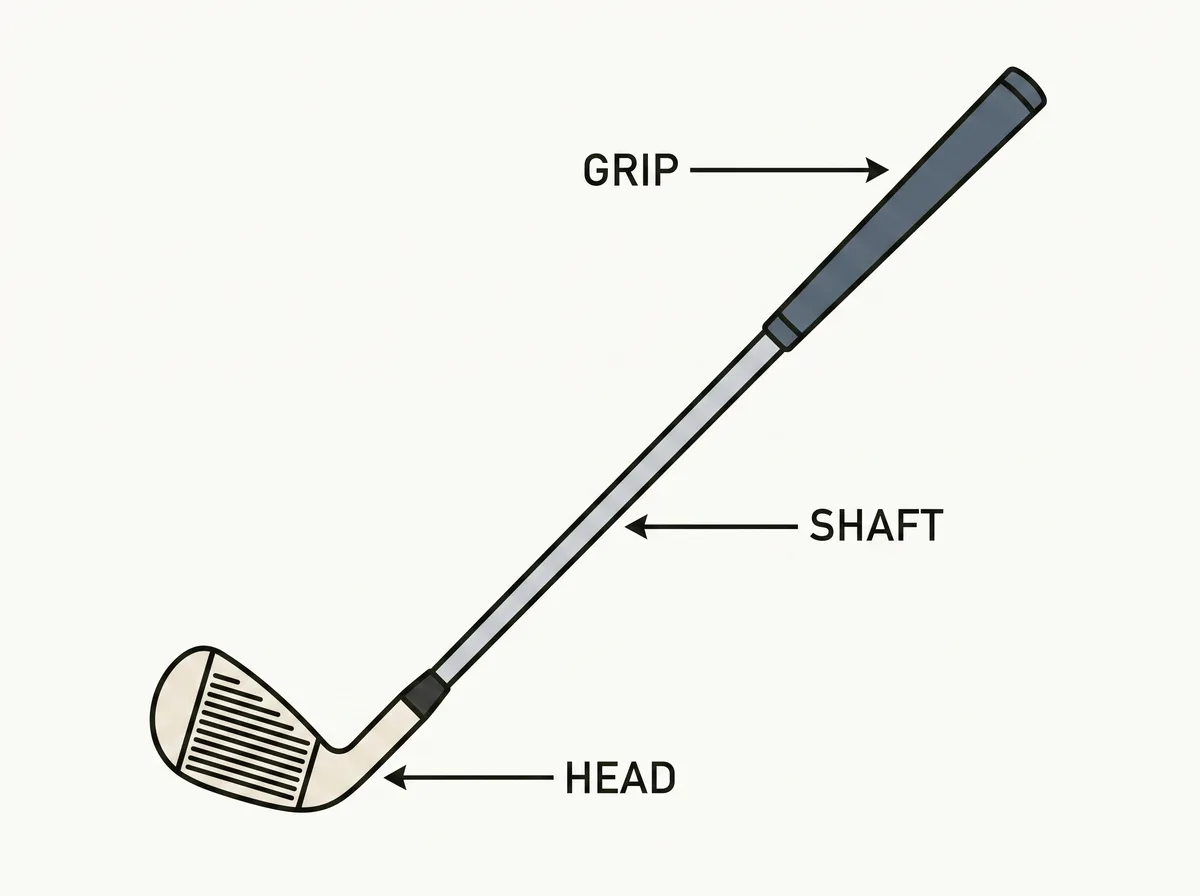
Two specification details matter far more than brand, and both are easy to get wrong buying blind. Shaft flex controls how much the shaft bends during the swing, and most beginners need regular rather than stiff. Club length matters if you are notably tall or short, because a club that does not fit forces a compensation at address, and compensations become faults.
Buy the rest of it cheap. A stand bag, a dozen soft balls, a glove, a handful of tees and a pitchmark repairer will cost less than one club. Balls in particular are worth thinking about differently as a beginner: you will lose several a round, so buy something forgiving and inexpensive rather than something a tour player uses. Our picks are in best golf balls for beginners.
The setup, where most faults are already decided
More beginner problems are created before the club moves than during the swing. Grip, posture, aim and ball position take five minutes to learn and no athletic ability at all, and getting them roughly right removes a large share of the faults you would otherwise spend a year fixing.
The grip is the only contact you have with the club, so it decides where the clubface points at impact, and the face decides where the ball starts. Hold the club in the fingers of the lead hand, not the palm, close the hand until you can see two or three knuckles, and add the trail hand so its lifeline covers the lead thumb. The full detail, including which joining style suits your hand size, is in how to grip a golf club.
Posture is the second one. Stand tall, tilt forward from the hips rather than rounding the back, let the arms hang, and add a small amount of knee flex. If your arms are reaching, you are standing too far away. If they are cramped against your body, you are too close.
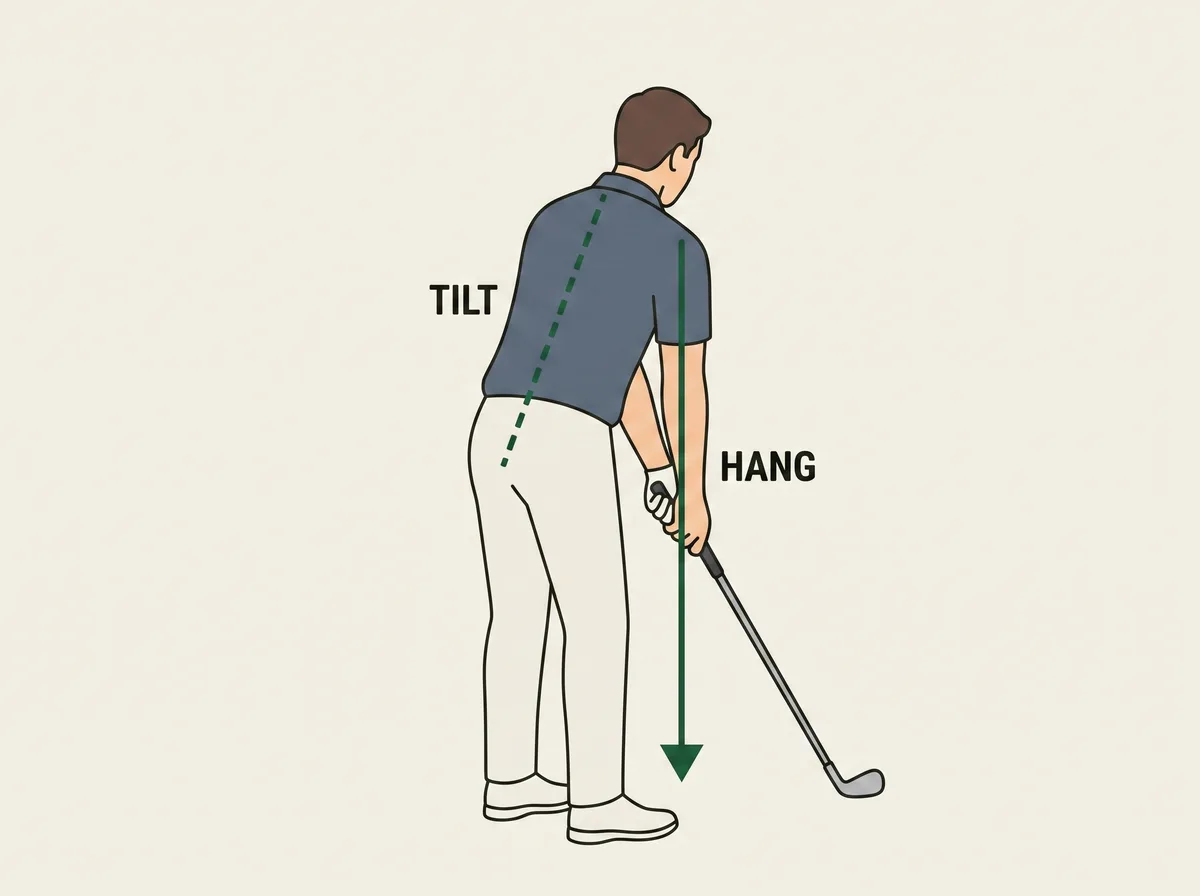
- Stand upright holding the club out in front of you at chest height.
- Push the hips back and let the upper body tilt forward until the club head reaches the ground.
- Add a small knee flex, enough to feel athletic, not enough to squat.
- Let the arms hang. Wherever the hands land is your distance from the ball.
- Set the feet about shoulder width apart for a mid iron.
Ball position changes by club and is worth learning as a rule rather than a feel, because it is the difference between hitting the ball first and hitting the ground first.
| Club | Ball position | Why |
|---|---|---|
| Driver | Off the lead heel | The club is travelling upwards by then, which is what you want off a tee |
| Fairway wood or hybrid | Two ball widths inside the lead heel | Shallow strike, ball swept off the turf |
| 7 iron | Just forward of centre | The club is descending slightly, so it strikes ball then turf |
| Wedge | Centre of the stance | Steeper strike, more control, less distance |
| Putter | Slightly forward of centre | Gets the ball rolling rather than bouncing |
The swing, in the simplest terms that are still true
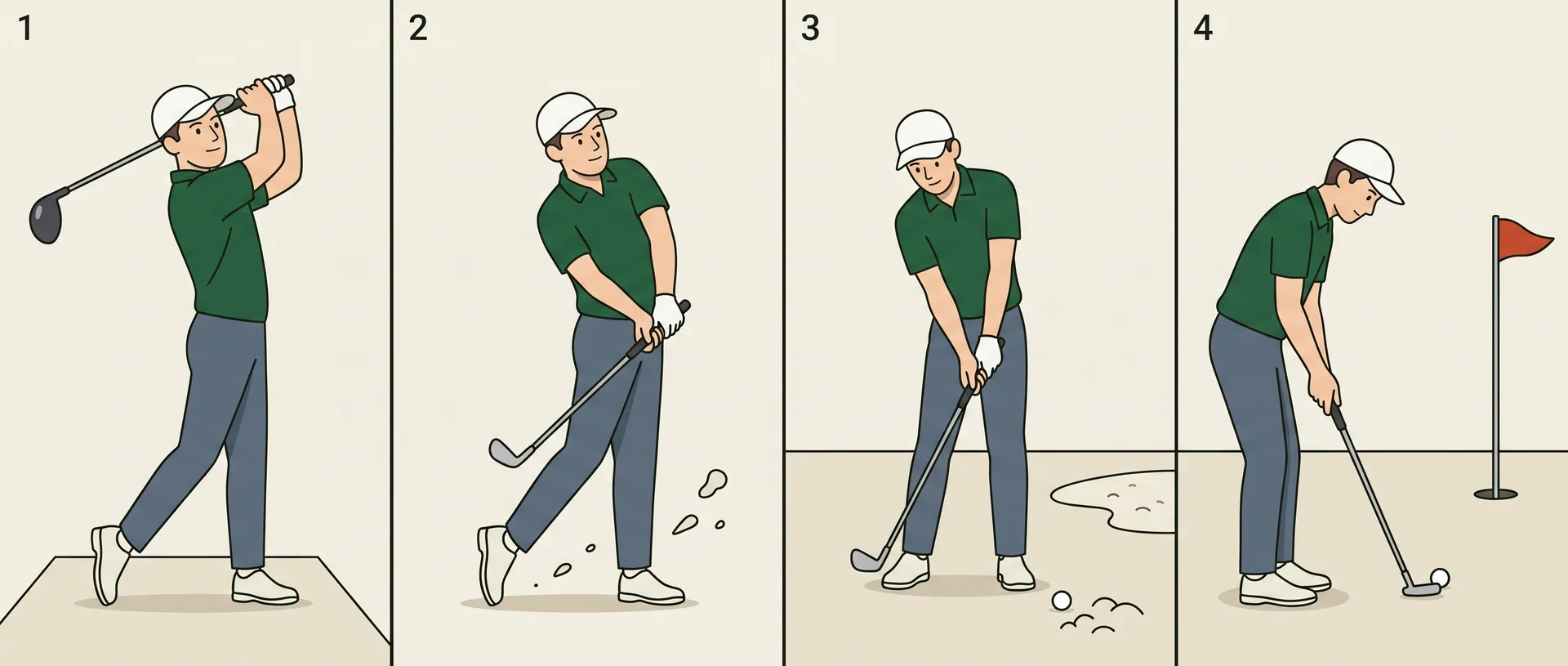
Everything a golf swing has to do can be described in one sentence: turn away, then turn through, and let the club strike the ball before it strikes the ground.
That is genuinely most of it. The backswing is a rotation of the chest away from the target, with the arms staying in front of the body rather than lifting independently. The downswing starts from the ground up, with the lower body moving first and the arms arriving last. The finish is balanced, with the chest facing the target and the weight on the lead foot.
Beginners almost universally do the opposite: they lift the arms, then throw them at the ball from the top, and the body never rotates at all. The result is a weak, glancing strike that leaks right.
The full breakdown, checkpoint by checkpoint, is in golf swing basics. Read it after you have spent a few sessions simply trying to make clean contact. Positions mean very little until you have felt what a solid strike is.
Where to learn: range, lessons, or the course
All three, but not in equal amounts, and not in the order most people choose.
The driving range is where contact gets built, and it is where you should spend most of your first two months. It is cheap, it is unhurried, and nobody is waiting behind you. The mistake is treating it as a session of hitting driver as hard as possible. Half a bucket with a 7 iron, hitting to a specific target, teaches more than a full bucket sprayed at the horizon.
Lessons are the highest-value money in golf and almost nobody spends it. Two or three lessons in your first two months will save you a year, because a coach fixes grip and posture in twenty minutes and those two things silently create most swing faults. Four lessons cost roughly what one mid-range club costs, and they change your golf in a way the club will not.
The course is where the game actually is, and beginners delay it far too long out of embarrassment. Nine holes on a quiet weekday evening, on your own or with one other person, is a perfectly normal thing to do and nobody will care how you play.
The anatomy of a golf hole
A hole runs from the teeing area to the green, and the ground in between is not all the same.
The teeing area is where each hole starts, and it is the only place you are allowed to put the ball on a tee. Most courses have several sets of tee markers at different distances. Play the shortest ones. They exist for exactly this reason, and playing forward tees as a beginner is the single easiest way to make the round enjoyable rather than exhausting.
Every hole is the same handful of surfaces with the details rearranged, and the vocabulary matters more than it sounds, because most of golf's rules are written in terms of which one you are standing in.
| Part of the hole | What it is | What it means for you |
|---|---|---|
| Teeing area | Where the hole starts, between the markers | The only place you may use a tee |
| Fairway | The closely mown strip down the middle | What you are aiming at off the tee |
| Rough | The longer grass either side | Playable, but expect less distance and less control |
| Bunker | A sand hazard | Do not ground the club in the sand before the stroke |
| Penalty area | Water or marked ground, red or yellow stakes | One penalty shot, then a drop |
| Fringe | The slightly longer collar around the green | Chip it or putt it, both are perfectly legal |
| Green | The very short grass holding the hole | Putter only, and repair your pitchmark |
Distances matter less than beginners expect. Shot Scope's distribution of amateur driving distances found that nearly 70% of amateur golfers average under 250 yards off the tee, with the largest single group between 200 and 224 yards. If you are hitting it 180 and worrying that everyone else hits it 300, they do not.
Playing your first round
Book a nine-hole slot on a weekday evening at a public course, or ask the pro shop for their quietest time. Arrive 30 minutes early. Turn up in a collared shirt and trousers or tailored shorts unless the course says otherwise, and take more balls than you think you need.
The structure of the round itself is simple. The player furthest from the hole plays first. On the green, mark your ball with a coin if it is in someone's line, repair your pitchmark, and take the flag out or leave it in as you prefer. Write your score down at the next tee, not on the green, because standing on a green doing arithmetic is what slows a course to a crawl.
The pace expectation is real and worth knowing. The R&A's pace of play guidance recommends making a stroke within about 40 seconds of it being your turn, and usually faster. Nobody minds a beginner playing badly. People mind a beginner playing slowly, and the two are not the same thing. Being ready when it is your turn covers almost all of it.
A fuller walkthrough of the day, from the car park to the last putt, is in your first round of golf.
The rules you actually need on day one
There are just under 25 rules and hundreds of clarifications. You need about six of them.
Two practical points that the rules do not cover but every club does. First, if you might have lost your ball, announce a provisional and play a second one before you walk forward. It saves the whole group a walk back. Second, in a social round, most beginners pick up after a certain number of shots on a hole rather than grinding out a 14. That is not a rules-compliant score, but it keeps the round moving and it is what almost everyone does.
We cover the rest, including the situations that genuinely come up every round, in golf rules for beginners.
Etiquette: the part nobody says out loud
Etiquette is not politeness for its own sake. Almost all of it is either safety or speed.
Stand still and stay quiet while someone is playing, and stand out of their eyeline rather than directly behind or in front. Never hit while anyone is within range ahead of you. Shout a warning if a ball goes anywhere near another person. Rake the bunker after you play from it. Repair your pitchmark on the green and do not walk across the line between another player's ball and the hole.
The one that catches beginners most is where to leave the bag: on the side of the green nearest the next tee, never between the green and the flag, so you are not walking back on yourself. Small thing, and it is the difference between a group of four taking three and a half hours and taking four and a half.
The full list, including the unwritten ones nobody explains, is in our guide to golf etiquette.
Scoring, handicaps, and what the numbers mean
Golf scoring is a small vocabulary that gets used constantly and explained rarely.
| Term | What it means |
|---|---|
| Par | The score a very good player is expected to take on the hole |
| Birdie | One shot under par |
| Eagle | Two shots under par |
| Bogey | One shot over par |
| Double bogey | Two shots over par |
| Gross score | Every shot you took, added up |
| Net score | Gross score minus your handicap allowance |
A handicap is the number that lets a beginner and a good player compete fairly. It is calculated from your recent scores relative to the difficulty of the courses you played, and it is expressed as a Handicap Index under the World Handicap System.
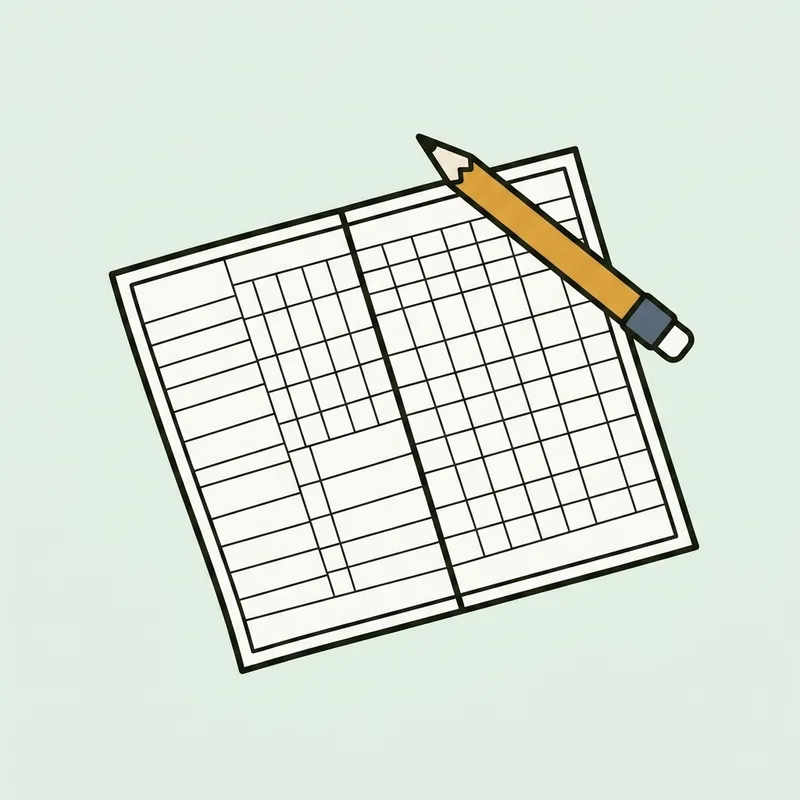
You do not need a handicap to play golf, and you should not rush to get one. Play ten or fifteen rounds first, so the number reflects something real. When you are ready, the mechanics are covered in golf scoring explained.
What the first year costs
Golf is expensive in the way it is usually sold and quite cheap in the way it is usually played. The difference is entirely in what you buy and where you play.
A realistic first-year setup, buying a used starter set:
- Seven-club used set with a bag: £220 to £400
- Balls, tees, glove and a pitchmark repairer: £30
- Shoes: £40 to £70 or trainers for the first few rounds
- Three lessons: £75 to £160
- Range sessions, two a month for a year: £120 to £240
- Green fees at council and pay-and-play courses, twice a month: £360 to £720
That puts a complete first year somewhere around £870 to £1,600 including everything. Membership is a separate decision and rarely worth it until you are playing weekly. The full breakdown, including where the numbers move most, is in how much golf costs.
A realistic first twelve months
Progress in golf is not linear and it is not fast. What follows is a sequence that works, not a timetable to hold yourself to.
| Phase | Focus | What good looks like |
|---|---|---|
| Months 1 to 2 | Grip, posture, contact with a 7 iron | Seven clean strikes out of nine on half swings |
| Months 3 to 4 | Full swing shape, plus chipping and putting | Getting round nine holes without losing more than three balls |
| Months 5 to 8 | Course play, club selection, keeping score honestly | A first full 18 holes, counted properly |
| Months 9 to 12 | Removing the disaster holes | Scores clustering rather than swinging by 20 shots |
The thing that changes scores fastest in that period is not the full swing. It is the short game and the decisions. Roughly half your shots happen within 50 yards of the hole, and none of them require speed, flexibility or a good swing. A beginner who practises chipping and putting for a third of their time improves noticeably faster than one who spends every session hitting driver.
The mistakes that cost beginners the most time
Three others worth naming, because they are quiet and they compound:
Practising only the full swing. If your practice looks nothing like your round, it will not transfer. Half your shots are short ones.
Changing something every session. A change needs two to three weeks of consistent repetition before you can judge it. Golfers who swap a swing thought every range trip never find out whether any of them worked.
Playing from the wrong tees. Playing off the back markers when you carry the ball 180 yards turns every par 4 into a par 6. Move forward. It is not a concession, it is playing the course at the length it was designed for at your distance.
None of those are technique problems, which is the point. A beginner who fixes only the four things on this page, and changes nothing else for three months, will be further along than one who rebuilds their swing every fortnight chasing a different tip.
Key takeaways
- Seven clubs cover every shot a beginner can hit. Fourteen is a legal ceiling, not a target.
- Grip, posture, aim and ball position decide most faults before the club ever moves.
- Two or three early lessons are the highest-value money in golf and almost nobody spends it.
- Play the forward tees. Nearly 70% of amateurs average under 250 yards off the tee.
- The driver is a club you grow into. A 3 wood or hybrid off the tee keeps you in play.
- Roughly half your shots happen within 50 yards of the hole, so practise there.
- Etiquette is mostly safety and speed. Be ready to play when it is your turn.
- Give any change two to three weeks before judging it, and change one thing at a time.
Common questions
How do I start playing golf as a complete beginner?
Get about seven used clubs, take two or three lessons, and spend your first month at a driving range working on clean contact with a 7 iron rather than distance. Then play nine holes at a quiet time. That sequence removes most of the frustration that makes people quit.
How many clubs does a beginner need?
About seven: something off the tee, a hybrid, two irons, two wedges and a putter. The rules allow a maximum of fourteen and set no minimum at all, so carrying seven is entirely legal and considerably easier to manage.
Do I need lessons to learn golf?
You do not need them, but they are the cheapest improvement available. A coach fixes grip and posture in one session, and those two things silently create most swing faults. Two or three lessons in the first two months save far more than they cost.
How long does it take to get decent at golf?
Most people who practise once a week and play twice a month are getting round comfortably within a year and breaking 100 somewhere in the first two. It varies enormously with how much you play, and progress arrives in steps rather than smoothly.
What should a beginner wear to a golf course?
A collared shirt with trousers or tailored shorts covers almost every course in the US. Golf shoes help but trainers are fine for your first few rounds. Check the club's dress code online, because the stricter private clubs still ban denim and round-neck shirts.
Should a beginner use a driver?
Not at first. The driver has the least loft and the longest shaft, which makes it the least forgiving club in the bag. A 3 wood or hybrid off the tee costs a beginner very little distance and keeps far more balls in play.
How much does it cost to start golf?
Roughly £870 to £1,600 for a full first year including a used set, shoes, a few lessons, range sessions and green fees twice a month. The equipment is a one-off; the recurring cost is entirely down to where and how often you play.
What is a good score for a beginner?
Anything under 120 for 18 holes is a genuinely respectable start, and breaking 100 is the first milestone worth aiming at. Comparing yourself to par is not useful early on, because par assumes a standard almost no amateur reaches.
Is golf hard to learn?
The motion is hard to repeat, but the entry point is not. Most beginners make solid contact within a few sessions and get round a course within a couple of months. What takes time is consistency, because the swing has to work identically every time rather than occasionally.
Do I need a handicap to play golf?
No. A handicap only matters for competitions and for comparing yourself fairly with other players. Play ten or fifteen rounds first, so that when you do get one it reflects something real rather than your first three attempts.
What is the fastest way for a beginner to lower their score?
Chipping and putting, and avoiding disaster holes. Roughly half your shots happen within 50 yards of the hole and none of them require speed or flexibility. A beginner who spends a third of their practice time there improves noticeably faster than one hitting driver every session.
On this page
- What golf actually asks of you
- The gear you need, and the gear you can ignore
- The setup, where most faults are already decided
- The swing, in the simplest terms that are still true
- Where to learn: range, lessons, or the course
- The anatomy of a golf hole
- Playing your first round
- The rules you actually need on day one
- Etiquette: the part nobody says out loud
- Scoring, handicaps, and what the numbers mean
- What the first year costs
- A realistic first twelve months
- The mistakes that cost beginners the most time
Tom Ashworth
Tom Ashworth is a PGA Professional who has taught golf since 2012, working mainly with beginners and mid-handicappers at club level in Surrey. He reviews the instruction guides on Learn Golf for technical accuracy before they publish.
Most of his teaching is with players in their first three years of the game, and most arrive having been told too much: six swing thoughts collected from videos, half of them contradicting each other. His approach is to check the grip and the alignment before touching the swing, on the basis that most bad ball flight is decided at address.