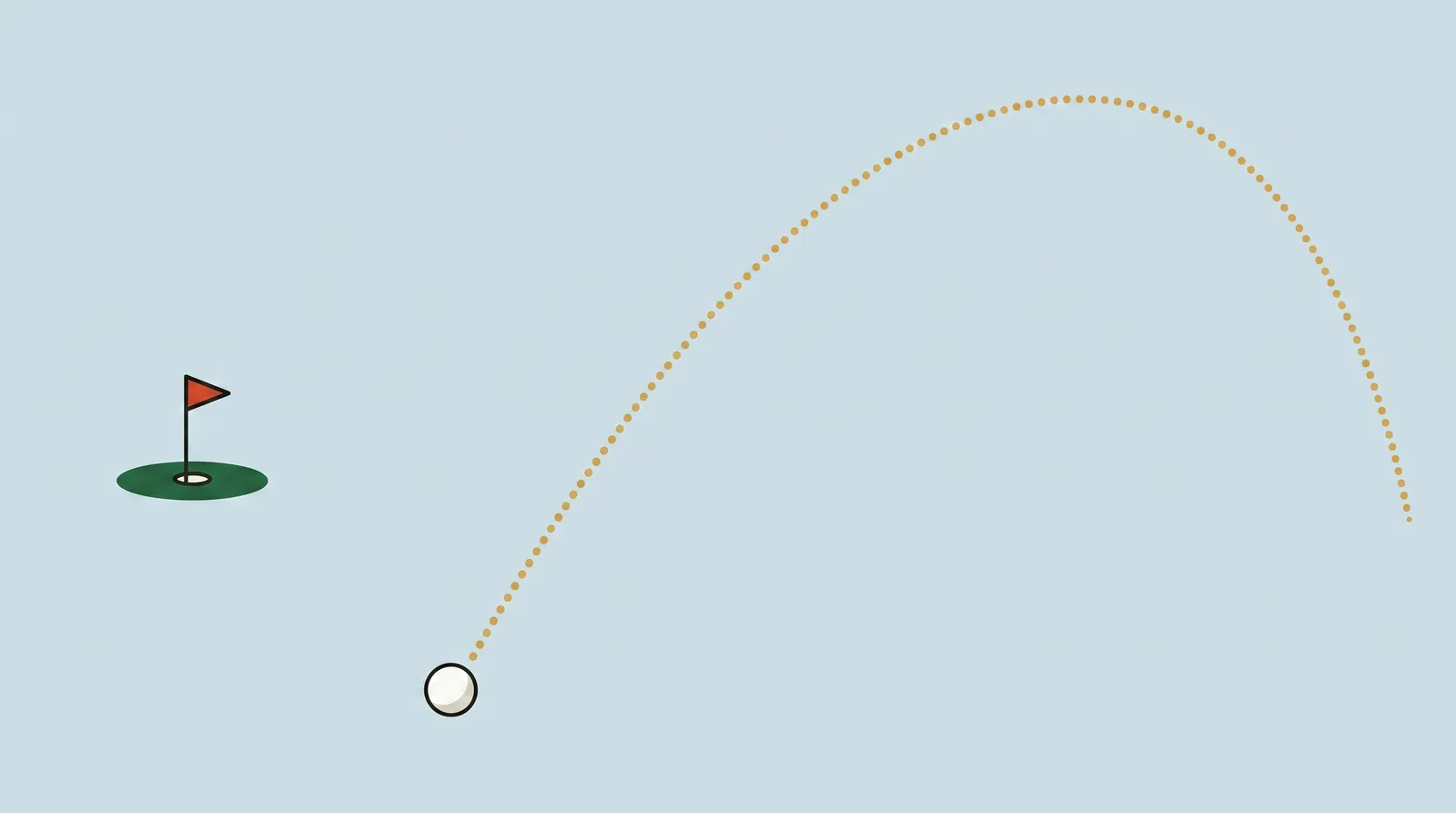
You have changed your grip twice, bought a draw-biased driver, and aimed further left every year. The ball still finishes right. Slicing is the single most common ball flight in amateur golf, and most advice aimed at it treats the symptom instead of the cause. This guide covers what a slice actually is, how to work out which version you have, and the drills that fix each one.
What a slice actually is
Two numbers decide where your ball goes: where the clubface points at impact, and the direction the club is travelling through impact.
According to TrackMan's guide to launch data, face angle controls roughly 85% of the ball's starting direction with a driver, and about 75% with an iron. The club path controls the rest.
The curve is the difference between the two. If your face points right of your path at impact, the ball curves right. The bigger that gap, the bigger the slice. This relationship is the whole of the ball flight laws, and everything below follows from it.
The two slices, and why they need different fixes
Almost every slice is one of two shapes. They look similar in the air and they need opposite work.
The pull slice starts left of your target and curves back to the right, often finishing near where you aimed. The path is swinging well left across the ball, the face is open to that path but still fairly close to the target.
The push slice starts right of your target and keeps going right. The face is open to the target itself, not just to the path.
| Shape | Starts | Finishes | Face at impact | Path at impact | Fix first |
|---|---|---|---|---|---|
| Pull slice | Left | Right | Open to path, near target | Well out to in | The path |
| Push slice | Right | Further right | Open to target and path | Roughly neutral | The face |
| Straight slice | Straight | Right | Open to path | Slightly out to in | The face |
Take three phone videos from behind, down the target line, and watch where the ball starts. That first 20 yards tells you which row you are in. Everything after that is curve.
Fix one: the grip
More slices are cured by the grip than by anything else, because the grip decides what the face can do.
Hold the club and look down at your lead hand. You want to see two to three knuckles. If you see one or none, your grip is weak, the face will arrive open, and no amount of swing work will close it in time.
- Hold the club out in front of you at waist height with the face square.
- Lay the grip across the fingers of your lead hand, not the palm.
- Close the hand and rotate it slightly away from the target until two or three knuckles are visible.
- Add the trail hand so its lifeline covers your lead thumb, with the V between thumb and forefinger pointing at your trail shoulder.
- Hit ten half shots. Expect the ball to go left at first. That is the face finally closing.
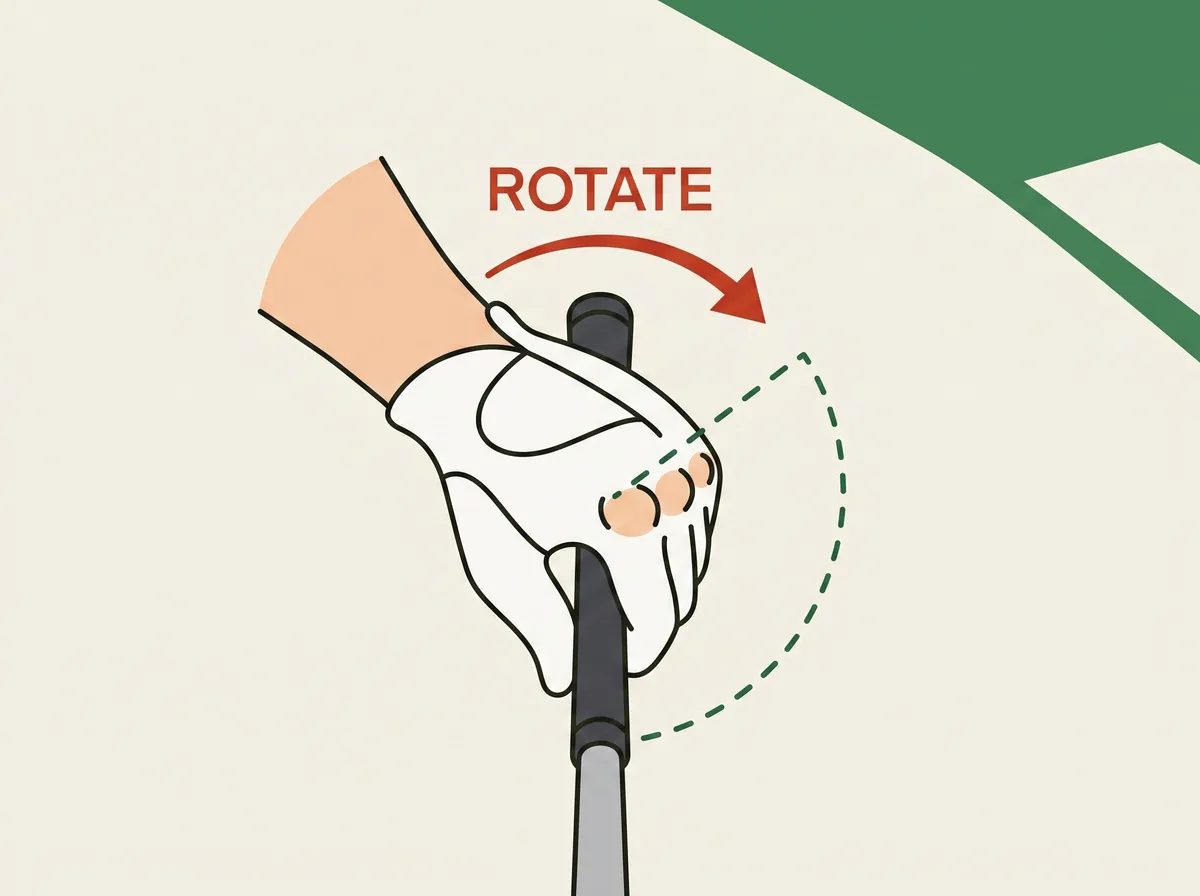
The full detail is in our guide on how to grip a golf club, including which of the three joining styles suits your hand size.
Fix two: setup and alignment
Once the face can square up, the setup stops the path from crossing over.
Most slicers stand with their shoulders open, which is what sends the club across the ball. Because they aim their feet left and their shoulders follow, this happens even when the feet look fine. Our guide to golf alignment covers the full check, but the short version is that shoulders matter more than feet.
Lay a club on the ground pointing at the target. Set your feet parallel to it. Then lay a second club across the front of your shoulders and check it points the same way. Most slicers find their shoulder line is 15 to 20 degrees left.
Ball position matters too. Too far forward with a driver and the club is already travelling left by the time it reaches the ball, which adds path-based curve on top of your face problem.
Fix three: the path
Only now is it worth working on the path, and only if you have a pull slice.
The club comes across the ball because the upper body starts the downswing. The arms throw the club out and away, the shoulders spin open, and the club arrives from outside the target line. This is the move most people mean by coming over the top.
The correct sequence starts from the ground. The lead hip clears, the torso follows, the arms come last. If you want the detail on how that order works, our golf swing basics guide breaks it down checkpoint by checkpoint.
What to practise, and in what order
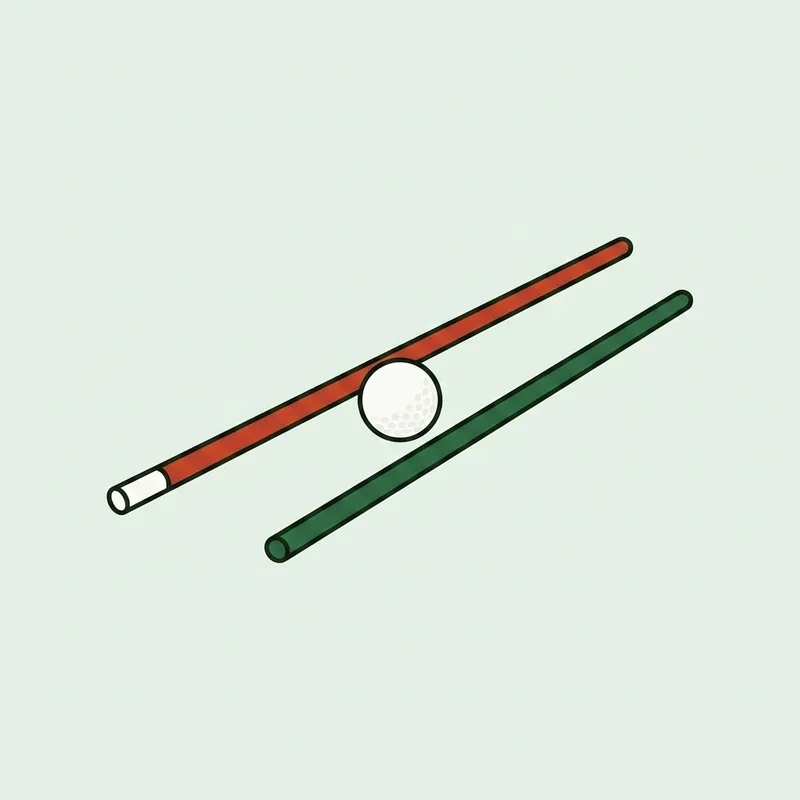
Work in this order. Skipping ahead is the reason slices come back.
Two weeks on the grip alone, hitting half shots with a 7 iron. Accept pulls and hooks. They mean the face is squaring.
Two weeks on alignment, with a club on the ground every single session. Keep the grip work going.
Then, only if the ball still starts left, two weeks on the headcover gate for the path.
Once the ball flies straight, the same two numbers let you shape it deliberately. A face slightly closed to a slightly in-to-out path is a draw, which is covered in how to hit a draw. Overdo it and you get the opposite problem, which is how to fix a hook.
Key takeaways
- A slice is an open clubface relative to your swing path, not either one alone.
- The face controls about 85% of your starting direction with a driver, so it decides where the ball sets off.
- Work out whether you have a pull slice or a push slice by watching the first 20 yards of flight.
- Fix the grip first. Two to three visible knuckles on the lead hand is the reference point.
- Check shoulder alignment, not just feet. Most slicers are 15 to 20 degrees open.
- Only work on the swing path once the face is squaring up.
- Aiming further left widens the gap between face and path and makes the slice bigger.
Common questions
Why do I slice the ball?
Your clubface is open relative to the direction the club is travelling at impact. The face sends the ball out on its starting line and the difference between face and path bends it right. The most common underlying cause is a grip that is too weak to square the face in time.
Is a slice caused by the grip or the swing?
Usually the grip, and it is the cheaper thing to check. A weak grip leaves the face open no matter how good the swing is. Fix the grip first, then look at alignment, then look at path.
Why does aiming left make my slice worse?
Aiming left encourages you to swing left across the ball. That increases the gap between your swing path and your clubface, and curve comes from that gap. You end up starting further left and curving further right.
How long does it take to fix a slice?
Give the grip change two weeks of consistent practice before you judge it. A full fix through grip, alignment and path typically takes six weeks of three sessions a week. It feels worse before it feels better.
Why do I only slice my driver?
The driver has the least loft, so it imparts the least backspin and the most sidespin, which exaggerates any face-to-path gap. It is also the longest club, so the face has more time to rotate open. The same fault is in your irons, just smaller.
Will a draw-biased driver fix my slice?
It will reduce it, not remove it. Draw bias moves weight to help the face close, which can take some curve off while you work on the cause. Treat it as a crutch that buys you enjoyable rounds during the fix.
What is the difference between a slice and a fade?
Only the size and the intent. A fade is a controlled curve of a few yards that starts on target and finishes slightly right. A slice is a large uncontrolled curve that costs distance and accuracy.
Should I close the clubface at address to stop slicing?
No. Closing the face at address usually makes you hold it open through impact without realising it. Change the grip so the face squares naturally instead of manipulating it at setup.
Can the wrong shaft cause a slice?
It can contribute. A shaft too stiff for your swing speed does not load and unload properly, which tends to leave the face open. It will not create a slice on its own, but it makes an existing one harder to fix.
Why does the ball go left when I fix my grip?
Because the face is finally arriving square instead of open, and your path is still swinging left. That is progress, not a new fault. Once the face is reliably square, the path work in this guide will straighten it out.
Tom Ashworth
Tom Ashworth is a PGA Professional who has taught golf since 2012, working mainly with beginners and mid-handicappers at club level in Surrey. He reviews the instruction guides on Learn Golf for technical accuracy before they publish.
Most of his teaching is with players in their first three years of the game, and most arrive having been told too much: six swing thoughts collected from videos, half of them contradicting each other. His approach is to check the grip and the alignment before touching the swing, on the basis that most bad ball flight is decided at address.