Most golfers have five separate setup skills and no reliable way of assembling them under pressure. That is what a routine is for. It is not a lucky sequence and not a rhythm exercise, but a fixed order of operations that produces the same address position on the first tee as on the range.
Left and right below assume a right-handed golfer. Everything mirrors for a left-hander with no other change.
What a routine is actually for
A routine does three jobs, and it is worth being clear about them because golfers routinely expect it to do a fourth thing it cannot.
It fixes the order. The setup has six elements and they only work if they arrive in a fixed sequence, because several of them depend on the ones before. Aim depends on the clubface being placed before the feet. Ball position depends on stance width being set first. Do them in a random order and each one is built on a different foundation every time.
It separates deciding from doing. Choosing a club, a target and a shot shape is a thinking task. Executing is not. Coaches usually split a routine into a thinking half behind the ball and a doing half over it, and the point of the split is that once you step in, the decision is closed and nothing is left to reconsider.
It gives you something to do with your attention. Under pressure the mind will fill the gap with something, and a routine decides in advance what that something is.
What it cannot do is make a bad decision work. A committed, beautifully timed routine over a shot you should never have attempted still produces the same result.
The order, and why it is this order
Six elements, one sequence. Each links to the page that covers it properly, because a routine assembles these rather than teaching them.
| Step | What you do | Why it comes here |
|---|---|---|
| 1 | Decide the shot from behind the ball | Everything downstream depends on the target, so it is chosen first and never revisited |
| 2 | Pick an intermediate mark on the target line | Gives the clubface something close to aim at |
| 3 | One rehearsal swing, away from the ball | Rehearses the shot without the ball pulling you into hitting it |
| 4 | Walk in and set the clubface behind the ball | The face is aimed while you can still see it |
| 5 | Build the stance around the club | Width, then ball position, then posture, in that order |
| 6 | One look at the target, then start | Confirms nothing has drifted, and gives the swing a trigger |
Step five carries most of the detail. Build it as width first from the golf stance page, then how far away you are standing from distance from the golf ball, then where the ball sits using golf ball position, then the hinge and knee flex from golf posture. The grip is set before you walk in rather than during the stance, and how to build it is in how to grip a golf club.
The one thing you never do at step five is check your aim, because you already set it at step four and re-checking it from beside the ball is how misaim gets introduced. The full explanation of why your eyes cannot be trusted from there is in golf alignment.
The half behind the ball
Everything that requires a judgement happens here, standing behind the ball with the target in front of you.
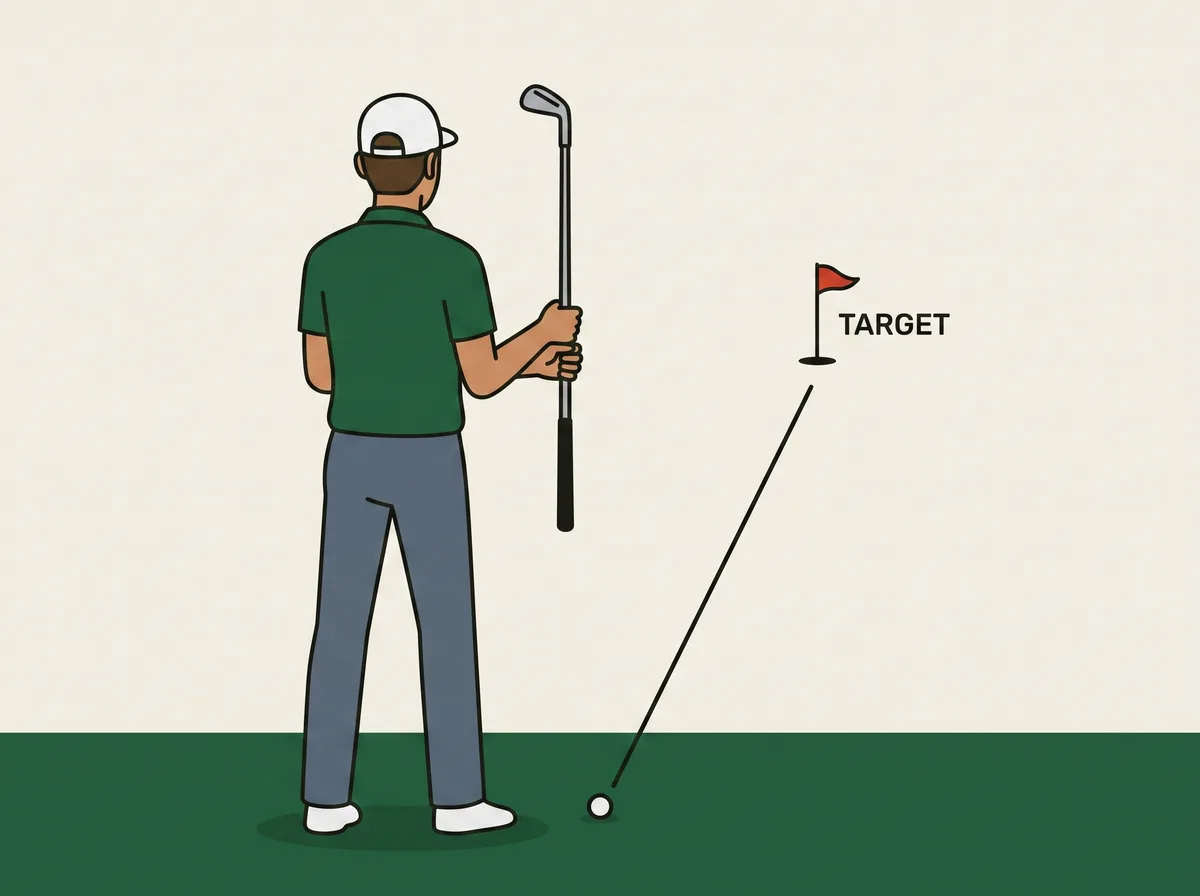
Pick the club and the target. Not the flag, necessarily: the target is where you want the ball to finish given what you actually do with that club, which is a different question and the subject of golf course management. Assess the lie honestly at the same time, because a ball sitting down in rough changes the club before it changes anything else.
Then pick the intermediate mark, a discoloured patch or an old divot within a yard or two of the ball on the line to the target. This is also the moment to notice whether you are talking yourself into a shot. A decision you are still arguing with will not survive the walk in, and stepping away now costs ten seconds where stepping away over the ball costs a shot.
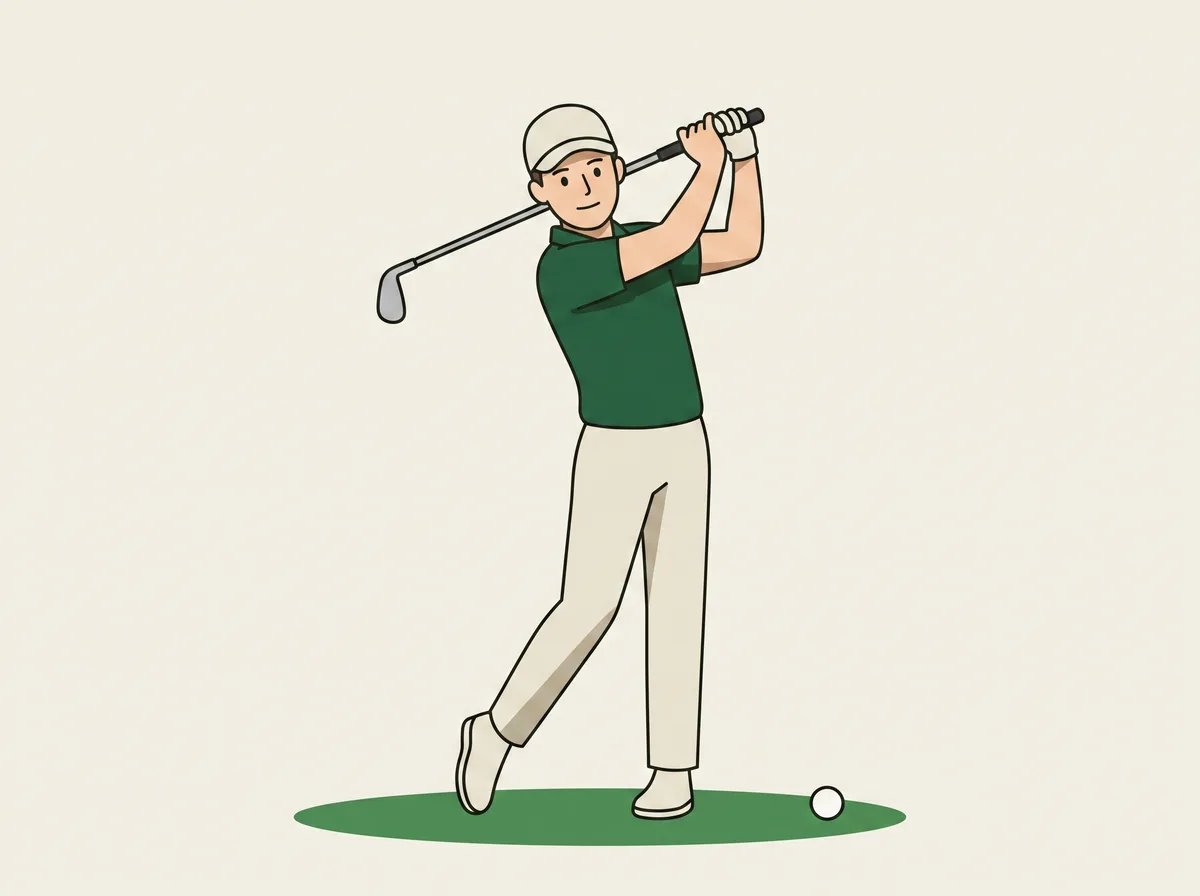
The rehearsal swing belongs here too, and it belongs beside the ball rather than over it. A practice swing taken over the ball is not a practice swing, it is a swing you decided not to finish, and the ball being there changes what your body does. Step to the side, make one swing at the shot you have chosen, and feel it.
Match the rehearsal to the shot rather than making a generic full swing. If you have chosen a three-quarter 8 iron, rehearse a three-quarter 8 iron. If it is a chip that has to land on the front third of the green, brush the grass at the speed that shot needs. A rehearsal that does not resemble the shot is just a stretch.
One rehearsal swing, not three. Three is a golfer trying to find something rather than confirming it, and the extra two are usually the ones that plant the doubt.
The half over the ball
Once you step in, the decision is closed. That is the whole rule of this half.
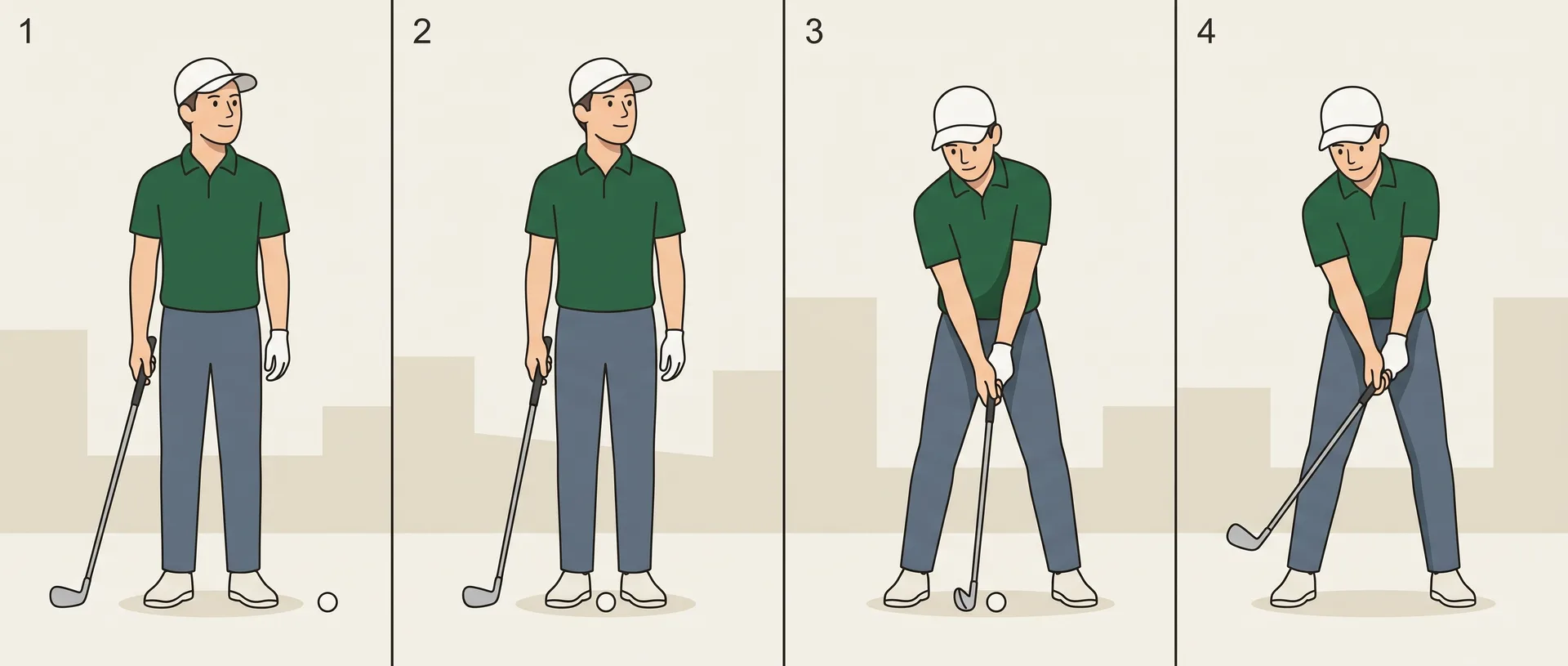
Walk in from behind, along the target line rather than from the side, because approaching from the side is how golfers end up aimed wherever their feet stopped. Set the club head behind the ball with your feet still together, aiming the face at the intermediate mark. Then step the trail foot back and the lead foot into place around it.
Then one look. Turn the head to the target, come back to the ball, and start. The look is short: long enough to confirm, not long enough to re-decide.
How long it should take
There is a real answer to this, and it comes from the Rules rather than from a coach.
Rule 5.6b recommends that a player make the stroke in no more than 40 seconds after they are, or should be, able to play without interference or distraction, and adds that a player should usually be able to play more quickly than that and is encouraged to do so. That 40 seconds covers the whole routine from arriving at the ball to starting the swing, and most good routines take considerably less.
The R&A's pace of play manual makes the same point from the other direction: preparation should happen before it is your turn, walking to the ball with the glove going on, distance worked out and club chosen on the way. Their arithmetic is worth reading, because five seconds saved per shot across roughly 80 shots in a four-ball adds up to about 26 minutes and 40 seconds for the group.
The number matters less than the consistency. A routine that takes 25 seconds on every shot is better than one that takes 12 seconds on easy shots and 45 on hard ones, because the variation is the thing that tells your body this shot is different.
The trigger
Every repeatable routine has a physical trigger that starts the swing, and golfers who do not have one tend to stand still until something eventually pushes them into it.
A trigger can be almost anything as long as it is the same every time: a small forward press of the hands, a waggle of the club head, a slight turn of the lead knee, or a single deep breath out. Its function is to convert a static position into a moving one, because starting a golf swing from complete stillness is harder than it sounds and gets much harder under pressure.
Building your own
A routine you copied from a professional will not survive, because it was built around their timing and their decisions. Build yours from the order above and your own preferences about length.
Adapting it without breaking it
The routine changes shape by shot type, and the order underneath stays identical.
| Shot | What changes | What stays the same |
|---|---|---|
| Tee shot | You choose where in the teeing area to tee up, which is a decision made from behind | Decide, aim the face, build the stance, one look |
| Approach shot | Distance and lie assessment take longer, all of it behind the ball | Same order, same trigger |
| Chip and pitch | The target is a landing spot rather than the flag, and the rehearsal swing brushes the grass | Club down before the feet |
| Bunker shot | Feet are dug in as part of building the stance, so the stance step is longer | Face aimed before the feet are set |
| Putt | Reading the green replaces club selection, and rehearsal strokes are made beside the ball | Everything else |
Putting deserves its own version rather than a shortened one, because the read is a genuine decision and it needs the same separation between deciding and doing. The full setup is in how to putt.
When it falls apart
Routines fail in predictable places, and knowing which failure you have makes it fixable.
On the first tee, a routine usually gets faster. Nerves compress everything, the golfer arrives at the ball before deciding anything, and the whole thinking half is skipped. The defence is to make the first tee routine deliberately slower than normal, which is dealt with in first tee nerves.
After a bad hole it gets longer, because the golfer starts trying to fix something mid-routine and adds practice swings and checks that were never part of it. Notice the additions and cut them rather than adding more.
And when you are playing well it tends to disappear entirely, because everything feels easy and the routine feels unnecessary. That version costs the most, because it removes the thing holding the round together at exactly the point you have most to lose.
How long before it feels like yours
Expect a fortnight of feeling mechanical and roughly two months before it runs without attention. That is normal for anything sequenced, and it is why routines built the week before a competition never survive it.
The measure of success is not that you feel calmer. It is that you can describe your routine step by step, that a playing partner could time it and get a similar number every time, and that you notice immediately when you skip a step. Once you notice the skip, the routine is doing its job.
Key takeaways
- A routine is a fixed order of operations, not a superstition or a rhythm exercise.
- Everything requiring a decision happens behind the ball. Once you step in, the decision is closed.
- Set the clubface before the feet, always. Feet first makes aim and ball position accidents.
- Build the stance in order: width, distance from the ball, ball position, posture.
- One rehearsal swing, taken beside the ball rather than over it.
- The Rules recommend making the stroke within 40 seconds of being able to play, and most good routines take much less.
- Consistency of length matters more than the length itself.
- Every routine needs a physical trigger to start the swing from.
- Under pressure routines get shorter and after a bad hole they get longer. Both are failures.
- Give it a fortnight to stop feeling mechanical and about two months to run on its own.
Common questions
What is a pre shot routine in golf?
It is the fixed sequence of steps you go through before every shot, covering the decision, the aim and the way you build your stance. Its purpose is to make the same setup available under pressure as on the range, by removing the choices about what to do next.
What are the steps of a good pre shot routine?
Decide the shot from behind the ball, pick an intermediate mark on the target line, take one rehearsal swing beside the ball, walk in and set the clubface, build the stance around it, take one look at the target and start. Six steps, always in that order.
How long should a pre shot routine take?
Less than 40 seconds from arriving at the ball, which is what the Rules recommend for making a stroke, and most workable routines run between 15 and 30 seconds. Consistency matters more than the exact figure, because varying the length shot to shot is what tells your body something is different.
Should I take practice swings before every shot?
One, and beside the ball rather than over it. Match it to the shot you have chosen instead of making a generic full swing. Three or more rehearsals usually means you are searching for a feel rather than confirming one, and the extra swings are where the doubt gets in.
Why do I freeze over the ball?
Because a decision is still open. The body waits for it to close, and standing still is what waiting looks like. The fix is to move the decision back behind the ball where it belongs, and to step away and restart the routine rather than trying to rescue it from over the ball.
Does a pre shot routine slow down play?
Done properly it speeds it up, because the thinking happens while you walk to the ball rather than once you get there. Slow play usually comes from golfers who prepare nothing in advance and then do all of it standing over the shot. Having the glove on and the club chosen before your turn is most of the answer.
Do I need a trigger to start my swing?
It helps a great deal. A forward press, a waggle, a small knee turn or one breath out all work, and the choice matters far less than using the same one every time. Starting a swing from complete stillness is difficult, and it becomes harder under pressure.
Should my putting routine be the same as my full swing routine?
The same structure, with different content. Reading the green replaces club selection, and the rehearsal strokes are made beside the ball rather than over it. The important part, deciding fully before you step in and then not reconsidering, is identical.
How do I stop my routine falling apart on the first tee?
Deliberately make it slower than normal rather than trying to calm down. Nerves compress a routine and the thinking half is what gets dropped, so the correction is to protect the time spent behind the ball rather than to change anything about the swing.
How long does it take to build a pre shot routine?
About two weeks before it stops feeling mechanical, and roughly two months before it runs without your attention. Practise it on complete blocks of shots rather than occasionally, because a routine used on one ball in five is not being trained at all.
Tom Ashworth
Tom Ashworth is a PGA Professional who has taught golf since 2012, working mainly with beginners and mid-handicappers at club level in Surrey. He reviews the instruction guides on Learn Golf for technical accuracy before they publish.
Most of his teaching is with players in their first three years of the game, and most arrive having been told too much: six swing thoughts collected from videos, half of them contradicting each other. His approach is to check the grip and the alignment before touching the swing, on the basis that most bad ball flight is decided at address.