A fade is the shape that gives you one side of the hole for free. Aim at the left edge of the fairway, let the ball drift back towards the middle, and the trees down the right stop being part of the decision. This guide covers what a fade is in numbers, the setup that produces one, where it earns its keep on a course, and the exact point at which it stops being a fade.
Every left and right here assumes a right-handed golfer. Left-handers get the mirror image and the words swap entirely: a fade curves away from your lead side, which means it moves right to left across the ground for you. Aim your body right of the target, aim the face at it, and read every "left" below as "right".
What a fade actually is
The club face decides where the ball starts. The difference between the face and the path decides which way it bends and how far. TrackMan puts it directly: the ball launches very closely to the direction the face is pointing at impact.
For a fade, the path travels left of the target and the face sits right of that path, which turns the ball back to the right. The face is still left of the target itself, which is what makes the ball start left of the flag rather than at it. Those two facts, in that order, are the whole shot. The relationship they come from is set out in the ball flight laws and this page applies it rather than rebuilding it.
A fade is not a slice you have made peace with
Every slicer has been told at some point that they have a natural fade. Almost none of them do, and the difference is not politeness.
A slice is a gap that arrived without an invitation, usually from a face that could not square up in time, and it grows under pressure. A fade is a gap you selected, from a start line you selected, and you can shrink it or switch it off. If you cannot hit the ball straight on request, you do not have a fade in your bag.
Two tests separate them. Can you start the ball left of your target on demand, and is the curve small enough to be an aiming decision rather than a rescue. If either answer is no, the ordered fixes in how to fix a slice come before anything on this page.
Why a fade is worth owning
A fade launches slightly higher and carries a little more spin than the same golfer's straight shot, so it lands more steeply and stops sooner. Into a green with trouble long, that is the difference between holding the surface and running through it. It also takes one side of the hole out of play, which is a scoring benefit rather than a technical one.
There is a cost and it should be stated. The same total spin tilted sideways produces less lift and less run, so a fade generally finishes a fraction shorter than a draw struck with the same speed. TrackMan's spin rate figures put the average male amateur at 3,275 rpm with a driver against 2,545 rpm on the PGA Tour, so a golfer already spinning the ball heavily has less room to add a fade before the flight starts climbing and stalling.
The setup, in the order you build it
A fade is almost entirely aim, and aim happens before the club moves.
- Pick the target, then pick a start point left of it. The gap between them is the curve you are asking for.
- Set the club face at the target first, while your feet are still out of the shot. The face is your start line, so it gets set first and then left alone.
- Line your feet, hips and shoulders up with the start point rather than the target. Shoulders decide the path, so a check on feet alone proves nothing.
- Play the ball about one ball forward of where you normally have it for that club, which lets the club arrive slightly after the arc has begun to travel left.
- Leave your grip alone. Weakening it to open the face is how a fade becomes a slice by August.
- Swing along your body line and keep your chest rotating to a full finish.
| What you set | Where it points | What it controls |
|---|---|---|
| Club face | At the target, or a fraction left of it | The start line, and half of the curve |
| Feet, hips, shoulders | Left of the target by roughly the curve you want | The club path |
| Ball position | About one ball forward of normal for that club | Whether the club is already travelling left when it arrives |
| Grip | Unchanged, two to three knuckles on the lead hand | Whether the face is open by two degrees or by ten |
Shoulder aim is where this succeeds or quietly fails, and most golfers are not aiming where they believe they are. The full check sits in golf alignment.
How much curve you are asking for
Golfers imagine a fade as a big sweeping arc. The measured version is much smaller.
| Player and club | Face open to path | Resulting curve |
|---|---|---|
| PGA Tour driver | 5 degrees | About 44 yards right |
| PGA Tour 6 iron | 2 degrees | About 8 yards right |
| LPGA Tour driver | 2 degrees | About 14 yards right |
| LPGA Tour 6 iron | 5 degrees | About 14 yards right |
Those figures come from TrackMan's face to path examples, measured with centred contact. Note the top row. Five degrees, a number you cannot see when you look down at the club, produces 44 yards of curve with a driver. That is not a fade, it is the shot that gets people into the trees, and it is only three degrees away from the row below it.
TrackMan's spin axis figures draw the same line. Anything between minus 2 and plus 2 is effectively straight, and a spin axis of 10 produces about 11 yards of curve on a 150 yard shot and about 15 yards at 200. A working fade sits between those two, which is a two to three degree gap and no more.
The two ways it goes wrong
The pull starts left and stays there. The face and the path agreed with each other and both were pointing left of the target, so there was no gap to bend it back. Leave the aim alone and let the face hang a degree or two behind the path.
The other miss is the fade that keeps going. The gap has grown, usually because the body stopped rotating and the arms took over, or because the aim crept further left after a bad shot, which sends the path further left and widens everything. That is a path problem before it is a face problem, and the extreme version has its own page in how to stop coming over the top.
Three drills with a dose
Each of these trains rotation or curve size, because those are the two things that keep a fade from widening.
Where a fade earns its money
The value shows up in club selection and in aiming, not in the swing.
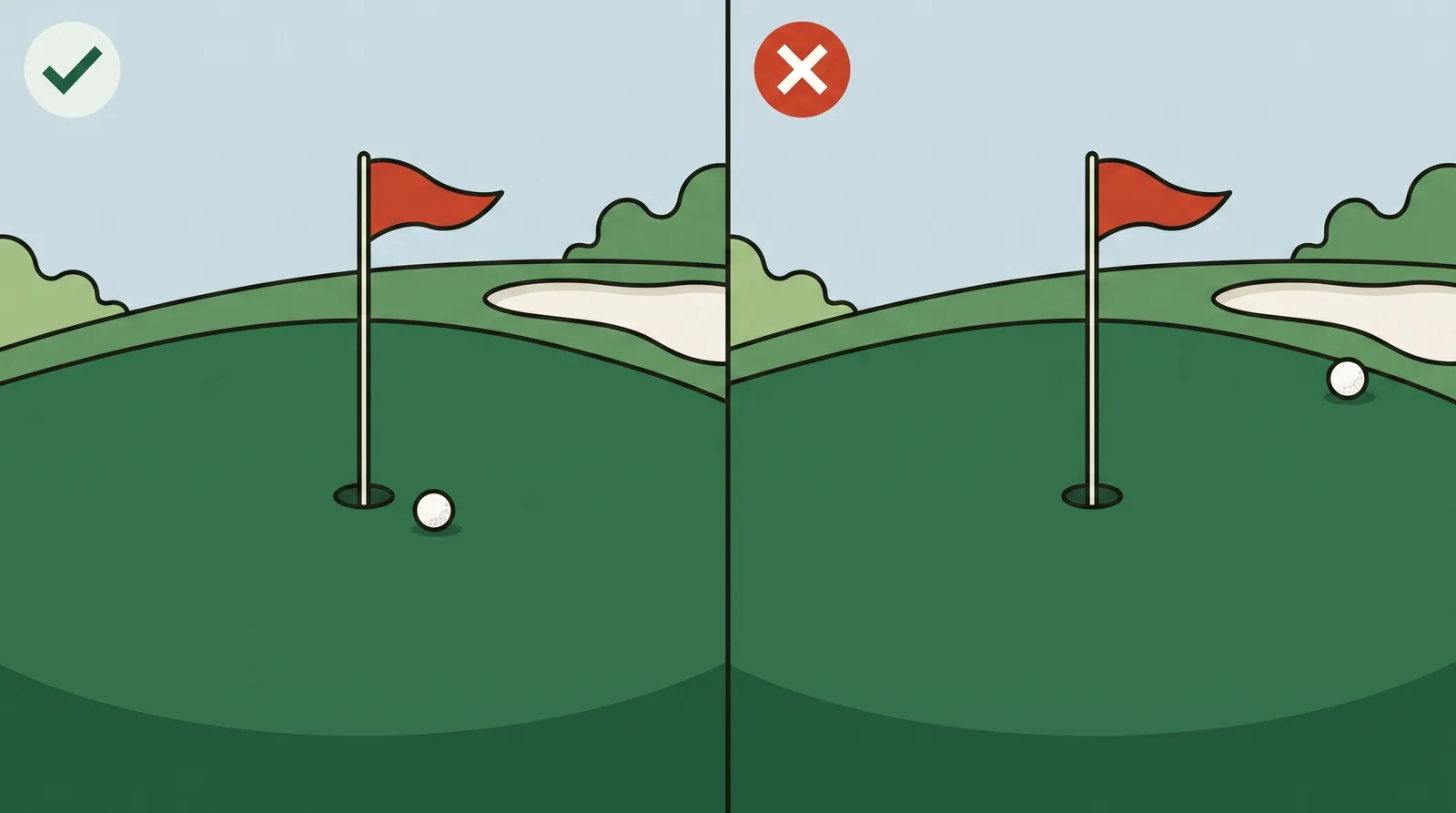
With a green tucked behind a bunker on the right, a fade lets you start at the middle of the surface and work the ball towards the flag, so the miss is the fat part of the green rather than the sand. On a tee shot with water down the right, aiming at the left edge means the ball has to cross the whole fairway before it can reach the trouble. That kind of decision is what stops a round unravelling, which is the subject of how to avoid big numbers.
It also changes club selection. A fade lands more steeply, so carry is the number that matters and the club that fits is often one more than a straight shot would need, which is the everyday version of the ball striking in how to hit irons.
The mirror of this page, with its own start line, its own setup and its own miss, is how to hit a draw. Neither shape is superior. They are the same relationship pointed the other way, and the one worth learning is usually the one closer to what your swing already does.
Key takeaways
- A fade is a path travelling left of the target with the face open to that path but still left of the target itself.
- The face sets the start line, so it is aimed first and the body is aimed around it.
- Aim the body left by roughly the curve you want, then swing along the body line.
- Five degrees of face to path is 44 yards of curve with a driver, which is a slice, not a fade.
- Do not weaken the grip or hold the face open. Both make the gap grow over a season.
- A fade launches higher and lands steeper, so it holds greens and finishes slightly shorter.
- The body must keep rotating. A fade widens the moment the chest stops and the arms take over.
- Left-handed golfers mirror everything: a fade still curves away from the lead side, so it moves right to left across the ground.
Common questions
How do I hit a fade with a driver?
The same way as with any club, with one warning. Aim the face at the target, aim your body left of it, and swing along the body line. The driver curves roughly twice as much as a mid iron for the same gap, so aim your body less far left than you would with an iron.
What is the difference between a fade and a slice?
The size of the gap between face and path, and whether you chose it. A fade is two or three degrees, worth a handful of yards. A slice is five or more, worth 40 yards with a driver. There is no separate mechanism, which is why one turns into the other so quietly.
Is a fade easier to hit than a draw?
For most amateurs, yes, because the out-to-in path a fade uses is already the path they have. That is also the argument against making it your permanent shape, since it means keeping the delivery that caused the slice in the first place. It is a genuine trade rather than a settled question.
Does a fade lose distance?
A little. Tilting the spin axis sideways produces less lift and less roll, so a fade usually finishes slightly shorter than a draw struck at the same speed. The gap is measured in a few yards, not in clubs, and it is easily paid for by keeping one side of the hole out of play.
Should I open the clubface to hit a fade?
Not at address. Opening the face there moves your start line right, which is the opposite of what the shot needs. The face should point at or slightly left of the target and be open relative to the path, which happens because the body is aimed left rather than because you manipulated anything.
Why does my fade start left and stay left?
That is a pull. The face and the path were both aiming left and agreed with each other, so there was nothing to bend the ball back. The aim is doing its job. Let the face arrive a degree or two behind the path rather than matching it.
Do I need to weaken my grip to fade the ball?
No, and it is the most common way this goes wrong. A weaker grip opens the face on every shot, including the ones where you wanted the ball to go straight. Aim is a decision you make per shot. Grip is not.
How do I stop my fade turning into a slice?
Keep the body rotating, keep the aim honest, and measure the curve. Fades widen when the chest stops turning and the arms take over, and when a golfer keeps aiming further left after each bad shot, which sends the path further left and grows the gap.
How do I hit a fade if I am left-handed?
Mirror it. Aim your body right of the target, aim the face at the target, and swing along the body line. The ball starts right and drifts back left. The degrees of gap, the size of the curve and everything else are identical.
How long does it take to learn a fade?
Two to four weeks of two or three sessions a week to produce one at the range, and a season before it holds up under pressure on a course. Golfers who already miss right get there faster, and should check they are controlling the shape rather than renaming it.
Tom Ashworth
Tom Ashworth is a PGA Professional who has taught golf since 2012, working mainly with beginners and mid-handicappers at club level in Surrey. He reviews the instruction guides on Learn Golf for technical accuracy before they publish.
Most of his teaching is with players in their first three years of the game, and most arrive having been told too much: six swing thoughts collected from videos, half of them contradicting each other. His approach is to check the grip and the alignment before touching the swing, on the basis that most bad ball flight is decided at address.