Everything before the transition is preparation and everything after it is consequence. The change of direction is where a swing either delivers what the backswing set up or throws it away, and it happens too fast to steer. This guide covers what moves first, the order the rest follows in, and the two failures that account for most amateur downswings.
Left and right assume a right-handed golfer. What comes before this is in the golf backswing, and what happens when the club finally arrives is in golf impact position.
The transition is shorter than you think
There is a moment where the lower body is already travelling towards the target while the club is still moving away from it. That overlap is not a trick of the camera, and its length has been measured.
TPI's biomechanics work found the average transition phase for male tour professionals is around 55 milliseconds, with the shortest in their database at 17 milliseconds. If every segment of the body reached the top at the same instant, the transition would be zero, and there would be no stretch anywhere in the chain to unwind. The overlap is the point.
Fifty-five thousandths of a second is not enough time to make a decision, which is the practical consequence. You cannot think your way through a transition. What you can do is change the thing that happens immediately before it, and let the change propagate.
The sequence, in order
Elite ball strikers accelerate their body segments in the same order regardless of how different their swings look. TPI's summary of the kinematic sequence is that the lower body peaks first, then the torso, then the arms, then the club, with each segment slowing down once the next one begins to accelerate.
That deceleration is the part that gets missed. The energy does not simply travel up the chain; each segment has to give it away, which means a body part that keeps accelerating all the way to the ball is a body part that never handed anything on.
| Segment | Peaks | What it is doing | The amateur version |
|---|---|---|---|
| Pelvis | First, while the club is still going back | Starting the unwind and moving pressure forward | Arrives late, after the arms have already gone |
| Torso | Second | Passing the load up from a stable base | Spins open with the pelvis, so both arrive together |
| Arms | Third | Being carried, then adding their own speed | Fire first from the top, throwing the club outward |
| Club | Last, at the ball | Releasing everything stored above it | Reaches top speed before the ball and slows into it |
The order runs up the body rather than down it, and every fault in the next section is a version of it being reversed.
What actually starts the downswing
Ask five coaches and you will get five answers: the lead knee, the hips, the pressure under the lead foot, the trail elbow dropping, or a feeling of the hands falling. They are not all describing different swings. They are describing the same swing from inside different bodies.
There is a second finding worth knowing here. TPI's work on ground force found that elite ball strikers get to their lead side much earlier in the downswing than higher handicappers, and that force applied too late is difficult to translate into club speed at all. Timing, rather than how strong you are, is what most amateurs are missing. The full picture of how pressure moves through the swing is in weight shift in the golf swing.
Holding the angle, and what that phrase really means
Halfway down, the angle between the lead forearm and the shaft is still close to what it was at the top. That retained angle is what most people mean by lag, and it is the most misunderstood idea in the golf swing.
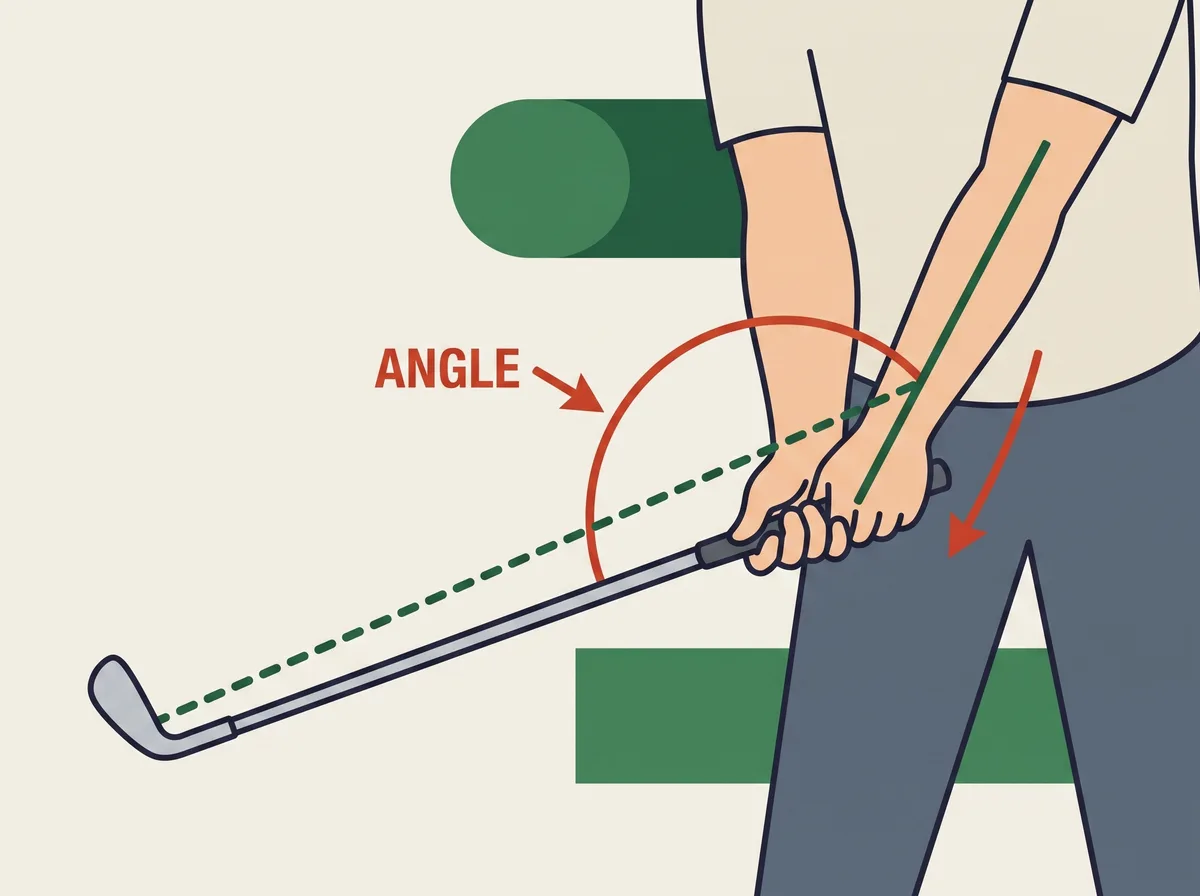
The angle is not created by squeezing. It survives because the hands are being pulled around by a body that started first, so the club head naturally trails behind. Golfers who try to hold it as an action end up with tight forearms, a late release and a blocked shot to the right, which is a different problem with the same name. There is more on this in lag in the golf swing.
The two ways the sequence fails
Almost every amateur downswing fault is one of two things, or both together.
The first is the arms going before the body. From the top the shoulders spin open, the club is thrown out and away, and it arrives at the ball travelling from outside the target line. That is coming over the top, and it has its own guide in how to stop coming over the top.
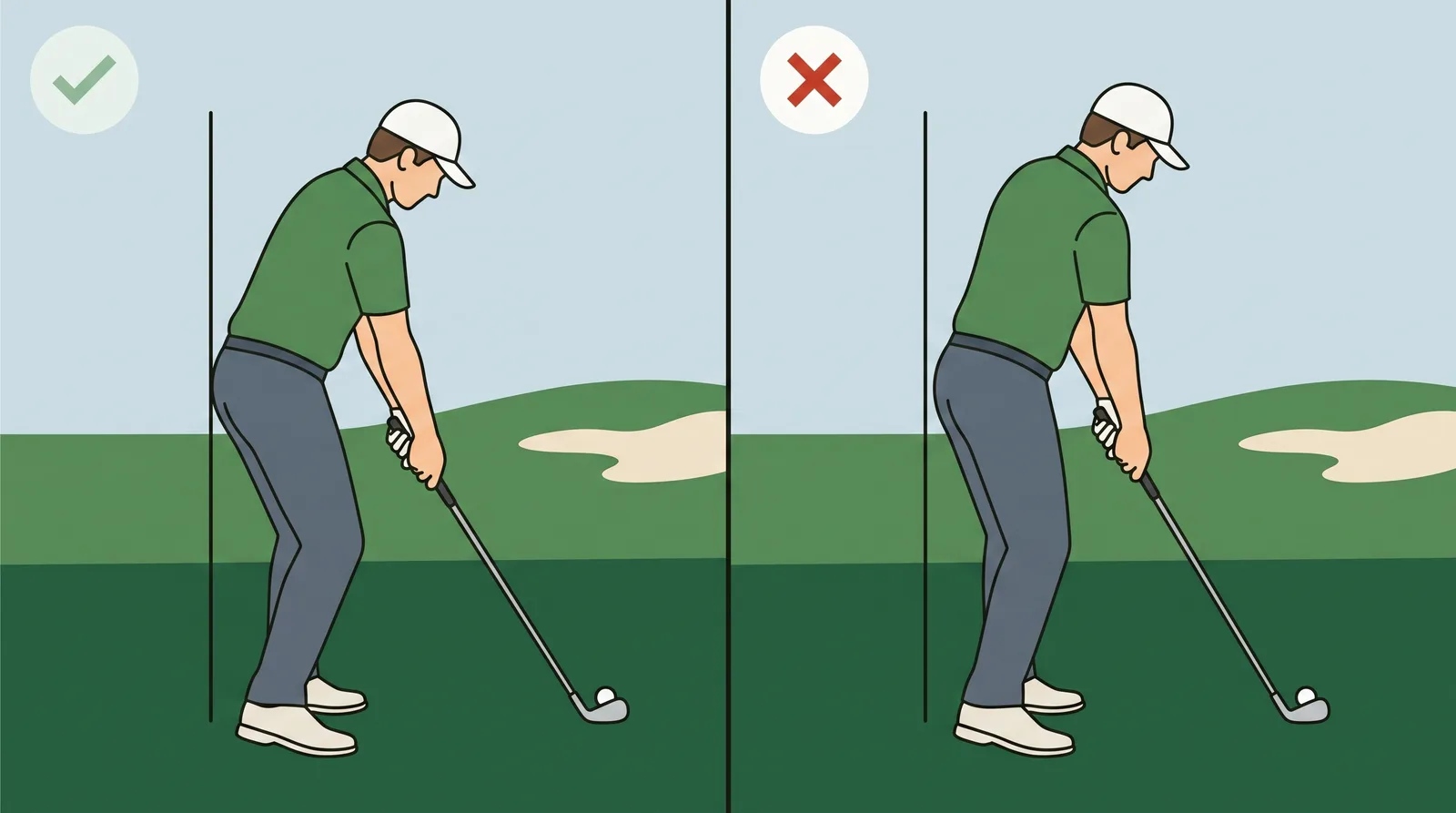
The second is the lower body moving towards the ball instead of around. TPI defines early extension as forward movement of the lower body towards the golf ball during the downswing, and lists restricted hip rotation, limited squat depth and weak glutes among the causes. It removes the space the arms need, so the hands have to lift and the strike goes thin or off the heel.
| Fault | What you see on video | Where it shows in the shot | First thing to check |
|---|---|---|---|
| Arms first | Club moves out and away from the body from the top | Left start, weak curve to the right | Whether the pelvis has begun to turn before the club changes direction |
| Casting | Wrist angle gone by waist height | High, weak, short | Whether you feel the effort peak at the top |
| Early extension | Hips move towards the ball, body stands up | Thin strikes, shots off the heel | Hip rotation range and squat depth |
| Slide without turn | Pelvis moves sideways past the ball, no rotation | Fat shots, pushes to the right | Whether the lead hip rotates or just travels |
Ball flight is feedback rather than diagnosis here, and two golfers can produce the same miss from opposite causes. The relationship between what the club did and where the ball went is in ball flight laws.
Two drills for the change of direction
Both work by making the wrong order physically difficult rather than by asking you to think about the right one.
How long a sequence change takes
Longer than anything else in this cluster, because you are changing an order rather than a position. Expect four to six weeks before a new sequence appears without a cue and several months before it survives a first tee.
The pattern is also predictable and worth preparing for. Ball striking usually gets worse for the first two weeks, because the old compensations are still firing at the new timing. Golfers who abandon a sequence change do it in that window, and they almost always do it a fortnight before it would have started working.
Practise it at half speed and hit no more than a third of your balls at full speed while the change is bedding in. Rotation work in the gym helps here more than swing volume does, and that side of it is covered in hip rotation in the golf swing.
Key takeaways
- The transition is about 55 milliseconds on tour, which is too short to steer consciously.
- The lower body starts forward while the club is still finishing the backswing.
- The order is pelvis, torso, arms, club, and each segment slows as the next accelerates.
- Elite players get pressure into the lead side earlier than amateurs do, not harder.
- The angle between the lead arm and the shaft is a by-product, not an action.
- Casting makes the club fastest above the ball, which is speed the shot never receives.
- Early extension moves the lower body towards the ball and removes the arms' space.
- Which cue starts your downswing is personal; the order it produces is not.
- Expect four to six weeks, with the first fortnight looking worse than before.
Common questions
What should start the downswing in golf?
The lower body. Pressure moves into the lead foot and the pelvis begins to rotate while the club is still finishing its backswing, and everything above it follows in order. What starts it in your body may be a knee, a hip or a pressure feeling, and any cue that produces the right order is the right cue for you.
What is the transition in a golf swing?
The overlap where the lower body has begun moving towards the target while the club is still travelling away from it. It measures around 55 milliseconds for male tour professionals, and it exists to create stretch in the chain that the downswing then unwinds.
Why do I hit the ball with my arms?
Because arms are fast, controllable and available, and the body is none of those things without practice. It is the default solution for anyone who has not built a sequence, and it works well enough at slow speeds to become a habit before it becomes a problem.
What is casting in golf?
Releasing the wrist angle at the start of the downswing rather than near the ball. The club reaches maximum speed above waist height, which means it is slowing down through impact and the loft is added rather than delivered.
How do I stop coming over the top?
Change the order rather than the path. The step drill on this page removes the option of starting with the arms, because the club cannot go anywhere until the lead foot has landed. Path drills alone tend to produce a golfer who steers rather than sequences.
What is early extension?
Forward movement of the lower body towards the golf ball during the downswing, so the hips lose their distance from the ball and the body stands up. It is frequently a mobility issue rather than a technique one, involving hip rotation range, squat depth and glute strength.
Should I feel like I am pulling the club down?
No, and it is a cue worth avoiding. Pulling with the arms produces exactly the sequence you are trying to escape. If a downward feeling helps you, locate it in the lead foot and the ground rather than in the hands.
How much lag should I have in the downswing?
There is no target number and chasing one usually backfires. Retained angle is a symptom of a body that started first, so if the sequence is right you will have as much as your speed and flexibility produce. Golfers who hold it deliberately tend to block the ball to the right.
Can I practise the downswing indoors?
Yes, and it is one of the better things to work on without a ball. The step drill and slow-motion transitions need no ball flight to be useful, and removing the ball removes the urge to hit at it, which is what breaks the sequence in the first place.
Why does my new downswing feel slower?
Because the effort has moved later, so the peak you used to feel at the top is gone. That absence reads as slowness even when a launch monitor shows the club is faster at the ball. Trust the strike and the sound rather than the feeling for the first month.
Tom Ashworth
Tom Ashworth is a PGA Professional who has taught golf since 2012, working mainly with beginners and mid-handicappers at club level in Surrey. He reviews the instruction guides on Learn Golf for technical accuracy before they publish.
Most of his teaching is with players in their first three years of the game, and most arrive having been told too much: six swing thoughts collected from videos, half of them contradicting each other. His approach is to check the grip and the alignment before touching the swing, on the basis that most bad ball flight is decided at address.