The swing bottoms out in roughly the same place every time, whether you know where that is or not. Ball position decides whether the ball is sitting there when it happens, and moving it an inch turns a clean strike into a fat one with nothing else changing. This guide gives the position for every club and how to spot yours drifting.
Left and right below assume a right-handed golfer. Lead means the side nearest the target, so for a left-hander the lead heel is the right heel and every position mirrors across.
Why ball position decides the strike
A golf swing travels on an arc. It comes down, reaches a lowest point, and goes back up. TrackMan measures that as low point, defined as the distance from the club head's geometric centre to the lowest point on the swing arc at the time of maximum compression.
For every club except the driver you want the ball sitting slightly before that lowest point, so the club is still descending when it reaches the ball and the turf gets brushed afterwards. That is what a ball-first strike is. It has nothing to do with hitting down hard and everything to do with the ball being in the right place on the arc.
The numbers back up how small the margins are. TrackMan's tour data puts the PGA Tour average attack angle at -3.7 degrees with a 6 iron and the LPGA Tour average at -2.3 degrees, which is a shallow descent rather than a chop. Move the ball forward of where it belongs and that shallow descent has already finished by the time the club arrives.
There is a second effect, and it is the one golfers rarely connect to ball position. The further forward the ball sits, the later in the arc it is struck, which means the hands have travelled further past it and the loft presented at impact changes. TrackMan calls that dynamic loft, the loft on the face at the moment of impact, and it is why the same 7 iron can launch noticeably higher or lower with nothing altered but where the ball was sitting.
The ball position chart
This is the reference table. Positions are given relative to the centre of your stance, measured in ball widths, because a golf ball is about 1.68 inches across and it is the one measuring device you always have with you.
| Club | Where the ball sits | Ball widths from centre | What the position is buying |
|---|---|---|---|
| Driver, from a tee | Opposite the inside of the lead heel | About 4 forward | The club arrives travelling upwards, which is what a teed ball wants |
| 3 wood and 5 wood, off the turf | Just inside the driver position | About 3 forward | A shallow strike with the low point just past the ball |
| Hybrid | Between the fairway wood and the long irons | About 2 to 3 forward | Enough forward position to sweep, not enough to thin it |
| 4 and 5 iron | Forward of centre | About 2 forward | A descending strike with a long club that still gets airborne |
| 6 and 7 iron | Slightly forward of centre | About 1 forward | The reference position most golfers should learn first |
| 8 iron, 9 iron, pitching wedge | Centre of the stance | 0 | The shortest full swings, with the low point just past the ball |
| Full sand or lob wedge | Centre of the stance | 0 | Same as above, no further back despite what it feels like |
| Partial wedge shots | Just back of centre | About 1 back | A steeper, more controlled strike for a shorter carry |
| Chip shots | Back of centre | About 1 to 2 back | Guarantees ball first, which is the whole job of a chip |
| Greenside bunker shot | Forward of centre | About 2 forward | Lets the club enter the sand behind the ball on purpose |
Putting sits outside this table entirely. It is a different discipline with its own setup and its own reference point, and treating it as the end of a continuum from the driver leads golfers astray.
The total travel from a wedge to a driver is about four ball widths, a little over six inches. That is much smaller than what actually happens on the course, where the swing between the two extremes is often nine or ten inches.
The reference point argument
Everything above is measured from the centre of the stance. Not everyone agrees that is the right reference, and this is one of the genuinely unsettled questions in golf instruction.
One caution about using the centre of the stance as a reference. Stance width narrows as the club gets shorter, so the centre moves too, and if you narrow only the trail foot then the centre of your stance has quietly shifted forward without you touching the ball. Set the width first, find the centre second, then place the ball. Widths club by club are in the golf stance guide.
The other reference worth knowing is the logo on your shirt, which sits above the middle of the stance when the setup is symmetrical. If your chest reference and your foot reference disagree, your weight or your shoulders have shifted, which is worth knowing before you hit anything. Posture affects this more than golfers expect, and it is covered in golf posture.
The driver is the real exception
Every other club is struck while the club is still descending. The driver is struck while it is climbing, and that difference is why its ball position sits so far forward.
TrackMan's tour figures show how far the two diverge. The PGA Tour driver average attack angle is -0.9 degrees while the LPGA Tour average is +2.8 degrees, and the LPGA number is the one worth copying for most amateurs because hitting up on a teed ball produces more carry for less speed. A ball forward in the stance is what makes an upward strike physically possible, with no swing change involved.
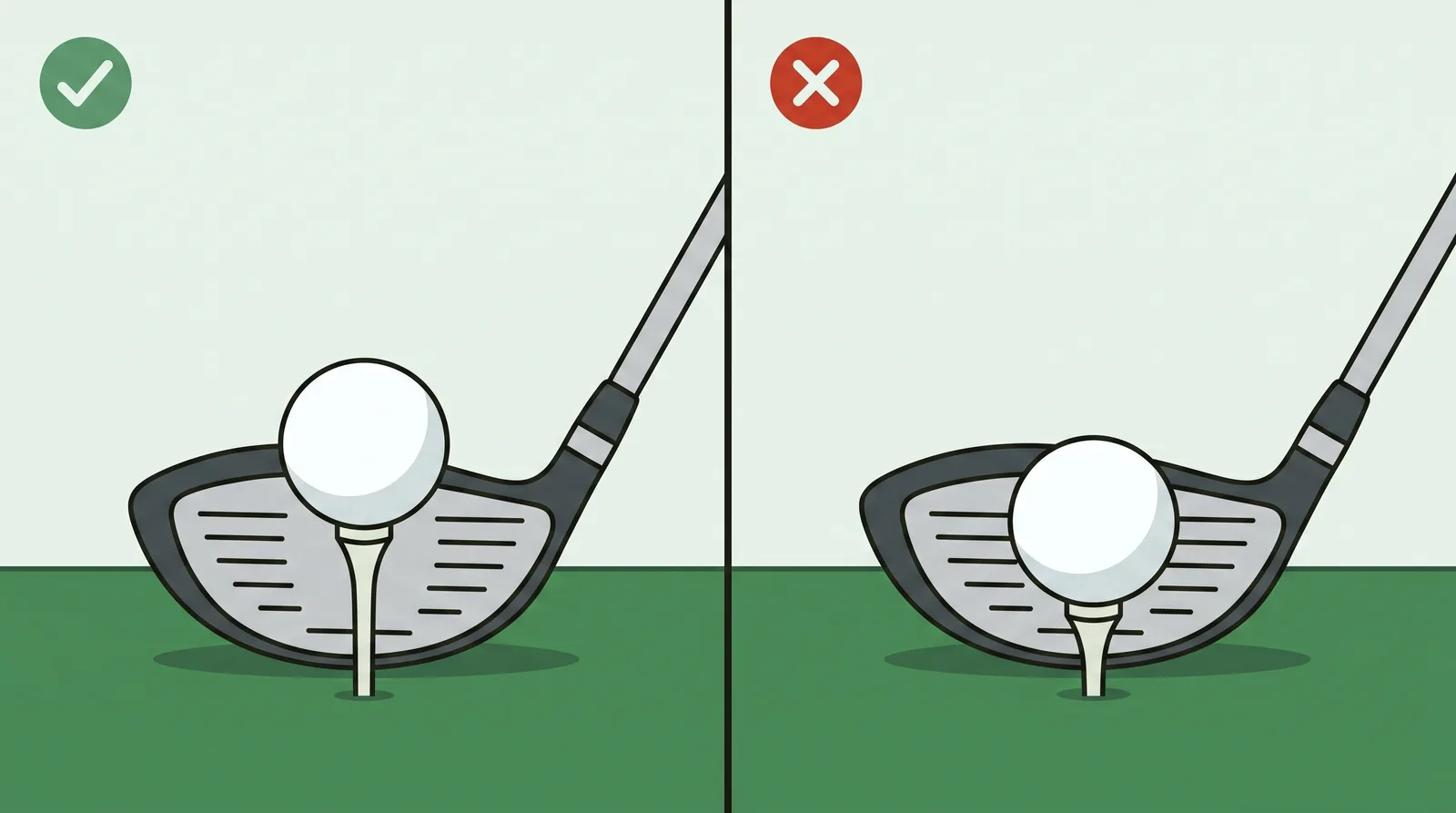
Tee height does the other half of the job. With the tee at the right height, roughly half the ball stands above the top edge of the driver crown when the club is resting on the ground behind it. Too low and the club has to reach down for it, which cancels out the forward ball position entirely.
The rest of the driver setup, including tilt and where the weight sits, is covered in how to hit a driver.
How ball position drifts, and it always drifts
Nobody moves their ball position deliberately. It moves because the setup moves, and there are two common causes.
The first is walking in from the side. Golfers who step into the shot from behind the ball and set the club down first keep a consistent position. Golfers who wander in from the side, plant their feet and then look down usually find the ball wherever their feet happened to stop.
The second is compensation. A golfer catching the ball heavy starts playing it further back, which steepens the strike, which produces more heavy shots, which pushes the ball further back again. Two weeks later they are playing a 7 iron off their trail foot and cannot work out why the ball flies low and right. The same loop runs in reverse for a golfer who has been thinning it.
The cure for both is a fixed order of operations, which is what a pre shot routine provides. Club behind the ball first, feet built around it second.
What each miss tells you
Ball position produces a recognisable set of misses, and they are not the ones golfers usually blame it for. Every row has other possible causes, so use this as a first place to look rather than a diagnosis.
| What you see | Likely ball position cause | What to try |
|---|---|---|
| Fat shots, divot starting behind the ball | Ball too far forward for the club | Move it back one ball width and hit five |
| Thin and low, no divot | Ball too far forward, caught on the way up | Same adjustment, then check posture |
| Ball flying low and right with irons | Ball too far back, face still closing | Move it forward one ball width |
| High weak shots with a short iron | Ball too far forward, extra dynamic loft | Move it back towards centre |
| Drives that climb steeply and fall short | Ball too far back for a teed shot, hitting down on it | Move forward to the lead heel and raise the tee |
| Drives struck off the top edge | Ball too far forward, or the tee too high | Lower the tee before moving the ball |
| Chips caught heavy | Ball forward of centre on a short shot | Move it back of centre and lean the shaft slightly forward |
Heavy contact is the most common of these and has causes beyond ball position, all covered in fat shots. The thin version is dealt with in topping the ball.
Checking your own ball position
The useful thing about ball position is that it leaves physical evidence. You do not have to guess.
A divot is a record of where the low point arrived. It should begin level with where the ball was sitting and run on from there, towards the target. A divot that starts behind the old ball position means the club reached the ground first, and the most common reason for that is a ball too far forward.
The partial-shot version of all this is a subject in itself, and the full breakdown is in wedge distance control.
Ball position and aim are easy to confuse
Ball position decides where on the arc the club meets the ball, which mostly affects strike quality and launch. Aim decides where the club is pointing and travelling, which mostly affects direction. A ball two inches too far forward produces heavy contact, not a slice. Consistent shots leaking one way are an aiming problem, and that lives in golf alignment.
The exception is worth naming. A ball too far forward gives the face longer to close and can send shots left, while too far back catches the face before it has squared and sends them right. Those effects are real, they are small, and they show up as a tendency rather than a curve. If the ball is bending hard, look at face and path first, and the strike quality question is covered in impact position.
Key takeaways
- The swing bottoms out in roughly the same place every time. Ball position decides whether the ball is there for it.
- Every club except the driver wants the ball slightly before the low point, so the turf is struck after the ball.
- The full range from a wedge to a driver is about four ball widths, which is smaller than most golfers play it.
- Driver sits opposite the inside of the lead heel because a teed ball is struck on the way up.
- Set stance width first, find the centre second, place the ball third.
- Whether the ball moves or the stance moves is genuinely contested. Pick one method and stay with it.
- Put the club behind the ball before you build your stance, not after.
- A divot that starts behind the ball is the clearest evidence that the ball was too far forward.
- Ball position affects strike quality and launch far more than it affects direction.
Common questions
Where should the golf ball be in my stance?
For a 6 or 7 iron, about one ball width forward of the centre of your stance. Move it forward from there as the club gets longer, out to the inside of the lead heel for a driver, and back towards centre as the club gets shorter, reaching the middle for a 9 iron or wedge.
Where do you position the ball for a driver?
Opposite the inside of your lead heel, which is the front foot for your swing direction. That is far enough forward that the club has already passed the bottom of its arc and is climbing when it reaches the ball, which is what produces carry from a teed shot.
Should the ball be in the middle of my stance for irons?
For short irons, yes. An 8 iron, 9 iron and pitching wedge all sit in the centre of the stance. Mid irons sit about one ball width forward of that, and long irons about two, so the ball moves steadily forward as the club gets longer rather than jumping between fixed positions.
What happens if the ball is too far forward?
The club has already reached the bottom of its arc before it gets to the ball, so it hits the turf first and produces fat shots, or catches the ball on the way up and thins it. Both misses come from the same cause, which is why they often alternate.
What happens if the ball is too far back?
The club arrives steeply and early, before the face has finished squaring, so shots tend to fly low and to the right for a right-handed golfer. It also compresses the ball harder, which is why some golfers chase it and then wonder where their trajectory went.
Should ball position move or should my stance move?
Both methods work and coaches genuinely disagree. Moving the ball within a roughly centred stance is easier to learn and easier to check on your own. Keeping the ball opposite the lead heel and changing the stance around it is more repeatable once trained. The mistake is using half of each.
How do I check my ball position on my own?
Hit shots from grass and look at where your divot starts relative to where the ball was. Put a tee in the ground beside the ball as a marker so you have a fixed reference afterwards. Divots beginning past the marker are correct, and divots beginning behind it mean the ball was too far forward.
Where should the ball be for a chip shot?
Just back of centre, usually one to two ball widths, with the weight favouring the lead foot. The whole purpose of a chipping setup is to guarantee the club reaches the ball before the ground, and a back-of-centre position does most of that work on its own.
Does ball position change for left-handed golfers?
Only in mirror image. Lead means the side nearest the target, so a left-hander plays the driver off the inside of the right heel and everything in the chart holds with the sides swapped. The ball widths and reference points are identical.
Why does my ball position keep changing without me noticing?
Almost always because you build your stance before the club goes down behind the ball, so the ball ends up wherever your feet stopped. Compensation is the other cause: a run of heavy shots quietly pushes the ball back, and a run of thin ones pushes it forward.
Tom Ashworth
Tom Ashworth is a PGA Professional who has taught golf since 2012, working mainly with beginners and mid-handicappers at club level in Surrey. He reviews the instruction guides on Learn Golf for technical accuracy before they publish.
Most of his teaching is with players in their first three years of the game, and most arrive having been told too much: six swing thoughts collected from videos, half of them contradicting each other. His approach is to check the grip and the alignment before touching the swing, on the basis that most bad ball flight is decided at address.