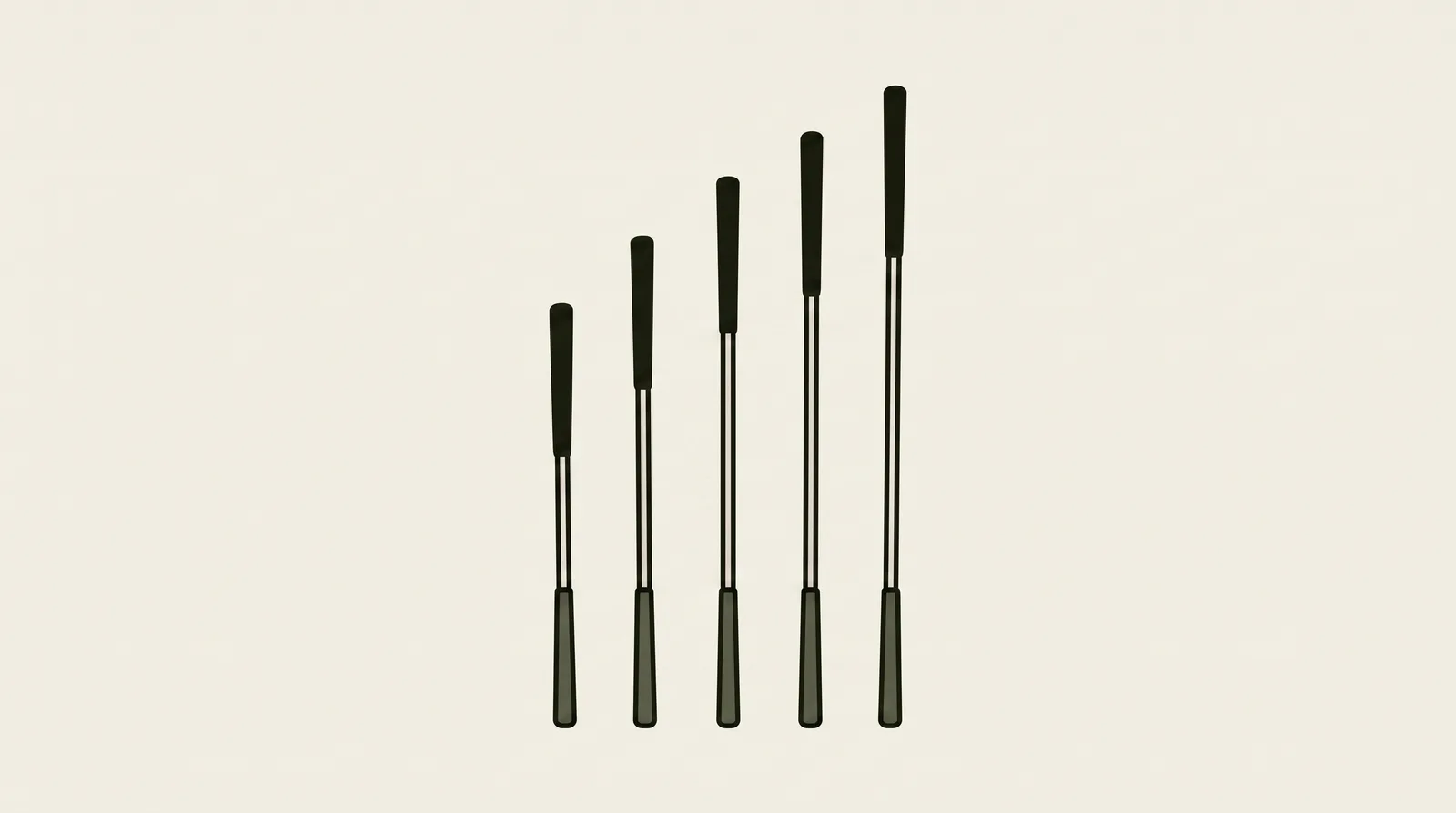
Golfers well outside average height get the same advice from both directions: taller means longer clubs, shorter means shorter ones. That covers about half of the problem. Length and lie angle are two different specifications, they are set from the same measurements but they do different jobs, and conflating them is why plenty of golfers who did buy longer clubs still cannot work out why the ball starts offline.
Left and right below assume a right-handed golfer. Left-handers should swap them and everything else holds.
Two adjustments, not one
The reason this gets muddled is that both specifications change when your build changes, so they arrive together and get remembered as one thing.
They are not one thing. They change different parts of the outcome.
| Club length | Lie angle | |
|---|---|---|
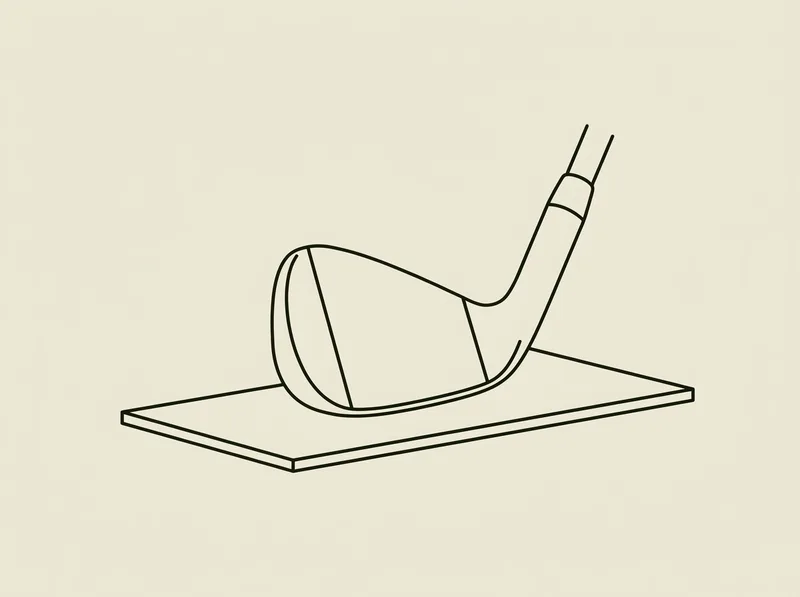
| What it is | How long the club is, from grip end to sole | The angle between the shaft and the ground when the sole sits flat |
| What it mainly changes | How far you stand from the ball, how the club feels, the arc it swings on | Where the clubface points at impact, and therefore the start line |
| What you notice when it is wrong | Reaching or crowding, an uncomfortable posture, a club that feels heavy or whippy | Shots that start left or right of where you aimed with a strike that felt fine |
| How it is changed | Cutting the shaft down or fitting a longer one | Bending the hosel, on clubs that can be bent |
The lie angle column is the one that catches people out, because a wrong lie angle does not feel wrong. The club sits fine, the strike feels fine, and the ball goes somewhere you did not aim. The mechanism, which is that tilting a lofted face sideways also aims it sideways, is worked through in golf club lie angle.
The two also interact, which is the part that gets left out entirely. Manufacturers publish lie angles at a stated length, so the figure you are quoted assumes the club has not been shortened or extended. PING's published specification table for its i230 irons notes that lie angle is given at standard length, which is a quiet admission that the two numbers travel together and that changing one changes how the other plays.
What standard length actually is
Every set of irons is built to a length progression, dropping by roughly half an inch per club as the loft goes up. Here is what one manufacturer publishes, taken from PING's specification table for the i230 irons.
| Club | Length | Lie angle | Loft |
|---|---|---|---|
| 3 iron | 39" | 59.0 degrees | 19.0 degrees |
| 4 iron | 38 7/8" | 59.8 degrees | 22.5 degrees |
| 5 iron | 38 1/4" | 60.5 degrees | 26.0 degrees |
| 6 iron | 37 5/8" | 61.3 degrees | 29.5 degrees |
| 7 iron | 37" | 62.0 degrees | 33.0 degrees |
| 8 iron | 36 1/2" | 62.8 degrees | 37.0 degrees |
| 9 iron | 36" | 63.5 degrees | 41.0 degrees |
| PW | 35 1/2" | 64.1 degrees | 45.0 degrees |
Notice what the table is and is not. It is a coherent internal progression: as the club gets shorter, the lie gets more upright, because you stand closer to the ball. It is not a statement that 37 inches is the right seven iron for a human being. It is the length this manufacturer chose to build to, against which every custom order is expressed as a plus or a minus.
Different manufacturers pick slightly different reference lengths, which is why a set described as standard from one brand can measure differently from another brand's standard. Standard is a manufacturing baseline, not a fitting.
The regulatory envelope around it is enormous by comparison. The R&A's equipment rules require that the overall length of a club be at least 18 inches and, putters excepted, not exceed 48 inches. There is also a specific provision for players who need more: local committees may permit clubs longer than the maximum where there is evidence of a medical or physical need, provided the shortest club carried is no more than 10 inches shorter than the longest, putter excluded. A driver built two inches over standard is nowhere near any limit.
Height on its own is a poor fitting input
The intuition that height determines club length is close enough to be dangerous. It is a proxy for the thing that actually matters, and a mediocre one.
What matters is how far your hands are from the ground when you stand normally, which is a function of height and arm length together. Two golfers who both measure six foot two can have wrist-to-floor measurements several inches apart, and the one with longer arms needs a shorter club than his height alone implies. Long legs and short arms push the requirement the other way.
This is why the best known static fitting system uses both. PING's colour code chart, devised by Karsten Solheim and in use for around fifty years, takes height and wrist-to-floor distance together and returns a colour code covering lie angle along with a recommended length. Taller golfers with longer wrist-to-floor measurements generally land on longer and more upright specifications, and shorter golfers with shorter measurements on the reverse, but the pairing is what the chart produces rather than something you can infer from height alone.
Height is a weak predictor in other places too. A 2026 study by Johansen and colleagues in the Scandinavian Journal of Medicine and Science in Sports examined what correlates with driver clubhead speed in elite golfers, and found that in 22 elite male players body height showed no significant association with speed, while body mass did. Being tall does not automatically mean hitting it further, and it certainly does not mean the standard set will fit.
What an ill-fitting set makes you do
Clubs that do not fit are rarely abandoned. They are compensated for, and the compensation becomes the swing.
A tall golfer using standard-length irons has to get their hands closer to the ground to reach the ball. There are only two ways to do that, and both cost something. Bending further forward tends to round the upper back, which removes shoulder turn before the club has moved, and is the exact fault described in golf posture. Squatting further into the knees locks the hips and leaves the arms nowhere to swing. Neither is a swing flaw the golfer chose.
A shorter golfer using standard clubs has the opposite problem. The club is longer than the setup wants, so either the hands ride high and the golfer stands taller than is comfortable, or they choke down two inches on every full shot and quietly play a different club from the one in their hands. Gripping down is a legitimate tool for one shot. As a permanent arrangement it changes the effective length, the balance and the feel of the club without changing anything the club actually is.
Both cases also drag distance from the ball out of position, which has its own consequences and its own page in distance from the golf ball. The setup that results is not a stance you chose, which is worth remembering before treating it as a habit to be fixed in golf stance.
The start line problem
Here is where length and lie stop being an abstract distinction.
A club sitting with its toe down at impact plays effectively flat, which for a right-hander points the face right and starts the ball right. A club sitting with the toe up plays effectively upright, which points it left. The effect grows with loft, so short irons and wedges show it far more than long irons do.
Now put the two together. A tall golfer squeezed into short clubs has lowered their hands to reach, which pushes the delivery towards the flat end of that scale. A short golfer stretching to hold a club that is too long has raised the hands and pushed it towards the upright end. In both cases the golfer is aiming correctly, striking the ball cleanly, and watching it start somewhere else. That pattern, a good-feeling strike with a start line nobody aimed at, is one of the more common items on the list in inconsistent ball striking.
What else changes when you change length
Length is not a free adjustment, which is the argument for measuring rather than guessing.
Adding an inch to a club adds weight beyond the balance point, so the head feels heavier through the swing even though nothing about the head changed. Cutting an inch off does the reverse and can leave a club feeling light and hard to sense. That is why a properly built custom set adjusts head weight to keep the feel consistent, and why an inch chopped off a secondhand set in a garage often produces a club that swings like nothing else in the bag.
A longer club also swings on a slightly flatter, wider arc and gives the shaft more leverage to bend, which is part of why shaft selection has to be revisited when length changes rather than carried over. The relevant background is in golf shaft flex.
Grip size interacts too, though less than people assume, and it is a separate measurement taken from hand size rather than from height. Large hands on a tall frame are common but not guaranteed, and the sizing question is dealt with in golf grip sizes.
A set built to one person's measurements is a set of matched compromises, chosen together. A standard set bought off a rack is a set of somebody else's, and every specification in it was picked for a golfer who does not exist.
What to check, and in what order
Most of this can be narrowed down before anyone spends anything.
| What you notice | First thing to check | How to check it |
|---|---|---|
| Reaching for the ball, weight on the toes | Length too short for your wrist-to-floor | Measure wrist-to-floor against a wall in your normal shoes |
| Standing too tall, hands riding high | Length too long | As above, plus check whether you always grip down |
| Short irons start left of the target | Lie too upright as delivered | Lie board and impact tape, mid iron and wedge |
| Short irons start right of the target | Lie too flat as delivered | As above |
| Long irons fine, wedges wild | Lie error, because the effect scales with loft | As above, compare a 5 iron with a pitching wedge |
| Rounded back at address, no shoulder turn | Length, forcing a posture compromise | Film your address position from behind |
| Everything feels heavy or unusually light | Length changed without a head weight adjustment | Ask whether the set was cut down or extended |
Two of those rows are directional, so worth restating: for a right-hander, too upright starts the ball left and too flat starts it right. Left-handers invert both.
Static charts start the conversation, dynamic fitting ends it
This is the plain answer, and it is worth saying without hedging.
A static chart takes two body measurements and predicts what should suit you. It is quick, free, and better than guessing from height. It is also blind to the only thing that actually determines lie angle at impact, which is how you deliver the club. Two golfers with identical wrist-to-floor measurements can arrive at the ball with the shaft leaning differently, the hands at different heights and the club bending by different amounts, and only one of them will be well served by the chart's answer.
A dynamic fitting measures the delivery. A lie board finds where the sole actually contacts, a launch monitor shows what the resulting start line and spin look like, and length gets tested by hitting rather than by prediction. That is the answer, and what happens in the bay is set out in golf club fitting.
Two practical notes for anyone weighing that up. Getting fitted is worth more once your strike is repeatable enough to produce a pattern, because a fitting reads your average and a beginner does not have one yet, which is part of the argument in what clubs beginners need. And if the budget points at a used set, length and lie should be checked before purchase rather than after, since a set already cut down for a previous owner is a different club from the one in the listing. That is covered in buying used golf clubs.
Key takeaways
- Length and lie angle are separate adjustments that are set together. Length decides where you stand, lie decides where the ball starts.
- Manufacturers quote lie angle at a stated standard length, so altering length changes how the lie plays and both need rechecking together.
- Standard length is a manufacturing baseline, not a fitting. PING's i230 seven iron is built at 37 inches with a 62 degree lie, and other brands pick slightly different references.
- The R&A allows clubs from 18 inches to 48 inches, putters excepted, with a further allowance where there is evidence of medical or physical need.
- Height alone is a weak input. Wrist-to-floor distance, taken together with height, is what static systems such as PING's colour code chart actually use.
- Being tall does not imply more speed. One 2026 study of elite male golfers found no significant association between body height and driver clubhead speed.
- A tall golfer in standard clubs tends to compensate by rounding the back or squatting, both of which cost shoulder turn.
- A shorter golfer in standard clubs tends to grip down permanently, which changes the club's effective length and balance without changing what it is.
- For a right-hander, a lie too upright starts the ball left and too flat starts it right, and the effect grows with loft.
- Changing length changes how the head feels and how the shaft loads, so a set cut down without a weight adjustment rarely feels like the rest of the bag.
- A static chart is a starting point. A dynamic fitting with a lie board is the real answer.
Common questions
What length golf clubs do tall players need?
There is no figure that follows from height alone, which is why static systems use wrist-to-floor distance alongside it. Two golfers of the same height with different arm lengths need different lengths, and the only way to settle it is to measure both and then confirm the result by hitting balls.
How do I measure wrist-to-floor?
Stand upright in the shoes you play in, on a hard flat surface, arms hanging relaxed at your sides. Measure from the crease of the wrist straight down to the floor. Have someone else read the tape, because bending to look at it moves the number you are trying to take.
Do tall golfers need more upright lie angles?
Generally yes, and it comes as part of the same recommendation rather than as a separate decision. PING's colour code chart returns a lie code and a length together from height and wrist-to-floor, and taller golfers with longer measurements typically land on longer and more upright specifications. It is still a prediction, and a lie board is what confirms it.
Is standard club length designed for a specific height?
No. It is a manufacturing baseline that lets factories build sets and shops stock them, and every custom order is expressed as a plus or minus against it. Different brands choose slightly different reference lengths, so one company's standard is not identical to another's.
Can short golfers just grip down instead of getting shorter clubs?
For a single shot, gripping down is a useful tool. As a permanent arrangement it changes the effective length and the balance of every club without changing the club, and it usually means the shaft is longer than the swing wants. It is a workaround rather than a fit.
Do longer clubs hit the ball further?
Not reliably, and the trade-off is real. A longer shaft can add arc but it also makes centred contact harder, and off-centre strikes cost more than the extra length gains. A driver you can find the middle of usually beats a longer one you cannot.
Are tall golfers at an advantage in golf?
Less than people assume. A 2026 study of elite golfers found no significant association between body height and driver clubhead speed in the male players examined, while body mass did correlate. Height changes what equipment you need more than it changes what you can do with it.
What happens if my clubs are too long?
The hands ride higher than the setup wants, which pushes the club towards playing upright and tends to start the ball left for a right-hander. It also encourages standing taller than is comfortable or gripping down on every shot, both of which alter posture and distance from the ball.
Can any golf club be bent to change the lie angle?
Most forged and many cast irons can be bent within a limited range by a fitter with a bending machine. Some cast heads and most drivers and fairway woods cannot, and hollow or multi-material heads vary. It is a question for the fitter with the club in the machine rather than one to assume.
Should juniors be fitted, or just given cut-down adult clubs?
Cut-down adult clubs are heavy and stiff for their length, because shortening a shaft makes it play stiffer and leaves the head weight wrong. Purpose-built junior sets are lighter throughout. The measurement principle is the same as for adults, it just has to be repeated as they grow.
How much difference does lie angle really make?
It scales with loft, so very little on a 4 iron and a good deal on a wedge. If your long irons behave and your short irons start offline while the strike feels clean, lie angle belongs high on the list of suspects rather than at the bottom of it.
On this page
Tom Ashworth
Tom Ashworth is a PGA Professional who has taught golf since 2012, working mainly with beginners and mid-handicappers at club level in Surrey. He reviews the instruction guides on Learn Golf for technical accuracy before they publish.
Most of his teaching is with players in their first three years of the game, and most arrive having been told too much: six swing thoughts collected from videos, half of them contradicting each other. His approach is to check the grip and the alignment before touching the swing, on the basis that most bad ball flight is decided at address.