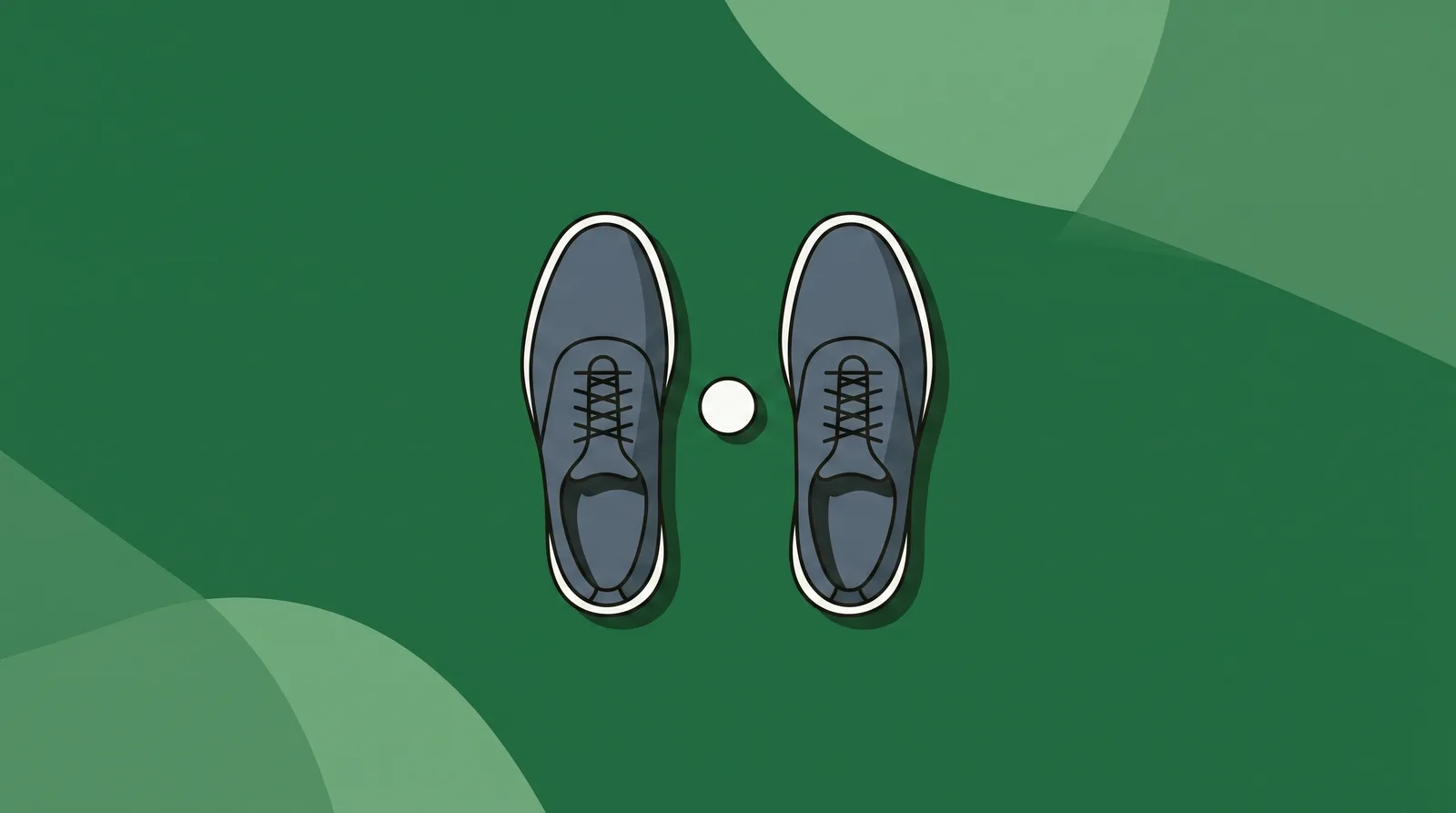
Width and foot position look like details, and they are not. They set how far the hips can turn, where the weight is allowed to travel, and whether the bottom of the swing arrives in a repeatable place. Most golfers stand wider than they need to and have never checked the angle of their feet. This guide covers width, flare and weight, club by club, and gives you a way to test each one.
Left and right below assume a right-handed golfer. If you play left-handed, swap them and everything else holds, and there is more on that in the left handed golf guide.
What the stance is actually for
A stance has two jobs and they pull against each other. It has to keep you stable enough that a fast rotation does not throw you off balance, and it has to leave your hips free enough to rotate in the first place. Every width argument in golf is really an argument about where to sit between those two.
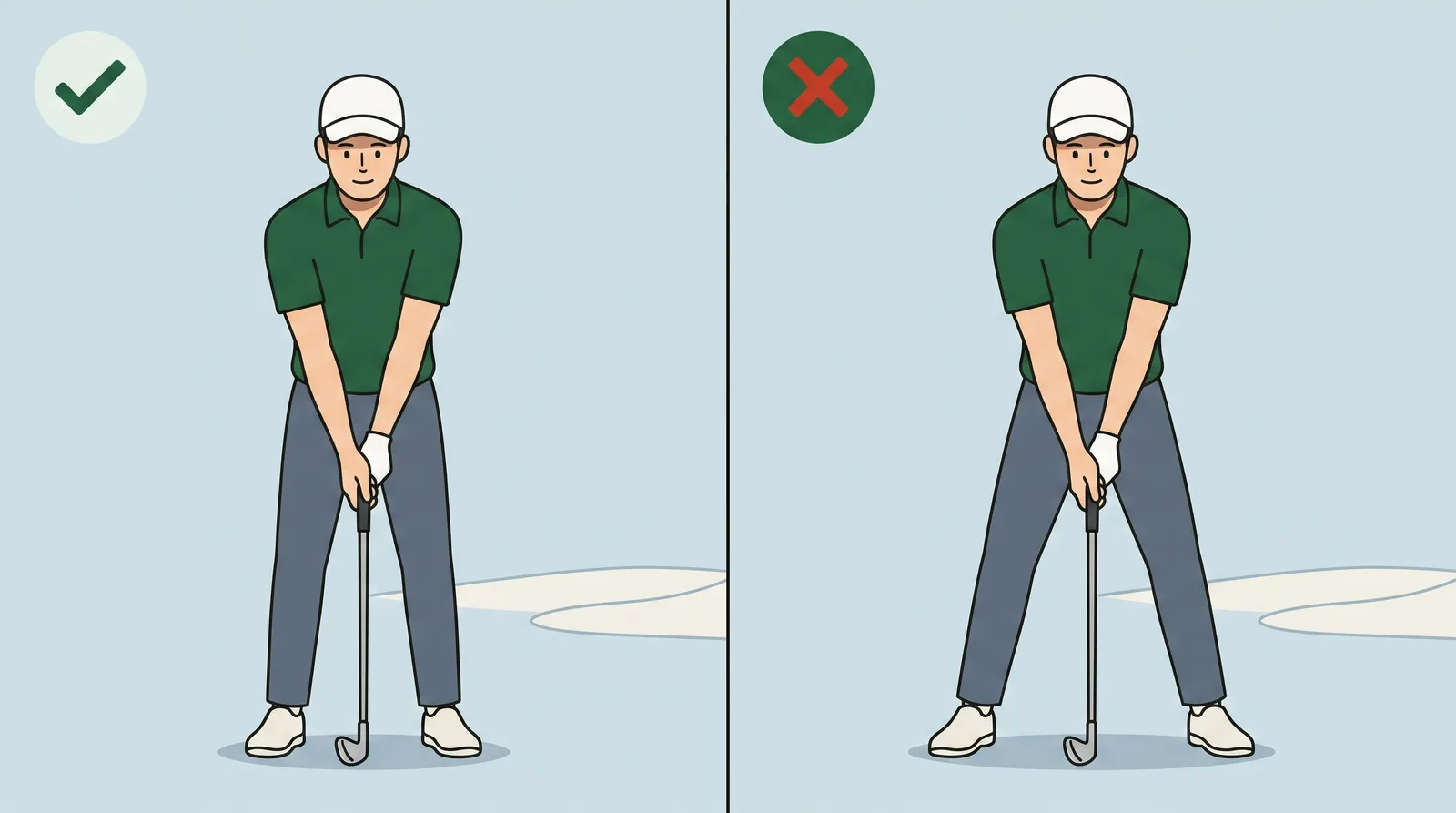
The trap is that stability is easy to feel and rotation is not. A wide base feels solid the moment you take it, so golfers keep widening until the swing feels safe. What they have actually built is a stance that can only slide, because at that width the hips have nowhere to turn.
Everything else at address is covered elsewhere and does not belong here. Spine angle and knee flex sit in the golf posture guide, where the ball sits relative to your feet is in ball position by club, and aiming the whole arrangement is in golf alignment.
Stance width, and the number most golfers get wrong
The reference point is your shoulders, measured heel to heel rather than toe to toe. Stand normally, look down, and see whether the outside of your heels sits inside or outside the width of your shoulders.
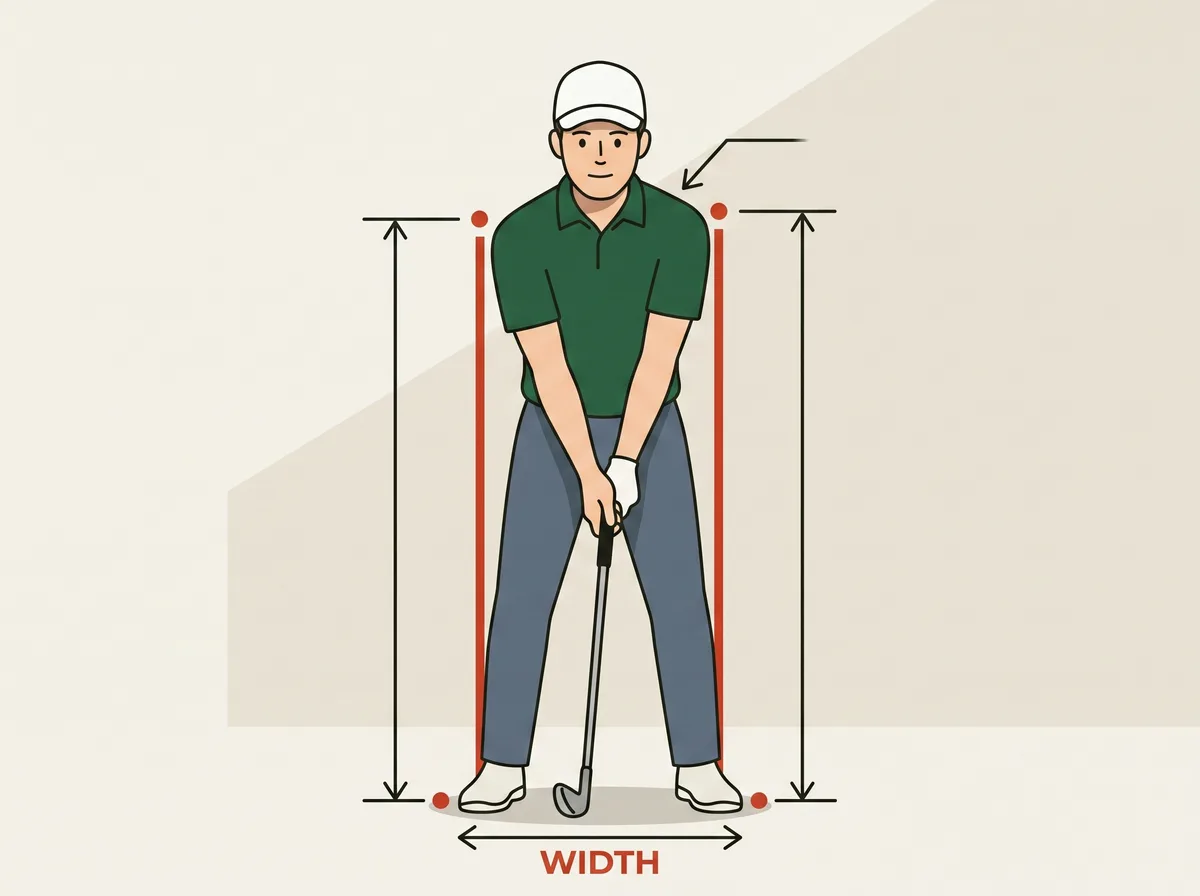
The Titleist Performance Institute's guidance is more restrictive than most golfers expect. Their article on stance width states that the most efficient width is no wider than shoulder width for most full swing shots, driver included, because a wider base demands a larger weight shift to work at all. Without that shift, the body substitutes side bend for rotation, and side bend is what produces both inconsistency and back trouble.
| Club | Heel to heel width | What it buys you |
|---|---|---|
| Driver and fairway wood | At shoulder width, no wider | Room to move laterally without losing the turn |
| Long and mid irons, 5 to 7 | Just inside shoulder width | Stability with the hips still free |
| Short irons, 8 to pitching wedge | About two thirds of shoulder width | A tighter arc and a more predictable low point |
| Full wedge shots | Feet close to under the hips | Less turn to control, less that can go wrong |
| Partial and greenside shots | Narrow, often with the feet almost together | Rotation only, no weight transfer to time |
Putting is a separate discipline with its own setup, and it is not covered by the table above.
Foot flare, and why the two feet are not symmetrical
Flare is the angle each foot is turned out from square to the target line. The two feet do different jobs, so they get different angles, and this is the part of the setup almost nobody checks.
The lead foot is turned out to let the lead hip get out of the way on the way through. The trail foot stays closer to square so the trail hip has something to load against on the way back. Flare the trail foot too much and the hip is already turned open before the swing starts, which means the backswing has nothing to coil against.
| Foot | Usual flare | What it decides |
|---|---|---|
| Lead foot | Turned out roughly 20 to 30 degrees | How freely the lead hip can rotate through |
| Trail foot | Square, or barely turned out | How much resistance the trail hip gives on the way back |
Those are starting points rather than measurements, and the right answer depends on your hips rather than on a protractor. TPI notes that the average PGA Tour player has over 45 degrees of internal hip rotation on both sides, which is a lot more than most amateurs carry into their forties. If your hips have less range, more lead foot flare is a reasonable accommodation rather than a fault.
There is a cheap self-test for this. TPI's lower quarter rotation test asks a player to stand on one leg with hands on the hips and rotate the pelvis as far as it will go in both directions, looking for at least 60 degrees each way. Fall short of that and the body finds the rotation somewhere else, which shows up as lateral sliding rather than turning.
Where the weight sits at address
Two different questions get confused here. One is how the weight splits between the two feet, which changes by club. The other is where it sits within each foot, which does not change at all.
Within the foot, the target is the middle, roughly over the arches, with the ankles free rather than locked. Weight on the toes tips you towards the ball as the swing starts. Weight on the heels sends you backwards and away from it. Both produce the same symptom, which is a strike that wanders around the face for no obvious reason.
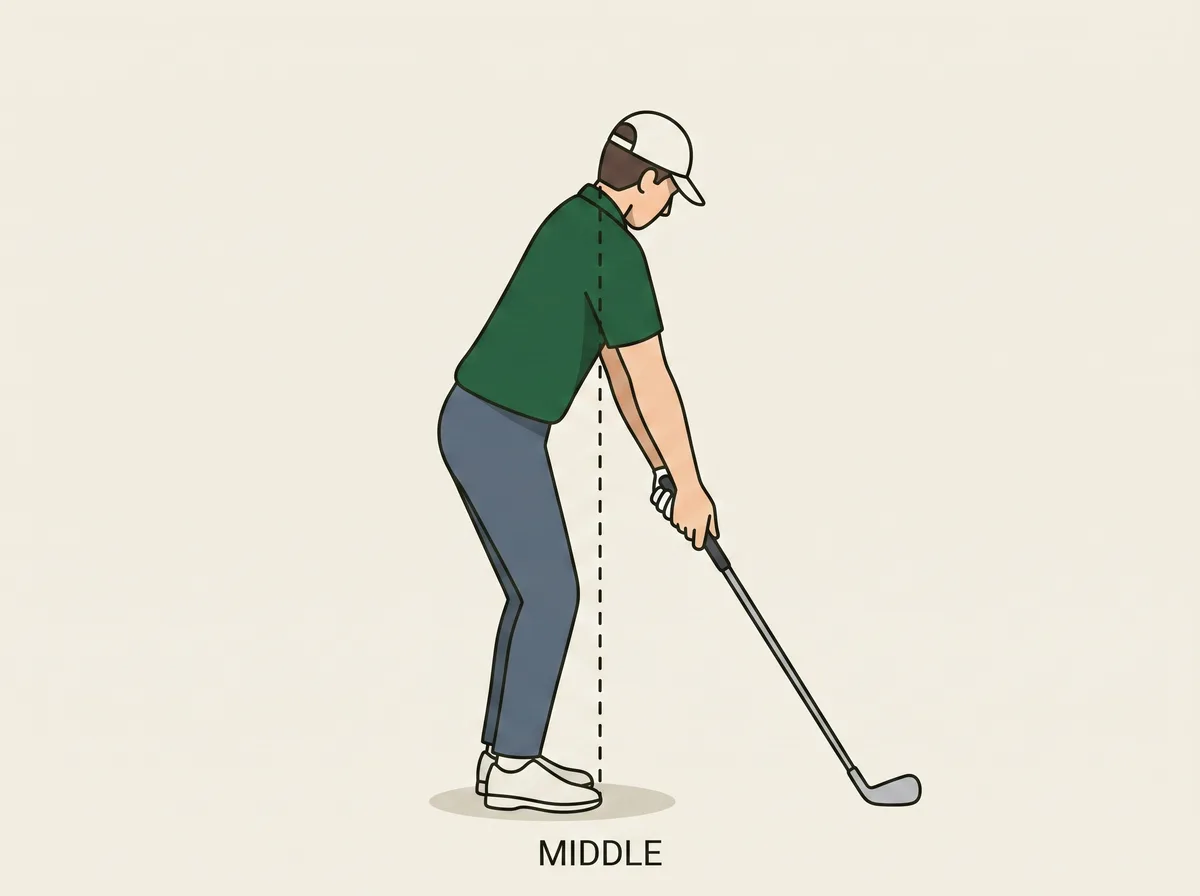
The split between the feet is the part that changes, and it changes because the low point of the swing needs to move.
| Shot | Lead foot | Trail foot | Why |
|---|---|---|---|
| Driver from a tee | 45% | 55% | Slight tilt away lets the club arrive travelling upward |
| Fairway wood or hybrid | 50% | 50% | Neutral, because the ball is on the ground |
| Mid iron | 50% | 50% | Low point just past the ball with no help needed |
| Short iron and full wedge | 55% | 45% | Moves the low point forward for a ball-first strike |
| Uphill or downhill lie | Follows the slope | Follows the slope | Match the shoulders to the ground, not to level |
That last row is a summary of a much longer subject, and the full version is in hitting from uneven lies.
Ground contact, and the one rule worth knowing
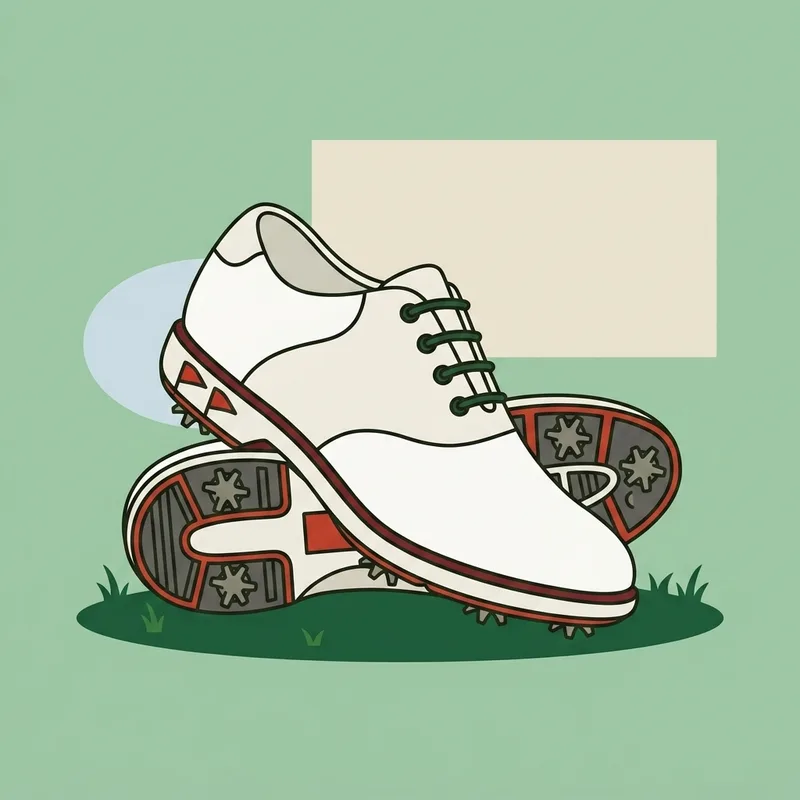
A stance only works if the feet stay where you put them. Worn spikes, wet turf and a stance built on a slope all move the base mid-swing, and no amount of technique survives that.
Faults that trace back to the stance
Before rebuilding a swing, it is worth ruling out the setup, because the setup takes ten seconds to change and a swing takes a season. Each of these has other causes too, so treat the table as a place to look first rather than a diagnosis.
| What you notice | Stance cause to check first | Quick test |
|---|---|---|
| Weight rolls to the outside of the trail foot going back | Stance too wide, or trail foot flared too far | Turn back slowly and see if the trail knee straightens |
| Hips slide towards the target instead of turning | Stance too wide for your hip range | Narrow by two inches and repeat the same swing |
| Ball struck off the toe with mid irons | Standing too far from the ball, or weight on the heels | Check whether you can lift your toes at address |
| Ball struck off the heel or shanked | Weight on the toes, drifting closer through the swing | Same test, and look at where your balance ends up |
| Lead hip blocks and the arms have to save the shot | Lead foot too square | Add 10 degrees of flare and hit five balls |
| Loss of balance forwards in the finish | Narrow stance plus a full-speed driver swing | Hold the finish and see which direction you fall |
Sliding rather than turning is the most common of these and has enough going on to deserve its own page, which is how to stop swaying. How far from the ball you should stand is a related setup question and is covered in distance from the golf ball.
Two ways to find your own width
Both of these are self-administered and neither needs a coach, a mirror or an aid.
How the stance changes when the club changes
The stance narrows as the club shortens, and that is nearly the whole story. The one setup that genuinely differs is the driver, and only because the ball is teed and has to be struck on the way up rather than on the way down. That means a fraction more weight on the trail foot at address and a stance at the wide end of your range, which is covered properly in how to hit a driver.
Everything after the stance is one motion regardless of club. Once you are set, the width you chose decides how much turn is available, and what you do with it is the subject of the golf backswing.
Key takeaways
- Heel to heel at or just inside shoulder width covers most full swings, driver included.
- Width buys stability and costs rotation, and most amateurs have already overpaid.
- Narrow the stance as the club gets shorter, down to almost together for partial shots.
- The lead foot flares out 20 to 30 degrees, the trail foot stays close to square.
- Matching both feet to the same angle pre-opens the trail hip and shortens the backswing.
- Weight sits over the middle of each foot, never the toes or the heels.
- The split between the feet moves forward as the club gets shorter, from 45/55 with a driver to 55/45 with a wedge.
- If your hips have limited rotation, more lead foot flare is an accommodation, not a fault.
- You may dig your feet in when taking a stance; you may not build one.
Common questions
How wide should my golf stance be?
Roughly shoulder width, measured from the outside of one heel to the outside of the other, for full swings with the longer clubs. Narrow it as the club shortens, to about two thirds of shoulder width for short irons and closer still for partial shots.
Should my stance be wider for a driver?
Wider than a wedge stance, yes. Wider than shoulder width is contested, and biomechanics research argues against it because the extra width demands a bigger weight shift to work and otherwise costs you rotation. Start at shoulder width and only widen if your strike genuinely improves.
How much should I flare my feet in a golf stance?
Turn the lead foot out about 20 to 30 degrees and leave the trail foot square or barely open. The lead foot is flared to let the lead hip clear; the trail foot stays square so the trail hip has something to turn against.
Why does my weight roll to the outside of my back foot?
Usually a stance that is too wide for your hip mobility, or a trail foot flared too far open. Both remove the resistance the trail hip needs, so the body slides sideways to find the turn instead of rotating around a stable centre.
Should my weight be on my toes or heels at address?
Neither. It sits over the middle of the foot with the ankles unlocked. A useful check is whether you can lift your toes inside your shoes without falling forwards. If you cannot, you are leaning towards the ball.
Does stance width change for chipping?
Yes, and substantially. Greenside shots need no weight transfer and very little turn, so the feet come close together and the weight favours the lead side. That narrow base is what keeps the low point in one place for a short shot.
How do I know if my stance is too narrow?
Balance in the finish is the giveaway. If you cannot hold a full-speed finish for three seconds without stepping to steady yourself, the base is too small for the speed you are swinging at. Genuinely too-narrow stances are rare in amateur golf.
Does a golf stance change for left-handed players?
Only in mirror image. The lead foot is still the one nearest the target and still takes the larger flare, which for a left-hander is the right foot. Widths, weight splits and the tests are all identical.
Should I change my stance if I have limited hip mobility?
Yes, and it is a sensible adjustment rather than a compromise. More lead foot flare and a slightly narrower base give restricted hips a way to rotate without the lower back compensating. A mobility screen tells you which one you need.
How long does a stance change take to feel normal?
About two weeks of regular practice for width and closer to a month for foot angles, because feet are more habitual than most golfers realise. A change that still feels alien after six weeks is usually too big, so halve it and rebuild from there.
On this page
- What the stance is actually for
- Stance width, and the number most golfers get wrong
- Foot flare, and why the two feet are not symmetrical
- Where the weight sits at address
- Ground contact, and the one rule worth knowing
- Faults that trace back to the stance
- Two ways to find your own width
- How the stance changes when the club changes
Tom Ashworth
Tom Ashworth is a PGA Professional who has taught golf since 2012, working mainly with beginners and mid-handicappers at club level in Surrey. He reviews the instruction guides on Learn Golf for technical accuracy before they publish.
Most of his teaching is with players in their first three years of the game, and most arrive having been told too much: six swing thoughts collected from videos, half of them contradicting each other. His approach is to check the grip and the alignment before touching the swing, on the basis that most bad ball flight is decided at address.