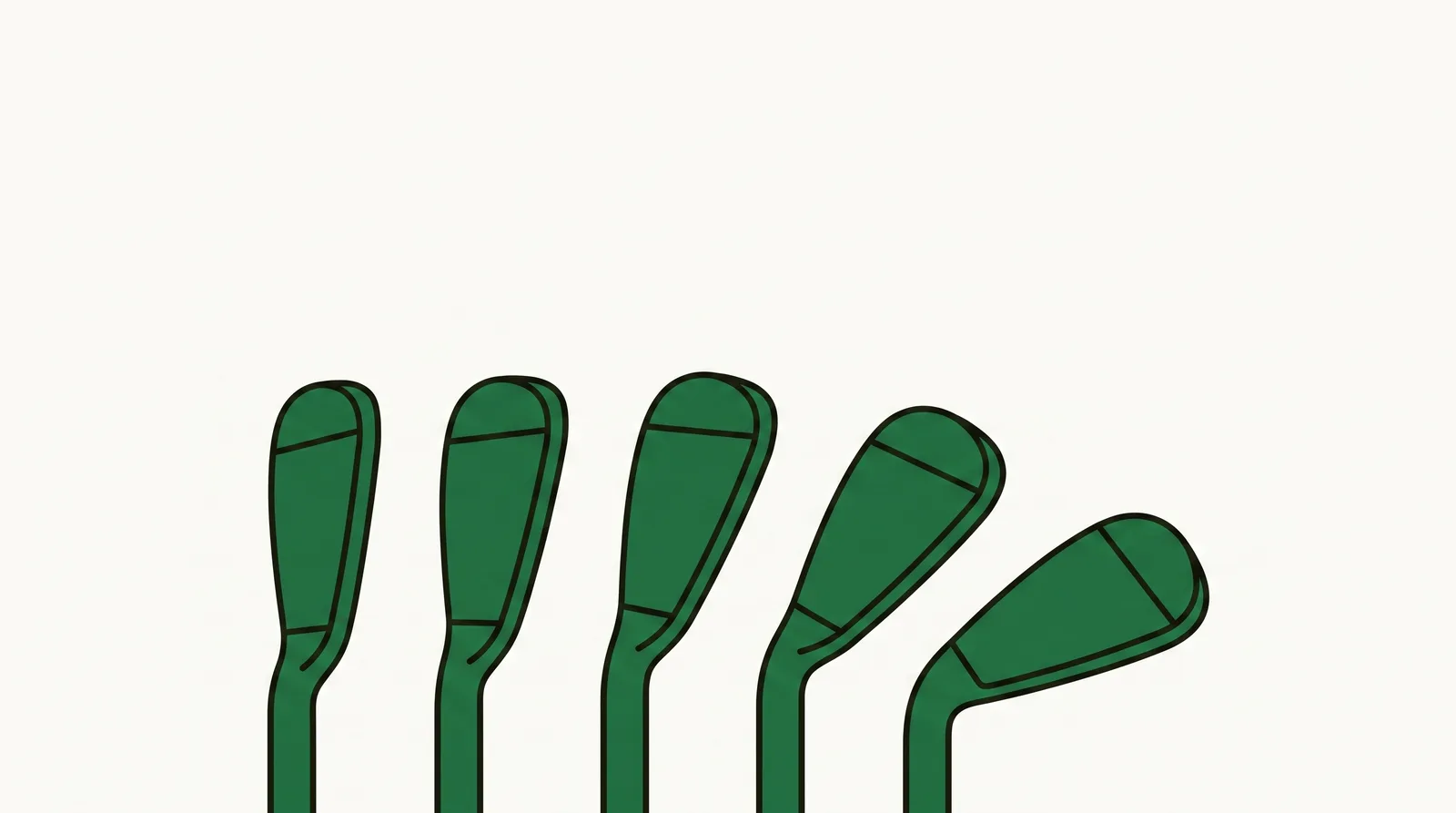
A 7 iron is not a loft. It is a label, and the loft behind it has been drifting stronger for thirty years. One manufacturer currently sells a 7 iron at 28 degrees and another 7 iron, in the same catalogue, at 35. That gap is larger than the gap between two neighbouring clubs, which makes almost every distance comparison you have ever read meaningless.
Loft is the only number that separates one iron from the next
Every iron in a set is built from the same idea: one head shape, gradually more loft and gradually less length as the numbers go up. Length changes clubhead speed a little. Loft changes launch, spin and carry a lot. Two 7 irons four degrees apart will not travel the same distance no matter how similar the badges look, and two clubs from different sets that share a loft will travel about the same distance whatever is stamped on them.
Nothing in the equipment rules governs it either. The Rules of Equipment constrain club length, groove volume, face roughness and head dimensions, and set no limit at all on how much loft a manufacturer may put on a club it chooses to call a 7 iron.
The chart, from one manufacturer's published tables
The clearest way to see the drift is to stay inside a single brand, because then nothing else changes. Ping publish a full loft, lie, length and offset table for every set they sell, and they also publish a weaker Retro Spec build as a fitting option.
| Club | G740 super game improvement | G440 game improvement | i230 players | i230 Retro Spec |
|---|---|---|---|---|
| 4 iron | not offered | 19° | 22.5° | 24.5° |
| 5 iron | 21° | 22° | 26° | 28° |
| 6 iron | 24.5° | 25.5° | 29.5° | 31.5° |
| 7 iron | 28° | 29° | 33° | 35° |
| 8 iron | 32° | 33° | 37° | 39° |
| 9 iron | 36° | 37° | 41° | 43° |
| Pitching wedge | 40° | 42° | 45° | 47° |
Read the top and bottom of the 7 iron row together. The super game improvement 7 iron is 28 degrees. The same manufacturer's Retro Spec 5 iron is also 28 degrees. Two clubs, identical loft, two numbers apart on the sole, both on sale today.
The Retro Spec column is the useful one, because it is a maker describing its own weaker build as the classic loft structure rather than a magazine estimating what irons used to be. Ping offer it to golfers who want height and stopping power rather than a distance number.
Across the industry, the spread is wider still
The same picture holds once you leave one brand. These are the figures each manufacturer publishes on its own specification pages.
| Set | 7 iron | Pitching wedge |
|---|---|---|
| Ping G740 | 28° | 40° |
| Ping i540 Power Spec | 27.5° | 41° |
| Ping G440 | 29° | 42° |
| Mizuno Pro 243 | 32° | 44° |
| Ping i230 | 33° | 45° |
| Ping Blueprint S | 33° | 45° |
| Ping i230 Retro Spec | 35° | 47° |
Seven and a half degrees separate the strongest 7 iron here from the weakest. In a set where neighbouring clubs sit three and a half to four degrees apart, that is very nearly two clubs of difference hiding behind one number.
The pitching wedge column matters even more, and it is covered properly in wedge lofts and gapping. Callaway's own wedge buying guide puts current pitching wedges anywhere from 42 to 48 degrees against a figure once standardised around 46, which is a manufacturer stating the drift in its own words.
Why lofts got stronger, and who it was for
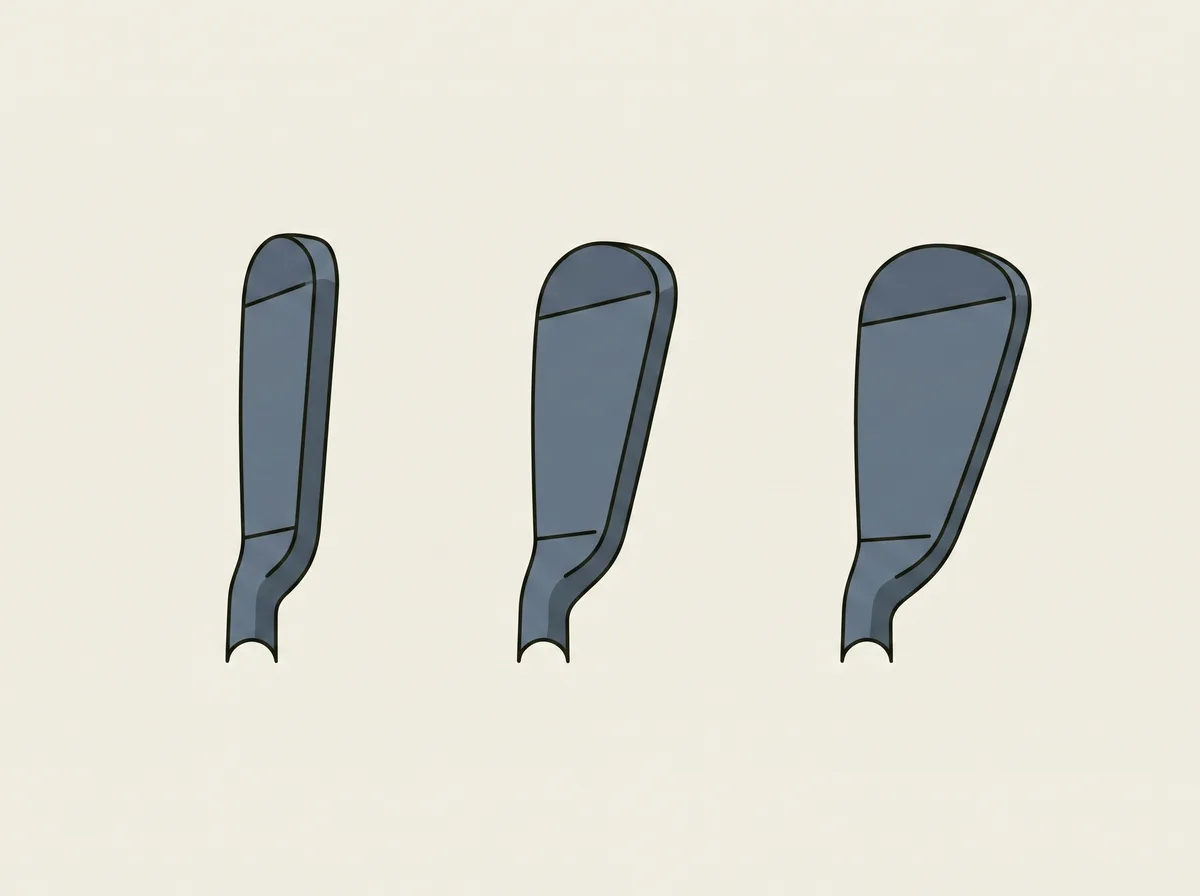
The mechanism is not complicated. Golfers compare clubs by hitting a 7 iron on a launch monitor in a shop and reading the carry number, so a manufacturer that takes two degrees off its 7 iron wins that comparison against an identical club with the old loft. Everyone else follows, and thirty years later the whole category has moved.
It works because the buyer is comparing the wrong two things. The 7 iron that went four yards further was not more efficient. It was less lofted, which is the same trick as swapping to the 6 iron and being pleased with the result.
Strong lofts do not simply mean more distance
A club with less loft does send the ball out lower and faster, and that is where the honest part of the argument ends. Two things move the other way at the same time.
The first is height. Loft is most of what produces launch angle, and launch angle is most of what produces a steep descent into the green. A shot that arrives flat runs on, which is the difference between stopping near the flag and finishing over the back.
The second is spin. TrackMan define spin loft as the angle between the direction the club head is travelling and where the face is pointing at impact, and they are explicit that a higher spin loft produces a higher spin rate. Take loft off the club and you take spin off the shot, losing height and stopping power together.
That trade lands badly for most club golfers, because the miss it worsens is the one they already have. Shot Scope's iron play data, drawn from a database of over 160 million tracked shots, shows 55.5% of a 15 handicapper's approach shots finishing short of the green, rising to 62.5% at 20 and 69.7% at 25. Greens in regulation over the same range fall from 23% to 16% to 9%.
Read those two facts together and the marketing inverts. If your approach shots are already finishing short, the club that helps is the one that launches highest and carries furthest from an ordinary strike, which points at more loft rather than less.
What the numbers on the sole are actually stamped for
Iron numbering was never a specification. It grew out of the names clubs carried before numbers existed, and it survives because a set has to be sorted somehow. The number tells you the club's position in that set and nothing about the club itself.
Even the published loft is only a starting point. TrackMan's dynamic loft is the loft actually presented to the ball at impact, and your shaft lean, attack angle and strike location all change it. A golfer who leans the shaft hard forward delivers several degrees less than the club was built with, and one who scoops delivers more.
What strong lofts do to the rest of your bag
The drift has an obvious consequence at the top of the set and a nastier one at the bottom.
At the top, a modern 4 iron of 19 degrees is the loft a 3 iron used to carry, which is why long irons have quietly become unusable for a large share of golfers and why hybrids sell. What each club family is for covers the swap.
At the bottom, the hole is worse. Sand wedge lofts have barely moved in fifty years and sit around 54 to 56 degrees, while pitching wedges have moved a long way. A 42 degree pitching wedge above a 56 degree sand wedge leaves fourteen degrees of nothing, in the part of the bag where every other gap is four.
How to find out what you are actually playing
Three routes, in order of effort.
Look it up. Every current set has a published specification table on the manufacturer's own site, and that is free and takes a minute.
Have it measured. A loft and lie machine reads every club in a set in a few minutes, and most shops will run one for a small fee or as part of a purchase. It is the only way to see what your clubs are today rather than what they left the factory as, which matters on anything bought second hand. Ping note on their own specification pages that design specifications may vary because of manufacturing tolerance.
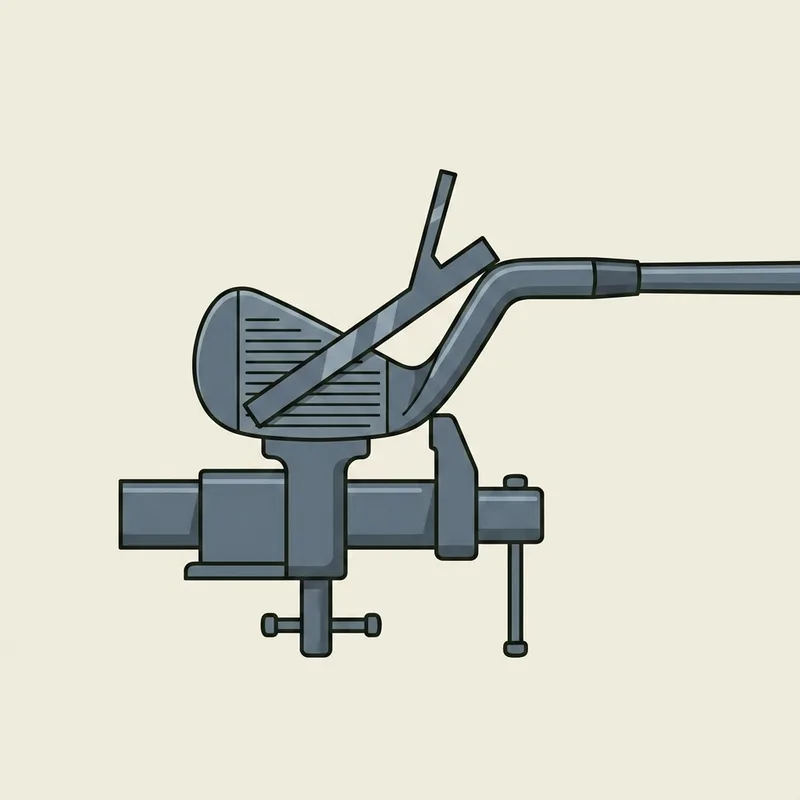
Have them adjusted. Forged and cast carbon steel heads can be bent a degree or two either way by anyone with the right machine, which is how a gap gets closed without buying a club. What a fitting measures sets out where loft sits among everything else on the list.
Choosing a set once you can read the numbers
Loft is the first thing to check and the last thing to be sold on. A weaker set is not a shorter set in any way that matters, because the club you reach for is chosen by the distance you need rather than the number on it. What a weaker set gives you is height, stopping power and gaps that still work at the bottom of the bag.
Shaft weight is the specification that changes more, and which flex you need covers how to work it out without a launch monitor. Where your own distances fall is set out in the club distance chart. If you want models rather than principles, forgiving iron picks compares four sets on published lofts rather than on distance claims, and striking your irons better is free and will do more than two degrees ever could.
Key takeaways
- Iron lofts run roughly three and a half to four degrees apart through a set, and the number on the sole is a manufacturer convention rather than a standard.
- A modern game improvement 7 iron is 28 to 30 degrees. Ping's own Retro Spec build puts a 5 iron at 28 degrees, so the two clubs are the same loft two numbers apart.
- Across published specification tables the spread on a current 7 iron runs from 27.5 to 35 degrees, which is close to two clubs of difference.
- Nothing in the equipment rules limits iron loft, which is why it has been free to drift for thirty years.
- Less loft means a lower launch and less spin as well as more speed, and TrackMan's spin loft work explains why the three move together.
- Two thirds of a 25 handicapper's approach shots already finish short of the green, so strong lofts make the dominant amateur miss worse rather than better.
- Pitching wedges have moved with the set and sand wedges have not, which is where the fourteen degree hole at the bottom of most bags came from.
- Check the published loft before comparing any two clubs. Most distance arguments dissolve at that point.
Common questions
What are standard golf iron lofts?
There is no standard. Current game improvement sets run a 7 iron around 28 to 30 degrees and a pitching wedge around 40 to 43, while players sets run a 7 iron at 33 and a pitching wedge at 45. The classic structure, which some manufacturers still offer as a fitting option, puts a 7 iron around 35 degrees.
What loft is a 7 iron?
Between 27.5 and 35 degrees depending on which set it came from. That range is taken from figures manufacturers publish on their own specification pages, and it is wide enough that the question has no single answer. Look your own set up rather than assuming.
How many degrees between each iron?
Roughly three and a half to four through most of the set, widening slightly toward the short irons. Ping's G440 runs 19, 22, 25.5, 29, 33, 37 and 42 degrees from the 4 iron to the pitching wedge, which is a fair picture of how a modern set is spaced.
Are modern irons really longer than old ones?
Longer for the same number on the sole, and not longer for the same loft. A modern 7 iron at 29 degrees is close to what an older 5 iron carried, so a golfer comparing sevens is comparing two different clubs. Head design has genuinely improved launch and forgiveness, but the distance headline is mostly loft.
What is loft jacking in golf?
The industry term for manufacturers strengthening iron lofts so their clubs win distance comparisons in a shop. It works because buyers compare 7 irons rather than lofts, and it has moved the whole category by around five degrees over three decades.
Should I play weaker lofted irons?
Most club golfers would be better served by them. Weaker lofts launch higher, spin more and stop faster, and tracked amateur data shows the dominant approach miss is short of the green rather than long. You give up a number on a launch monitor and get back the height that makes an approach shot hold.
Do stronger lofts mean I hit the ball further?
Only in the sense that a 6 iron goes further than a 7. The ball leaves lower and faster with less spin, which adds roll on firm ground and costs carry and stopping power on soft ground. Nothing about your swing has changed, so the total gain is far smaller than the shop demonstration suggests.
What is the loft of a pitching wedge?
Anywhere from 40 to 47 degrees on current sets. Callaway note in their own wedge guide that pitching wedges now run 42 to 48 against a figure once standardised around 46. This is the single most consequential loft in the bag, because everything below it has to gap off it.
Can iron lofts be adjusted?
Yes, on most forged and cast carbon steel heads. A club builder can bend a head a degree or two stronger or weaker on a loft and lie machine, which is a common fix for a gap that is too wide or too narrow. Cast stainless heads and hollow bodied irons are more limited, so ask before assuming.
How do I find out what loft my irons are?
Look the set up on the manufacturer's specification page, which takes about a minute, or have every club read on a loft and lie machine at a shop. The second is worth doing on used clubs, since a set that has been bent or bounced around a boot for ten years may not match what it left the factory as.
On this page
- Loft is the only number that separates one iron from the next
- The chart, from one manufacturer's published tables
- Across the industry, the spread is wider still
- Why lofts got stronger, and who it was for
- Strong lofts do not simply mean more distance
- What the numbers on the sole are actually stamped for
- What strong lofts do to the rest of your bag
- How to find out what you are actually playing
- Choosing a set once you can read the numbers

Tom Ashworth
Tom Ashworth is a PGA Professional who has taught golf since 2012, working mainly with beginners and mid-handicappers at club level in Surrey. He reviews the instruction guides on Learn Golf for technical accuracy before they publish.
Most of his teaching is with players in their first three years of the game, and most arrive having been told too much: six swing thoughts collected from videos, half of them contradicting each other. His approach is to check the grip and the alignment before touching the swing, on the basis that most bad ball flight is decided at address.