
You have seen the photograph: hands at hip height, club shaft still pointing back over the trail shoulder, an angle sharp enough to look impossible. Every golfer wants that position and most who try to copy it make their ball striking worse. This guide covers what lag actually does to a golf shot, why it cannot be held on purpose, and what to work on instead.
Left and right assume a right-handed golfer.
What lag actually is
At the top of the backswing the wrists are hinged, so the shaft sits at roughly a right angle to the lead forearm. If you start down with the arms, that angle disappears almost immediately. If you start down with the lower body, the hands get dragged around while the club head, which has weight and inertia, stays behind. The angle survives, and that survival is what everyone calls lag.
So lag is not an action. It is evidence that the swing was sequenced correctly. TPI's summary of the kinematic sequence describes the order as lower body, then torso, then arms, then club, with each segment slowing as the next accelerates. A retained wrist angle is what that order looks like from the outside.
Why it matters to the strike
The mechanism is not the mystical energy storage it is usually described as. It is much simpler, and it is measurable.
An angle that survives into the downswing means the hands arrive ahead of the club head, which leans the shaft forward and reduces the loft the ball actually sees. TrackMan calls that number dynamic loft, the vertical face orientation at the moment of maximum compression, and reports a PGA Tour average of 20.2 degrees with a 6 iron. That is well under the loft stamped on most modern 6 irons, which you can check against our golf iron loft chart.
Less delivered loft narrows the gap between the direction the club head is travelling and the way the face is pointing. TrackMan calls that gap spin loft and states plainly that a higher spin loft will create a lower smash factor with all else equal. Smash factor is ball speed divided by club speed, so a club arriving with too much loft is converting less of its speed into the ball.
That is the whole argument for lag, and notice what it is not. It is not that lag makes the club head move faster. It is that lag makes the club deliver what speed it has.
| What lag changes | The measurement | The direction it moves | What you notice |
|---|---|---|---|
| Loft at the moment of contact | Dynamic loft | Down | Lower, more penetrating flight |
| Gap between path and face | Spin loft | Down | Firmer, more solid feel |
| Speed converted into the ball | Smash factor | Up | More ball for the same effort |
| Where the club bottoms out | Low point | Forward of the ball | A divot that starts after the ball |
Casting, and what causes it
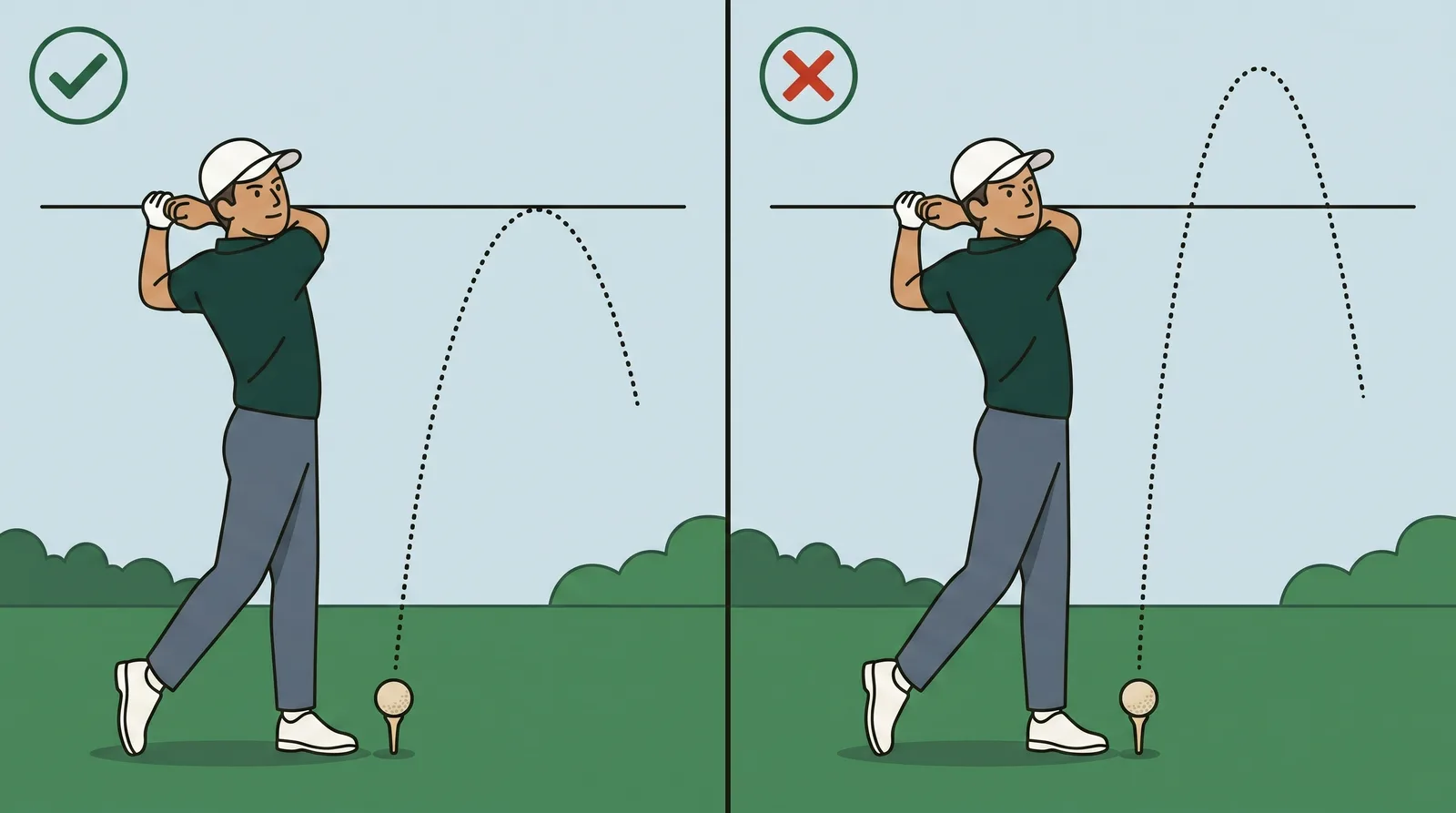
Losing the angle early has a name. TPI defines casting as an early release of the golf club during the downswing, and describes the result as a weak impact position with a cupped lead wrist that adds loft to the face.
The important part of that page is the causes it lists, because almost none of them are about the wrists. Lack of contribution from the lower body in the downswing is named as one of the leading causes. Limited hip mobility, restricted ankles, an inability to separate lower body from upper body, and weakness through the glutes and abdominals all appear before anything about the hands. The one wrist-specific item is trail wrist extension, which TPI notes is difficult to maintain a good set without.
Read that list again and it is a description of a lower body that is not doing its job, so the arms step in. The relevant work is in hip rotation in the golf swing, not in your forearms.
Can lag be trained directly? This one is genuinely contested
Two respectable positions exist and coaches you trust will give you opposite answers.
The sequence camp says lag is entirely downstream. Fix the order, fix the mobility, and the angle appears on its own, because it is a physical consequence of the hands being pulled by a body that started first. Working on it directly is treating a symptom.
The position camp says wrist conditions are trainable in their own right. The lead wrist can be taught to flex rather than cup, the trail wrist can be taught to hold extension, and golfers who drill those positions do change what shows up on video. There is a reasonable point buried in there, which is that a golfer with a perfect sequence and a chronically cupped lead wrist will still add loft.
Our view is that both are half right and the order matters. Sequence and mobility first, because they account for most of what goes wrong and because wrist drills layered onto a bad sequence just add tension. Wrist condition second, once the body is contributing, and specifically the trail wrist rather than the lead. And never lag itself as a target, because the only way to consciously produce more of it is to hold, and holding is what causes the block.
Too much of a good thing
The angle has to go somewhere. A golfer who holds it past the point where the body has stopped rotating ends up delivering the face open, because the release that squares it never happens.
The signature of that pattern is a shot that starts right and stays right, often with a deep divot and a heavy feel. It is the block, and it is what happens when lag becomes an intention. There is also a stalling version, where the pelvis stops turning halfway down and the arms have to fire past a body that has quit, which produces the same open face with worse contact.
| Pattern | Divot | Ball flight | What is really happening |
|---|---|---|---|
| Casting | Behind the ball, or none at all | High, weak, short of expectation | Angle released in the first third of the downswing |
| Correct release | Starts just after the ball, shallow | Lower, penetrating, consistent height | Angle unwinds through the strike, not before it |
| Holding the angle | Deep, starting well after the ball | Starts right and stays right | Release delayed past the point the face can square |
| Body stall | Variable, often deep | Right, or a sudden hook when the hands rescue it | Pelvis stopped rotating and the arms took over |
Contact quality tells you which row you are in faster than video does. If the strikes are inconsistent in both directions, the wider diagnostic in inconsistent ball striking is the better place to start.

Three drills that work on the cause
None of these ask you to hold an angle. They all make the wrong order harder to produce.
How long before anything changes
Longer than a range session and shorter than you fear. The sequence work usually shows up on video in four to six weeks, and the strike change tends to arrive before the flight change, which is worth knowing because it is easy to miss.
The pattern is predictable. Contact firms up first and the sound changes. Then the flight comes down. Then, and only then, does the club start reaching the ball with more of its speed intact. Golfers who judge the whole project by ball flight in week two conclude it is not working, when what has actually happened is that the first change landed and they were looking at the wrong thing.
Practise at three-quarter speed while it beds in. Full speed reinstates the old order faster than anything else, because the throw from the top is what your body reaches for when it wants to hit something hard. What the club is supposed to look like when it finally arrives is in golf impact position, and the same delivery applied across the set is in how to hit irons.
Key takeaways
- Lag is the wrist angle still present partway down, and it is a result of sequence rather than an action.
- It works by reducing delivered loft, not by making the club head travel faster.
- TrackMan puts PGA Tour dynamic loft with a 6 iron at 20.2 degrees, under the club's stamped loft.
- Higher spin loft lowers smash factor, so a lofted delivery wastes speed you already have.
- TPI lists lower body contribution and hip mobility as leading causes of casting, ahead of anything about wrists.
- Squeezing the grip to hold the angle slows the hands and delays the release.
- Whether lag can be trained directly is genuinely disputed. Sequence first, trail wrist second, lag never as a target.
- Holding the angle too long produces a block, which is a different fault with the same name.
- Expect strike quality to change before ball flight does, over four to six weeks.
Common questions
What is lag in a golf swing?
The angle between the lead forearm and the club shaft that is still present partway into the downswing. At the top that angle is close to a right angle. If the body starts down first, the club head trails behind the hands and the angle survives into the strike. If the arms start down first, it disappears almost immediately.
How do I create more lag?
By changing the order rather than the hands. Lag appears when the lower body and torso begin unwinding before the arms do, so drills that make an early arm throw physically difficult, like the pump drill, produce more of it than any conscious holding. Working on hip mobility usually does more than working on wrists.
Is more lag always better?
No. Past a certain point the release is delayed so far that the face cannot square in time, which produces a shot that starts right and stays there. Plenty of amateurs already retain enough angle and lose it in the last few feet instead, and those golfers need to release rather than hold.
What is casting in golf?
Releasing the wrist angle at the start of the downswing instead of near the ball. TPI defines it as an early release during the downswing that leaves a cupped lead wrist and adds loft to the face. The club reaches its fastest point above the ball, so the strike gets what is left over.
Why does holding my lag make me hit it right?
Because holding is an active effort that outlasts the body's rotation. The face needs the release to square it, and if the release is delayed past the point where the pelvis has stopped turning, the club arrives open. It feels powerful and it produces a block.
Does lag actually add distance?
Indirectly, and not by increasing club speed. It lowers the loft the ball sees, which lowers spin loft, which raises the proportion of club speed that ends up in the ball. Whether that shows up as extra yards depends on your strike quality, your equipment and where you were starting from, so treat it as better use of the speed you have.
Can you have lag with a poor grip?
You can retain the angle, but you may not benefit from it. A grip too weak to square the face will deliver an open face regardless of how late the release is, and the resulting shot looks like a lag problem when it is a face problem. Sort the grip before drawing conclusions.
How do I know if I am casting?
Two checks. Film from behind at hip height on the way down and look at whether the shaft is still angled back or already pointing at the ball. Or listen to a swoosh made with the club held by the head: casting puts the loudest point well before where the ball would be.
Do I need lag with a driver?
Less of it, and for a different reason. Driver shots are struck at or above the low point rather than descending into the ball, so the shaft lean that matters with an iron is not the goal. The sequence that produces lag still matters, but chasing forward shaft lean with a driver adds a downward strike you do not want.
Should juniors and seniors work on lag?
Not as a first project. Both groups are usually better served by sequence and mobility work, which is where lag comes from anyway, and neither benefits from drills that add forearm tension. A senior golfer with a stiff trail hip will get more from twenty minutes of rotation work than from any wrist drill.
Why do I lose lag only with long clubs?
Because longer clubs feel harder to move, so the instinct to throw at them from the top is stronger. The fault is the same as with a short iron, just louder. Practise the pump drill with a mid iron until the order holds, then move up through the bag one club at a time rather than jumping to a driver.

Tom Ashworth
Tom Ashworth is a PGA Professional who has taught golf since 2012, working mainly with beginners and mid-handicappers at club level in Surrey. He reviews the instruction guides on Learn Golf for technical accuracy before they publish.
Most of his teaching is with players in their first three years of the game, and most arrive having been told too much: six swing thoughts collected from videos, half of them contradicting each other. His approach is to check the grip and the alignment before touching the swing, on the basis that most bad ball flight is decided at address.