Swing plane is the most argued-about phrase in golf instruction and the least precisely used. One coach means the angle of the shaft at address, another means the surface the club head travels on coming down, a third means the angle your shoulders turn on. All three are real, they move independently, and only one of them decides where the ball goes.
Left and right assume a right-handed golfer throughout. This page is one layer down from golf swing basics, and it pairs with the ball flight physics in ball flight laws.
Three things called swing plane
Getting these apart is most of the work.
The first is the shaft plane at address, the angle the shaft makes with the ground when the club is soled behind the ball. This is the one the old pane of glass image refers to, and it is set almost entirely by the club, not by you.
The second is the plane the club head actually travels on, which is what a launch monitor measures. TrackMan defines swing plane as the vertical angle between the plane created by the club head's geometric center movement and the horizon, and pairs it with swing direction, the angle between the base of that same plane and the target line. Note what that means in practice: swing plane is a steepness measurement, and the left-or-right part is a separate number.
The third is the shoulder plane, the angle your shoulders turn on relative to your spine. This one is a body measurement rather than a club measurement, and it is the one most often responsible for the other two going wrong.
Your plane is mostly decided before you swing
The single most useful thing to understand here is that there is no universal correct plane angle, because the club sets it.
A wedge is short, so you stand closer to the ball, the shaft stands up more steeply, and the swing that results is naturally more upright. A driver is much longer, you stand further away, the shaft lies down closer to horizontal, and the swing that results is naturally flatter. Nothing about that is a choice and none of it needs managing.
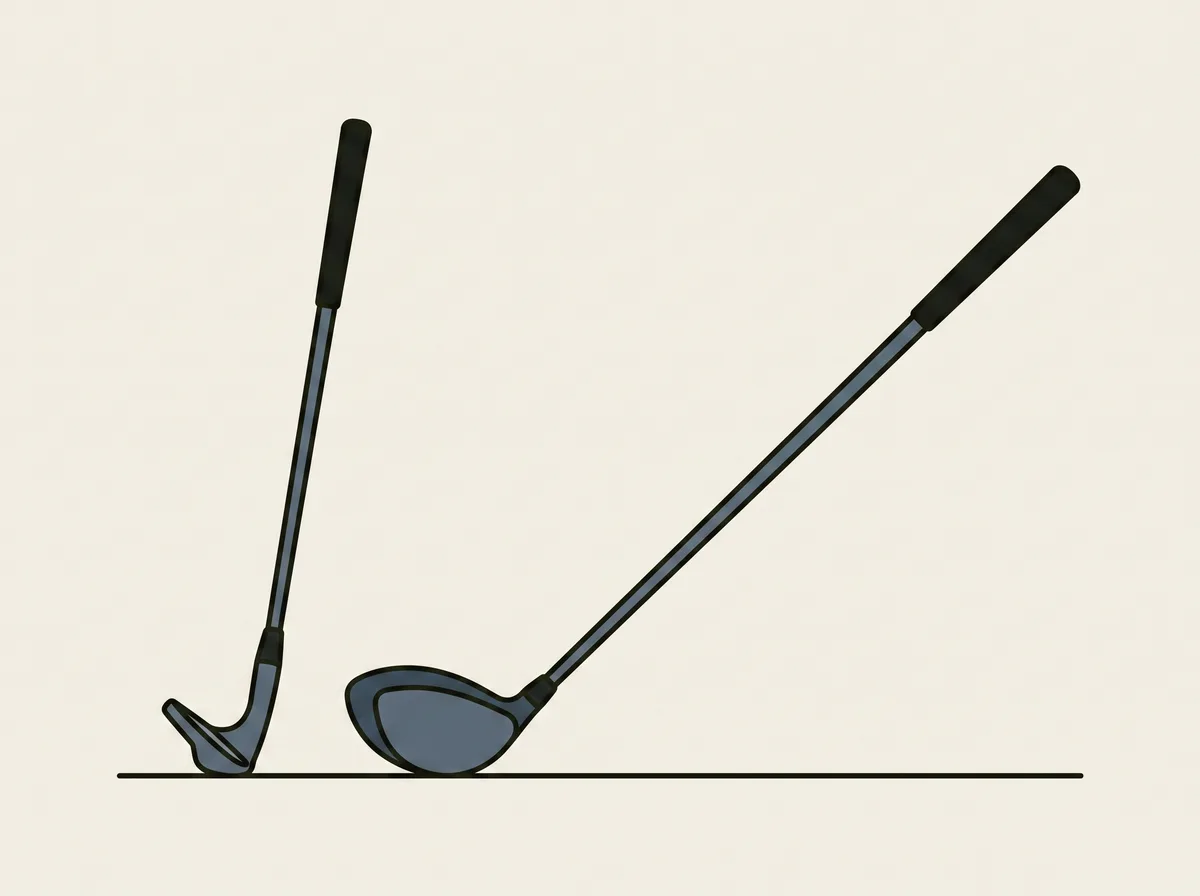
Your build matters too. A tall golfer with short arms stands closer to the ball and swings more upright. A shorter golfer with long arms stands further away and swings flatter. Both can play excellent golf, and trying to move one toward the other because a video looked different is how people ruin working swings.
| Club | Where you stand | Natural plane | What tends to go wrong |
|---|---|---|---|
| Wedges and short irons | Closest to the ball | Most upright | Getting too steep, digging, fat shots |
| Mid irons | Middle | Between the two | Usually the most reliable club in the bag |
| Long irons and hybrids | Further away | Flatter | Getting under it, thin strikes |
| Driver | Furthest from the ball | Flattest | Swinging too far around, hitting up and out |
What being off plane actually costs
A plane that is too steep on the way down forces a choice, and neither option is good. Either the club digs into the ground behind the ball, or the body has to make room by pulling the arms across the chest, which sends the club left across the ball.
That second option is what most golfers are describing when they say they are over the top. The Titleist Performance Institute calls it perhaps the most common swing fault among high handicap golfers and puts the cause in the transition, where the upper body dominates instead of the lower body starting the downswing. The result is the club approaching from outside the target line, and a pull or a slice depending on where the face is pointing.
The full set of fixes for that pattern is in how to stop coming over the top, because it is a sequencing problem rather than a plane problem in the strict sense.
The opposite fault gets far less attention and is more common among better players. A club that drops too far under the plane on the way down arrives from too far inside, which produces a push, a hook, or a hosel strike, and the last of those has its own guide in how to fix a shank.
Flat shoulder plane, the body version
The plane fault that is genuinely a plane fault rather than a path fault sits in the shoulders.
TPI defines a flat shoulder plane as the shoulders turning on a more horizontal plane than the axis of the original spine angle, and lists three physical causes: limited separation between the trunk and the pelvis, weak core stability, and restricted hip and shoulder range of motion. In other words, a golfer whose shoulders flatten out is usually a golfer whose body cannot rotate around a tilted spine, so it rotates around a level one instead.
This matters because it puts the club in a bad position at the top and then requires a compensation on the way down to rescue it. TPI's own note is that the result is inconsistent striking, lost power, and a reliance on hand or body compensations to square the face.
One-plane versus two-plane, and why this is contested
This is a genuine and unresolved disagreement between good coaches, so treat anyone who presents it as settled with caution.
The one-plane idea is that the arms should swing on roughly the same inclined plane the shoulders turn on, producing a flatter, more rotary swing that repeats well and needs less timing. The two-plane idea is that the arms swing on a steeper plane than the shoulders turn on, producing a more upright swing that generates speed through a longer arc and a more vertical arm drop.
| One-plane | Two-plane | |
|---|---|---|
| Arms relative to shoulders | Roughly matched | Steeper than the shoulders |
| Body type it tends to suit | Stronger, less flexible, shorter arms | Taller, more flexible, longer arms |
| Main claimed benefit | Fewer moving parts, repeats under pressure | More arc, more room to generate speed |
| Main risk | Getting too flat and stuck behind the body | Getting steep and coming across the ball |
| Ball flight it drifts toward | Draw | Fade |
How to actually see your own plane
You cannot feel plane. Every golfer who has ever filmed their swing for the first time discovers this, and it is why plane work without a camera is guesswork.
Film from down the line. That means standing directly behind the ball on an extension of the target line, with the phone at roughly hip to hand height, not chest or head height. This is not a detail. A camera above hand height looks down on the swing, which visually flattens the shaft and makes an on-plane backswing look laid off, and half the swing footage golfers bring to a coach cannot be read for that reason alone.
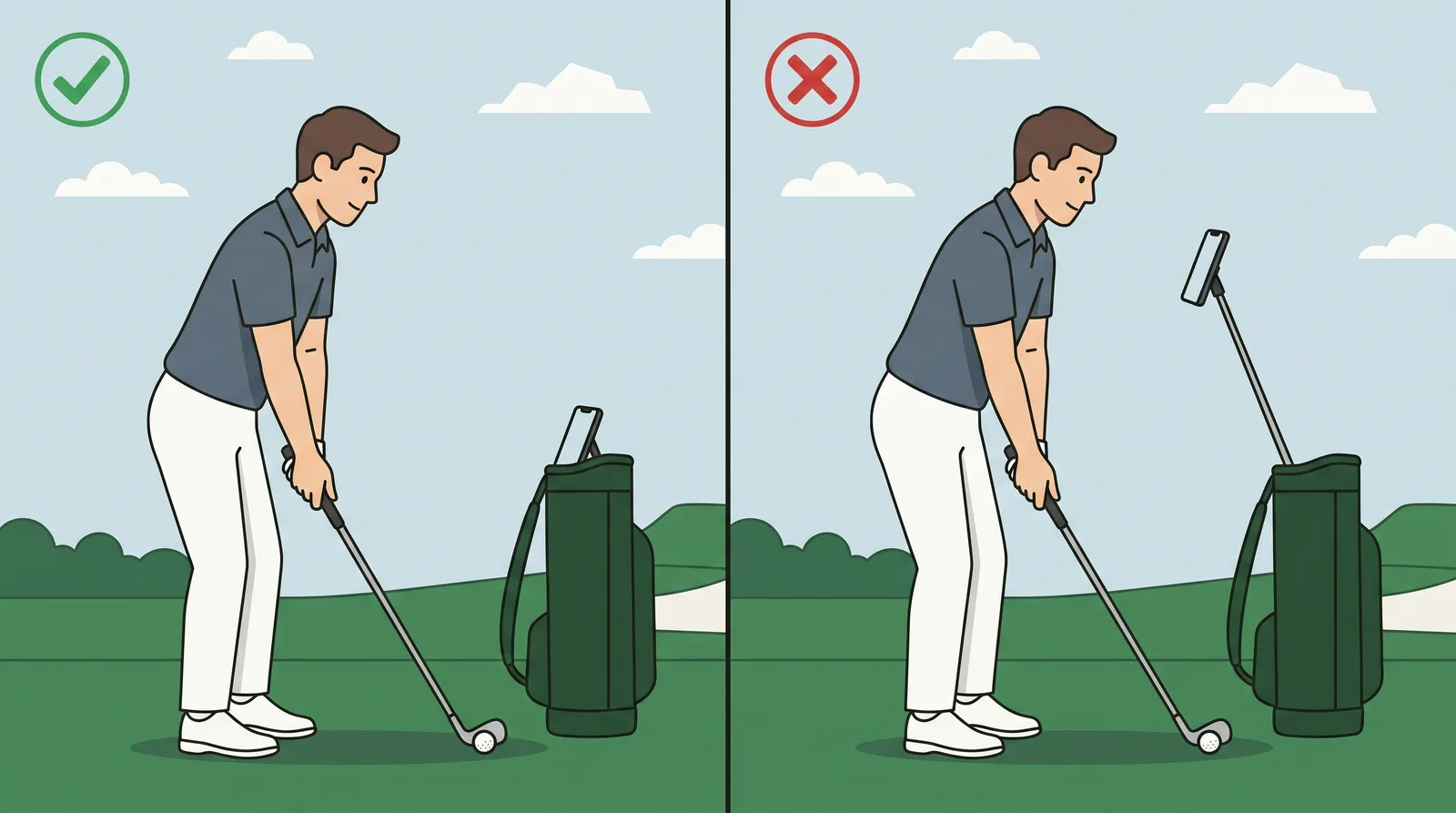
Once you have usable footage, check two frames only.
- Find the frame where the shaft is horizontal in the backswing. The butt end of the club should point roughly at the target line, somewhere between the ball and your toes.
- Find the frame where the shaft is horizontal again coming down. It should be pointing at a similar place, ideally a touch closer to your toes than it was on the way back.
- If the butt end points well outside the ball on the way down, you are steep and coming across it.
- If it points well inside your toe line on the way down, you are shallow and coming from underneath.
- Compare the same two frames again in four weeks. Do not compare consecutive swings on the same day.
Two drills that change plane without a lesson
Neither of these asks you to think about angles while swinging, which never works.
Plane, path, and the thing that actually curves the ball
It is worth ending on the distinction that causes most of the trouble, because plane gets blamed for a lot of curve it did not create.
Club path is a direction. TrackMan defines it as the direction the club head is moving at maximum compression, left or right relative to the target line, and it is one of the two numbers that decide the shape of a shot. Plane is a steepness. A very steep swing can still deliver a neutral path, and a beautifully on-plane swing can still deliver an out-to-in path if the body spins early.
So if your ball is curving, the fix is a face and path fix, not a plane fix. If your strike is inconsistent, fat one swing and thin the next, plane is a genuine suspect, and it is worth checking alongside how the club arrives in the golf downswing and what the last frame shows in the golf follow through.
Key takeaways
- Swing plane means three different things: the shaft angle at address, the surface the club head travels on, and the angle the shoulders turn on.
- Plane is a steepness measurement. Direction is a separate number with a separate name.
- There is no correct plane angle. Shaft length, your height and your arm length set yours before you move.
- Too steep forces the club either into the ground or across the ball. Too shallow produces pushes, hooks and shanks.
- A flat shoulder turn is usually a mobility or posture problem, not something to fix by lifting the arms.
- One-plane versus two-plane is genuinely contested. Do not mix drills from both.
- You cannot feel plane. Film from down the line at hip height or the footage is unreadable.
- Check two frames only, shaft horizontal going back and shaft horizontal coming down.
Common questions
What does swing plane actually mean?
It is the tilted surface the club travels around during the swing, described as an angle relative to the horizon. Confusingly the phrase is also used for the shaft angle at address and for the angle the shoulders turn on, which is why two golfers can disagree about plane while both being right.
Is there a correct swing plane angle?
No. The angle is set mainly by the length of the club and by how far you stand from the ball, which is a function of your height and arm length. What can be judged is whether the club returns on a similar plane to the one it left on, and whether the delivery is steep enough to force a compensation.
What is the difference between swing plane and swing path?
Plane is steepness, measured against the horizon. Path is direction, measured left or right against the target line. A steep swing can have a neutral path and an on-plane swing can have a bad one, which is why curing curve is a path and face job rather than a plane job.
Am I better off with a flat or an upright swing?
Whichever one your body produces naturally. Taller golfers with shorter arms tend to be upright, shorter golfers with longer arms tend to be flat, and both patterns have produced tour winners. Converting one into the other is a long project with a real chance of making things worse.
How do I know if I am too steep?
Two signs. On video, the butt end of the club points outside the ball when the shaft is horizontal on the way down. On the ground, your divots are deep and start behind the ball, and your misses are pulls and pull-slices rather than pushes.
What is a one-plane swing?
A pattern where the arms swing on roughly the same inclined plane the shoulders turn on, producing a flatter, more rotary motion with fewer moving parts. The two-plane alternative has the arms working on a steeper plane than the shoulders. Good coaches disagree about which to teach and both approaches produce good players.
Can I fix my swing plane without lessons?
Partly. The camera work and the two drills on this page are self-serviceable and will move a steep swing shallower. What you cannot self-diagnose reliably is whether the cause is technique or a physical restriction, and a flat shoulder turn caused by limited trunk rotation will not respond to drills at all.
Why does my swing look laid off on video when it feels on plane?
Very often because the camera was too high. A phone at chest or head height looks down on the swing and visually flattens the shaft, which makes an on-plane backswing appear laid off. Reshoot from hip to hand height, directly behind the ball on the target line, before changing anything.
Does swing plane change between clubs?
Yes, automatically. A wedge is short so the shaft stands up steeply and the swing is upright; a driver is long so the shaft lies down and the swing is flat. This happens on its own because of where the club makes you stand, and it is not something to manage consciously.
Do alignment sticks help with swing plane?
They help you see it, which is most of the battle. One on the ground along the target line gives the camera a reference, and one angled in the ground behind the ball creates a physical boundary a steep club will hit. They do not change anything on their own.
On this page
- Three things called swing plane
- Your plane is mostly decided before you swing
- What being off plane actually costs
- Flat shoulder plane, the body version
- One-plane versus two-plane, and why this is contested
- How to actually see your own plane
- Two drills that change plane without a lesson
- Plane, path, and the thing that actually curves the ball
Tom Ashworth
Tom Ashworth is a PGA Professional who has taught golf since 2012, working mainly with beginners and mid-handicappers at club level in Surrey. He reviews the instruction guides on Learn Golf for technical accuracy before they publish.
Most of his teaching is with players in their first three years of the game, and most arrive having been told too much: six swing thoughts collected from videos, half of them contradicting each other. His approach is to check the grip and the alignment before touching the swing, on the basis that most bad ball flight is decided at address.