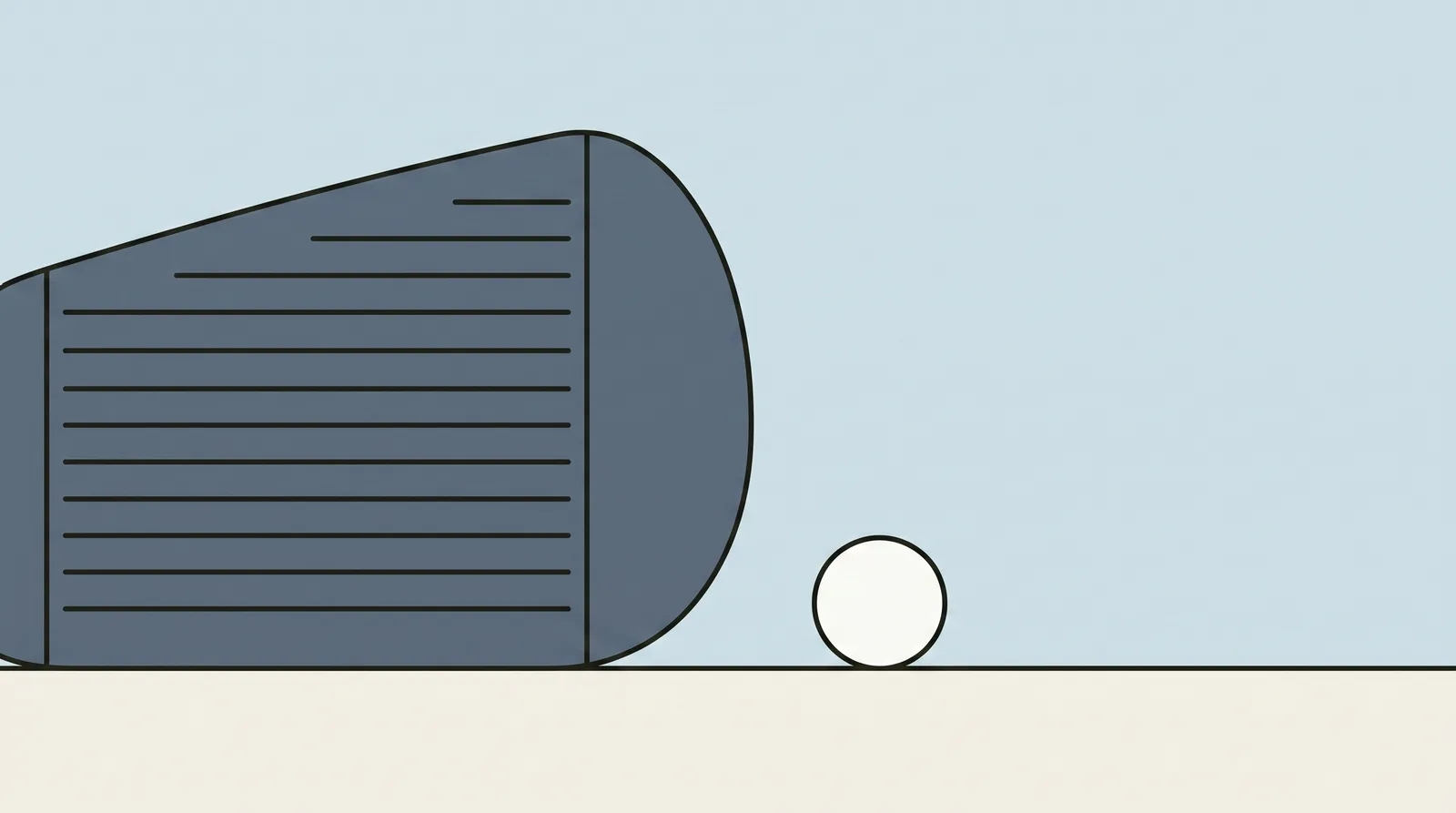
Iron shots are judged by one thing before anything else. Did the club reach the ball before it reached the ground? Get that right and distance, height and spin arrange themselves. Get it wrong and no amount of swing work shows up on the scorecard. This guide covers the strike, the setup that produces it, what to do about the fat and thin shots on the way, and how to practise it.
Left and right below assume a right-handed golfer. The lead side is the one nearest the target, so a left-handed golfer reads lead foot as the right foot and everything else is identical.
Ball first, then turf
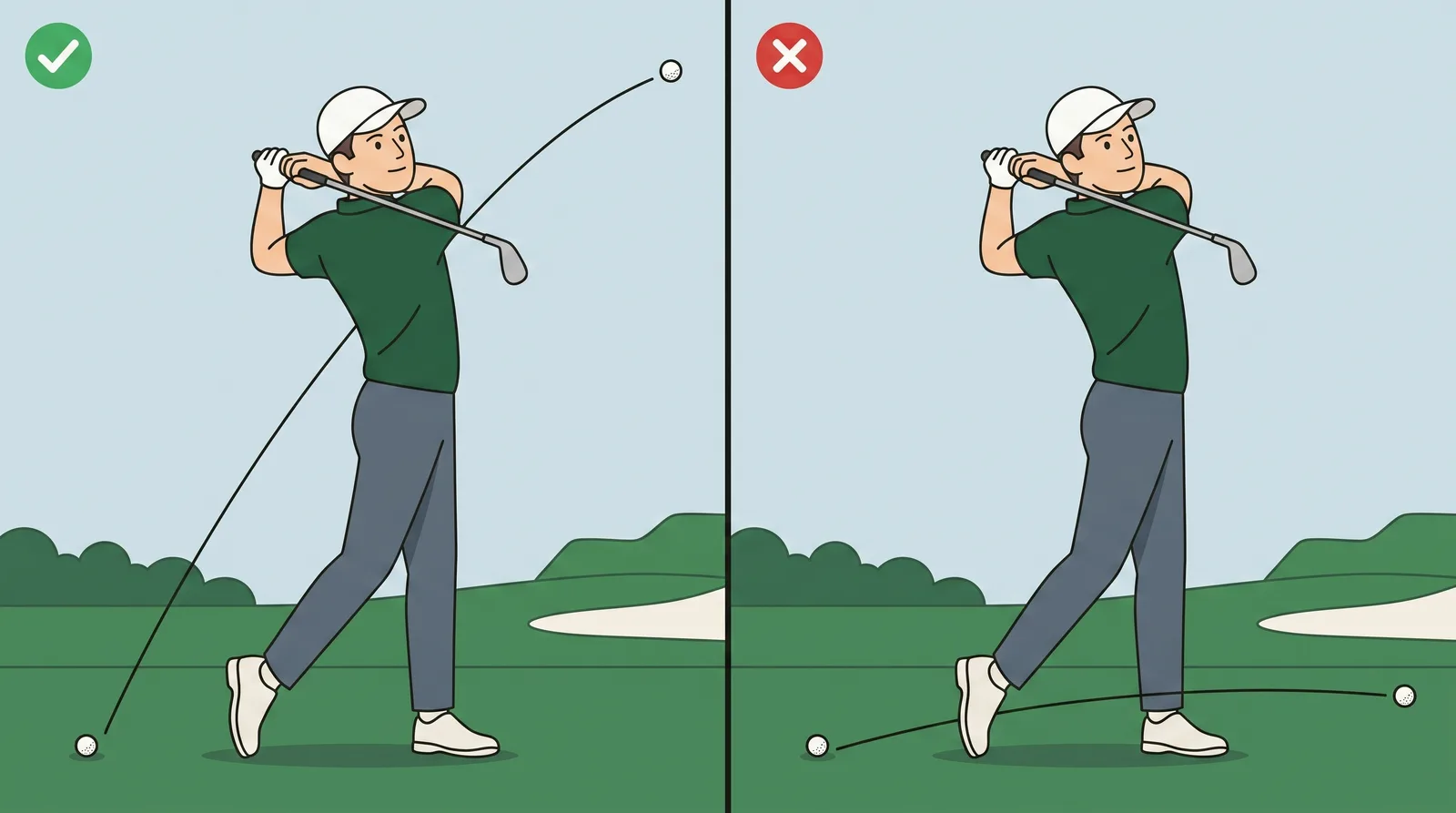
The lowest point of a golf swing sits a few inches in front of the hands, which means it moves when your body moves. A good iron shot happens when that low point arrives after the ball rather than before it.
TrackMan's attack angle data puts the PGA Tour average at minus 3.7 degrees with a 6 iron and the LPGA Tour average at minus 2.3 degrees. Those are clubs still descending when they meet the ball, which is why tour players take a divot on the target side of where the ball was sitting.
The divot is the evidence, not the goal. A shallow strip of turf that starts where the ball was and finishes a few inches nearer the target means the low point was in the right place. A crater behind the ball means it was not.
Hitting down is what sends the ball up
This is the sentence beginners refuse to believe, and it costs more shots than any swing fault.
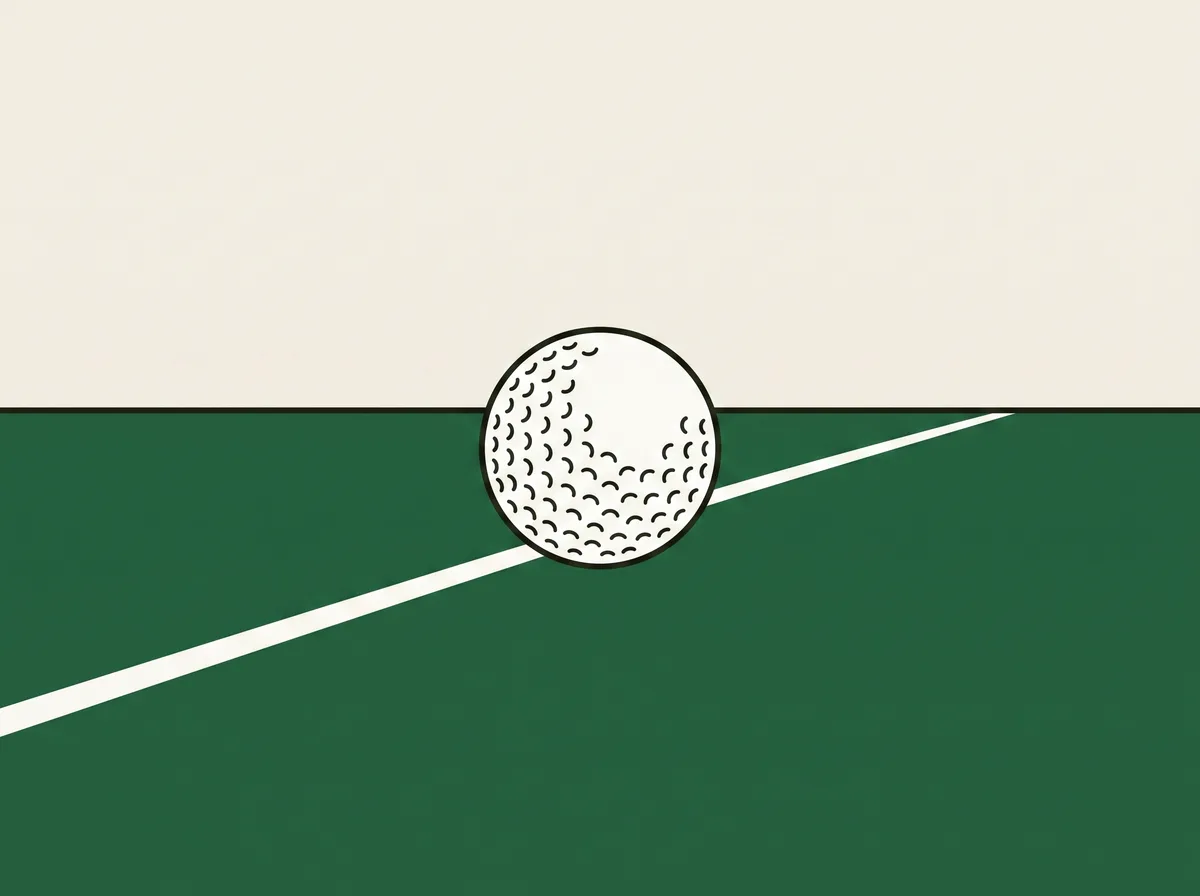
The club is descending, but the face has loft on it, and loft is what launches the ball. TrackMan's launch angle figures put a PGA Tour 6 iron leaving the face at 14.0 degrees and an LPGA Tour 6 iron at 16.7 degrees, while the club itself is travelling downward by three or four. The ball goes up because the face points up, not because the club does.
The forward part of that is real too. TrackMan reports around 20 degrees of dynamic loft on a tour 6 iron, which is less loft than the club has stamped on it, because the hands are ahead of the head at impact. That is a position you are delivered into by the body moving forward, not something the wrists push at the ball. The full anatomy of that moment is in the golf impact position.
The setup that puts the low point ahead of the ball
Nothing here is a swing thought. It is where you stand and how you are balanced.
- Set your feet about shoulder width apart, narrowing slightly for the shorter irons.
- Place the ball in the centre of the stance for wedges and short irons, moving it about one ball forward of centre by the time you reach a 6 iron.
- Let your hands sit a fraction ahead of the ball, so the shaft leans very slightly towards the target.
- Keep your weight even at address and let it move onto the lead foot as you swing through. Finishing with weight on the trail foot guarantees a low point behind the ball.
- Stand tall enough that your arms hang, rather than reaching. Reaching moves the low point backwards on its own.
| Club | Ball position | What a good strike leaves behind |
|---|---|---|
| Wedges and 9 iron | Centre of the stance | A shallow strip of turf starting past the ball |
| 8 iron to 6 iron | About one ball forward of centre | A clear divot, target side of the ball |
| 5 iron and 4 iron | About two balls forward of centre | A bruise or a thin divot rather than a deep one |
| Fairway wood off the turf | Just inside the lead heel | A brush mark, no real divot |
Ball position does more work than any swing change available to you, and it is free. The full chart, including how far it moves for a driver, is in ball position by club.
One swing, different lengths of club
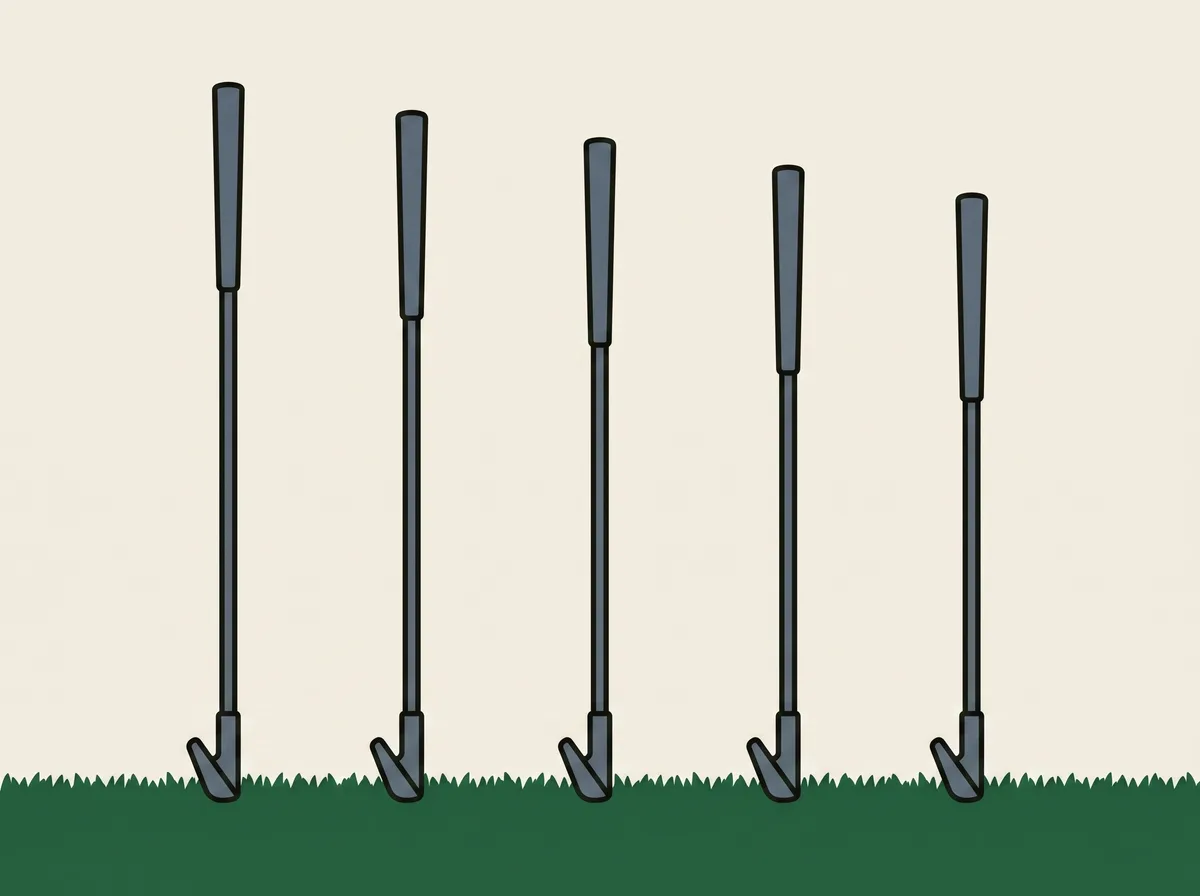
There is no separate technique for a 5 iron and a 9 iron. The clubs are different lengths, so you stand a little further from the ball and the plane tilts a little flatter, and both of those happen without you doing anything. The swing itself does not change, which is the argument made in full in does the golf swing change by club.
What does change is difficulty. Long irons have less loft, so they are less forgiving of a strike a few grooves low, and they punish a poor low point more visibly. If your 4 and 5 irons are the clubs you dread, they may simply be the wrong clubs to be carrying, and how to hit a hybrid covers the replacement most golfers end up making.
Iron play is distance control, not distance
Amateurs practise irons to hit them further. Scoring comes from hitting them the right distance, and the tracked data on this is unambiguous.
Read those two numbers together. Roughly four misses in ten are short and one in ten is long, which means most amateurs are choosing the club that would work if they struck it perfectly. Clubbing up one and swinging easier turns a large share of those into greens without a single technical change.
The other half of it is knowing your own carry numbers rather than your best ever numbers, which is what the golf club distance chart is for. A 7 iron that goes 150 once a month and 138 the rest of the time is a 138 yard club.
Direction, and why irons curve less
The face decides where the ball starts and the gap between face and path decides how much it bends. The full relationship is in the ball flight laws, and irons obey it exactly like every other club.
The difference is loft. A 6 iron puts far more of its spin into backspin than a driver does, so the same mistake tilts less of that spin sideways and the ball curves less. This is why a golfer can slice a driver into the trees and hit a passable 8 iron with the identical fault. The fault is still there. The club is hiding it.
Fat and thin are the same fault
Golfers describe these as two separate problems and treat them as two separate projects. They are one error with two endings.
If the low point sits behind the ball and you do nothing about it, the club hits the ground first and the shot goes nowhere. If the low point sits behind the ball and your body senses it coming, you lift, and the leading edge catches the equator of the ball instead. Same cause, opposite-looking results, which is why the two misses alternate in the same round.
The dedicated fixes for each ending sit in how to stop hitting fat shots and how to stop topping the ball. Work on one at a time, and start with whichever one is more common in your last three rounds.
Three drills with a dose
Every drill here converts a low point you cannot feel into something you can see or hear.
Key takeaways
- Good iron play is one thing: the ball struck before the ground, with the divot starting past the ball.
- Tour players hit down about 3.7 degrees with a 6 iron, so a descending strike is normal rather than aggressive.
- The ball goes up because the face has loft, not because the club travels up.
- Ball position runs from the centre of the stance for wedges to about one ball forward for a 6 iron.
- Weight must move onto the lead foot through the shot or the low point stays behind the ball.
- The swing does not change from club to club. Only the length of the club does.
- Amateurs miss short of the flag around four times as often as they miss long, so club up and swing easier.
- Fat and thin are the same error with different endings, so fix the low point rather than the symptom.
- Keeping your head down pins your weight back and makes the strike worse.
Common questions
How do I hit my irons pure?
Strike the ball before the ground. That means the low point of your swing has to arrive on the target side of the ball, which comes from ball position, weight moving onto the lead foot and a body that keeps rotating through the shot. The line drill on this page tells you within one swing whether it is happening.
Should I really hit down on the ball with an iron?
Yes, with any iron played off the ground. The club is descending and the loft on the face is what sends the ball up. Tour averages sit near 3.7 degrees down with a 6 iron. If the phrase makes you chop at the ball, think instead about brushing the grass on the far side of the ball.
Where should the ball be in my stance for irons?
Centre of the stance for wedges and short irons, moving roughly one ball forward of centre for mid irons and about two for the longest ones. Small moves. Anything more dramatic changes the low point more than it changes anything useful.
Why do I keep hitting the ground before the ball?
Your low point is behind the ball, usually because your weight stays on the trail foot through impact or the ball has crept too far forward. Both are setup and balance problems rather than swing problems, and both respond quickly to the towel drill.
Why are my iron shots so low?
Usually a strike low on the face, or a delivery with too much shaft lean stripping the loft off the club. Both feel like a solid hit. Spray the face with a light coat of foot spray for one session and look at where the marks are before changing anything in the swing.
How far should I hit a 7 iron?
Far enough to be repeatable, which is a smaller number than your best one. Carry distances vary enormously with speed, height and gear, so use your own averages rather than a chart of somebody else's. Recording ten shots with a launch monitor or a phone and a marked distance is enough.
Why do I hit my short irons well and my long irons badly?
Less loft means less forgiveness. A 4 iron punishes a strike a few grooves low far more than a 9 iron does, and it needs more club speed to launch properly. Plenty of golfers score better after replacing the 4 and 5 iron with hybrids.
Should I take a divot with every iron?
With wedges and mid irons, yes, a shallow one starting past the ball. With long irons a bruise or a thin scrape is normal, because the ball sits further forward and the arc is shallower. A deep divot behind the ball is never right with any club.
Is the iron swing different from the driver swing?
The motion is the same. The setup is not. An iron wants the ball central and the club still descending, a driver wants the ball forward and the club rising off a tee. Golfers who hit one well and the other badly are almost always using one setup for both.
Does any of this change for left-handed golfers?
No. The lead side is the side nearest the target, so a left-handed golfer moves the weight onto the right foot and takes a divot on the target side just the same. Ball positions, drills and dosages are identical.
How long before iron striking improves?
Give the low point work four to six weeks of three sessions a week. Ball position changes show up almost immediately, weight and rotation changes take longer, and both need feedback rather than repetition to stick.
Tom Ashworth
Tom Ashworth is a PGA Professional who has taught golf since 2012, working mainly with beginners and mid-handicappers at club level in Surrey. He reviews the instruction guides on Learn Golf for technical accuracy before they publish.
Most of his teaching is with players in their first three years of the game, and most arrive having been told too much: six swing thoughts collected from videos, half of them contradicting each other. His approach is to check the grip and the alignment before touching the swing, on the basis that most bad ball flight is decided at address.