You have 87 yards. A full sand wedge is too much, a smooth one might be right, and the honest answer is that you have no idea. So you make a swing at about eighty percent effort and the ball finishes anywhere across a forty yard window. This guide covers how to set your wedge gaps, how to measure what each one actually carries, and how to practise to a number rather than to a feeling.
Distance control is a measurement problem
A wedge shot that finishes twenty yards long is rarely a bad swing. It is usually a good swing at a distance the golfer never established, with a club whose carry they have never measured, aimed at a flag they should not have been aiming at.
That matters because the shot happens so often. Shot Scope's six scoring benchmarks count multiple chips from inside 50 yards at 4.1 per round for golfers shooting in the 100s, 3.2 in the 90s and 2.1 in the 80s. Every one is a shot that finished in the wrong place and cost a stroke.
Carry is the number you write down
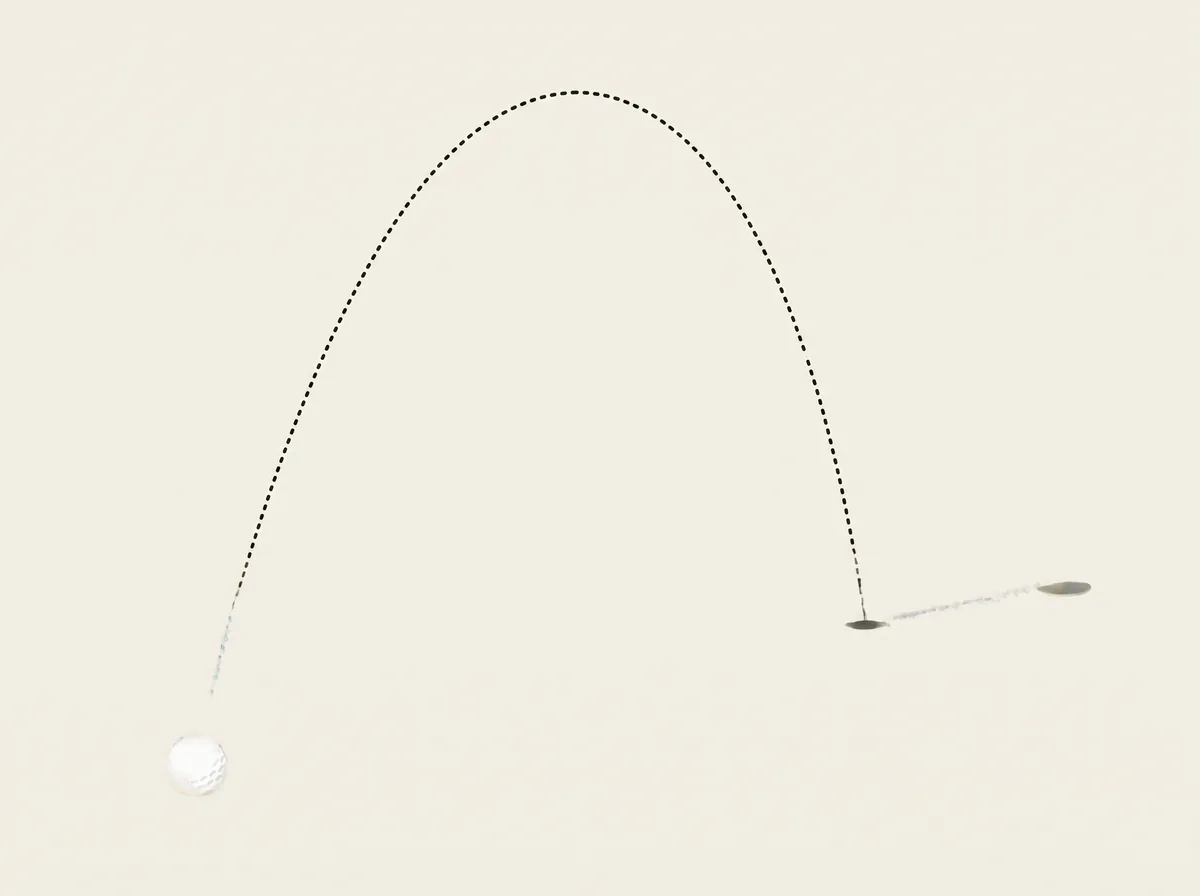
TrackMan defines carry as the distance the ball flies before it first touches down at the height it was struck from, and total distance as carry plus everything the ball does afterwards. For a driver the difference is large and fairly stable. For a wedge it is small and wildly variable.
That variability is why charts built on total distance fall apart. The same 60 yard wedge stops on a soft green in April and runs eight yards through the back in August. Landing angle drives it, and as TrackMan notes, a flatter landing angle produces more bounce and roll. Wedges land steeply, so roll is short, but firmness changes it far more than technique does.
So the chart records carry, and roll is judged on the day from the lie, the wind and how the greens are running. It also means the yardage marker is not your number: a sprinkler head reading 92 to the middle is a distance along the ground, and you need to know what the ball does in the air to use it.
How many wedges, and at what gaps
Before any of the measuring is worth doing, the set has to make sense. A bag with a 44 degree pitching wedge and a 56 degree sand wedge has a twelve degree hole in it, and no amount of practice fills a gap that large with a swing you can repeat.
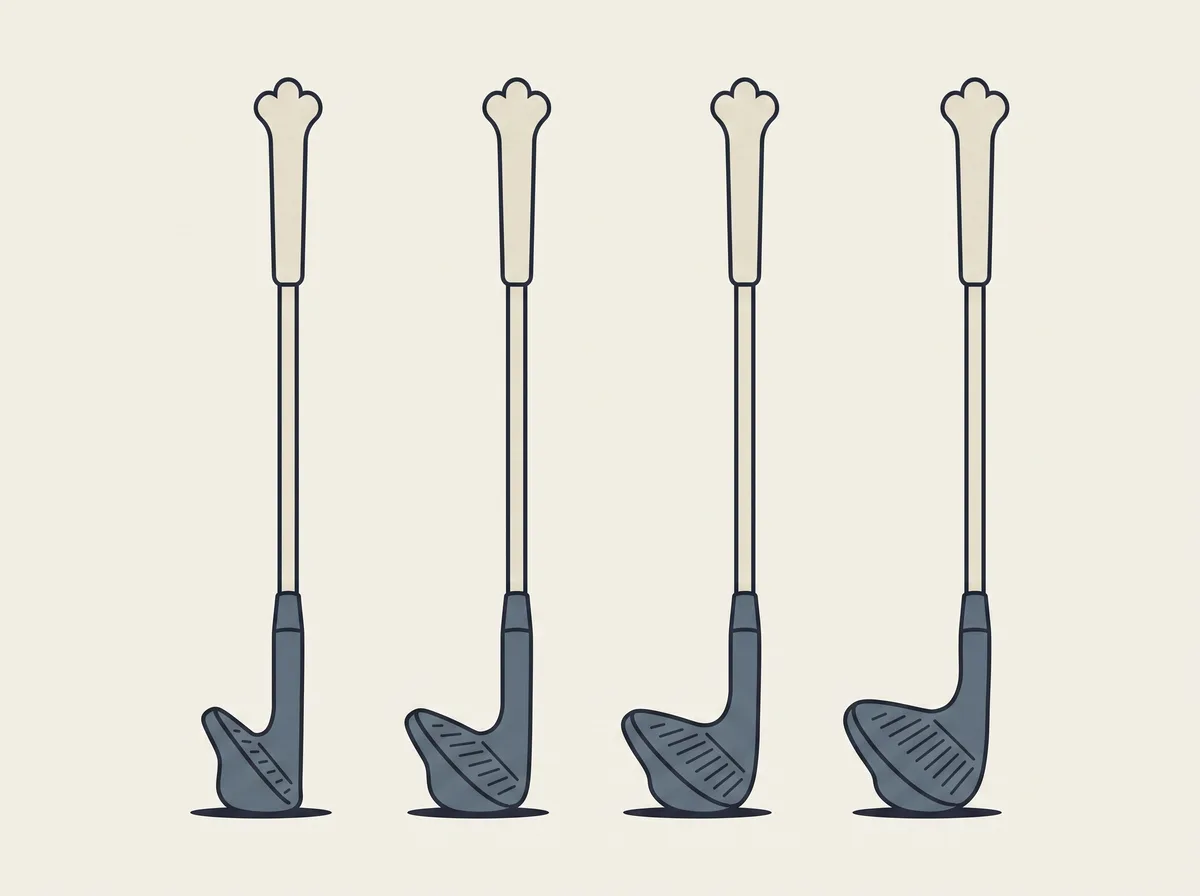
Titleist's wedge gapping guidance puts the workable loft separation at 4 to 6 degrees between wedges, which produces roughly 10 to 15 yard gaps for most players, and gives typical lofts as 44 to 48 degrees for a pitching wedge, 50 to 52 for a gap wedge, 54 to 56 for a sand wedge and 58 to 60 for a lob wedge.
| Setup | Lofts | What it gives you | Who it suits |
|---|---|---|---|
| Three wedges | Roughly 46, 52, 58 | Even six degree steps, three full-swing numbers | Most golfers, and anyone carrying a hybrid they actually use |
| Four wedges | Roughly 46, 50, 54, 58 | Four degree steps, tighter gaps, one fewer long club | Golfers who miss a lot of greens from inside 120 yards |
| Two wedges | Roughly 46, 56 | A ten degree hole that has to be swung around | Beginners, and nobody else by choice |
This has quietly got worse because iron lofts have been strengthened over the last two decades while sand wedges stayed where they were. A modern pitching wedge can be 43 degrees, so the club that used to sit neatly above your sand wedge now sits a long way above it. The full loft picture is in the wedge loft guide.
Building your own chart
The chart takes about two hours to build and it is the single highest-return practice session available to a mid-handicap golfer. It also has to be done properly or it produces numbers that are worse than none.
- Pick your reference lengths. Two per wedge is enough to start, three is the most anyone uses well. Where the lead arm points at the top is the usual reference and the one used in the pitching guide above.
- Hit at least ten balls at each length with each wedge, in sets, with a real target.
- Record the carry of every ball, not the total, and not just the good ones.
- Throw out the single longest and the single shortest, then write down the middle of what is left. That number is your carry, not your best strike.
- Repeat the whole exercise once a season, and after any change to your shafts, your ball or your swing.
Two things corrupt the numbers if you let them. Range balls fly shorter than the ball you play, often by several yards on a wedge, so a chart built on a mat with limited-flight balls reads low on the course. And a launch monitor set to a different altitude or temperature than your course reads differently again, which is worth knowing before you trust the screen over your eyes. What each number on it means is covered in launch monitor data explained.
Here is what a finished chart looks like. These are one golfer's measured carries, recorded to show the shape of the thing rather than as a target, and yours will not match them.
| Wedge | Short swing | Medium swing | Full swing |
|---|---|---|---|
| Pitching wedge, 46 degrees | 62 yds | 84 yds | 104 yds |
| Gap wedge, 52 degrees | 50 yds | 70 yds | 88 yds |
| Sand wedge, 56 degrees | 40 yds | 58 yds | 74 yds |
| Lob wedge, 60 degrees | 30 yds | 46 yds | 60 yds |
Read down a column and you see even gaps. Read across a row and you see the range of one club. Read the whole grid and you have twelve numbers covering 30 to 104 yards with nothing wider than a six yard hole in it, which is the entire point. Your full-swing column belongs alongside the rest of your bag in a golf club distance chart.
The clock system, and whether it survives
The clock system asks you to picture your lead arm as the hand of a clock and stop it at fixed positions, usually 7:30, 9:00 and 10:30, with each position producing a fixed carry for each wedge.
It is the most widely taught approach to this problem and it is also the one most likely to be abandoned within a month, for reasons worth knowing before you commit to it.
Filling the gaps between your numbers
A chart with twelve numbers still leaves you on 79 yards when your nearest entries are 74 and 84. There are three honest ways to bridge that and one dishonest one.
| Lever | What it does | When to use it |
|---|---|---|
| Change club, keep the length | Moves the number by roughly a gap | The first choice, every time |
| Grip down an inch or two | Shortens the club and takes a little off | Small adjustments, and into wind |
| Move the ball back a fraction | Lowers flight and reduces carry slightly | Firm ground and windy days |
| Swing harder or softer | Changes everything at once | Never, if you can avoid it |
Gripping down is the most underrated of these because it changes the distance without changing anything you have practised. The swing stays the same length and the same speed, and the club is simply shorter.
Trajectory is the other real lever. A lower, more penetrating wedge carries less and runs more, which is the logic behind the bump and run and behind every shot played into a wind.
Practising to a number
The practice that builds this is not the practice most golfers do. Hitting forty wedges at the same flag teaches you almost nothing about distance control, because there is no number attached to any of them.
Both of these belong in a structured session rather than at the end of a bucket, which is the argument the driving range routine guide makes at more length. Expect the numbers to move for the first three or four sessions and then settle. Anything you record in the first fortnight should be treated as provisional.
Using the chart on the course
A chart changes your decisions before it changes your scores, starting with where you aim.
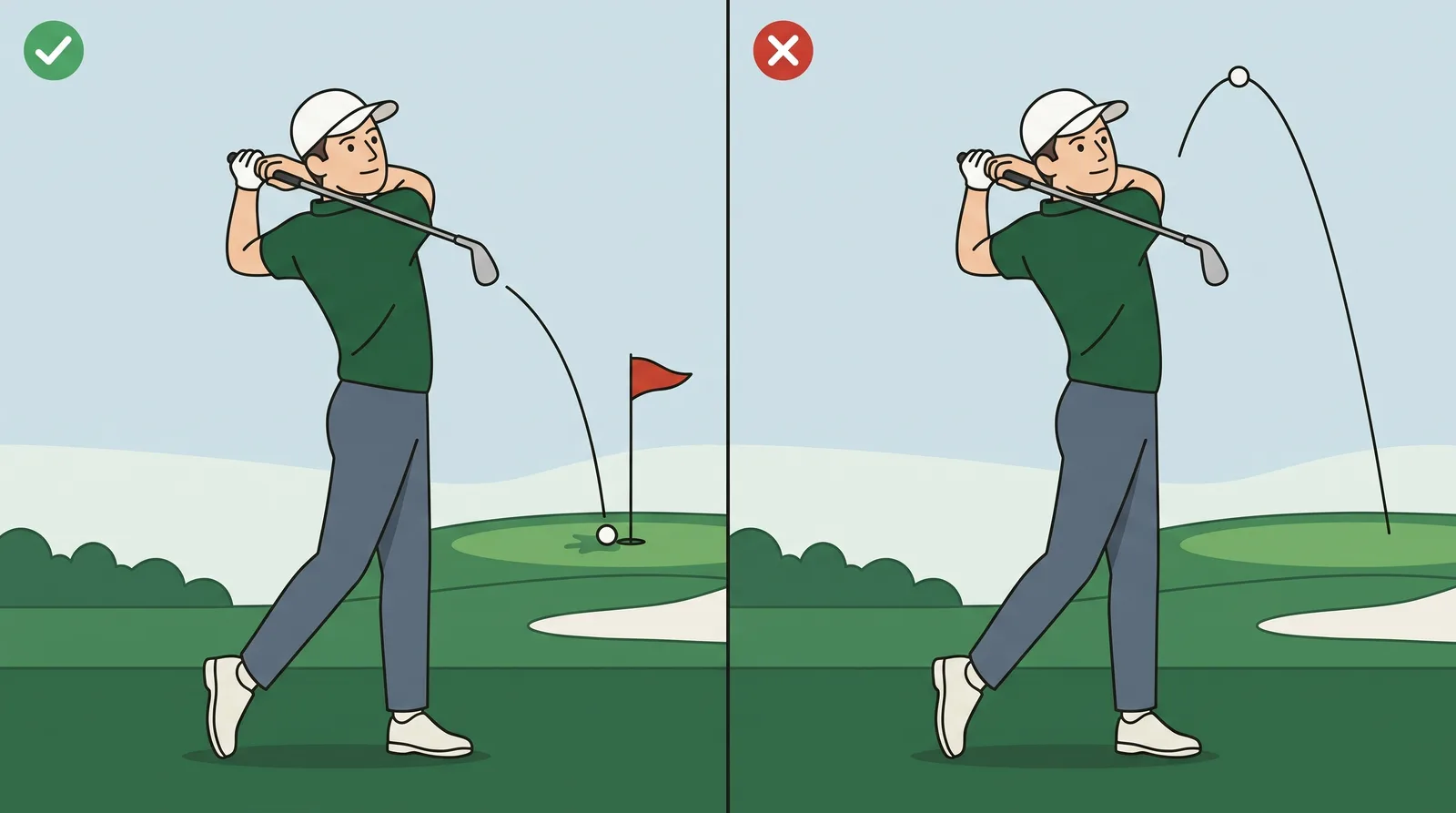
Forty feet is more than a third of the way across most greens, so the flag is rarely the right target even with a wedge in hand. Aim at the middle of the surface and treat a shot that finishes on the green as the good outcome it is.
The second decision is the lay-up. If you know your numbers, you know which yardages you own, so a lay-up should finish on one of them rather than at whatever distance the club you grabbed happens to go. That is the most immediately useful piece of golf course management available to a mid-handicapper.
The third is club selection around the green. Once you know your lob wedge carries 30 yards at its shortest measured length, you also know what it does not do, and the running chip shot becomes the obvious choice more often.
Key takeaways
- Wedge distance control is a measurement problem. A repeatable action with no numbers attached is still a guess.
- Record carry, not total. Roll belongs to the firmness of the green and changes week to week.
- Titleist puts workable wedge gapping at 4 to 6 degrees of loft, which gives roughly 10 to 15 yard gaps.
- Modern strong iron lofts have opened the gap between the pitching wedge and the sand wedge, so check yours.
- Use two or three fixed swing lengths per wedge, no more, and pick a reference you can actually feel.
- Hit at least ten balls per length, discard the extremes, and write down the middle of the group.
- Range balls fly shorter than your own, so a chart built on the range reads low on the course.
- Change club or length to change distance. Changing effort changes tempo, and tempo change costs the strike.
- Gripping down is the cleanest small adjustment, because nothing about the swing changes.
- Shot Scope has amateurs averaging 40 feet from 60 to 100 yards out, so the middle of the green is the target.
Common questions
How do I control my wedge distances?
Fix a small number of backswing lengths, measure what each one carries with each wedge over at least ten balls, and write the numbers down. Then change the club or the length to change the distance, and keep the effort and tempo the same on every shot.
How far should each of my wedges go?
There is no correct answer, only your answer, and it depends on swing speed, shaft, ball and turf. What matters is that the gaps between your wedges are even and that you have measured them rather than assumed them. Titleist's gapping guidance suggests 4 to 6 degrees of loft between wedges as the range that produces usable yardage gaps.
Should I use carry or total distance for my wedge chart?
Carry. Total distance on a wedge depends almost entirely on how firm the green is, so a chart built on total is only accurate on the day you built it. Record where the ball lands and judge the roll on the course.
What is the clock system for wedges?
Picturing your lead arm as a clock hand and stopping it at fixed positions, usually around 7:30, 9:00 and 10:30, with each position producing a known carry for each wedge. The principle is sound. The clock face itself is optional, and many golfers do better with a reference they can feel rather than one they have to visualise.
How many wedges should I carry?
Three suits most golfers and four suits anyone who misses a lot of greens from inside 120 yards. Two is a problem, because a ten or twelve degree jump between clubs leaves a hole no swing can reliably cover.
Why do I fly the green with a wedge in my hand?
Usually because the swing got longer or quicker than the one that produced your number, which happens most often when the shot matters. It is also common when the yardage came from a marker giving total distance to the middle while your reference number is a carry.
How do I hit a wedge 80 percent?
You do not, if you can avoid it. Percentages of effort are not repeatable, because the same intention produces a different swing on different days. Take a shorter swing at normal speed with a straighter-faced club, or a full swing with a more lofted one.
Do range balls affect my wedge yardages?
Yes, and by enough to matter. Limited-flight range balls carry shorter than the ball you play, so a chart built entirely on a driving range will read low on the course. Check the numbers on grass with your own ball at least once before trusting them.
How long does it take to build a reliable wedge chart?
About two hours to gather the first set of numbers and roughly a month of weekly sessions before they stop moving. Treat anything recorded in the first fortnight as provisional, and expect the grouping to tighten before the averages settle.
Should I aim at the flag with a wedge?
Usually not. Tracked amateur data has the average approach from 60 to 100 yards finishing around 40 feet from the hole, which is a long way. Aiming at the middle of the green turns a short-sided miss into a two-putt and costs almost nothing on the rare occasion you would have been close.

Tom Ashworth
Tom Ashworth is a PGA Professional who has taught golf since 2012, working mainly with beginners and mid-handicappers at club level in Surrey. He reviews the instruction guides on Learn Golf for technical accuracy before they publish.
Most of his teaching is with players in their first three years of the game, and most arrive having been told too much: six swing thoughts collected from videos, half of them contradicting each other. His approach is to check the grip and the alignment before touching the swing, on the basis that most bad ball flight is decided at address.