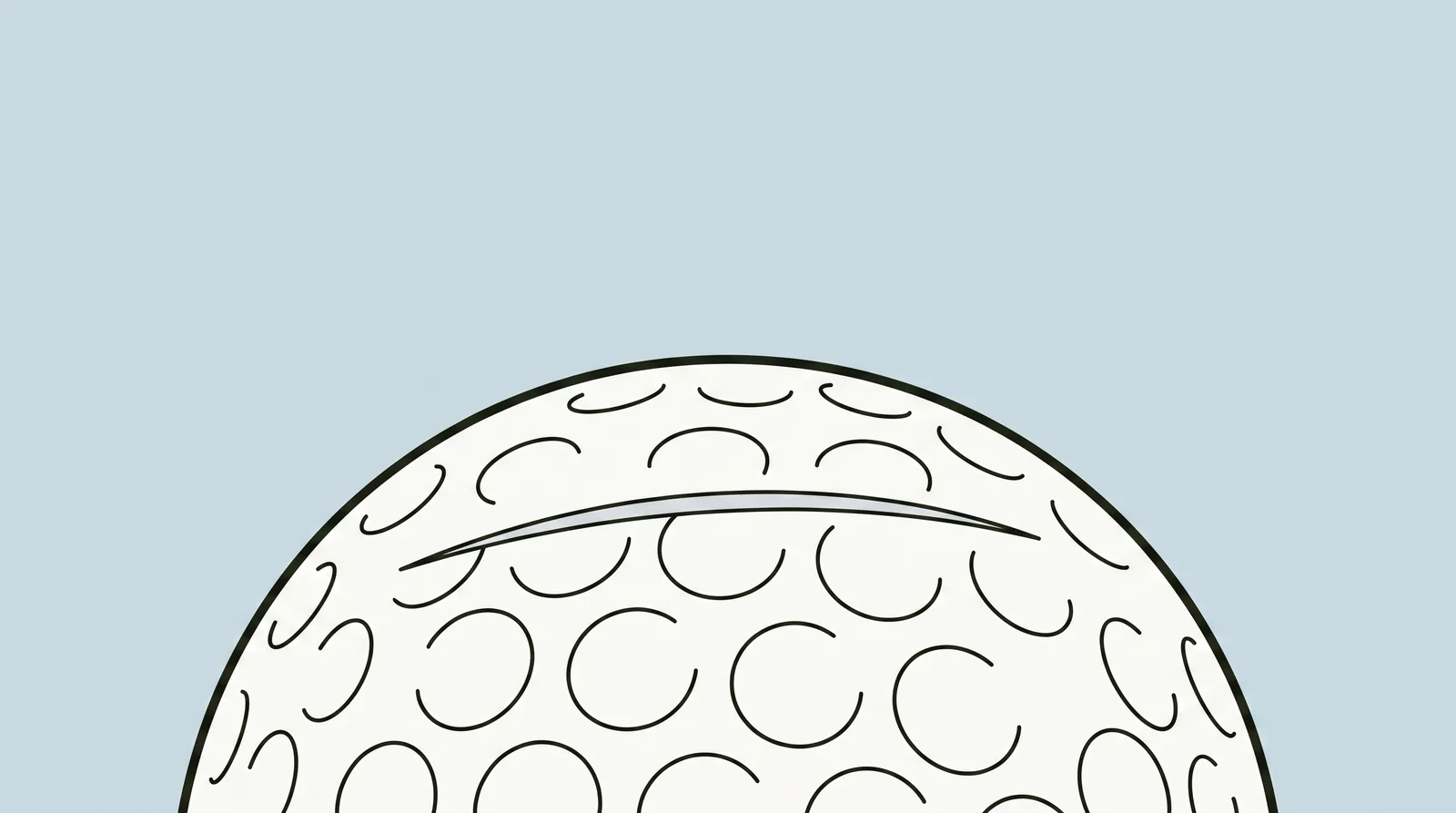
A topped shot is the most public miss in golf. It dribbles thirty yards, everyone watches it, and the natural response is to try harder to get the next one airborne, which guarantees another one. This guide covers what is actually happening at the ball, the four causes worth checking in order, and the drills that change the strike rather than the swing.
Every left and right below assumes a right-handed golfer. Left-handers can follow every drill unchanged, because topping is a vertical fault: read lead shoulder as the right shoulder and lead heel as the right heel and the rest holds exactly.
What topping actually is
Strike happens in two dimensions. Face and path decide where the ball goes sideways. Height of the club head at the ball decides whether it goes anywhere at all.
The leading edge of a club sits below the ball's centre when everything is right, so the face gets under the ball and the loft launches it. A topped shot is the leading edge arriving above the ball's centre, which presses the ball down into the turf instead of up into the air. Nothing else has to go wrong for that to happen. Push the same error a little further and the leading edge passes over the ball entirely, which is missing the ball completely rather than a separate fault with a separate cure.
Topping and fat shots share one root and diverge immediately. Both are a low point in the wrong place relative to the ball. On a topped shot the club has not yet reached the bottom of its arc, or the arc itself has lifted. When the arc bottoms out early and the ground is struck first, that is the other fault entirely, and it is covered in how to stop hitting fat shots.
TrackMan measures this directly as low point, the position of the lowest part of the swing arc relative to the ball, reported as before or after impact. An iron wants the low point after the ball. Push it far enough past the ball and the club is still descending, still high, when it gets there.
The vertical number that goes with it is attack angle. TrackMan puts the PGA Tour average at minus 3.7 degrees with a 6 iron, meaning the club head is unmistakably still travelling downward when it meets the ball. Good iron players are not sweeping anything.
Topped, thin and flushed are the same shot
There is no separate technique for a thin shot. It is a topped shot that got closer.
| Strike | Where the face meets the ball | What you see | What you feel |
|---|---|---|---|
| Topped | Above the centre of the ball | Rolls or bounces along the ground | A dull click, no resistance |
| Thin | On the leading edge, just below centre | Low, fast, running, often further than expected | A sharp sting through the hands |
| Flushed | Centre of the face, ball struck before the ground | Normal height and distance | Almost nothing |
That is a difference of a few millimetres of club head height. It is why golfers can hit one perfect 7 iron and then top the next one with a swing that felt identical: the swing was almost identical, and the strike window is far smaller than the swing.
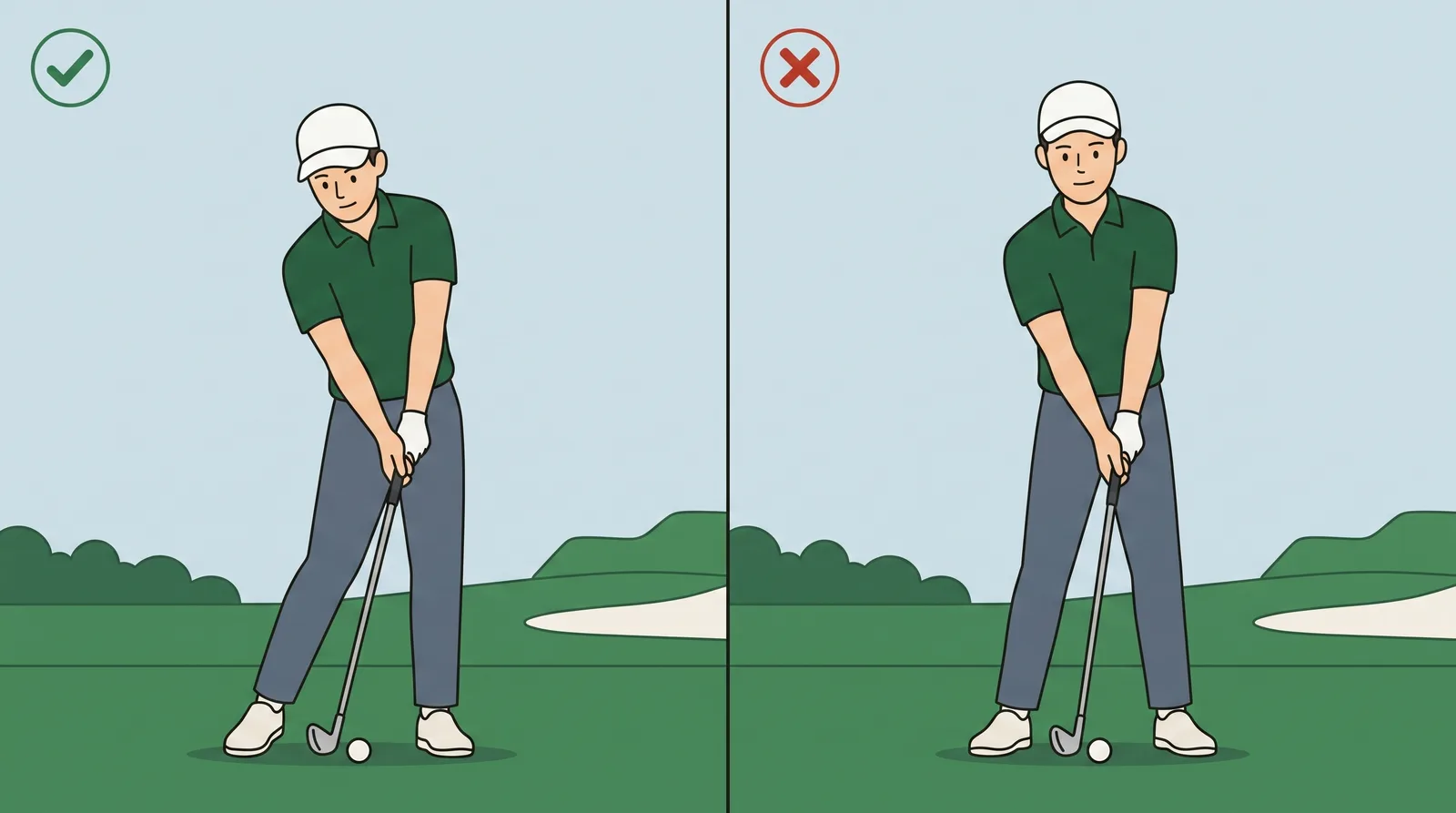
Cause one: you are trying to lift the ball
This is the beginner's fault and it is close to universal, because it is completely logical. The ball needs to go up, so you help it up.
The club already does that job. Loft is the angle built into the face for exactly this purpose, and it only works if the club arrives travelling downward or level. When you try to add height with your body, you straighten your spine, raise your hands and lift the club head clear of the ball. The result is the opposite of the intention, every time.
The physical version of the fix is short. Keep your chest over the ball as the club comes down and let the ball get in the way. What that looks like at impact, including where the hands and weight should be, is set out in golf impact position.
Cause two: your body rises through impact
If lifting is the instinct, standing up is the movement that carries it out, and it is the most common cause of topping in golfers past their first season.
The pattern is that the hips push in towards the ball on the way down and the legs straighten, which raises the whole upper body. Every part of the swing arc goes up with it. The arms often try to rescue this by pulling in, which shortens the radius further and produces the thin one instead of the topped one.
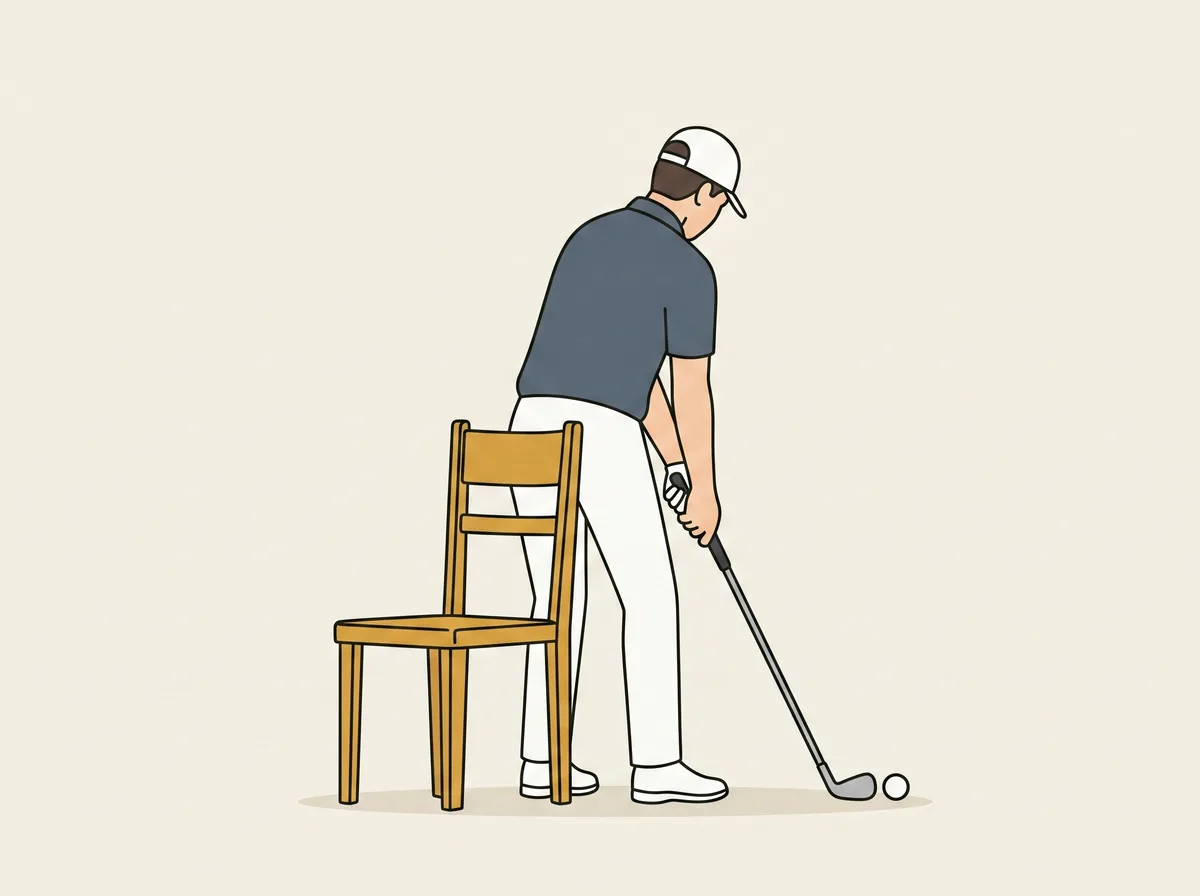
There is good evidence for how widespread this is. The Titleist Performance Institute reports that 67% of the golfers in its screening database, more than 90,000 players, show early extension, which it defines as the pelvis moving forward towards the ball during the swing. TPI lists thin contact among the results and notes that 99% of the elite professionals it has tested do not do it.
Early extension is often a mobility issue rather than a technique one. If you cannot squat with your heels down or bend forward from the hips without rounding your back, your body is choosing the only movement available to it, and drills alone will keep losing.
Cause three: the ball is too far forward
This one is specific and it explains why so many golfers top fairway woods and hybrids while striking their irons cleanly.
The bottom of the arc sits roughly under your lead shoulder and it does not move much. Put the ball ahead of that point, off the lead heel as if you were teeing a driver, and the club has to travel further to reach it. From the turf, with no tee, it is still on its way down and still too high when it arrives.
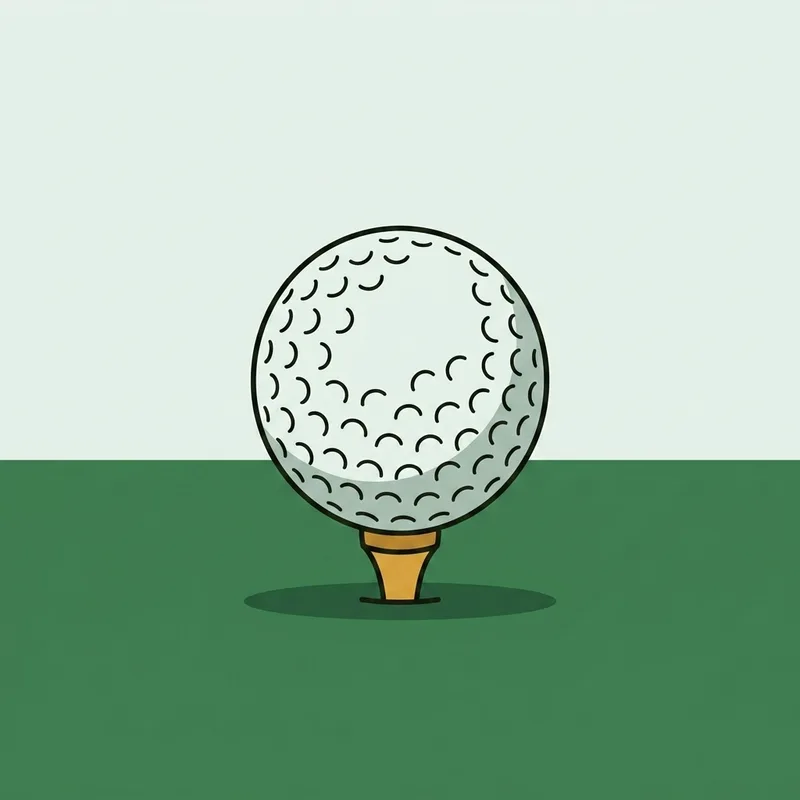
Move the ball back to roughly two ball-widths inside your lead heel for a fairway wood off the turf and one ball-width for a mid iron, then check it every shot for a fortnight, because it drifts. The reference positions for every club are in golf ball position, and the setup that makes a fairway wood work from the deck is in how to hit a fairway wood.
Cause four: your posture had nowhere to go
Some tops are built before the club moves. A golfer who sets up too upright, with straight legs and the arms reaching out for the ball, has already used all their available height.
From there, any small change in the backswing has to come back down accurately, because there is no depth in the setup to absorb it. Tilt forward from the hips rather than rounding the upper back, add a light knee flex, and let the arms hang instead of reaching. The full checklist is in golf posture.
Read your strike marks
Guessing is optional. The club tells you where it met the ball if you make it visible.
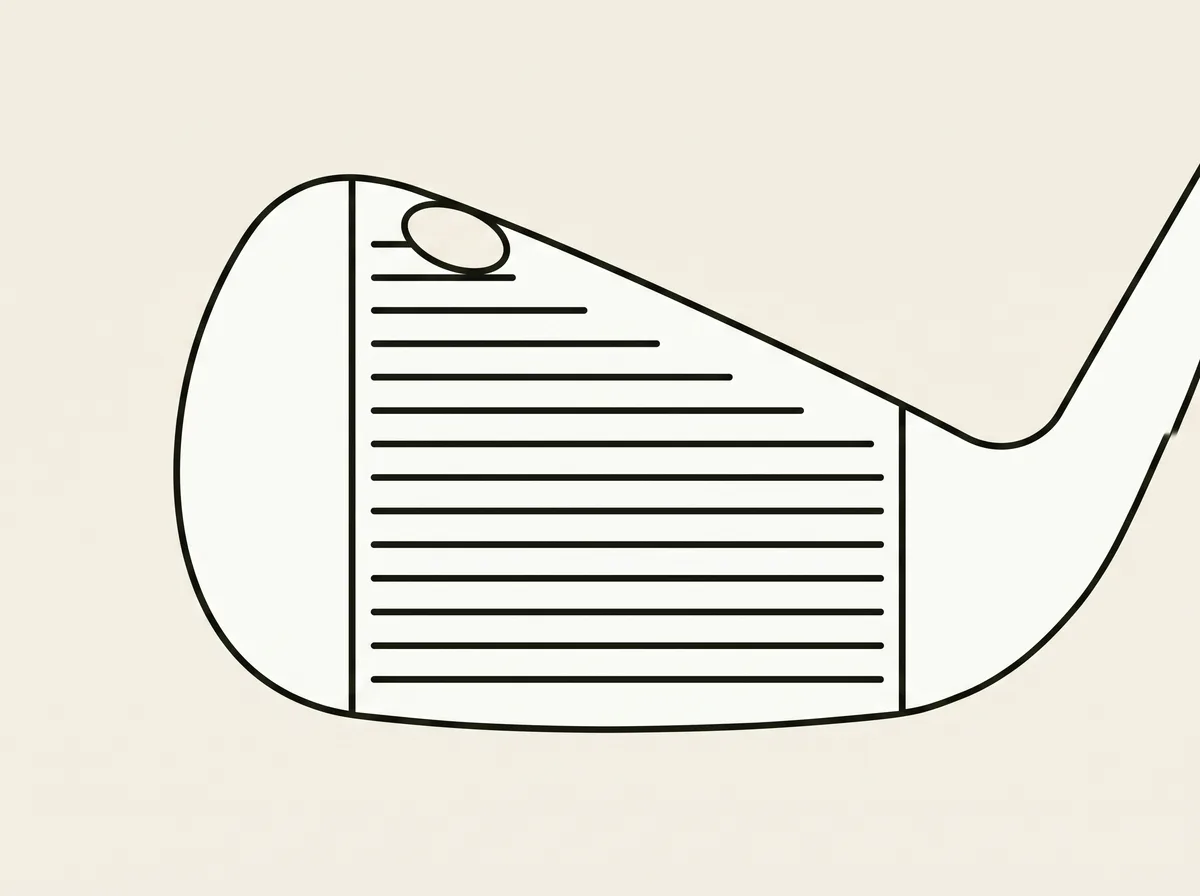
Spray the face with foot powder or use a strip of impact tape for one bucket. Marks clustered near the top edge confirm the club is arriving high. Marks in the middle with poor flight point somewhere else, usually loft being added through impact, which is a different conversation covered in how to hit irons.
The order to work in
Doing all four at once is how a fault survives a whole season. Take them in this sequence, one per session.
| Order | What to check | How long | You are done when |
|---|---|---|---|
| 1 | Posture and knee flex at address | 1 week | You can set it without a mirror and the arms hang rather than reach |
| 2 | Ball position, checked every shot | 2 weeks | Position is identical shot to shot with each club |
| 3 | Staying in posture through impact | 3 weeks | The chair drill holds on half swings without conscious effort |
| 4 | Trusting loft rather than lifting | Ongoing | Your best strikes feel like you hit down on the ball |
Three sessions a week is realistic and enough. Give any single change three weeks before you judge it, and expect the improvement to arrive as fewer bad ones rather than as a sudden run of good ones.
If your strike is unpredictable in both directions, some thin and some heavy, the underlying problem is the position of your low point rather than any one of these causes, and the broader diagnosis sits in inconsistent ball striking. If the whole motion still feels unformed, work through golf swing basics before spending another month on the strike alone.
Key takeaways
- A top is the club head arriving above the centre of the ball. It is a height problem, not a power problem.
- Topped, thin and flushed are the same shot separated by a few millimetres of club head height.
- Loft launches the ball. Trying to lift it raises your body and takes the club head with it.
- Standing up through impact is the most common cause, and TPI screening finds early extension in 67% of golfers.
- Set a chair behind you at address. Losing contact with it on the way down is the fault made visible.
- Ball too far forward is why fairway woods and hybrids get topped by golfers who strike irons cleanly.
- Keeping your head down makes topping more likely, because the body finds its rotation by standing up instead.
- Strike marks near the top edge of the face confirm the diagnosis in one bucket of balls.
Common questions
Why do I keep topping the golf ball?
The club head is above the middle of the ball when it arrives. In almost every case that is because your body rose out of its address posture during the downswing, or because the ball sits ahead of the lowest point of your swing arc so the club is still descending when it reaches it.
What is the difference between a topped shot and a thin shot?
Only a few millimetres of club head height. A topped shot catches the ball above its centre and drives it into the ground. A thin shot catches it just below centre on the leading edge, so it flies low and fast and stings your hands. The cause is identical.
Should I keep my head down to stop topping?
No. It is the most common piece of advice on this fault and it makes it worse. Locking the head down prevents the chest from rotating through the ball, and the body compensates by standing up, which raises the club head. Maintain your forward tilt instead and let the head move naturally.
Why do I top my driver but not my irons?
Usually tee height and ball position working together. With the ball forward and teed, the club should be travelling slightly upward at impact, and that only works if your upper body stays behind the ball. Golfers who slide towards the target take the low point past the ball and catch it on the way down.
Why do I top fairway woods and hybrids?
Because they are usually played too far forward in the stance, copying a driver setup on a ball sitting on the turf. Move the ball back to about two ball-widths inside your lead heel and let the club's own loft do the work rather than trying to sweep it up.
Is topping caused by lifting my head or by standing up?
Standing up, in almost every case. Lifting the head is what people see, but the head only rises because the legs straightened and the hips pushed towards the ball. Fix the body's height and the head stops being an issue.
How do I stop topping the ball at the driving range?
Push a tee into the turf until only two or three millimetres show, put the ball on it, and hit half swings with a 7 iron trying to clip the tee. Fifteen balls at the start of each session. It gives immediate feedback and does not let you fake a clean strike.
Can the wrong club length cause topping?
It contributes. Clubs that are too long for you push you into a taller setup with the arms reaching out, which leaves nowhere to go if anything changes in the swing. It is worth checking after posture and ball position, not before them.
Why do I top the ball when I swing harder?
Because effort usually arrives through the arms and shoulders, which pulls the upper body up out of posture. Swinging at around 80% keeps the tilt of your chest stable, and a struck 80% shot travels much further than a topped full one.
How long does it take to stop topping the ball?
Expect three weeks of consistent work on a single change before it feels normal, and roughly two months to work through posture, ball position and staying in your tilt. Progress shows up first as fewer bad strikes rather than as more good ones.
Does hitting off a mat hide the problem?
It hides the opposite fault more than this one. A mat lets a club bounce into the ball after hitting behind it, so heavy contact reads as acceptable. A topped shot looks the same on grass and on a mat, so mats are a fair test of this particular miss.
Tom Ashworth
Tom Ashworth is a PGA Professional who has taught golf since 2012, working mainly with beginners and mid-handicappers at club level in Surrey. He reviews the instruction guides on Learn Golf for technical accuracy before they publish.
Most of his teaching is with players in their first three years of the game, and most arrive having been told too much: six swing thoughts collected from videos, half of them contradicting each other. His approach is to check the grip and the alignment before touching the swing, on the basis that most bad ball flight is decided at address.