Best Golf Hitting Mats: Base, Turf and the Fat Shot
A hitting mat either tells you the truth about where the club met the ground or it flatters you every single swing. That difference is a construction detail, and it is the only thing worth buying on.
Some links here earn us a commission at no extra cost to you. It never changes what we recommend or the order we rank it. How this works.
Almost every hitting mat is sold on how realistic it feels, which is not a specification and cannot be checked. Two things can: what the turf is made of and what sits underneath it. Those two decide whether the mat reports your strike honestly or quietly flatters it, and a mat that flatters a fat shot is teaching you a fault every time you use it.
The four, compared
All four are hitting surfaces for full swings rather than putting mats, which solve a different problem and are covered in the putting mats worth owning. All four are sold in Britain by British sellers in sterling, which narrowed this list more than any specification did.
| Pick | Best for | Turf | Base | Real tee | Build height | Price |
|---|---|---|---|---|---|---|
| TrueStrike Mk7 Single Golf Mat | A surface the club goes into rather than off | Ruckable nylon top over a gel-filled strike section | Silicone gel bag, polyurethane pillow and closed-cell foam under the strike surface | No, 50 TrueTee rubber tees and a holder supplied | 4.6 cm | Around £699 at UK retail |
| SimSpace Premium Tee Turf Hitting Mat | A real wooden tee, and a published build height | 30 mm nylon | 12 mm foam | Yes, pushed straight into the turf | 42 mm | Around £270 to £290 |
| SimSpace Premium Standard Turf Hitting Mat | The cheapest full size square here | 17 mm nylon | 12 mm foam | No, rubber and plastic tees in six perforated holes | 29 mm | Around £180 to £200 |
| The Net Return Pro Turf | The largest surface here, and it doubles as a putting strip | 42 oz nylon face, 2 in grass height | 5 mm foam backing | Not published | About 56 mm, 2 in of pile over a 5 mm backing | Around £899 at UK retail |
The column worth reading twice is Build height, because it is the number that governs both the feedback and the load through your joints, and because three of these four publish it while almost nobody selling a mat leads with it.
Two of the four carry the same badge, and that is deliberate rather than lazy. SimSpace's two 1.5 m squares are the cleanest demonstration in this category of what the money actually buys: identical size, identical 12 mm base, £90 apart, and the entire difference is 17 mm of turf against 30 mm and whether you can push a real tee into it.
What a hitting mat does to a fat shot
This decides everything below it, and it is why a cheap mat is not simply a smaller version of an expensive one.
A fat shot is the club reaching its lowest point behind the ball. On grass the sole digs, the club decelerates, and the ball comes up thirty yards short.
On a thin mat over a hard floor the same swing does something else. The sole meets a surface that will not let it in, skids forward off the backing, and arrives at the ball almost as fast as it was travelling. The strike sounds acceptable and the ball flies. Nothing tells you that on grass it was a chunk.
Three things stop a mat lying to you: a subsurface the club can displace, a dense fibre over a real cushion that lets the sole sink and slow, or simply enough depth of material to absorb a heavy strike. Fifteen millimetres of turf on a thin foam backing does none of those, which is why the cheap mats sitting below everything on this page are also the most flattering.
The on-course symptom is worth putting a number on. Shot Scope's tracked benchmarks have golfers scoring in the 100s taking 4.1 multiple chips from inside 50 yards per round, against 3.2 for those in the 90s and 2.1 in the 80s. Those are duffed and thinned short shots, and they are exactly the strike a hitting mat is supposed to be improving. Stopping fat shots is where the fault itself gets diagnosed.
TrueStrike Mk7 Single: a surface the club goes into
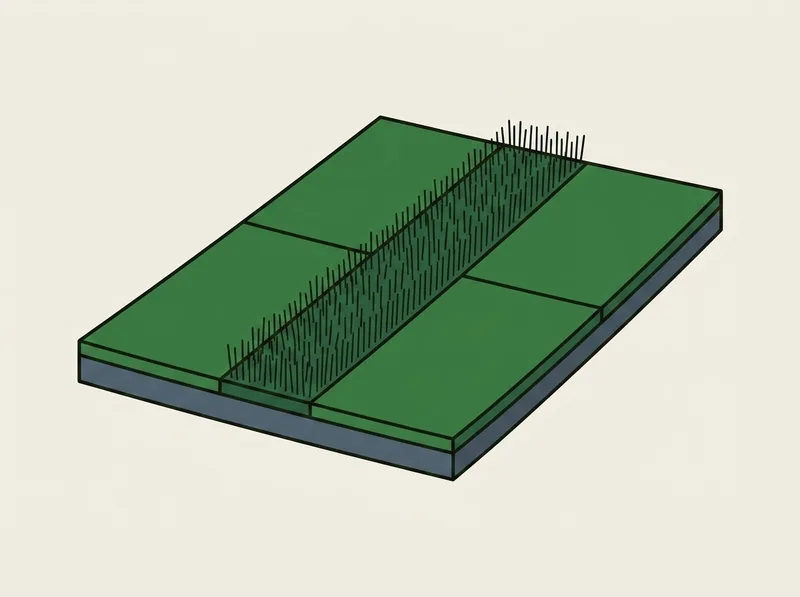
The TrueStrike Mk7 Single arrives as five pieces: a gel section, three range mat sections, a ball tray and an edge trim, finishing at 195.6 by 132.1 cm and 4.6 cm high, and weighing about 50 kg. Fifty TrueTee rubber pegs and a tee holder come in the box.
The gel section is the whole argument. Under a sliding nylon top surface sits a silicone gel bag over a polyurethane pillow and closed-cell foam, and the club displaces that stack on the way through rather than bouncing off it. Every other mechanism in this category tries to be forgiving. This one tries to be honest, which is a different goal and the correct one.
 Around £699 at UK retail
TrueStrike Mk7 Single Golf Mat
- Turf
- Ruckable nylon top over a gel-filled strike section
- Base
- Silicone gel bag, polyurethane pillow and closed-cell foam under the strike surface
- Real tee
- No, 50 TrueTee rubber tees and a holder supplied
- Build height
- 4.6 cm
- Rated life
- Not published
- Sizes
- 195.6 by 132.1 cm, one size
- Weight
- 112 lb, around 50 kg
- Warranty
- Not published
- The strike section is a gel-filled bag under a sliding top surface, so the club moves into the mat instead of skidding off it.
- Fifty kilos of mat in five separate sections, which is what stops it creeping forward under repeated impact.
- British designed and properly distributed here, which on this page is rarer than it should be.
- No wooden tee. TrueTee rubber pegs sit in a holder set into the panel, and that is the only tee option.
- TrueStrike publish no shot life and no warranty terms, at the second highest price here.
- The strike section is a strip, so ball position and where you stand are both fixed once it is laid out.
VerdictThe default buy for a golfer who wants the mat to report a fat strike rather than hide it, because the gel section is the only construction on this page that lets the sole sink and slow the way turf does. The gap is what TrueStrike do not publish: no shot life, no warranty, and a website that has been a holding page for the whole of this year.
Fifty kilos is the specification nobody mentions and everybody should. A mat that slides an inch a swing has moved your ball position by the twentieth shot, and weight is what stops that happening without you having to bolt anything down.
Two things are genuinely missing. There is no shot life figure of any kind at this money, and no warranty terms published anywhere. TrueStrike's own website has been an "opening soon" holding page throughout 2026, so every specification above comes from British retailers rather than from the maker, which is a poor state of affairs for a British brand.
SimSpace Premium Tee Turf: a real tee, and a published build height
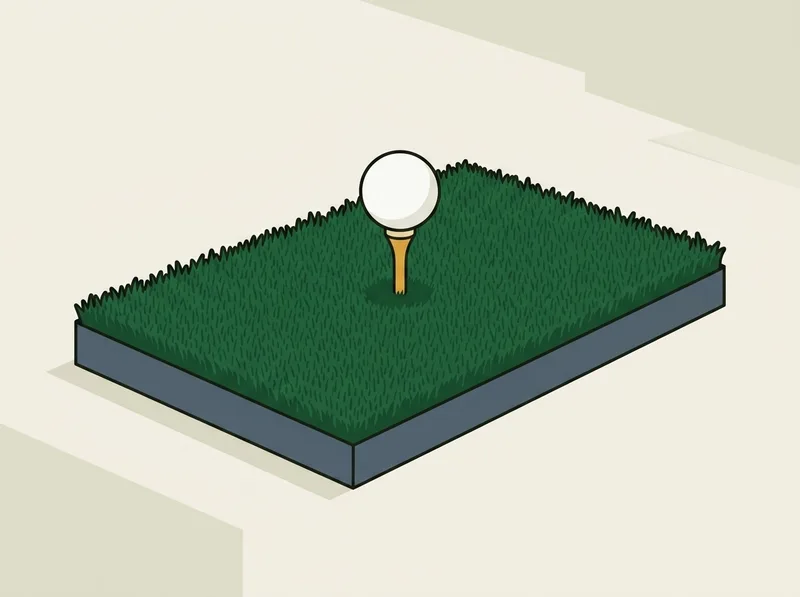
The SimSpace Premium Tee Turf Hitting Mat is 30 mm of nylon turf on a 12 mm foam base, 1.5 m square, finishing at 42 mm total, and it ships with six tees at 54, 70 and 83 mm.
The tee point is not a gimmick. Two of the other three mats here need a rubber peg, which is a fixed cylinder that behaves differently from a wooden tee both under the club and in your eye at address. Pushing a real tee into 30 mm of pile is the only way a driver rehearsal at home is the shot you actually play.
 Around £270 to £290
SimSpace Premium Tee Turf Hitting Mat
- Turf
- 30 mm nylon
- Base
- 12 mm foam
- Real tee
- Yes, pushed straight into the turf
- Build height
- 42 mm
- Rated life
- Not published
- Sizes
- 1.5 m by 1.5 m, 4 ft 11 in square
- Included
- Six tees, at 54, 70 and 83 mm
- Warranty
- Not published
- Takes a real tee straight into the turf, so a tee shot at home is a tee shot rather than a rubber approximation.
- Publishes its turf pile and base thickness separately, at 30 mm and 12 mm, which only one other mat here does.
- Four foot eleven square clears the heel-to-toe room a driver swing needs, at well under half the price of the top pick.
- Twelve millimetres of foam is the whole of the cushioning, so the floor underneath still matters a great deal.
- No published weight, no published warranty and no shot life.
- The extra £90 over the same maker's standard mat below buys 30 mm of turf against 17 mm. The base is the same 12 mm.
VerdictThe sensible middle of this market and the one to buy if hitting a real tee shot at home matters to you. It is also the only mat on this page that tells you what it is made of layer by layer, which on a product sold entirely on how the surface behaves should be the minimum rather than the exception.
The published construction is the quieter reason it earns its place. SimSpace are the only maker here who give you turf pile and base thickness as two separate numbers, which is what lets you work out that the 42 mm total is mostly surface and only 12 mm of cushion. That is a useful thing to know before you put it on concrete, and both other makers on this page leave you guessing at it.
The honest caveat is what the money buys against the same maker's standard mat below, which is £90 cheaper in the same 1.5 m square. The base is identical at 12 mm. The whole of the difference is 30 mm of turf against 17 mm, and the real tee that the deeper pile allows. If you only ever hit irons off it, you are paying for a feature you will not use.
SimSpace Premium Standard Turf: the cheapest full square
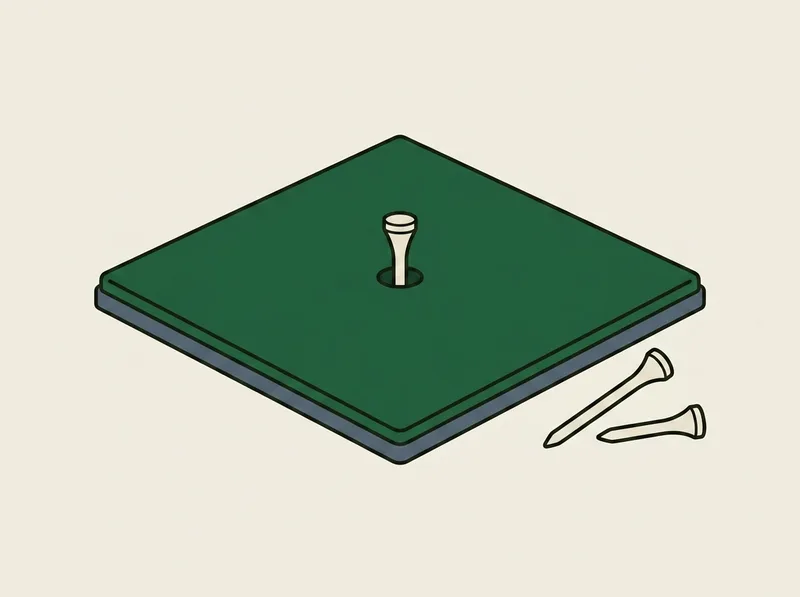
The SimSpace Premium Standard Turf Hitting Mat is the same 1.5 m square as the mat above it, with 17 mm of nylon turf on the same 12 mm foam base, finishing at 29 mm. It carries six perforated tee holes set for right and left handers, and ships with rubber and plastic tees.
Its argument is size at a price. Four foot eleven square is what a driving range uses, and it is the size at which a driver swing stops being a compromise, so this is the cheapest way onto a full-size surface here by some distance.
 Around £180 to £200
SimSpace Premium Standard Turf Hitting Mat
- Turf
- 17 mm nylon
- Base
- 12 mm foam
- Real tee
- No, rubber and plastic tees in six perforated holes
- Build height
- 29 mm
- Rated life
- Not published
- Sizes
- 1.5 m by 1.5 m, 4 ft 11 in square
- Included
- Rubber and plastic tees, six tee holes for either handedness
- Warranty
- Not published
- The cheapest full 4 ft 11 in square here, which is the size at which a driver swing stops being a compromise.
- Publishes its turf pile and its base thickness separately, which only one other mat on this page does.
- Six perforated tee holes set for right and left handers, so tee position is not fixed to one side.
- Twenty nine millimetres is the thinnest total build on this page, and 17 mm of that is turf.
- Rubber and plastic tees only, and 17 mm of pile is too short to push a wooden tee into.
- No published weight, no published warranty and no shot life.
VerdictThe right buy for a golfer who wants a full size square surface and does not need to hit a real tee off it, and the sensible floor of this market. Twenty nine millimetres is genuinely thin, though, so what you put it on becomes part of the product: budget for plywood or a rubber tile if it is going on concrete.
Twenty nine millimetres is the thinnest total build on this page, and that is the number to weigh honestly rather than the price. Seventeen millimetres of pile is not much for a club head to move through, and the 12 mm of foam beneath it is doing all of the cushioning, which means whatever the mat lies on becomes part of the product. Plywood, a rubber gym tile or even an old carpet under it is a cheap upgrade nobody mentions at the point of sale, and on this mat it is closer to a requirement than a nicety.
The six tee holes are the small idea worth having. Most mats fix the tee position, which fixes where you stand; setting holes for both handedness and at more than one point along the mat spreads the wear as well as the stance.
The Net Return Pro Turf: the biggest surface here
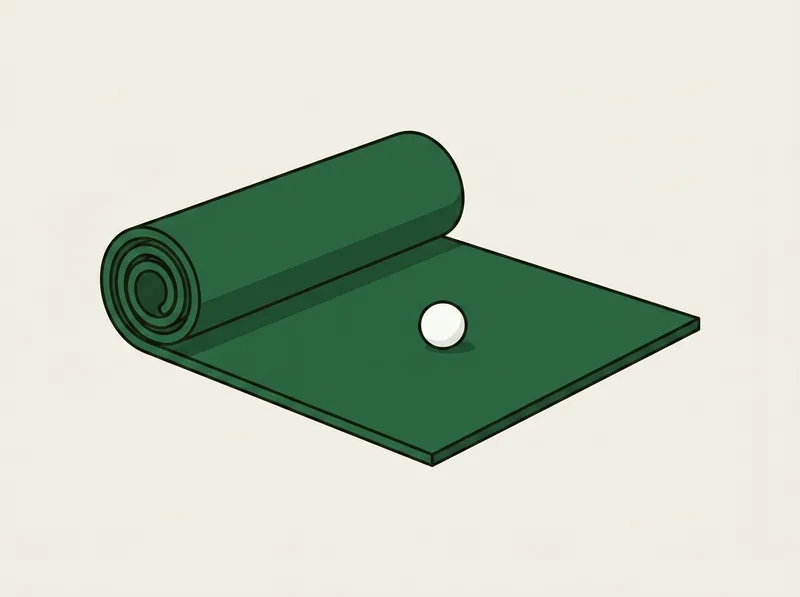
The Pro Turf is 6 ft by 10 ft, a 42 oz nylon face over a 5 mm foam backing, with a 2 inch grass height, a continuous ball return, two rubber tees, a putting speed quoted at around 10 on the Stimpmeter and a three year warranty. It rolls up like a carpet.
Sixty square feet removes every placement compromise at once. Stance, ball position and a full turn all fit without shuffling the mat around, and the same surface takes putts at a stated pace.
 Around £899 at UK retail
The Net Return Pro Turf
- Turf
- 42 oz nylon face, 2 in grass height
- Base
- 5 mm foam backing
- Real tee
- Not published
- Build height
- About 56 mm, 2 in of pile over a 5 mm backing
- Rated life
- Not published
- Sizes
- 6 x 10 ft
- Putting speed
- About 10 on the Stimpmeter
- Warranty
- 3 years
- Included
- Two rubber tees, continuous ball return
- Sixty square feet of surface, so stance, ball position and a full turn all fit without shuffling.
- The face weight is published at 42 oz and the grass height at 2 in, which is unusual detail for the category.
- A published putting speed of around 10 stimp means the same surface does two jobs.
- A 5 mm foam backing under a 6 by 10 ft mat is thin, so the floor under it does most of the cushioning.
- The most expensive mat on this page, and it publishes no shot life at all.
- Sized to sit under a specific range of nets, which is a constraint if you already own something else.
VerdictThe pick if you are building a bay rather than buying a mat, because the size removes every placement compromise and the ball return keeps a session moving. The thin backing means it wants a forgiving floor underneath, and at nine hundred pounds the absence of any shot life figure is harder to forgive than it is lower down this page.
The specification to weigh is that 5 mm backing. Five millimetres of foam under a mat this size means the floor does most of the cushioning, and on concrete that is not much cushioning at all. The 2 inch grass height helps, since there is real material for the club to move through, but the pad is thin for the money. There is also no shot life figure of any kind, which at nine hundred pounds is the least forgivable version of a gap every mat on this page shares.
The two mats you will have read about, and cannot buy here
If you have researched this category at all you will have met the Country Club Elite Real Feel and the Fiberbuilt Grass Series, because they lead almost every American roundup. Neither has a British route to purchase worth the name.
Fiberbuilt ship to the contiguous United States only. Country Club Elite reach Britain solely as an import listing on a marketplace, with no UK distribution behind it and no maker's page in sterling. Both are good mats and neither is a purchase a British golfer should be making on the strength of a review written for a different market, which is why they are named here rather than ranked.
They are still worth reading for one thing. Country Club Elite publish the clearest sizing guidance in this category, and it settles a question people usually get wrong by buying too small.
What actually decides a hitting mat
Five specifications, and only two of them appear on most product pages.
| What to look at | What it changes | What good looks like |
|---|---|---|
| Turf depth and fibre | Whether the club goes into the surface or skids off it | A published fibre type and pile depth, ideally over a subsurface that gives |
| Base construction | Feedback, noise, and load through your joints | A real pad, a rubber base or a gel section, not a 5 mm skin |
| Real tee | Whether a tee shot at home is the shot you play | Turf you can push a wooden tee into |
| Size | Which clubs you can actually swing | 5 ft heel to toe for driver, less for irons |
| Total build height | The honest measure of what is between club and floor | A stated figure. Twenty nine millimetres and fifty six are different products |
Total build height is the number to hold in your head, not turf pile alone. Twenty nine millimetres and fifty six millimetres are different amounts of material between a club travelling at speed and a hard floor, and that governs both the feedback and how your body feels afterwards.
Size: the heel to toe rule
Country Club Elite's own listing states that 3 by 4 ft and 4 by 4 ft mats will not allow most golfers to hit driver, and that you typically need 5 ft in the heel-to-toe direction to do it, which is why the standard range mat is 5 by 5. Anything smaller is a chipping, pitching and iron mat, and there is nothing wrong with that as long as you bought it knowing.
British retail has quietly settled on the metric version of the same rule. Both 1.5 m square mats on this page measure 4 ft 11 in a side, which is the 5 ft standard within an inch, and it is the size to look for on any brand.
The second half of the same point is where you stand. A mat wide enough for the club but not for your feet leaves you standing on the floor and hitting off a raised surface, which changes the effective lie and quietly encourages a thin strike. The TrueStrike is the exception worth naming: at 195.6 by 132.1 cm it is longer than it is deep, and the stance sections are part of the product rather than an afterthought.
Ranges order 5 by 5 mats specifically so the mat can be rotated 90 degrees, which spreads the wear over four times the area. A mat you can turn lasts a good deal longer than the box implies.
Joints, and the thing nobody selling mats says
Hitting mats are the most repetitive practice environment in golf, and repetition is where golf injuries come from. That is worth saying on a page whose job is to sell one.
The Titleist Performance Institute's overview of injury prevalence in golf reports that almost 80% of injuries in professional golfers come from overuse, concentrated in wrists, back, shoulders and hips, while amateur injuries sit mostly in the lower back and elbows and come from technique rather than volume. A mat is not named there as a cause, and nobody publishes a controlled comparison of hitting surfaces against injury rates, so what follows is reasoning from mechanism rather than a cited finding.
The mechanism is simple. A club that meets a surface it cannot enter sends the shock back up the shaft into hands, wrists and elbows. A club that can move through it does not. That is why the TrueStrike gel section leads for high practice volume, and it is also the honest limit of the cheaper end of this page: neither SimSpace mat has anything under the turf but 12 mm of foam, so at that price the floor you lay it on is doing as much of the work as the mat is.
Durability should be a shot count, and here it is nothing
A mat is consumed by swings rather than by time, so the honest unit is shots. It is also the unit that lets you work out the real price: a golfer hitting 100 balls twice a week gets through about 10,000 shots a year, which turns a 300,000 shot rating into an effectively permanent surface and a 150,000 shot one into a very long lived mat.
Not one of the four mats on this page publishes that figure. Neither the £180 mat nor the £899 one. Three of the four publish no warranty terms either, which leaves the Net Return's three years as the only durability commitment of any kind in the whole roundup.
That is a straightforward mark against the category rather than against any one product, and it is worth naming because the American mats that do publish a shot count are the same two you cannot buy here. If a maker will not quote a life in swings, ask them directly before you spend four figures, and treat a warranty in years as an answer to a different question wearing the same clothes.
The mat and the net are one purchase
Almost nobody buys a hitting mat on its own. It arrives as half of a home setup, and buying the halves separately is how people end up with a mat sized for the wrong space.
One placement detail people get wrong: put the mat on something that stops it creeping forward under repeated impact, or buy one heavy enough that it cannot. A mat that slides an inch a swing has moved your ball position by the twentieth shot.
What a mat can and cannot improve
A good mat gives you an honest strike, which is most of what indoor practice can offer. It cannot give you a lie, because every ball on it sits perfectly, so uphill, downhill, rough and hardpan are all missing.
What it does, better than any range mat, is let you rehearse a low point at high volume with real feedback. Where the club bottoms out is the most fixable thing in amateur ball striking, and thin shots and fat shots are two faces of the same fault, which topping the ball sets out from the other direction. The rest of the indoor picture, including what transfers and what only feels like practice, is in practising golf at home.
What to spend
The price ladder in this category maps onto construction rather than onto size, which is worth knowing before you pay for square footage you do not need.
- £50 to £150: a strip or tri-turf mat for chipping, wedges and short irons. Not a driver surface.
- £180 to £200: a full 4 ft 11 in square with around 17 mm of turf on a thin foam base. Put something forgiving underneath it.
- £270 to £300: the same square, with turf deep enough to take a real wooden tee.
- £700 and up: a gel subsurface the club can displace, or the floor space of a full bay.
The jump worth making is from a mat the club bounces off to one it can move into. That is where the surface stops flattering a fat strike and starts reporting it, and it is the only step on that list that changes what the mat teaches rather than how big it is or how long it lasts. Note that the ladder is not a straight line: the most expensive mat here is also one of the thinner ones under the club, because you are buying sixty square feet rather than a subsurface.
Key takeaways
- A thin mat on a hard floor lets the club skid into a fat shot and calls it a good one, which rehearses the wrong low point at high volume.
- Total build height matters more than turf pile alone. Twenty nine millimetres and fifty six are different amounts of material between the club and the floor.
- The TrueStrike Mk7 Single is the default pick: a gel-filled strike section under a sliding top surface that the club displaces rather than bounces off.
- The SimSpace Premium Tee Turf is the only mat here that takes a real wooden tee, at 30 mm of pile on a 12 mm base.
- The SimSpace Standard Turf is the cheapest full 4 ft 11 in square here at around £180, and the thinnest total build on the page at 29 mm, so the floor under it does real work.
- Not one mat on this page publishes a life in shots, and three publish no warranty terms at all. The two mats that do quote a shot count are American and have no British route to purchase.
- You need about 5 ft heel to toe to hit driver off a mat, which is why British retail settles on 1.5 m squares at 4 ft 11 in a side.
- Whatever a thin mat sits on becomes part of the product. Plywood or a rubber tile under it is a cheap and real upgrade.
- Repetition is where golf injuries come from, so prefer a surface the club can move through and cut volume rather than pushing through soreness.
Common questions
What is the best golf hitting mat?
For most golfers with the budget, the TrueStrike Mk7 Single, because its gel-filled strike section lets the club displace the surface instead of skidding off it, which is the whole point of a mat. If a real wooden tee matters or £700 does not, the SimSpace Premium Tee Turf takes one straight into 30 mm of nylon for around £280.
Do golf hitting mats ruin your swing?
A bad one can nudge it in the wrong direction. A thin mat over a hard floor lets the club bounce into the ball after hitting behind it, so a fat strike still produces an acceptable shot and the fault gets rehearsed rather than exposed. A mat with real depth, or a gel section the club can displace, does not do that.
How thick should a golf hitting mat be?
Think in total build height rather than turf pile. The mats on this page run from 29 mm to about 56 mm, and anything at the thin end of that needs something forgiving underneath it if it is going on concrete. Ask for the base thickness separately, because a 40 mm mat that is 35 mm of turf and 5 mm of foam is not the same product as one split half and half.
Can you use a real tee on a golf mat?
Only on a mat built for it, and it is a question of pile depth. The SimSpace Premium Tee Turf accepts a wooden tee pushed straight into 30 mm of pile; the same maker's Standard mat has 17 mm and gives you rubber and plastic tees in perforated holes instead. The TrueStrike uses proprietary rubber TrueTees in a holder. A rubber tee sits at a fixed height and behaves slightly differently at impact, which is the whole of the difference.
What size golf mat do I need for a driver?
About five feet in the heel-to-toe direction, which is why range mats are typically 5 by 5 and why the British standard is a 1.5 m square at 4 ft 11 in a side. Anything at 3 by 4 or 4 by 4 ft will not let most golfers hit driver, and the same logic applies to any brand.
Are golf mats bad for your wrists?
The surface matters more than the mat itself. A club that meets something it cannot enter sends the shock back up the shaft, which is why a thin mat on concrete is the worst combination. A gel subsurface, a real pad or a forgiving floor underneath all reduce it, and cutting volume is more effective than any of them.
How long does a golf hitting mat last?
Nobody selling into Britain will tell you. The honest unit is shots, and not one mat on this page publishes a figure in shots, while three publish no warranty terms either. As a rule of thumb, a golfer hitting 100 balls twice a week gets through roughly 10,000 shots a year, so ask a maker for a swing count before you spend four figures.
Can I put a hitting mat on concrete?
Yes, but put something between them unless the mat has a substantial base of its own. Plywood, a rubber gym tile or a strip of old carpet costs very little and does more for the feel and for your joints than moving up a price bracket in mats.
Is an expensive golf mat actually better?
At this end of the market, mostly yes, and for a specific reason. The money buys a subsurface the club can move through, which is what stops the mat flattering a poor strike. It does not buy you a better swing, and a cheap mat with plywood under it beats an expensive one bought for the wrong size room.
Why are Country Club Elite and Fiberbuilt not on this list?
Because neither can be bought properly in Britain. Fiberbuilt ship to the contiguous United States only, and Country Club Elite reach the UK solely as a marketplace import with no British distribution behind it. Both appear in almost every American roundup of this category, which is worth knowing before you take one as a recommendation.
What is the difference between a hitting mat and a putting mat?
Different jobs and different surfaces. A hitting mat is built to survive a club head arriving at speed and to report where it met the ground. A putting mat is built to roll a ball at a stated pace over a long flat run, and putting a ball on a hitting mat tells you nothing useful about speed.
How we put this together
- Published manufacturer specifications for each mat, taken from the maker's own listing or FAQ rather than a retailer's summary, and prices read in sterling at British retailers rather than converted from a US figure.
- Where a maker publishes no figure, this page records it as Not published rather than borrowing a number from a review site, and treats the gap as part of the assessment.
- One test applied to every mat: what happens to a strike that arrives behind the ball, because a surface that lets the club skid into a fat shot is teaching a fault every time it is used.
- Total build height, turf and base separately, since the layer under the turf is what decides both the feedback and the load through your joints.
- Whether a life is quoted in shots rather than in months, because a mat is consumed by swings and a warranty measured in years tells a golfer who practises daily nothing at all. Not one mat sold into Britain publishes that figure.
- Whether the mat can actually be bought in Britain from a British seller, which rules out two of the mats that dominate American roundups of this category.
- Shot Scope's tracked amateur data on multiple chips inside 50 yards, which is the on-course symptom of the strike a mat is supposed to be improving.
- The Titleist Performance Institute's published position on golf injuries, for the repetition question that indoor practice raises and nobody selling mats mentions.
On this page
- The four, compared
- What a hitting mat does to a fat shot
- TrueStrike Mk7 Single: a surface the club goes into
- SimSpace Premium Tee Turf: a real tee, and a published build height
- SimSpace Premium Standard Turf: the cheapest full square
- The Net Return Pro Turf: the biggest surface here
- The two mats you will have read about, and cannot buy here
- What actually decides a hitting mat
- Size: the heel to toe rule
- Joints, and the thing nobody selling mats says
- Durability should be a shot count, and here it is nothing
- The mat and the net are one purchase
- What a mat can and cannot improve
- What to spend
- How we put this together
Tom Ashworth
Tom Ashworth is a PGA Professional who has taught golf since 2012, working mainly with beginners and mid-handicappers at club level in Surrey. He reviews the instruction guides on Learn Golf for technical accuracy before they publish.
Most of his teaching is with players in their first three years of the game, and most arrive having been told too much: six swing thoughts collected from videos, half of them contradicting each other. His approach is to check the grip and the alignment before touching the swing, on the basis that most bad ball flight is decided at address.