Every driving range works roughly the same way, but nobody explains it, so a first visit means guessing at a machine, a bay and a set of unwritten rules all at once. None of it is complicated. This guide covers how to buy balls, where to stand, what mats and grass tees are for, and what the distance markers actually mean, so the only thing left to think about is the shot.
If a full session is the goal rather than a first look around, driving range practice routine covers how to structure a bucket into blocks that actually build a change. This page is the version for a golfer who has not been to a range before and wants the basics first.
Buying a bucket
Most ranges sell balls in small, medium and large buckets, sometimes called a token or a top-up depending on the venue, and pay either at a staffed desk, a coin or card machine, or increasingly an app tied to the bay. A small bucket is usually somewhere between 40 and 50 balls and is enough for a short warm up before a round. A large bucket runs to 100 balls or more and suits a proper practice session.
There is rarely a reason to buy the largest bucket on a first visit. Quality falls off once a swing gets tired, and a smaller bucket hit with full attention teaches more than a large one hit quickly. How much golf costs covers where a range visit sits in the wider cost of the game.
Finding a bay, and what is inside it
A bay is the individual stall each golfer hits from, usually with a low divider on one or both sides for safety and a small pile of balls delivered to a tray or mat. Ranges rarely assign a bay by name. Any open one is fair game, and the etiquette is simply to leave one empty bay of space between an occupied one and a new arrival where the layout allows it.
Inside the bay there is a mat, sometimes a small bucket or tray for the balls, and often a set of clubs for hire hanging nearby, though most golfers bring their own. Bags rest to the side rather than in the hitting area itself, and phones stay off unless a bay is empty either side.
Mat or grass: which to use
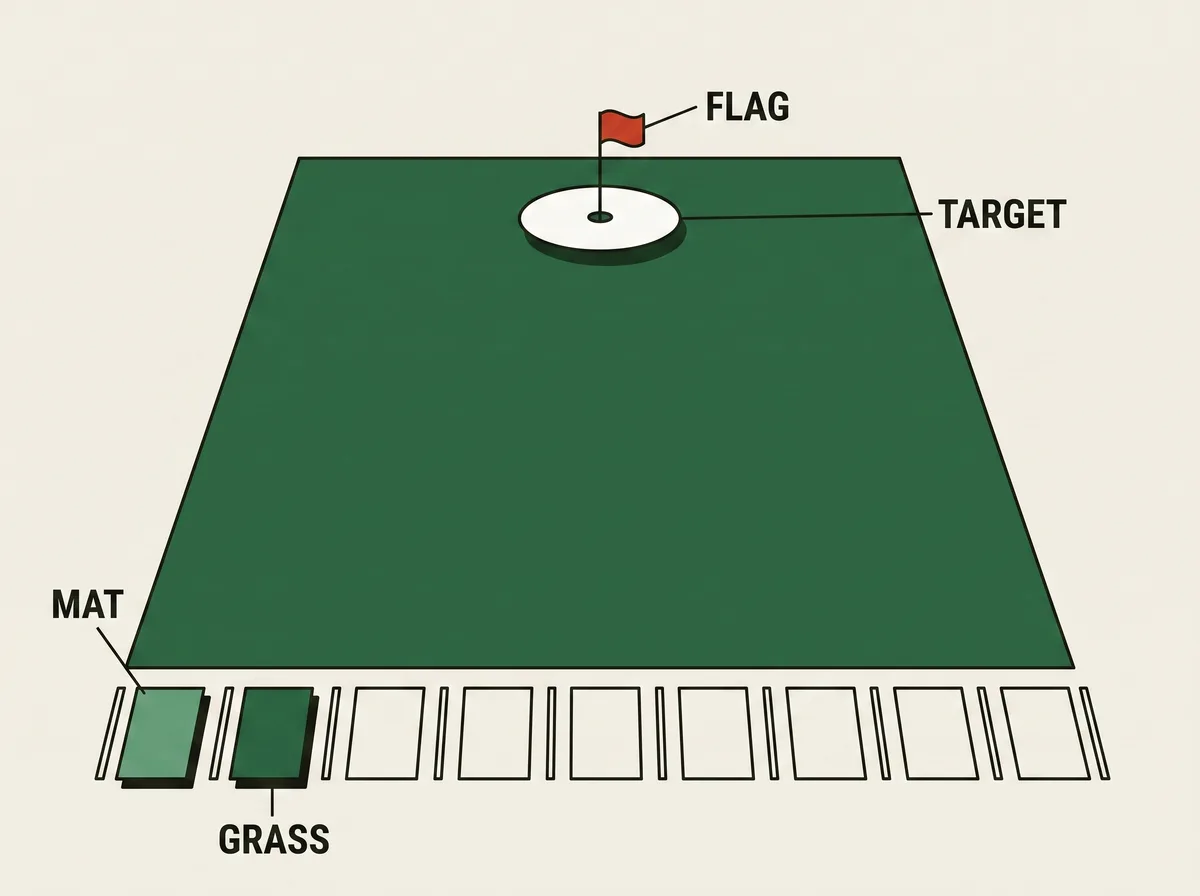
Where a range offers both, the choice matters more than it looks.
A beginner working on pure contact benefits from grass when it is open, because a fat shot feels exactly as heavy as it should. For volume practice, technology testing, or a quick warm up before a round, the mat is the sensible default and the one that will be open every time.
Reading the yardage markers
Ranges mark distance with flags, numbered boards or painted lines, usually at intervals such as 50, 100, 150 and 200 yards. Treat these as rough targets to aim at, not as a precise measurement of how far the ball actually travelled, for two reasons that both push in the same direction.
Range balls are typically older, lower-compression stock than the ball played on the course, and they fly shorter as a result. TrackMan's own data on club distance notes that most golfers already misjudge their real yardages by 10 to 15 yards even with a course ball in normal conditions, and a range ball on top of that gap makes the number on the flag even less reliable as an absolute distance.
| Marker | Useful for |
|---|---|
| 50 yards | Wedge and short game distance control |
| 100 yards | Short iron and gap wedge reference |
| 150 yards | Mid iron reference, the most commonly used marker |
| 200 yards | Long club and driver carry, least reliable on a mat |
Range etiquette nobody explains
Golf etiquette on the course is its own subject, covered in golf etiquette. A range has a shorter, more practical set of habits that exist almost entirely for safety and shared space.
The rest of range etiquette is short enough to list:
- Wait for the bay beside an occupied one to be clear before warming up a driver, since the sound and the practice swing both intrude on a neighbour's routine.
- Keep a bag and any spare clubs out of the hitting area itself, not leaning against the divider where a backswing could catch them.
- Return a hire club to the rack rather than leaving it on the mat, and leave the bay's stray balls for the picker rather than collecting them personally.
- Keep children within the bay rather than the walkway behind the bays, which stays behind every golfer's swing.
Warming up before hitting a driver
Starting a bucket with a driver is the single most common mistake on a range, because the body is cold and the club is the least forgiving one in the bag. Ten balls with a wedge at half length, gradually working up through the bag, gets far more out of the rest of the bucket than starting big and hoping.
Once the basics of paying, finding a bay and reading the yardage markers feel automatic, the next question is what to actually hit. A short iron struck cleanly is worth more early on than a driver hit well once in ten, covered in how to hit irons, and the driver is worth leaving until the rest of the bucket feels comfortable, covered in how to hit a driver.
Key takeaways
- Buy a bucket at the desk, machine or app, and take any open bay.
- Mats are available in any weather and forgive a heavy strike. Grass gives more honest feedback when it is open.
- Yardage flags are rough targets, not precise distances. Range balls and mats both add their own gap on top of the usual 10 to 15 yard misjudgement most golfers already make.
- Never chase a short ball or hit toward the ball picker.
- Warm up with a wedge at half length before reaching for a driver.
- Compare clubs against each other on the range rather than trusting the number on any single marker.
Common questions
How much does a bucket of range balls cost?
It varies by venue, but a small bucket of around 40 to 50 balls is typically the cheapest option and a large bucket of 100 or more costs proportionally more. Ranges attached to a golf course are usually a little more expensive than a standalone practice facility.
Do I need my own clubs to use a driving range?
No. Most ranges hire a basic set for a small fee, which is a reasonable way to try golf before buying anything. Anyone planning to play regularly is better off with their own short set, covered in what clubs does a beginner need.
Should I hit off the mat or the grass?
Grass gives more realistic feedback, especially on a heavy strike, but it is not always open and is unavailable in wet weather. The mat is the reliable default for volume practice and for testing technology, and it will not punish a fat shot the way grass or a real course does.
What do the yardage markers at a driving range mean?
They mark rough distances, usually at intervals such as 50, 100, 150 and 200 yards, and work as aiming points rather than precise measurements. Range balls typically fly shorter than the ball played on the course, so the number on a flag should not be read as an exact yardage.
Can I hit a driver at the range?
Yes, but not as the first club out of the bag. Warming up with a wedge at half length and working up through the bag protects a cold body and produces a better strike once the driver comes out.
Is it rude to retrieve my own golf balls at the range?
Yes, and most ranges prohibit it outright for safety, since it puts a person on a field where balls are still being hit and where a mechanical picker may be operating. Leave stray balls for the collection process.
How do I know which bay to use?
Any open bay is available. Where the layout allows it, leaving one empty bay between an occupied one and a new arrival is the common courtesy, particularly when warming up a driver.
Why does the ball not go as far at the range as it does on the course?
Range balls are usually older and lower compression than the ball played on the course, and mats change how the club interacts with the turf, both of which shorten the result compared with a real fairway. Treat range distances as relative between clubs rather than absolute.
How long should a first driving range visit be?
A small bucket, around 30 to 40 minutes including a proper warm up, is enough for a first visit. There is no need to buy a large bucket before knowing how a session actually feels.
What should a complete beginner practise first at the range?
Contact before anything else. A short iron hit from a comfortable, repeatable setup teaches far more in a first session than a driver ever will, and it is far less discouraging. Golf for beginners covers where a first range visit fits into the wider first year of the game.
Tom Ashworth
Tom Ashworth is a PGA Professional who has taught golf since 2012, working mainly with beginners and mid-handicappers at club level in Surrey. He reviews the instruction guides on Learn Golf for technical accuracy before they publish.
Most of his teaching is with players in their first three years of the game, and most arrive having been told too much: six swing thoughts collected from videos, half of them contradicting each other. His approach is to check the grip and the alignment before touching the swing, on the basis that most bad ball flight is decided at address.