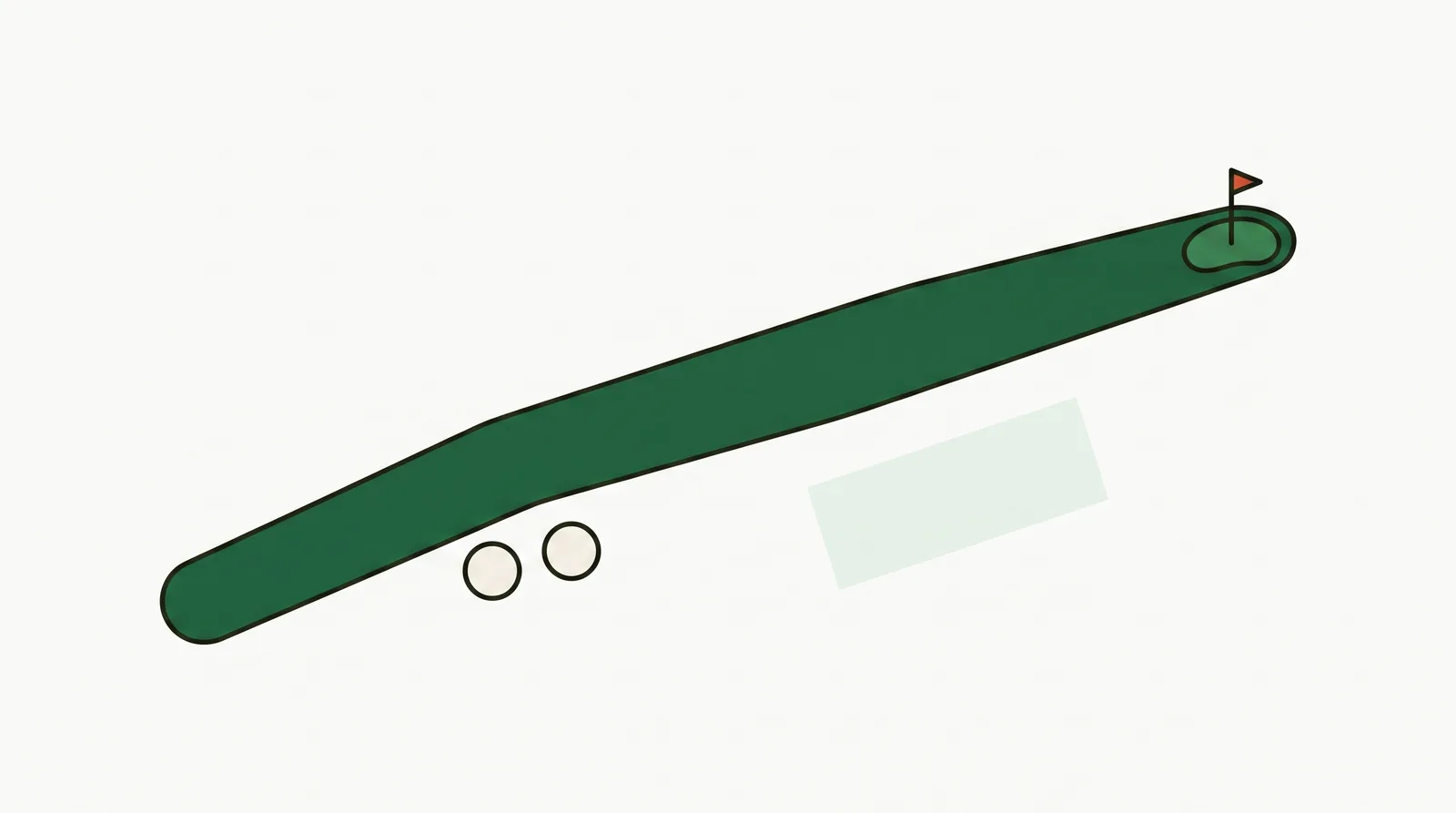
Course management gets taught as a personality trait. Be patient, be disciplined, take your medicine. That framing is why it never sticks, because nobody changes their temperament between the fourth and fifth holes. It works far better as arithmetic: every position on a course has a known average cost in strokes, and a decision is the cheaper of two prices.
Every position on the course has a price
The useful idea underneath all of this is shots to finish: the average number of strokes it takes a golfer of a given standard to hole out from a given place. It is measurable, tracking companies publish it, and it turns an argument about bravery into a subtraction.
Shot Scope's analysis of distance against accuracy gives four numbers that do more work than any other data in amateur golf.
| Tee shot | Where it finishes | Shots to hole out |
|---|---|---|
| Driver | Fairway | 3.45 |
| Driver | Rough, 150 yards left | 3.9 |
| Hybrid | Fairway, 150 yards left | 3.7 |
| Hybrid | Rough, 120 yards left | 3.7 |
Read the bottom three lines together. The safe play in the fairway and the aggressive play in the rough finish within two tenths of a shot of each other, and the hybrid miss and the hybrid hit finish level. The entire gap between the best and worst outcome there is under half a stroke, which is what a normal decision is worth.
Distance is worth more than a good lie, up to about 30 yards
The most useful single rule in the amateur game comes out of the same dataset, and it contradicts what most golfers have been told.
Shot Scope found that roughly 30 yards of distance cancels out the disadvantage of a poor lie. The rough is a real cost, and it is smaller than the cost of being 30 yards further back.
| From the rough | Equivalent from the fairway | Shots to finish |
|---|---|---|
| 70 yards | 100 yards | 3.4 |
| 170 yards | 200 yards | 4.0 |
The consequence is uncomfortable for anyone who has been told to keep the ball in play at all costs. Trading 30 yards for a better chance of light rough is roughly break-even, and trading more than that is losing money slowly. The reason to take less club off the tee is never the fairway in general. It is a specific piece of trouble that turns a miss into something other than an ordinary next shot.
Note what this does not say. Light rough is not thick rough, a fairway bunker or a tree line, and a lie that removes your ability to advance the ball sits in a different category, which is the next section. If you routinely find the heavy stuff, the recovery technique is in hitting out of the rough.
What actually costs shots is penalties and recoveries
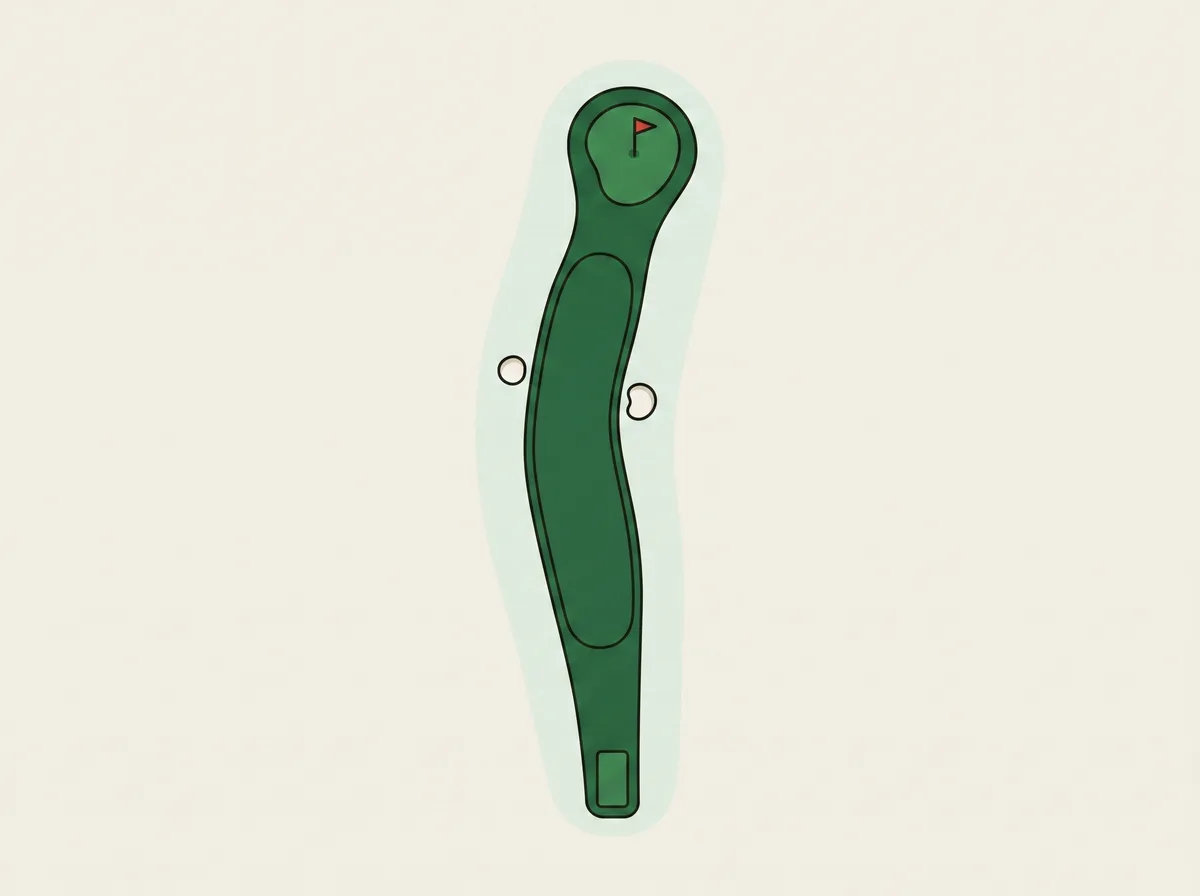
Amateur golfers think their problem is missing greens. The data says otherwise, and the distinction is the most valuable thing on this page.
Arccos, whose dataset covers more than 1.5 billion tracked shots across 25 million rounds, reports that 45.1 percent of all driver tee shots by 30 or higher handicap players end in a penalty or a recovery situation, against 12 percent for players between scratch and 4.9. Their separate look at realistic expectations by handicap has a 10 handicap taking three or more penalty shots in around a quarter of their rounds.
Those are not shots lost to a poor strike. They are shots lost to positions from which a normal swing at the green is no longer available, and that is the definition of trouble worth using.
| Where the ball finishes | What it really costs | How to treat it |
|---|---|---|
| Light rough | Under half a shot, less than being 30 yards back | Not trouble. Take the distance |
| Fairway bunker | Around 1.4 shots a round for the average golfer | Real trouble. Worth a club change to avoid |
| Trees with no gap | One shot minimum, often two | Real trouble. Chip out sideways and move on |
| Thick rough, ball sitting down | Costs the ability to control distance | Advance it to a full-swing number |
| Water or out of bounds | A stroke plus the distance, and often the hole | The only thing worth changing your whole plan for |
The fairway bunker figure comes from Shot Scope's work on driving accuracy, and it surprises people most. A bunker 240 yards out is a bigger threat to your card than the rough on both sides put together, because it removes the shot rather than degrading it.
The same rule applies around the greens. Arccos found a 10 handicap takes the same number of shots to hole out from 12 yards in the rough as from 81 feet on the putting surface, which is 27 yards away. Anything that gets the ball onto the green buys a large amount of distance for free.
Aim the pattern, not the ball
Golfers aim at a target as though the ball will go there. It will not. Every golfer has a shot pattern, roughly a cone that widens with distance, and the only question on a tee is where that whole cone fits.
That changes the decision. A 200 yard cone that is 60 yards wide will not fit a fairway with water down one side, however well you aim it. A 160 yard cone that is 40 yards wide might. Club choice is made by the width of the pattern, not by the distance to the target.
- Stand on the tee and find the widest landing area you can reach, not the furthest point down the hole.
- Name the one thing on the hole that would cost you two shots rather than one.
- Ask which club puts your whole pattern, including the miss you have hit three times this month, outside it.
- Aim at the edge of the safe area furthest from the trouble rather than at its middle, so your bad side still finds grass.
- Commit before you address the ball. Changing your mind over it is what produces the tentative swing that finds the trouble anyway.
Two habits make this workable. Know your carry numbers, because a pattern you cannot locate is not a plan, which is what a personal club distance chart is for. And be honest about the pattern's shape: a golfer who curves the ball one way has a cone that is not centred on their aim, and pretending otherwise is why the same side of the course keeps eating their golf balls.
Plan the hole backwards
The best habit in course management costs nothing and almost nobody does it. Look at the green first, then work back to the tee.
Start with the flag and which side of the green leaves a straightforward next shot. That tells you which side of the fairway makes the approach easiest, because the angle into a green changes what the shot has to do. Then ask what distance you want to play the approach from, which is usually a full swing with a club you trust rather than the shortest possible number. Only then pick the tee shot.
Working forwards produces the standard amateur sequence: hit it as far as possible, then deal with whatever is left. Working backwards gives every shot a job, and it takes about fifteen seconds once it is a habit, because most holes only offer two or three sensible plans.
Par 5s are where this pays most, and the arithmetic of laying up against going for it is in how to play a par 5. The club question inside all of it is in golf club selection.
Conditions move the numbers
Every figure on this page assumes a normal day, and a golf course is rarely having one.
Firm ground moves the landing area of every shot and makes greens harder to hold, which argues for landing short and letting it run rather than for a heroic carry. Soft ground does the reverse and quietly costs distance everywhere. Wind is the largest variable in the amateur game and the most underestimated, especially into the breeze, and it is covered in playing golf in the wind.
Altitude is the one golfers guess at, and it is measurable. Arccos found a 10 handicap gains 19.2 yards, about 8.3 percent, above 5,000 feet compared with sea level. On a holiday round somewhere high, every club is a club and a half longer, and the first three holes are where that gets discovered expensively.
Judge the decision, not the result
The hardest habit is the last one. A good decision can produce a bad hole and a terrible decision can produce a birdie, and golfers overwhelmingly learn from the outcome rather than from the choice.
The 5 iron threaded between two trees that finishes on the green teaches a lesson that will cost you for years. It was the right shot perhaps one time in eight, and the other seven include a triple bogey and a lost ball. The only honest way to evaluate it is to ask what happens if you play it ten times.
Which is why a record beats memory. Circle every hole that went two or more over par and write down the single decision that made it inevitable. Most golfers find the same two or three repeating all season. The chain that turns one bad shot into a big number is how to avoid big numbers, and accepting a bad hole and moving on belongs to the golf mental game.
What changes as you get better
Course management is not one set of rules. The correct amount of aggression rises as your pattern tightens, which is why advice aimed at a 20 handicap sounds absurd to a 5 handicap.
| Standard | The decision that costs most | What to fix first |
|---|---|---|
| Shooting over 100 | Attempting recovery shots that need a perfect strike | Get back to a normal lie in one shot, every time |
| Shooting 90 to 100 | Taking on trouble that is genuinely in reach | Choose the club by where the pattern fits |
| Shooting 80 to 90 | Aiming at flags that are guarded on the short side | Play to the fat of the green unless the lie is perfect |
| Shooting under 80 | Being too conservative and capping the score | Take on flags where your miss is a fringe, not a bunker |
The level specific versions sit either side of this page. The double bogey chain, tee shot club selection and centre of green aiming are in intermediate golf tips, and miss side selection and scrambling in advanced golf tips. None of it can give you an execution you do not own, which is why the plan and the practice move together, and the range half of that is in a driving range routine.
Key takeaways
- Price a decision in shots to finish rather than in yards or in courage.
- Ordinary decisions are worth tenths of a shot. Disasters are worth two or three, so spend your attention there.
- Around 30 yards of distance cancels out the disadvantage of a poor lie, so light rough is not a reason to lay back.
- Penalties and recovery situations, not ordinary misses, are what separate handicaps off the tee.
- A fairway bunker costs the average golfer around 1.4 shots a round and deserves a club change.
- Aim your whole shot pattern, not the ball, and pick the club whose pattern fits the space.
- Plan every hole backwards from the flag, so each shot has a job.
- Firm, soft, windy and high all move the numbers, and altitude moves them by more than golfers expect.
- Judge a decision by what it would do ten times, not by what it did once.
Common questions
What is course management in golf?
It is the set of decisions made before each swing: which club, which target, and which risks to accept. The practical version is pricing each option in average shots to hole out and choosing the cheaper one, rather than deciding on feel or on what a better player would do.
Does course management actually lower your score?
Yes, and it is the cheapest improvement available because it needs no practice. Most of the gain comes from removing a small number of expensive decisions a round rather than from optimising every shot, and it arrives immediately rather than after weeks of work.
Should I always lay up rather than hit driver?
No. Tracked amateur data has roughly 30 yards of distance cancelling out the disadvantage of a poor lie, so trading big distance for a marginally better lie is usually a losing deal. Take less club when a specific hazard is genuinely in range, not as a general policy.
What counts as trouble on a golf hole?
Anything that removes your ability to make a normal swing at the green. Water, out of bounds, trees with no gap, fairway bunkers and rough deep enough to hide the ball all qualify. Light rough does not, and treating it as though it does costs distance for nothing.
How do I stop making big numbers?
By changing the shot after the bad one rather than the bad one itself. Big numbers almost always come from attempting a recovery that requires a perfect strike. Getting the ball back to an ordinary lie with an ordinary swing converts most would-be triples into bogeys.
Should I aim at the flag or the middle of the green?
At the widest part of the green you can reach with the trouble out of play, which on most holes is the middle. The exception is a green that is very long with a front flag, where the middle can leave a putt long enough to three-putt. Aggression is earned by a tight shot pattern, not by confidence.
How do I know my own shot pattern?
By recording where the ball actually finishes for three or four rounds, not by remembering. Write down your tee shot result and its side on every hole. Most golfers discover a distinct bias they had been mentally averaging out, and one number tells them how wide their pattern really is.
How much does wind and altitude change club selection?
More than most golfers allow. Tracked data has a 10 handicap gaining about 19 yards, roughly 8 percent, above 5,000 feet compared with sea level. Wind into the face costs more than the same wind behind gives back, so take the extra club early rather than after the first shot comes up short.
How long does it take for better decisions to show up on the card?
Immediately for the disasters and slowly for everything else. Removing one blow-up hole a round is worth two or three shots straight away, while gains from better angles and club choice are small per shot and only visible across several rounds.
On this page
Tom Ashworth
Tom Ashworth is a PGA Professional who has taught golf since 2012, working mainly with beginners and mid-handicappers at club level in Surrey. He reviews the instruction guides on Learn Golf for technical accuracy before they publish.
Most of his teaching is with players in their first three years of the game, and most arrive having been told too much: six swing thoughts collected from videos, half of them contradicting each other. His approach is to check the grip and the alignment before touching the swing, on the basis that most bad ball flight is decided at address.