A golfer who shoots 94 does not have a swing problem. They have a swing that works on eleven holes out of eighteen and falls apart on the rest, and it is the rest that the card records. This guide is about those holes: where the shots actually leak once you can strike the ball, which of the leaks are cheap to close, and the order worth attacking them in.
What actually separates a 94 from an 86
The gap between shooting in the 90s and shooting in the 80s is smaller than it feels from inside it, and it is almost entirely made of things that are not the full swing.
Shot Scope's benchmark data on breaking 90 puts it in three numbers. A golfer who cards a score in the 90s hits 3.6 greens in regulation, puts six tee shots a round into trouble, and takes four or more three-putts. A golfer who cards a score in the 80s hits 5.4 greens, puts four tee shots in trouble, and three-putts three times or fewer.
| Metric | Shoots in the 90s | Shoots in the 80s |
|---|---|---|
| Greens in regulation | 3.6 a round | 5.4 a round |
| Tee shots into trouble | 6 a round | 4 a round |
| Three putts | 4 or more | 3 or fewer |
Two greens. Two tee shots. One three-putt. That is the whole difference, and none of it requires a swing you do not already own. It requires you to stop giving shots away in the places you are currently giving them away.
Every left and right on this page assumes a right-handed golfer. If you play left-handed, swap them and nothing else changes.
Find your own leaks before you fix anyone else's
Most intermediate golfers can tell you what they think is wrong with their game and most of them are wrong about it. The shot you remember is the one that felt worst, not the one that cost most, and those are rarely the same shot.
The cheapest fix is an audit. For three rounds, write four things on the card beside each hole: the club you hit off the tee, whether the tee shot finished in play, how many shots you took from inside 100 yards, and how many putts. Nothing else. Four columns and no judgement.

Three rounds is enough to see a pattern that a season of vague dissatisfaction will not. Almost everyone who does this finds the same two things: a particular club that keeps producing the trouble shots, and a cluster of holes where the score inflates from inside 100 yards rather than off the tee.
Shot tracking systems do the same job automatically and in more detail, and their real value is not the technology, it is that they compare your shots against golfers at your level rather than against a professional. A pencil and four columns gets you most of the way there for nothing, and it has the advantage of forcing you to notice the pattern yourself.
Course management: play the shot you actually own
This is the largest and cheapest source of shots available at this level, and it needs no practice at all. It is a set of decisions made before each swing rather than a skill.
The first decision is off the tee, and it is not the one most golfers think they are making. Across large amateur datasets, a 3 wood hits barely more fairways than a driver does, so swapping down for general accuracy is a poor trade: you give away real distance for an accuracy gain small enough to disappear inside the noise.
The reason to leave the driver in the bag is therefore never accuracy in the abstract. It is a specific piece of trouble on a specific hole. The right question on the tee is not "which club is straighter", it is "which club cannot reach the thing that will cost me two shots".
- Stand on the tee and find the trouble, not the target. Water, out of bounds, a bunker at 240 yards, a tree line down one side.
- Ask what club takes that trouble out of range entirely.
- If driver still leaves you short of it, hit driver.
- If it does not, hit the club that does, and accept the longer approach.
- Aim at the widest part of the fairway rather than the middle of it. They are often not the same place.
The second decision is the approach. Aim at the middle of the green, every time, until you are genuinely good enough for the flag to be worth the risk. Shot Scope's data on greens hit shows a 15 handicap hits 23% of greens in regulation and a 20 handicap hits 16%. From 100 yards in the fairway, a 15 handicap hits the green 49% of the time and a 20 handicap 42%.
| Handicap | Greens in regulation | Greens hit from 100 yards in the fairway |
|---|---|---|
| 0 | 62% | 74% |
| 5 | 46% | 65% |
| 10 | 35% | 57% |
| 15 | 23% | 49% |
| 20 | 16% | 42% |
| 25 | 9% | 36% |
Read that as a permission slip. If you hit fewer than one green in four, the flag is not a target, it is a coin flip with a penalty attached. Aiming at the centre turns a large share of your misses from short-sided disasters into ordinary two-putt bogeys, and bogeys are not what is wrecking your card.
Par 5s are where intermediate golfers most often talk themselves out of shots. Shot Scope's comparison of going for it against laying up found that laying up costs roughly 0.6 shots per hole on average, which over four par 5s is about two shots a round. The same data shows why: from 110 yards, a shot from the fairway finishes an average of 64 feet from the hole against 80 feet from the rough, and from 50 yards it is 35 feet against 48 feet. Being closer helps even when you miss.
The nuance that matters at this level is what "going for it" means. It does not mean taking on a forced carry over water with a 3 wood off a downhill lie. It means advancing the ball as far as you comfortably can towards a spot with no trouble around it, rather than deliberately wedging backwards to a "favourite number" you have never actually measured. The full framework sits in golf course management, and the specific mechanics of stopping a hole running away from you are in how to avoid big numbers.
Wedge distance control, the biggest single scoring lever
Once the disasters stop, the next block of shots is sitting inside 100 yards, and almost nobody at this level has any control over how far the ball goes from there.
The problem is not the swing. It is that most intermediate golfers own exactly one wedge shot, a full swing, and then try to hit it softer when the number is smaller. Hitting a full swing softer is the least repeatable thing in golf, because you are changing speed, which changes everything, rather than changing length, which changes only distance.
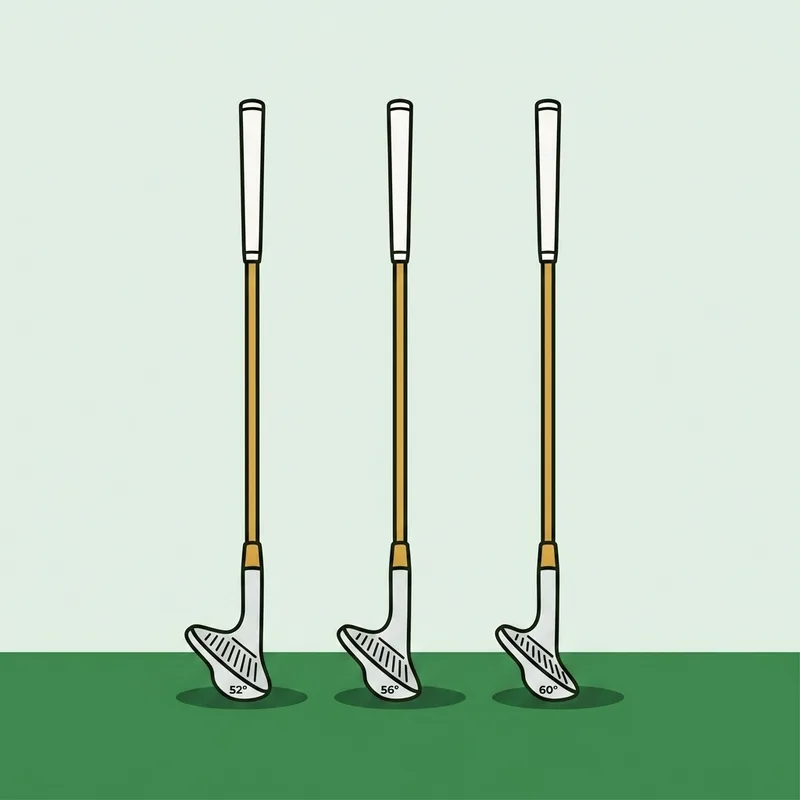
The fix is a system: three fixed backswing lengths per wedge, each swung at the same unhurried speed. Three lengths across three wedges gives you nine known distances, which covers everything between 40 and 115 yards for most golfers.
The three lengths are defined by where the hands stop, not by how the shot feels. Hip height, chest height, and a full but unhurried backswing. Speed and rhythm stay identical across all three, and the follow-through mirrors the backswing rather than being cut short.
| Backswing length | Where the hands stop | What stays the same |
|---|---|---|
| Short | Level with the trail hip | Speed, rhythm, and a full finish |
| Medium | Level with the chest | Speed, rhythm, and a full finish |
| Full | Above the trail shoulder, unhurried | Speed, rhythm, and a full finish |
Measuring them takes one session. Go to a range with marked targets or a launch monitor, pick your sand wedge, and hit ten balls at each of the three lengths. Ignore the two best and the two worst and write down the middle of what is left. Repeat with the other two wedges. Then put the numbers on a card and keep it in the bag.
| Swing length | 56 degree sand wedge | 52 degree gap wedge | 46 degree pitching wedge |
|---|---|---|---|
| Hands to hip height | 40 yards | 50 yards | 60 yards |
| Hands to chest height | 65 yards | 78 yards | 90 yards |
| Full and smooth | 85 yards | 100 yards | 115 yards |
Those are one golfer's numbers from one measured session, printed here to show the shape of the card rather than the contents. Yours will be different, and the entire point is that they are yours rather than someone else's.
Proximity data explains why this is worth a session. From 60 to 100 yards, Shot Scope's proximity figures put the average amateur approach at 40 feet from the fairway, 46 feet from the rough and 56 feet from a bunker. A golfer with three known wedge distances is not going to start hitting it to four feet, but they will stop leaving the ball 25 yards short of the green, and that shot is worth more than any putt they will hole this year.
The full breakdown of the system, including partial shots inside 40 yards and how to gap the wedges themselves, is in wedge distance control.
The chip that stops a double becoming a triple
Missing greens is normal at this level. Turning a missed green into a two-shot mess is the thing to stop.
A greenside chip is not a small version of a full swing. It is a putting stroke with a lofted club: the ball sits back of centre, the weight starts and stays on the lead foot, the hands lead the club head, and the wrists stay quiet. The club changes the shot, not the swing.
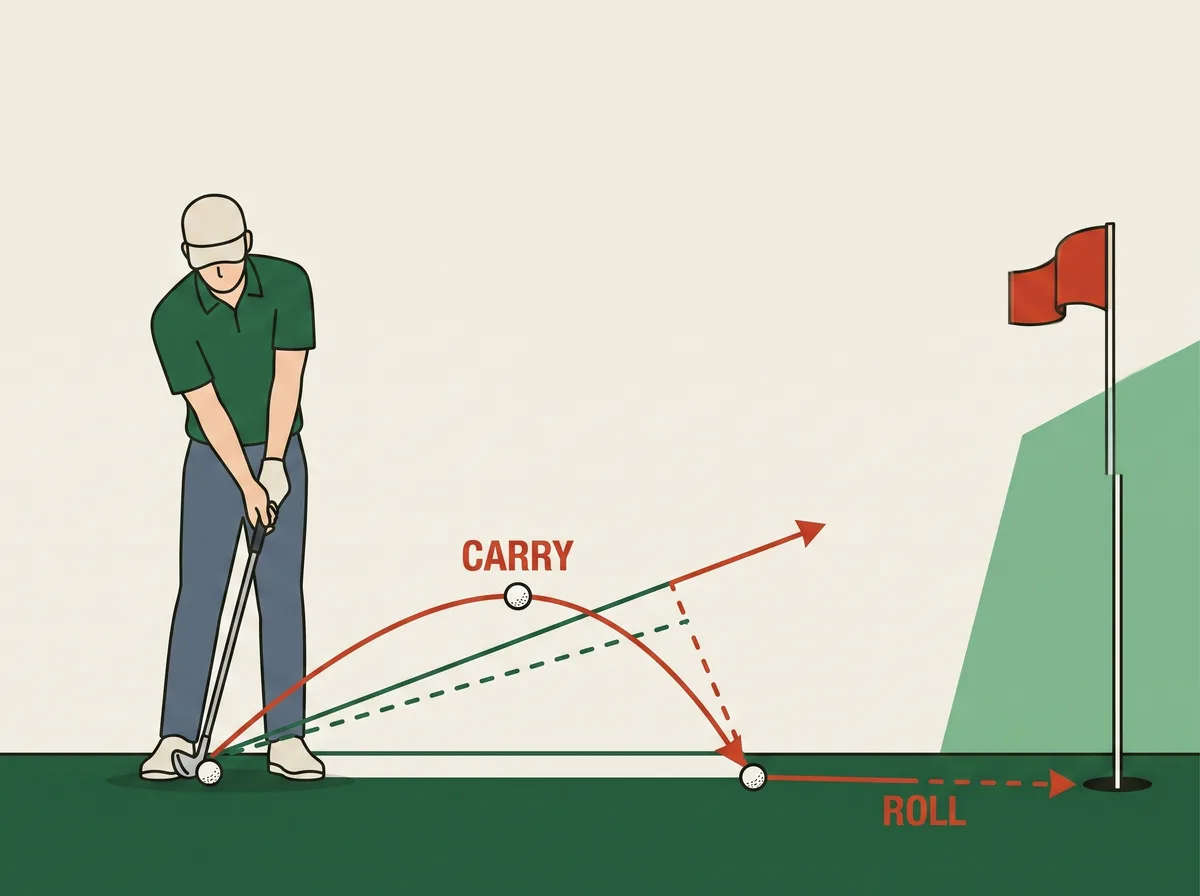
Because the ratio of carry to roll is fixed by the loft, the club is a lever you can use rather than a decision to agonise over. The rough starting points below are worth treating as a hypothesis to test on your own greens rather than a law, because they move considerably with green speed and slope.
| Club | Rough carry to roll ratio |
|---|---|
| Sand wedge | 1 to 1 |
| Pitching wedge | 1 to 2 |
| 9 iron | 1 to 3 |
| 8 iron | 1 to 4 |
| 7 iron | 1 to 5 |
The practical version is simple. Find the flattest spot on the green you can land the ball on, about a yard or two on. Work out how much green is left between there and the hole. Pick the club whose ratio matches. Then make the same stroke you would have made with any of them.
The full technique, including setup, ball position and what to do from an awkward lie, is in how to chip a golf ball.
Putting: kill the three-putt before you chase the make
Intermediate golfers practise holing putts. The scoring gain is almost entirely in the other thing.
Look at what actually separates handicap levels on the green. Shot Scope's make percentages by handicap show that from six feet and out, the difference between a 5 handicap and a 20 handicap is remarkably small.
| Distance | 5 handicap | 10 handicap | 15 handicap | 20 handicap |
|---|---|---|---|---|
| 0 to 6 ft | 90.2% | 89.3% | 84.4% | 84.0% |
| 6 to 12 ft | 41.4% | 38.1% | 39.6% | 37.8% |
| 12 to 18 ft | 23.9% | 20.2% | 20.2% | 18.8% |
| 18 to 24 ft | 13.0% | 10.3% | 11.2% | 11.8% |
| 24 to 30 ft | 10.1% | 5.4% | 7.8% | 6.8% |
| 30 ft plus | 4.3% | 2.8% | 3.2% | 1.9% |
From 12 to 18 feet, a 5 handicap makes about one in four and a 20 handicap makes about one in five. That difference is worth almost nothing over a round. The gap that matters is at the top of the table, inside six feet, and the way to spend more time inside six feet is to hit better lag putts rather than to make more twelve-footers.
Two habits do most of the work. First, every long putt gets its speed rehearsed by looking at the hole rather than the ball while you make practice strokes. Second, every long putt is aimed to finish just past the hole rather than at it, because a ball that dies at the front edge was never going in and still leaves you three feet.
The mechanics of speed control, including how to read pace off a slope, sit in putting distance control.
Own one shot shape and aim off it
Intermediate golfers usually have a miss. They also usually spend every round hoping it will not appear, which is a strategy with no plan attached.
The better approach is to accept the shape, aim to allow for it, and only then work on reducing it. A golfer who reliably curves the ball ten yards left to right and aims ten yards left has a functioning golf game. A golfer with the same curve who aims at the flag has a bad day waiting on every hole with trouble down the right.
The reason this works is that the clubface decides where the ball starts and the gap between the face and the club's direction of travel decides how much it bends. Neither of those things is random. They are the same on most swings you make, which is why your miss has a shape at all.
Shaping the ball deliberately in both directions is a different skill and belongs a level up. It is covered in advanced golf tips, and it is worth reading only once one shape is genuinely reliable.
How a par 4 becomes a 7
Big numbers almost never come from one catastrophic shot. They come from a chain, and the chain has the same shape nearly every time.
The sequence runs like this. A drive finds the trees. The golfer takes on a 5 iron gap between two trunks instead of chipping out sideways, and catches a branch. Now they are 190 yards out in the rough, still needing a hero shot, and they attempt one. It comes up in a greenside bunker, short-sided. The bunker shot stays in. Two putts. Seven.
Exactly one decision in that chain was expensive, and it was the second one. The drive was bad luck. The recovery attempt was a choice, and it was the moment the hole stopped being a bogey.
The rule that removes most of these is worth memorising as a sentence: after a bad shot, the next shot's only job is to get the ball back to somewhere ordinary. Not to save par. Not to make up the distance. Just back to a fairway, a normal lie, a full swing at a green.
Practising when you play twice a month
The intermediate golfer's real constraint is not talent, it is that they get out perhaps twice a month and practise less than that. That changes what practice should look like, because there is no room in the budget for a swing rebuild that takes a season to bed in.
Spend the time where the shots are. Roughly half of everyone's shots happen within 50 yards of the hole, and that half needs no speed, no flexibility and no swing change.
| Minutes | What | Why it is there |
|---|---|---|
| 10 | Long putts from 30 to 40 feet, scoring proximity | Removes three-putts |
| 15 | Chips and pitches to a specific landing spot | Converts missed greens into bogeys |
| 20 | Three wedge distances, alternating targets | The largest single scoring lever |
| 15 | Full swing, one club, one target, half of them at 80% | Keeps the strike honest |
Sixty minutes, and the full swing gets a quarter of it. That split will feel wrong to almost every golfer reading it, which is precisely why the short game stays where it is.
Two rules make the hour transfer to the course. Change targets constantly, because a range session where you hit the same shot forty times teaches your body something the course will never ask for. And hit every shot with a full routine, including the walk in behind the ball, on at least a third of your balls.
More on structuring limited practice time, including what to do with a session that is only twenty minutes long, is in how to practise golf effectively.
The order to do this in
Everything above is worth doing. Doing it all at once is why people stall.
| Order | What | Roughly how long | You are done when |
|---|---|---|---|
| 1 | Tee-shot club selection and centre-of-green aiming | One round | You can name the trouble on every tee before you pick a club |
| 2 | The recovery rule after a bad shot | 3 to 5 rounds | Your worst hole in a round is a double, not a seven |
| 3 | Lag putting for proximity | 3 weeks | Three or fewer three-putts a round |
| 4 | Three measured wedge distances | 4 weeks | You know your numbers without guessing |
| 5 | Chipping with the right club rather than the most lofted | 4 weeks | You get down in two from beside the green about a third of the time |
That is roughly three months, and none of it involves changing a swing. The temptation is to skip to a lesson and a swing rebuild, because that feels like real improvement and the list above feels like admin. The card disagrees.
There is one genuine exception. If your ball striking is so inconsistent that you cannot predict whether a 7 iron will travel 90 yards or 150, none of the strategy above can help you, because strategy needs a predictable outcome to work with. In that case the strike comes first, and the place to start is inconsistent ball striking.
Key takeaways
- Two greens, two tee shots and one three-putt is the entire difference between a 94 and an 86.
- Your score is decided by your worst holes, so removing doubles beats chasing birdies.
- On the tee, pick the club that cannot reach the trouble rather than the one that goes furthest.
- Aim at the fattest part of the green you can reach. At under one green in four, the flag is a coin flip.
- Three fixed backswing lengths across three wedges gives nine known distances and beats swinging softer.
- From six feet and out, a 5 handicap and a 20 handicap hole almost the same percentage. Lag putting is where the gain is.
- Chip with the lowest-lofted club that reaches the landing spot, and putt from off the green when you can.
- After a bad shot, the next shot's only job is to get back to somewhere ordinary.
- Give the short game most of your practice hour, however wrong that feels.
Common questions
What counts as an intermediate golfer?
Broadly a golfer who shoots between about 88 and 100, has a swing that produces a usable shot most of the time, and knows the rules and etiquette well enough not to think about them. In handicap terms that is roughly 15 to 22, though the score band matters more than the number.
What should an intermediate golfer work on to lower their score?
Course management, wedge distance control and lag putting, in that order. All three are cheap, none of them requires a swing change, and together they account for most of the gap between a score in the 90s and a score in the 80s.
Do I need lessons at this level or can I work it out myself?
Both are defensible. A lesson is worth far more once you can strike the ball, because a coach can watch you play rather than teach you to swing. What does not work is a lesson every few months on a different topic, because no change gets long enough to bed in.
How do I stop making double bogeys?
Almost always by changing the second shot on a hole rather than the first. Big numbers come from attempting a hero recovery after a bad drive. Getting the ball back to an ordinary lie with an ordinary shot turns most would-be doubles into bogeys.
Should I hit driver on every par 4 and par 5?
No, and yes more often than most golfers think. A 3 wood hits barely more fairways than a driver across large amateur datasets, so trading distance for accuracy in general is a poor deal. Leave the driver in the bag only when a specific piece of trouble is in reach of it.
How far should an intermediate golfer hit each club?
Far less consistently than the charts suggest, which is why measured personal numbers beat published averages every time. Spend one range session recording your own distances with a mid iron and three wedges, and use those rather than what a friend claims to hit.
Why am I inconsistent from one round to the next?
Usually because the good rounds and the bad rounds contain the same shots in different proportions. One extra tee shot in trouble and one extra three-putt is a five-shot swing on its own, without your swing having changed at all.
Is it better to practise chipping or putting?
Putting removes more shots first, because three-putts are frequent and predictable. Chipping matters more once the three-putts are gone, because it decides how many of those putts start from six feet rather than 30.
How many greens should I be hitting?
At a 15 handicap the recorded average is about 23% of greens, and at 20 handicap about 16%. If you are hitting four or five greens a round you are performing normally for the level, and the score is being decided somewhere else.
How long does it take to go from shooting in the 90s to the 80s?
For a golfer playing a couple of times a month and practising with any structure, a few months is realistic, and it usually arrives as a step rather than a slope. It comes from removing bad holes, so the first sign is that your worst score on a hole falls before your average does.
Should I change my swing to stop slicing, or just aim left?
Aim to allow for it now and work on it separately. A predictable curve you have aimed for is a playable golf shot. A curve you are hoping will not appear is a hazard on every hole, and correcting a swing takes weeks that your next round does not have.
On this page
- What actually separates a 94 from an 86
- Find your own leaks before you fix anyone else's
- Course management: play the shot you actually own
- Wedge distance control, the biggest single scoring lever
- The chip that stops a double becoming a triple
- Putting: kill the three-putt before you chase the make
- Own one shot shape and aim off it
- How a par 4 becomes a 7
- Practising when you play twice a month
- The order to do this in

Tom Ashworth
Tom Ashworth is a PGA Professional who has taught golf since 2012, working mainly with beginners and mid-handicappers at club level in Surrey. He reviews the instruction guides on Learn Golf for technical accuracy before they publish.
Most of his teaching is with players in their first three years of the game, and most arrive having been told too much: six swing thoughts collected from videos, half of them contradicting each other. His approach is to check the grip and the alignment before touching the swing, on the basis that most bad ball flight is decided at address.