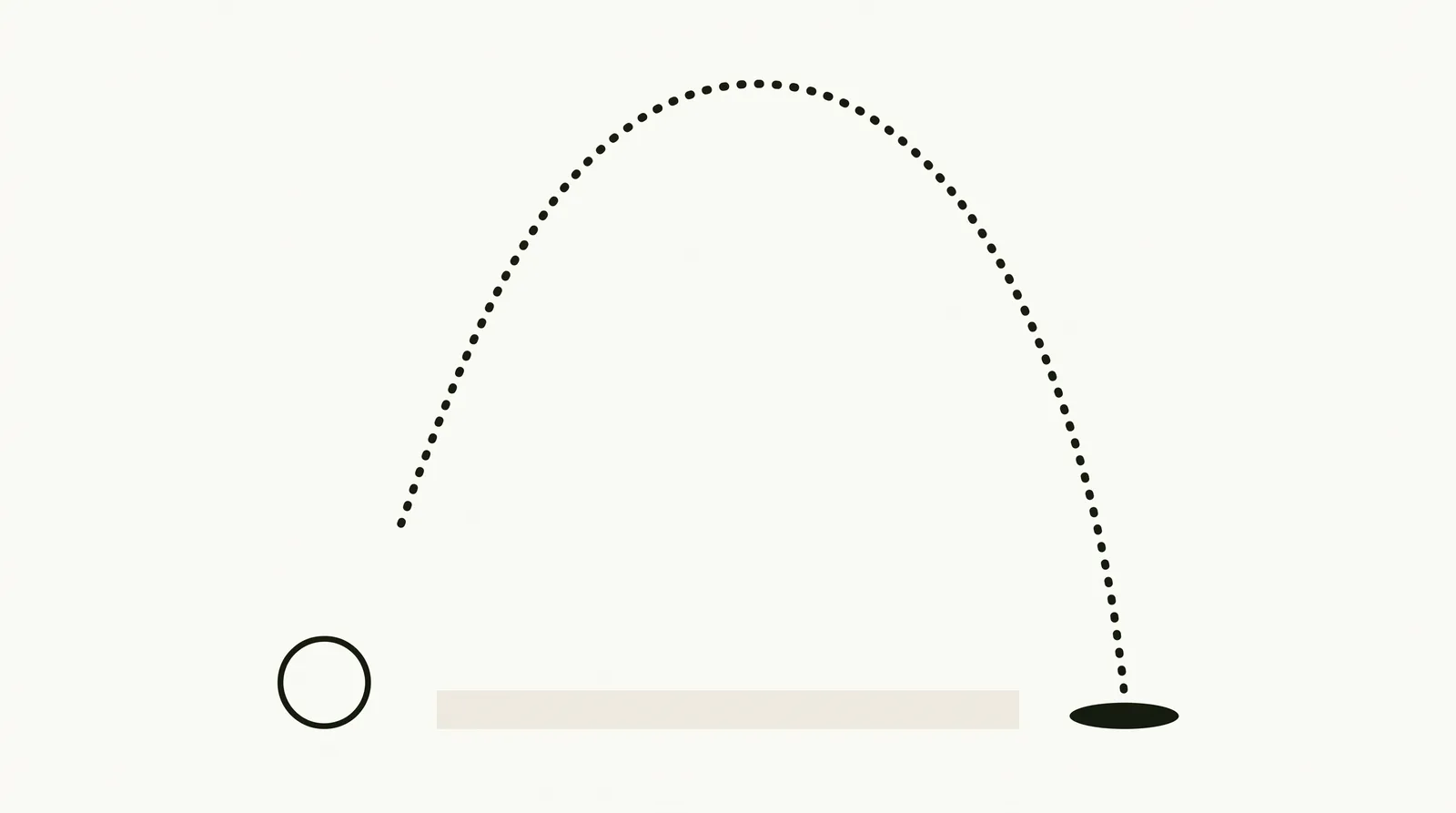
You are 45 yards out with a bunker to carry. Too far for a chip, half a swing short of a full wedge, and no number to aim at. This is the shot that turns a missed green into a double bogey, and it is the one nobody practises. This guide covers the setup, how much wrist hinge to use, how to let the sole of the club work, and how to build a distance you can repeat.
What a pitch is, and what it is not
A pitch is a lofted shot that carries most of its distance and stops fairly quickly. The swing is long enough to need wrist hinge and body rotation, and it is played with a wedge rather than an iron.
That separates it cleanly from the other short shot. A chip is the low running shot with almost no wrist action, played from just off the green, and the two are set out side by side in chipping versus pitching. If the ball has to fly over something, or if you are more than about 30 yards out, you are pitching. Everything below is about that shot.
The pitching setup
The pitch setup sits between a chip and a full shot, and each element has a reason.
- Narrow the stance slightly, to about the width of your shoulders or a little less.
- Play the ball in the middle of that stance, not back like a chip and not forward like a driver.
- Set about 55 to 60 percent of your weight on the lead foot and keep it there.
- Let the handle sit level with the ball or barely ahead of it, not pressed forward.
- Grip down an inch or two for shorter pitches, and keep the pressure light.
- Aim your feet very slightly open to the target line, which makes it easier to clear the lead hip through the shot.
The handle position is the difference most golfers miss. Leaning the shaft hard forward, which is correct for a chip, takes the loft off the club and lifts the leading edge, and a raised leading edge is exactly what produces a thin pitch. Keep the shaft close to vertical and let the club's own loft do its job. If you are unsure where the middle of your stance really is, the reference points are in the ball position guide.
The swing: hinge, then turn
A pitch is a small version of a full swing rather than a big version of a chip, and the order matters.
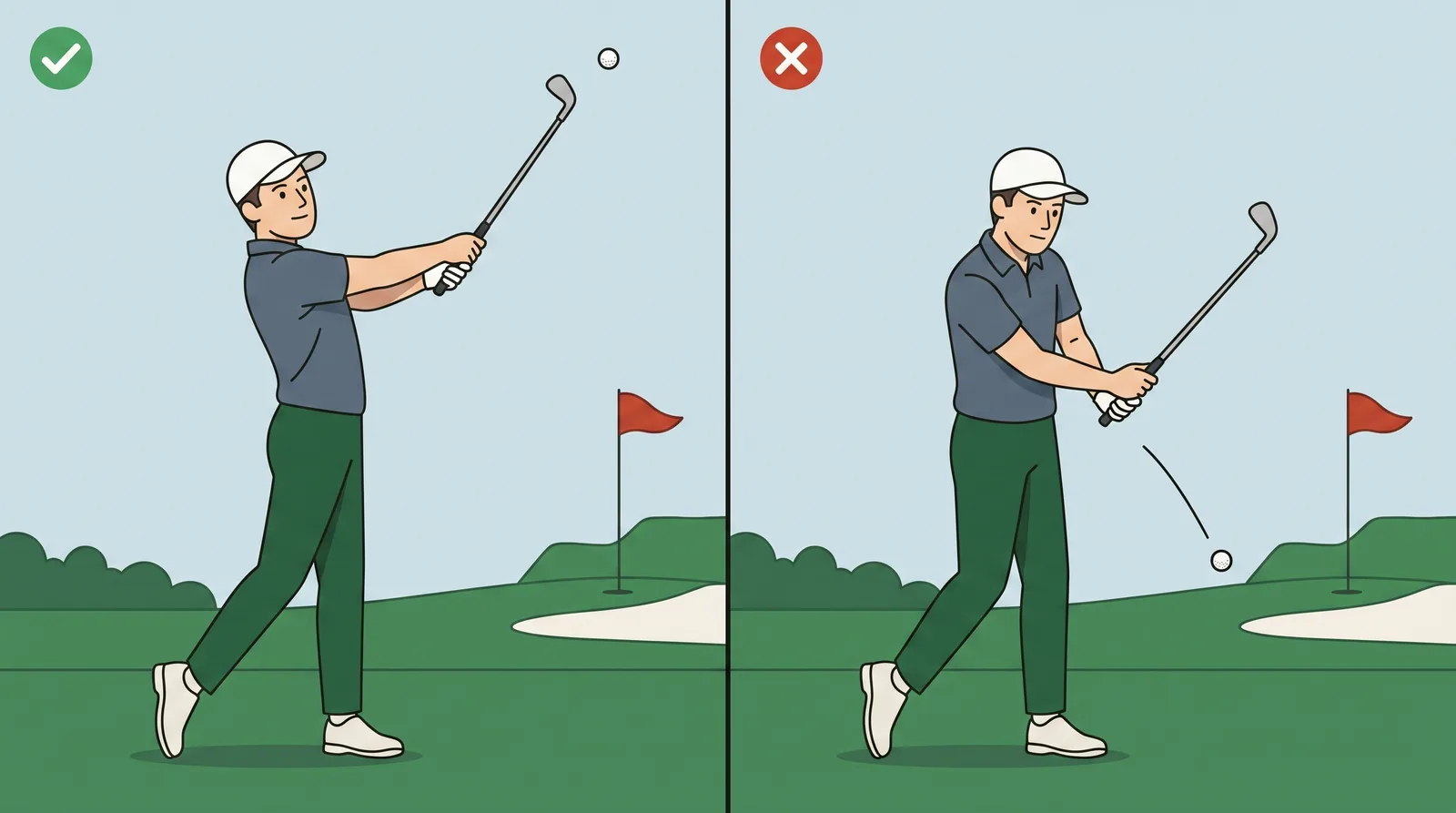
The wrists hinge early. As the club moves away, let the wrists set so that by the time your hands are at waist height the shaft is pointing up rather than trailing behind you. That hinge is what creates the height and spin a pitch needs. Then the body turns through, with the chest rotating toward the target and the arms staying in front of it.
The finish is the honest test. If your chest is facing the target and your weight is on your lead foot, the body led. If your hands have flipped past the clubhead and your chest is still pointing at the ball, the arms did all the work and you have hit a scoop.
Let the bounce do the work
The sole of a wedge is not flat. It is angled so the trailing edge sits lower than the leading edge, and that angle is bounce. Titleist's explanation of wedge bounce from Bob Vokey groups it into low bounce of roughly 4 to 6 degrees for firm turf, mid bounce of about 7 to 10 degrees for normal conditions, and high bounce above 10 degrees for soft ground and steep swings.
What that angle does is stop the club digging. Instead of the leading edge burying itself in the turf, the sole skids along it and the face slides under the ball. A pitch that comes off the middle of the face with a shallow brush of turf after it is a pitch where the bounce was allowed to work.
| Bounce | Degrees | Suits | Feels like |
|---|---|---|---|
| Low | 4 to 6 | Firm turf, tight lies, shallow swings | Sharp, digs if you hit down steeply |
| Mid | 7 to 10 | Most courses and most golfers | Forgiving without feeling clumsy |
| High | Above 10 | Soft turf, fluffy lies, steep swings | Skids, can bounce into the ball on firm ground |
Most golfers should be pitching with a mid bounce wedge and stop thinking about it. Where the numbers matter is the gap between your wedges rather than the sole grind on any one of them, which the wedge loft guide covers properly.
Controlling distance
Every pitch is the same swing at a different length. That is the whole system, and it is why the shot becomes repeatable once you stop trying to hit each one a specific distance.
Pick three backswing lengths and learn what each one carries with each wedge. Most golfers use the lead arm as the reference: pointing at the ground, pointing at the horizon, and halfway between. Then hit twenty balls at each length and write down the average carry. Those nine numbers, three lengths across three wedges, cover almost every pitch you will ever face.
| Backswing length | Lead arm at the top | Typical use |
|---|---|---|
| Short | Pointing down toward the ground | Inside 25 yards, tight pin |
| Medium | Roughly parallel to the ground | The middle of your wedge range |
| Long | Above parallel, close to a full swing | The top of each wedge's range |
The speed of the swing never changes. Only the length does. Building the full ladder, including how to fill the gaps between the numbers, is the job of wedge distance control.
Two things follow from those numbers. Forty feet is a long way, so a pitch that finishes on the green is already a good outcome and chasing the flag is usually the wrong instinct. And because most misses are short, the safe error on a pitch is one that runs past rather than one that comes up in the fringe.
Height, spin and what actually stops a ball
Golfers ask how to put spin on a pitch when what they mean is how to stop the ball. Height does more of that than spin does, and height is easier to produce.
TrackMan's explanation of spin loft describes it as the angle between the direction the clubhead is travelling and the direction the face is pointing, and more of that angle means more spin and less compression. In practice this means a clean strike with a lofted club and a slightly descending blow produces spin, while a fat strike produces none at all because grass and moisture get between the face and the ball.
So the checklist for a ball that stops is short. A clean lie, a clean strike, a clean face with grooves that still bite, and enough height. Chasing spin off a wet lie in the rough is chasing something the conditions have already taken away, which is part of why pitching from the rough needs a different plan.
The 50 yard shot
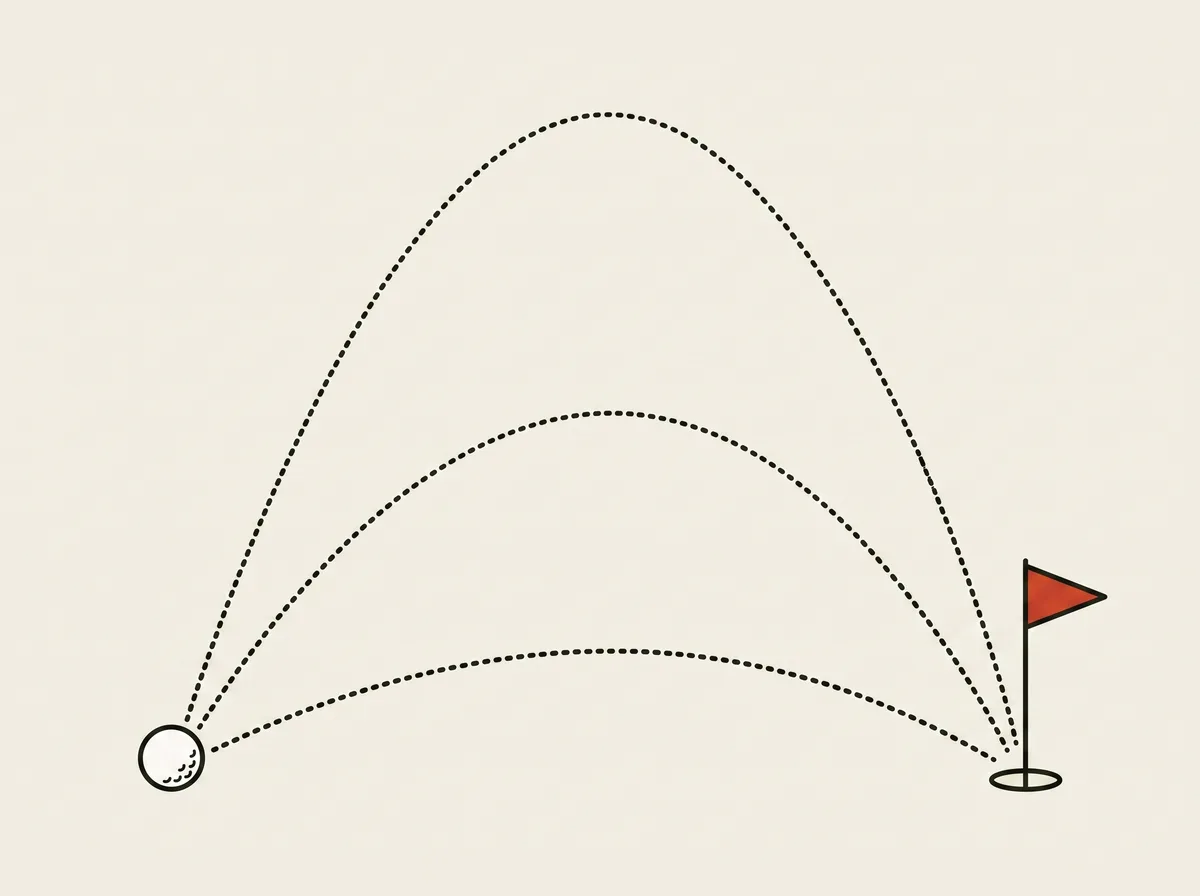
There is a specific reason this yardage is so uncomfortable. It is longer than the shot most golfers rehearse and shorter than a full swing, so it falls in the one place where neither instinct helps.
Treat it as a medium length backswing with your highest lofted wedge, or a short one with the next wedge down. Trying to hit a soft full sand wedge is the trap, because a swing made at reduced effort loses its rhythm and the strike goes with it. Pick the club that lets you make a normal-paced swing at a measured length.
Aim for the middle of the green rather than the flag from this range. The chance of holing out from 40 feet is small either way, and the difference between a 40 foot putt and a short-sided chip from the wrong side is roughly a stroke.
Fixing a fat pitch
The fat pitch is the most damaging miss in the short game because it can lose almost the whole shot. It comes from the low point of the swing arriving behind the ball, and there are usually three reasons.
Weight hanging on the trail foot is the first, and it is the most common. Deceleration is the second, because a club that is slowing down drops behind the hands. Too much forward shaft lean is the third, because it removes the bounce that would otherwise have saved the strike. The wider diagnosis, including the swing patterns behind it, sits in how to stop hitting fat shots.
When to pitch and when not to
A pitch is the right shot when something must be flown, when the pin is close to the near edge, or when the green is running away from you. It is the wrong shot when there is clear ground between the ball and the putting surface, because then a running chip shot is lower risk and finishes closer more often.
The very high, very soft version of the shot is a different technique again, with an open face and a much fuller swing, and it belongs in the flop shot. It is also the shot amateurs attempt most often and need least.
Key takeaways
- A pitch carries most of its distance and needs wrist hinge and body rotation, unlike a chip.
- Ball in the middle of a slightly narrow stance, weight a little forward, handle level with the ball rather than pressed ahead.
- Hinge the wrists early so the shaft points up by the time the hands reach waist height.
- The chest should face the target at the finish. If it does not, the hands took over.
- Bounce is the angle that stops the club digging. Mid bounce of 7 to 10 degrees suits most golfers and most courses.
- Distance comes from the length of the backswing at a constant speed, never from swinging harder.
- Learn three backswing lengths with each wedge and write down the carry for each.
- Shot Scope's data has amateurs averaging 40 feet from the hole from 60 to 100 yards, so the green is the target and the flag rarely is.
- Height stops a ball more reliably than spin, and spin disappears from a poor lie whatever you do.
- Fat pitches come from weight hanging back, deceleration, or too much forward shaft lean.
Common questions
What is a pitch shot in golf?
A lofted shot of roughly 20 to 60 yards that carries most of its distance and stops fairly quickly. It uses wrist hinge and body rotation, which is what separates it from the chip, and it is played with a wedge rather than an iron.
How far back should I swing on a pitch?
Whatever length lets you accelerate smoothly through the ball. Learn three fixed lengths, using where your lead arm points at the top as the reference, and change the length rather than the effort when you need a different distance.
Why do I thin my pitch shots?
Usually because you are trying to help the ball into the air, which raises the low point of the swing behind the ball so the leading edge catches its middle. Pressing the handle too far forward at address causes the same thing by lifting the leading edge off the turf.
Why do I hit pitch shots fat?
Most often weight hanging on the trail foot, deceleration through impact, or too much forward shaft lean removing the bounce. Check where the club meets the ground: the mark should start level with the ball and run toward the target.
How do I get more spin on a pitch shot?
Strike it cleanly with a lofted club from a good lie, and keep your grooves clean. Spin needs direct contact between the face and the ball, so grass or water in the way removes it regardless of technique. Height stops the ball more reliably than spin does anyway.
What wedge should I use for a 50 yard pitch?
Either a medium length swing with your most lofted wedge or a shorter swing with the next one down. Avoid trying to hit a soft full wedge, because reducing the effort of a full swing tends to cost you the strike.
What is wedge bounce and how much do I need?
Bounce is the angle that holds the leading edge slightly off the ground so the sole skids rather than digs. Titleist puts mid bounce at roughly 7 to 10 degrees, which suits most golfers on most courses. High bounce suits soft turf and steep swings, low bounce suits firm ground and shallow ones.
Should my weight stay forward on a pitch?
Yes, around 55 to 60 percent on the lead foot at address, and it should stay there or move further forward. Weight sliding back onto the trail foot is the single most common cause of a fat pitch.
Is a pitch the same as a chip?
No. A chip is low, short and mostly roll, played with quiet wrists and often an iron. A pitch is higher, longer and mostly carry, played with a wedge and a hinged, rotated swing. Use the chip whenever the ground between you and the green is clear.
How often should I practise pitching?
Two sessions a week of about twenty minutes each does more than one long session. Work on the strike first with a line on the ground, then on distance with three fixed backswing lengths, and expect the grouping to tighten before the average changes.
Tom Ashworth
Tom Ashworth is a PGA Professional who has taught golf since 2012, working mainly with beginners and mid-handicappers at club level in Surrey. He reviews the instruction guides on Learn Golf for technical accuracy before they publish.
Most of his teaching is with players in their first three years of the game, and most arrive having been told too much: six swing thoughts collected from videos, half of them contradicting each other. His approach is to check the grip and the alignment before touching the swing, on the basis that most bad ball flight is decided at address.