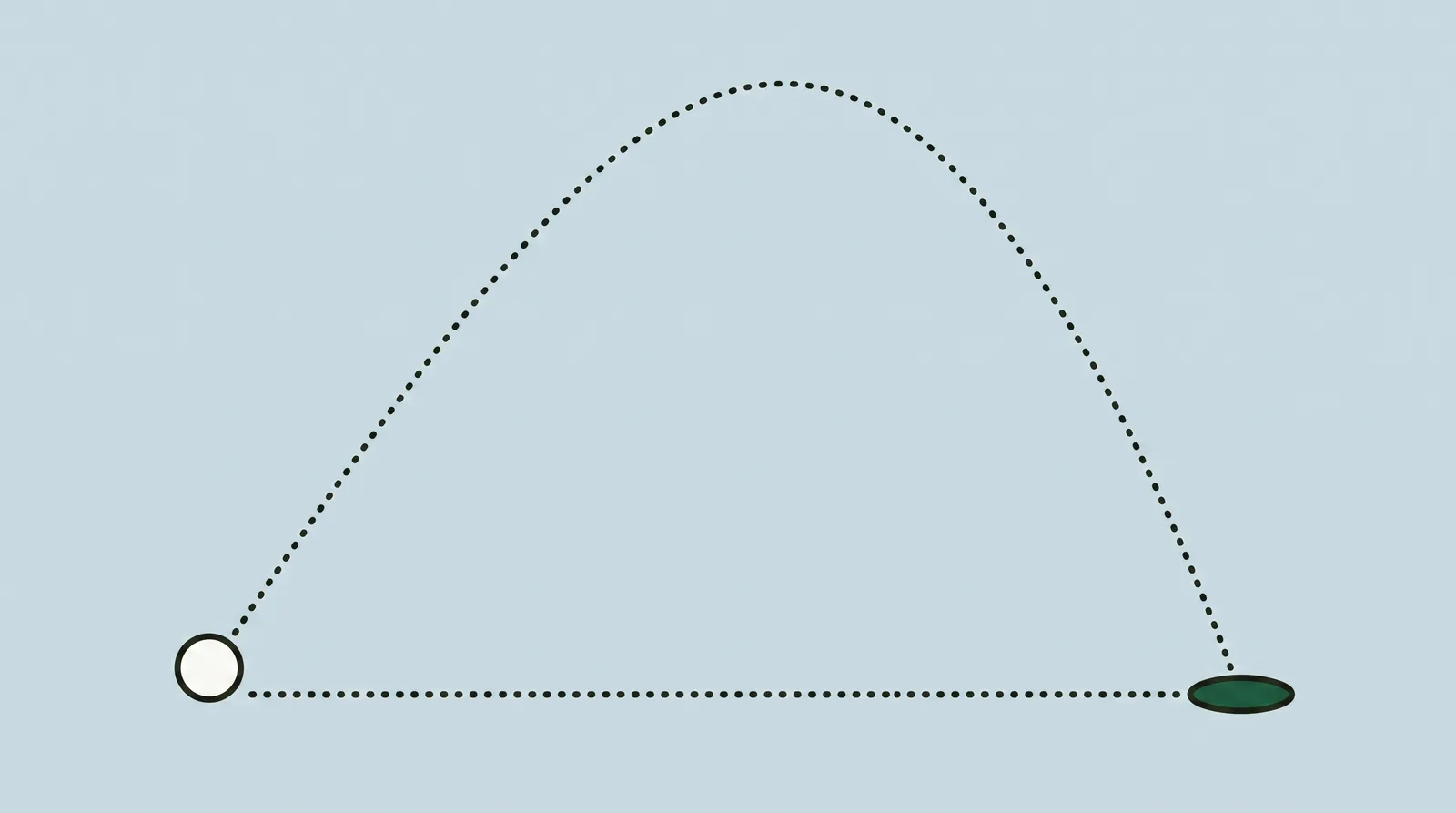
You are twenty yards short of the green and the club in your hand is a sand wedge, because a sand wedge is what you always pull. That decision, made before you have looked at the ground, is the subject of this page. Chip and pitch are two shots with two different jobs, and choosing well between them is worth more strokes than improving either one.
The difference in one sentence
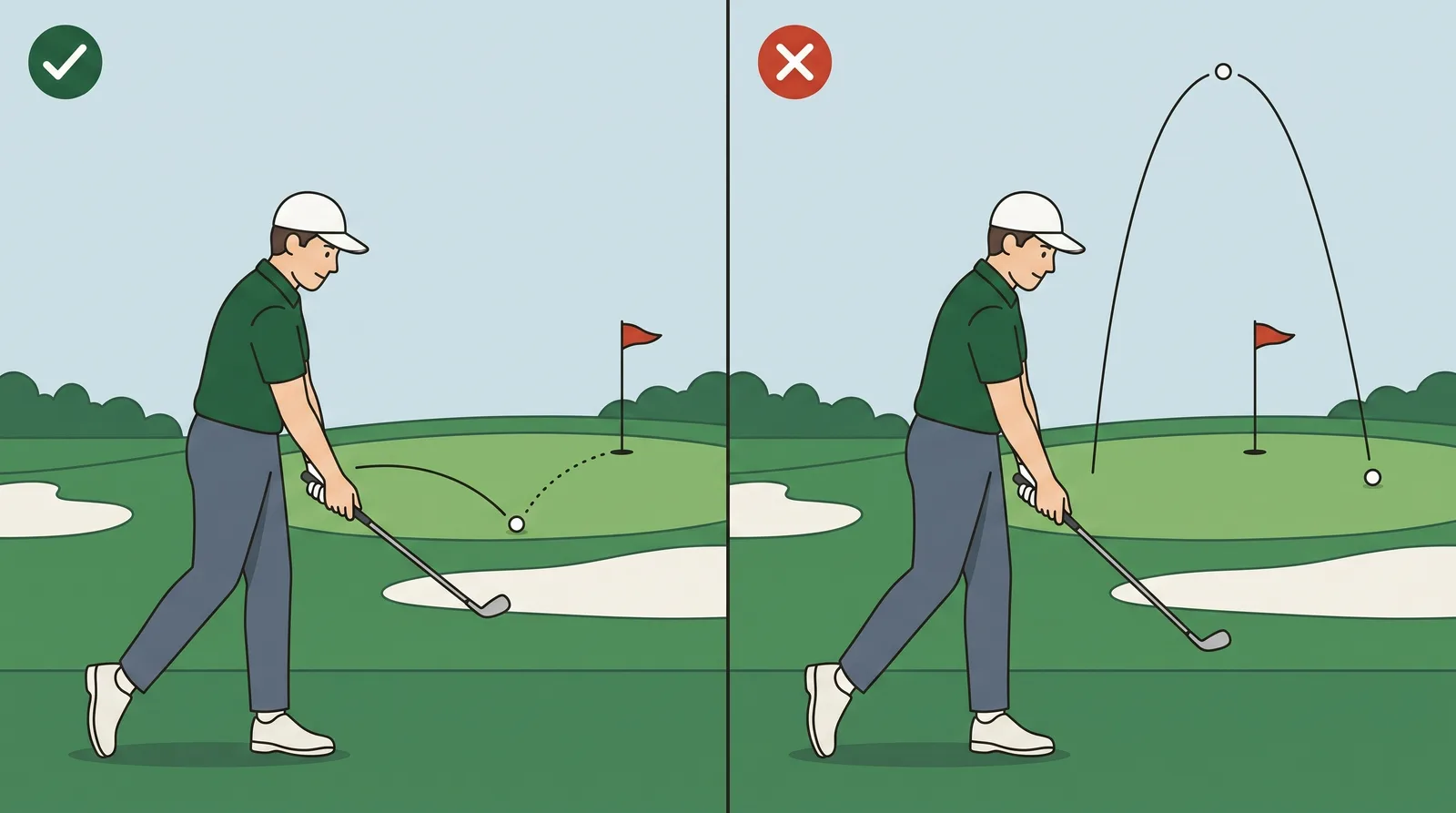
A chip rolls. A pitch flies. Every other difference between the two shots exists to produce one of those two outcomes.
That sounds too simple to be useful, and it is the most useful thing on this page. Once you know which of the two you want the ball to do, the club, the swing and the wrist action are all decided for you rather than chosen.
| Chip | Pitch | |
|---|---|---|
| Job | Get the ball rolling as soon as possible | Fly the ball over something and stop it |
| Club | 7 iron through pitching wedge | Gap, sand or lob wedge |
| Trajectory | Low, barely above the turf | High, dropping steeply |
| Wrist action | Almost none, whatever angle you set at address | Hinged early, released through the ball |
| Swing length | Below the waist, back and through | Waist to chest, sometimes further |
| Body | Small chest turn, very quiet legs | Full rotation through to a finish |
| Typical range | Inside 30 yards, usually much less | 20 to 60 yards |
| Where it lands | Just onto the putting surface | Close to where it needs to stop |
Read that table as one idea repeated eight ways. A chip removes air from the shot and a pitch adds it.
The club is the first fork in the road
Most golfers treat club selection as the last decision in the short game. It is the first, because the club you pull has already picked the shot.
An 8 iron cannot be pitched. There is not enough loft to fly a ball high and land it softly, so if an 8 iron is in your hand you are playing a running shot whether you meant to or not. A 60 degree wedge cannot be chipped low with any reliability either, because its leading edge sits high off the turf and the smallest error in strike becomes a thin one.
The practical version of that rule is short. If the shot needs to fly, take a wedge. If it does not, take the least lofted club that can get the ball onto the putting surface, and let the ground do the rest. The table in the next section is the ladder in full, running from the club that produces the most roll to the one that produces almost none.
Carry to roll is the whole consequence
The reason this decision matters is that the two shots divide the same distance in completely different proportions. A chip might fly a quarter of the way and roll three quarters. A pitch might fly nine tenths of the way and roll the last tenth.
TrackMan splits every shot the same way, defining carry as the distance the ball flies before it first touches down and total distance as carry plus everything afterwards, and noting that a flatter landing angle produces more bounce and roll. A chip is built to land flat and a pitch is built to land steeply, which is where the whole difference in run out comes from.
That ratio is the single most useful number in the short game, because it tells you where to land the ball. Aim a chip at the hole and it runs twenty feet past. Aim a pitch at a spot short of the flag and it stops there.
| Club | Shot it plays | Rough carry to roll | Lands |
|---|---|---|---|
| 7 iron | Chip | 1 part air to 4 parts ground | Just on the front edge |
| 8 iron | Chip | 1 part air to 3 parts ground | A pace or two on |
| 9 iron | Chip | 1 part air to 2 parts ground | A third of the way to the hole |
| Pitching wedge | Either | 1 part air to 1 part ground | Halfway to the hole |
| Gap wedge | Pitch | 2 parts air to 1 part ground | Two thirds of the way |
| Sand wedge | Pitch | 3 parts air to 1 part ground | Close to the hole |
| Lob wedge | Pitch | Almost all air | On the hole, or past it |
Where each shot lands is the real difference
Because the ratios differ so much, the two shots have completely different targets even when the hole is in the same place.
A chip is aimed at a landing spot, usually a couple of paces onto the putting surface where the grass is even and predictable, and the club is then chosen so the roll from that spot reaches the hole. A pitch is aimed close to where the ball needs to finish, because it is not going to travel far after it lands.
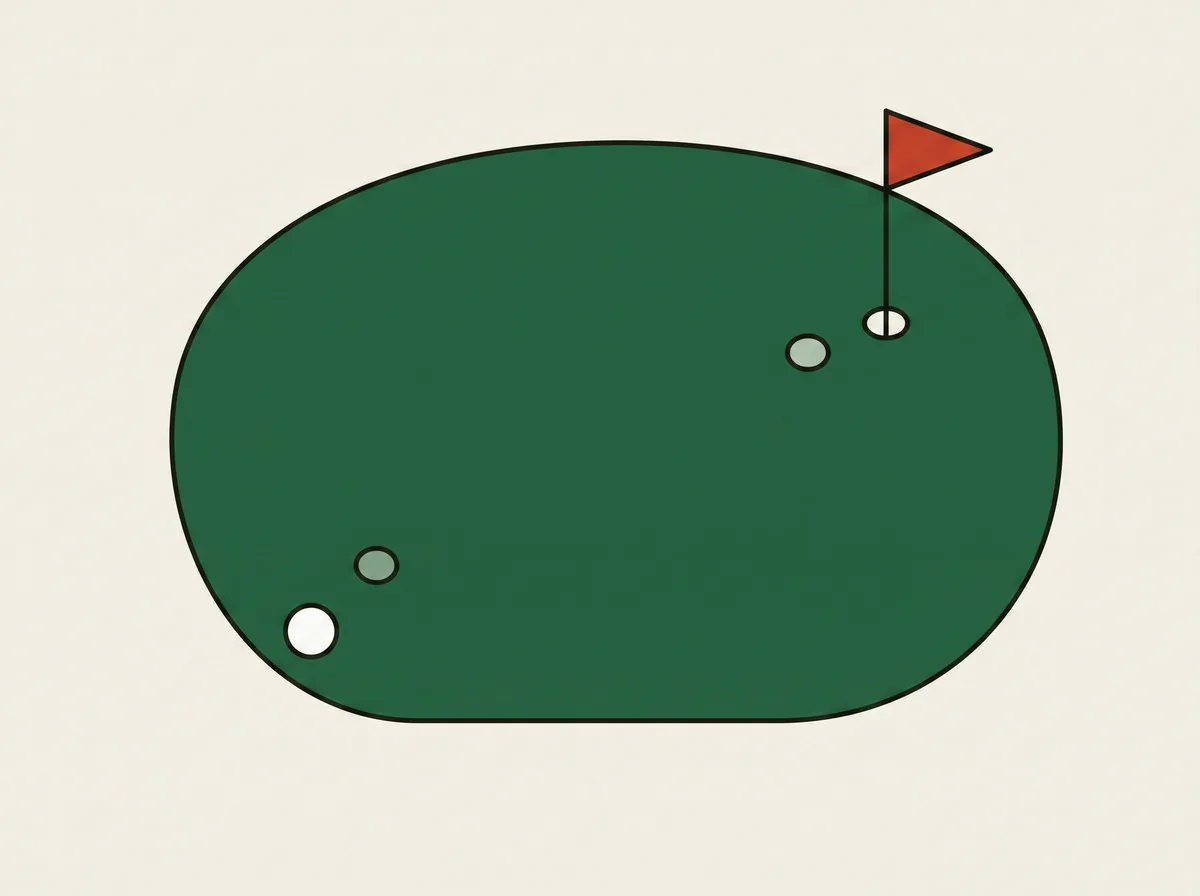
This is why golfers who never think about the difference struggle with both shots. They aim everything at the flag, so their chips run past and their pitches come up short, and neither miss teaches them anything.
The two questions that decide it
You do not need a system for this. You need two questions, asked in order, before you pick a club.
- Is there anything between the ball and the putting surface that has to be flown? A bunker, a bank, a thick collar of rough, a slope running away from you. If yes, it is a pitch and the decision is over.
- If the ground is clear, how much green is there between the front edge and the hole? Plenty of green means a chip. Very little green, with the flag tucked close to the near edge, means a pitch even though nothing is in the way.
That second question is the one most golfers skip. Being short-sided, with the flag close to the edge you are approaching from, removes the room a chip needs to run out. It is the only common situation where a lofted shot beats a running one on clear ground.
Everything else is a chip. That is a much larger share of shots than most golfers play as one.
What the tracked data says
The choice is not evenly balanced, and there is real evidence for which way it leans.
Roughly a sixth of a stroke, every time that shot comes up. Shot Scope's five key scoring stats have a 15 handicap missing the green short on 54 percent of approach shots beyond 50 yards, so it comes up several times a round.
The point is not that pitching is bad. It is that most golfers reach for the lofted shot in situations that did not require it, and pay for the extra air every time.
Where each shot goes wrong
The two shots fail differently, and knowing which failure belongs to which shot is half of the diagnosis.
A chip fails when the golfer tries to help the ball up. Adding loft with the hands moves the low point of the swing behind the ball, and the club either takes turf first or catches the ball on the way up. Both misses have the same cause and both are covered in how to stop chunking chips.
A pitch fails when the swing gets short and the golfer hits at the ball rather than through it. Deceleration on a longer swing is more damaging than on a shorter one, because there is more speed to lose.
Practising the choice rather than the shot
Almost all short game practice is repetition of one shot to one flag, which trains the stroke and never trains the decision. The decision is the part that costs you strokes on the course.
Both of these belong in a session that also includes some strike work, which is set out in chipping drills. The choice is worth nothing if the contact is unreliable.
The two shots at the extremes
Chip and pitch are the middle of a range, not the ends of it. Each has an extreme version and both are worth knowing about mainly so you can recognise when you are being tempted into one.
At the low end sits the bump and run, which takes the chip idea further out from the green and further down the loft ladder, sometimes with as little as a 6 iron. It is the lowest risk shot in the short game and the one most amateurs should play more often.
At the high end sits the flop shot, which is a pitch with the face laid wide open to produce maximum height over a very short distance. It is the highest risk shot in golf for an amateur and the one they attempt most often relative to how often it is required.
Sand is its own category again. A ball in a greenside bunker is neither chipped nor pitched, because the club never touches it, and that shot is set out in the greenside bunker guide.
Learning the two techniques
This page deliberately stops at the difference. Each shot has its own setup, its own stroke and its own faults, and learning both from one page is how golfers end up with a hybrid action that does neither job.
Start with the running one. The chipping guide covers the narrow stance, the forward shaft lean and the quiet-wristed stroke, and it is the easier of the two to make reliable. Then add the flying one: the pitching guide covers the early wrist hinge, the body rotation and how to let the bounce work. Once both are reliable, build a set of numbers for the pitch, because a shot that carries most of its distance is only as good as your knowledge of how far it carries, which is the job of wedge distance control.
Key takeaways
- A chip rolls and a pitch flies. Every other difference exists to produce one of those two outcomes.
- Wrist action is the mechanical difference. A chip keeps the angle it starts with, a pitch hinges and releases it.
- The club decides the shot before the swing does. An 8 iron cannot pitch and a lob wedge cannot chip reliably.
- Carry to roll runs from about one part air to four parts ground with a 7 iron down to almost all air with a lob wedge.
- A chip is aimed at a landing spot on the front of the green. A pitch is aimed near where the ball needs to stop.
- Two questions decide it: is anything in the way, and is there enough green to run the ball out.
- Being short-sided is the only common reason to pitch on clear ground.
- Shot Scope has amateurs getting up and down 8 percent more often and finishing 6 feet closer with an 8 iron, 9 iron or pitching wedge.
- Arccos has the same golfer averaging 2.68 strokes to hole out with a pitching wedge against 2.85 with a 60 degree wedge.
Common questions
What is the difference between a chip and a pitch in golf?
A chip is a short, low shot played with quiet wrists that lands early and rolls most of the way. A pitch is longer and higher, played with a wedge, an early wrist hinge and a fuller swing, and it carries most of its distance. The test is how much of the journey happens on the ground.
Should a beginner chip or pitch?
Chip, almost always. The stroke is shorter so there is less to go wrong, and tracked amateur data has golfers getting up and down more often with the lower lofted running shot. Add the pitch when a shot genuinely has to fly over something.
At what distance does a chip become a pitch?
There is no fixed yardage, but the stroke stops being wristless somewhere around 30 yards for most golfers. Past that the backswing gets long enough that the wrists hinge whether you intend it or not. Distance is a weaker guide than what lies between you and the green.
Which club should I chip with?
An 8 iron or 9 iron covers most chips, with a pitching wedge when you have less green to work with. Shot Scope's tracking has amateurs performing better with those clubs than with a gap, sand or lob wedge. Learning one properly beats owning all seven.
Which club should I pitch with?
A gap, sand or lob wedge, chosen by how high the ball needs to go rather than how far away the hole is. Distance comes from the length of the backswing at a constant speed, so two different wedges can cover the same yardage at different heights.
Do I hinge my wrists on a chip?
No. Keep whatever wrist angle you set at address and rock your shoulders instead, which is why the motion is described as a putting stroke with loft on it. Wrist hinge belongs in the pitch, and adding it to a chip produces both the fat one and the thin one.
When should I pitch instead of chipping on clear ground?
Only when you are short-sided, with the flag close to the edge you are playing from and not enough putting surface for a running ball to slow down on. If there is a decent stretch of green between the front edge and the hole, the chip is lower risk.
Why do my chips run past the hole?
Almost always because you aimed at the flag rather than at a landing spot. A chip is designed to roll, so landing it near the hole means finishing well past. Pick a spot a couple of paces onto the green and choose the club whose roll covers the rest.
Can I use the same club for both shots?
A pitching wedge genuinely does both, which is why it confuses people. Played with quiet wrists and a short stroke it chips, and played with a hinged fuller swing it pitches. Deciding which one you are making before you stand to the ball matters more with that club than any other.
Does the setup change between a chip and a pitch?
Yes, in three places. A chip uses a narrower stance, the ball just back of centre and the hands clearly ahead. A pitch uses a slightly wider stance, the ball in the middle and the handle level with it, because pressing it forward removes the loft the shot needs.
On this page
- The difference in one sentence
- The club is the first fork in the road
- Carry to roll is the whole consequence
- Where each shot lands is the real difference
- The two questions that decide it
- What the tracked data says
- Where each shot goes wrong
- Practising the choice rather than the shot
- The two shots at the extremes
- Learning the two techniques

Tom Ashworth
Tom Ashworth is a PGA Professional who has taught golf since 2012, working mainly with beginners and mid-handicappers at club level in Surrey. He reviews the instruction guides on Learn Golf for technical accuracy before they publish.
Most of his teaching is with players in their first three years of the game, and most arrive having been told too much: six swing thoughts collected from videos, half of them contradicting each other. His approach is to check the grip and the alignment before touching the swing, on the basis that most bad ball flight is decided at address.