Wedges are the only clubs golfers buy by name rather than by number, which is how so many bags end up with a pitching wedge, a sand wedge and nothing in between. The hole that leaves is not small. It is routinely fourteen degrees wide, in the part of the bag where every other gap is four, and it sits exactly where most shots are lost.
Gapping starts with your pitching wedge, not your sand wedge
The pitching wedge is the last club in your iron set, so its loft was decided by whoever designed the irons rather than by anyone thinking about your short game. That is the number every other wedge has to gap off, and it varies more than any other loft in the bag.
| Set | Pitching wedge | Next club the maker offers |
|---|---|---|
| Ping G740 | 40° | 45°, then 50° and 56° |
| Ping G440 | 42° | 47°, then 52° and 56° |
| Mizuno Pro 243 | 44° | 48° |
| Ping i230 | 45° | 50° |
Two things jump out. The pitching wedge spans five degrees across four current sets, so two golfers who both say "pitching wedge" may be holding clubs a full club apart. And every one of those makers offers a club immediately above it, which is a manufacturer telling you the gap exists.
Why the number moved is covered in iron lofts and the drift. The short version is that pitching wedges were strengthened along with the rest of the set while sand wedges sat at 54 to 56 degrees, and the two ends stopped meeting somewhere in the 2000s.
The arithmetic
Wedge gapping is one calculation repeated. Take your pitching wedge loft, add four to six degrees, and keep going until you reach the highest loft you can use.
Callaway put the same rule on their own wedge buying guide: four to six degrees of separation between wedges, which they say produces distance gaps of ten to fifteen yards. They give a three wedge setup of 46, 52 and 58 degrees and a four wedge setup of 46, 50, 54 and 58.
Applied to real pitching wedge lofts, that produces this.
| Your pitching wedge | Two wedges above it | Three wedges above it |
|---|---|---|
| 40° | 46° and 52° | 45°, 50° and 56° |
| 42° | 48° and 54° | 47°, 52° and 56° |
| 44° | 50° and 56° | 48°, 52° and 56° |
| 46° | 52° and 58° | 50°, 54° and 58° |
Notice what happens with a strong pitching wedge. A 40 degree wedge gapped properly needs three clubs above it to reach 56, and a golfer carrying only a sand wedge is asking one club to cover sixteen degrees. That is not a small stretch. It is roughly the distance between a 6 iron and a 9 iron.
How many wedges you need
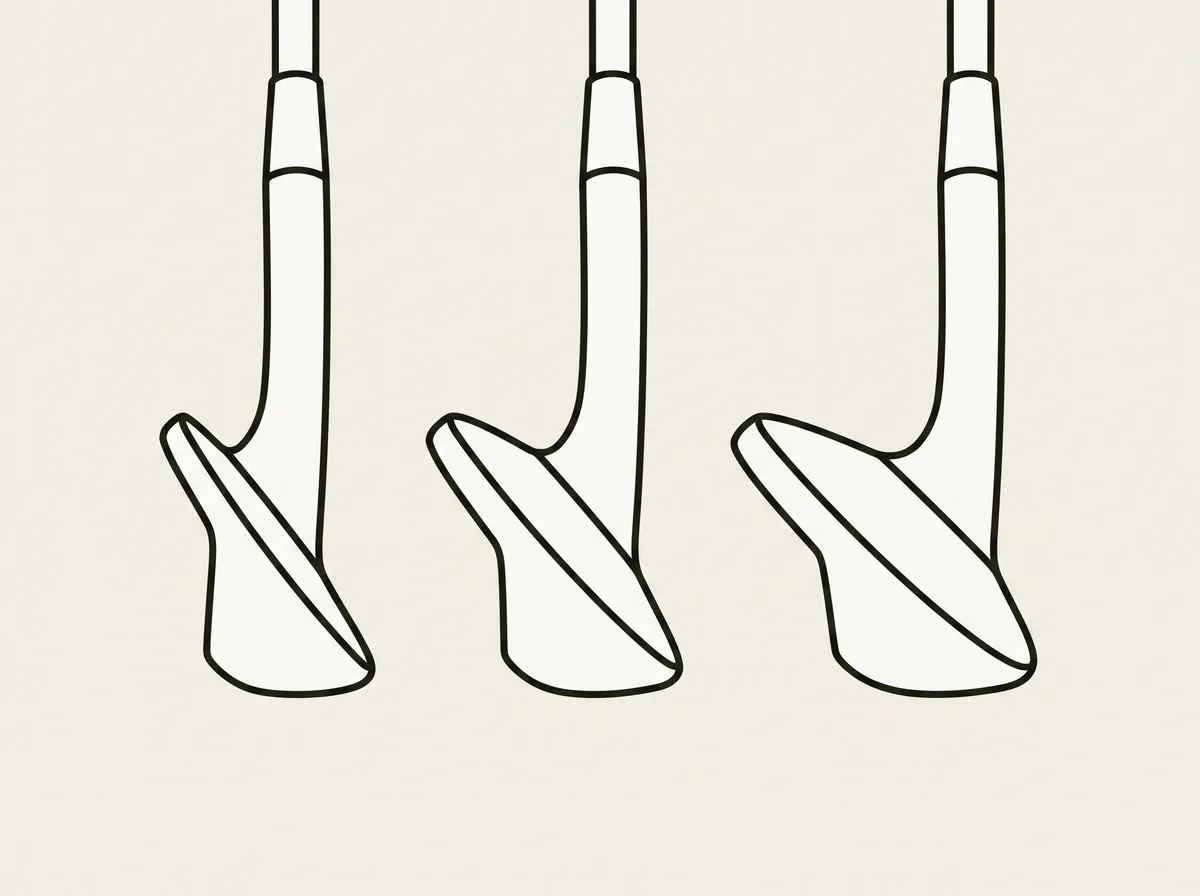
Three, for most golfers. Two is what most bags carry and it leaves the gap described above.
| Setup | Clubs above the pitching wedge | Who it suits |
|---|---|---|
| Two wedges | Sand wedge only | A beginner still learning to strike the ball cleanly |
| Three wedges | Gap and sand, or gap, sand and lob | Most club golfers, and the sensible default |
| Four wedges | Gap, sand, lob, plus one more step | Golfers who miss a lot of greens from inside 120 yards |
The gap wedge is the one to buy first, whatever it is stamped with. Manufacturers label it A, U, G, W or simply the loft, and the letters mean nothing consistent across brands, so buy the number rather than the badge.
A fourth wedge is a real decision rather than an upgrade, because the fourteen club limit means something has to leave. It is usually a long iron or a fairway wood you were not hitting anyway, and what each club family does is a useful check on which slot is earning its place.
52 against 56 against 60
These three lofts account for most wedge sales and they are not interchangeable.
A 52 degree wedge is a full swing club. It sits close enough to the pitching wedge to be hit hard without ballooning, it covers the awkward yardage between a full pitching wedge and a full sand wedge, and it is comfortably the easiest of the three to strike. It is also the wedge most often missing from a bag that needs it.
A 56 degree sand wedge is the workhorse. Wide sole, plenty of bounce, and the club that comes out of bunkers, long greenside grass and anything soft. If you carry one wedge above the pitching wedge, this is it, and greenside bunker technique is built around what it does.
A 60 degree lob wedge is a specialist. It needs a clean strike and reasonable speed to produce anything on a full swing, it is the least forgiving club in the bag from a poor lie, and it exists for shots that must go up more than out.
What is actually on the shelf
Wedge ranges are sold in two degree steps, which is finer than you need and useful because it lets you land exactly on your gap rather than near it.
| Range | Lofts offered | Bounce published per loft |
|---|---|---|
| Ping s259 | 46° to 60° in 2° steps, plus 62° | Yes, 6° to 14° depending on grind |
| Callaway Opus SP | 48° to 60° in 2° steps | Yes, 6° to 14° depending on grind |
Both ranges stop at 46 and 48 degrees at the bottom, which is awkward if your pitching wedge is 40 or 42. That is the argument for taking the matching wedge your iron set offers, since it is built to the same head shape, shaft and lie as the clubs above it.
Not every manufacturer publishes this cleanly. Titleist's wedge pages refuse automated requests, so their lofts and bounce figures are not repeated here rather than borrowed from a retailer's listing. Our wedge roundup works through what each range publishes and what it leaves out.
Loft picks the club, bounce decides how it behaves
Once the lofts are right, the sole is the next decision, and it is a different question with a different answer.
Bounce is the angle between the leading edge of the sole and its lowest point when the club sits square. More of it lifts the leading edge off the ground so the sole strikes the turf first and skids. Less of it puts the edge close to the ground so it cuts in. Ping publish an effective bounce figure for every head they sell, running from 6 degrees to 14, and Callaway's grinds cover the same span.
The rule of thumb is about your turf and your divot rather than your handicap. Soft ground and a deep divot want high bounce. Firm ground and a sweeping strike want low. Most club golfers buy less bounce than suits them because that is what tour players use, and tour players play firm turf.
That decision matters most in your highest lofted wedge and barely at all in your gap wedge, which is hit square on a full swing almost every time.
Lofts on their own are not yardages
A gapped set of wedges gives you evenly spaced clubs. It does not give you numbers, and the two get confused constantly. Callaway's four to six degree rule produces gaps of roughly ten to fifteen yards on a full swing, which is a reasonable planning assumption and a poor substitute for measurement.
Those figures are the case for owning the right lofts and for knowing what they carry, in that order. Turning a gapped set into numbers you can trust is a separate job, and wedge distance control covers it properly.
Getting the specification right when you buy
Two things travel with the loft and both are worth settling before you pay.
Shaft weight is the first. Wedges are traditionally built heavier than the irons above them, which is fine if your irons are steel and wrong if they are graphite. A wedge forty grams heavier than the 9 iron it follows is a different club on a partial swing.
Lie angle is the second, and it is checked far less often on wedges than on irons even though the club is shorter and the effect is identical. A wedge sitting too upright at impact points the face left of target for a right-handed golfer. What a fitting measures covers where both of those sit in the process.
Once the set is right, the shots are what turn it into strokes. Pitching technique covers the swings these clubs are built for, and chipping technique covers everything from the fringe in, where loft matters far less than most golfers assume.
Key takeaways
- Gap upward from your pitching wedge loft, not downward from your sand wedge. The pitching wedge is the number everything else has to fit around.
- Current pitching wedges run from 40 to 45 degrees across published manufacturer tables, so two golfers saying "pitching wedge" can be a full club apart.
- Four to six degrees between wedges is the manufacturer's own rule, and Callaway put the resulting distance gaps at ten to fifteen yards.
- A strong pitching wedge needs three wedges above it to reach 56 degrees cleanly. A 40 degree one gapped to a 56 alone leaves sixteen degrees to one club.
- Three wedges suits most club golfers. The one missing from a typical bag is the gap wedge, and letters like A, U, G and W mean nothing consistent across brands.
- A 52 is a full swing club, a 56 is the workhorse, and a 60 is a specialist that only pays back practice.
- Ranges are sold in two degree steps from around 46 to 62 degrees, with bounce published per loft by some makers and not by others.
- Correct lofts give you even gaps, not yardages. Measuring what each one carries is a separate job.
Common questions
What wedge lofts should I carry?
Work upward from your pitching wedge in four to six degree steps. A 44 degree pitching wedge gaps into 50 and 56. A 42 degree one wants 48 and 54, or 47, 52 and 56 if you carry three. Check your pitching wedge loft on the manufacturer's specification page before buying anything.
How many wedges should I have?
Three suits most club golfers: the pitching wedge from the iron set, something around 50 to 52 degrees, and a sand wedge around 56. Two leaves a gap of twelve to sixteen degrees at the distances that decide scores. Four makes sense if you regularly miss greens from inside 120 yards.
What is the difference between a 52, 56 and 60 degree wedge?
A 52 is a full swing club for the yardage between a full pitching wedge and a full sand wedge, and it is the easiest of the three to hit. A 56 is the all-purpose sand wedge with a wide sole for soft ground and bunkers. A 60 is a specialist for shots that have to go up more than out, and it punishes a poor strike harder than anything else in the bag.
Do I need a gap wedge?
If your pitching wedge is 44 degrees or stronger and your next club is a 56, yes. That is twelve degrees or more in a part of the bag where every other gap is four, and it usually shows up as a distance you have no comfortable club for. It is the cheapest scoring improvement available to most golfers.
What loft is a sand wedge?
Usually 54 to 56 degrees. Unlike pitching wedges, sand wedge lofts have barely moved in decades, which is precisely why the gap above them has opened up. The specification that matters more on a sand wedge is bounce rather than loft.
What is an approach wedge or A wedge?
Another name for a gap wedge, the club between a pitching wedge and a sand wedge. Manufacturers stamp it A, U, G, W or just the loft, and the letters are not standardised across brands. Buy the number rather than the letter.
Can I get a wedge that matches my irons?
Most iron sets offer one, and it is often the better choice. Ping's G440 set continues into a 47 degree utility wedge, then 52 and 56 degree heads built to the same shape and lie. A matching wedge keeps the head shape, shaft and lie angle consistent with the clubs above it, which a specialist wedge from another maker will not.
Should I bend my wedge to change its loft?
It is a legitimate fix for a gap of one or two degrees and a poor substitute for buying the right loft. Bending a wedge changes its bounce at the same time, roughly a degree of bounce for every degree of loft, so a wedge bent two degrees strong also loses two degrees of bounce and digs more than it did.
How far should each wedge go?
There is no honest figure, because it depends on your speed, your strike and how much loft you deliver at impact. What the gapping gives you is even spacing, commonly ten to fifteen yards per club on a full swing. Turning that into numbers you can play to requires measuring carry over a decent number of balls rather than trusting a chart.
Does bounce change which lofts I should buy?
No. Choose the lofts first, from the gaps in your bag, then choose the bounce for each one from your turf and your divot depth. They are separate decisions and mixing them up is how golfers end up with a well-shaped sole on a club that does not fit anywhere in the set.

Tom Ashworth
Tom Ashworth is a PGA Professional who has taught golf since 2012, working mainly with beginners and mid-handicappers at club level in Surrey. He reviews the instruction guides on Learn Golf for technical accuracy before they publish.
Most of his teaching is with players in their first three years of the game, and most arrive having been told too much: six swing thoughts collected from videos, half of them contradicting each other. His approach is to check the grip and the alignment before touching the swing, on the basis that most bad ball flight is decided at address.