The fairway wood is the club amateurs top more than any other, and the reason is almost never the swing. It is the setup. Every iron in the bag wants the club still descending at the ball, and a fairway wood off the turf wants something much flatter than that. This guide covers the sweep, the setup that produces it, the lie test, and when the 3 wood is genuinely the right club.
Left and right below assume a right-handed golfer. The lead side is the one nearest the target, so a left-handed golfer reads lead heel as the right heel and nothing else changes.
The one club you sweep
A fairway wood sits between a driver and an iron, and it does not behave like either.
A driver is struck while the head is still rising, because the ball is teed up and played well forward. An iron is struck while the head is still descending, and the divot starts past the ball. TrackMan's attack angle data puts the PGA Tour driver average at minus 0.9 degrees and the 6 iron average at minus 3.7 degrees, which is the whole spread of the bag in two numbers.
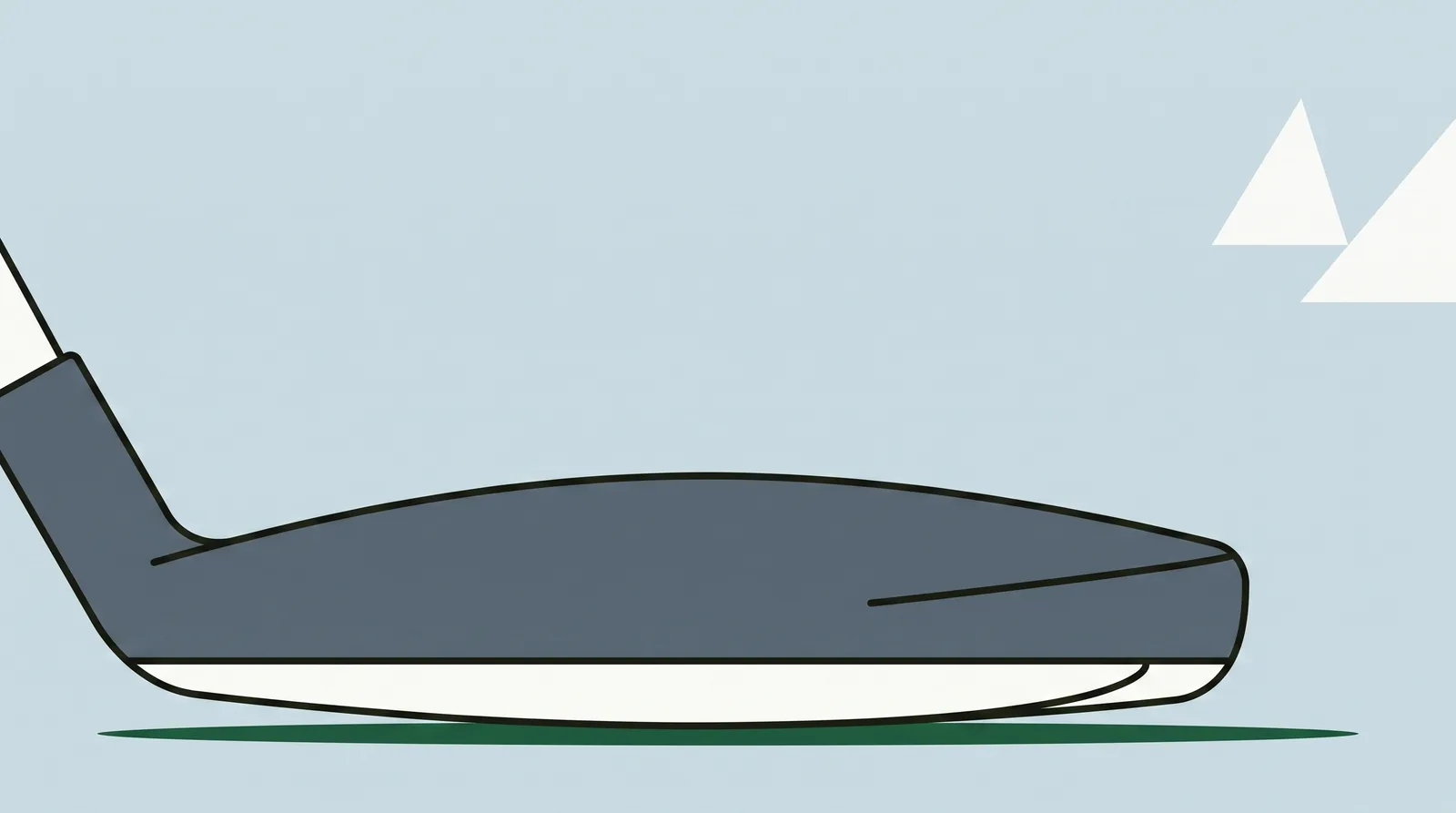
A fairway wood off the turf lives at the flat end of that range. The ball is sitting on the ground, so the club cannot be rising when it arrives, but the head has a wide flat sole built to slide across the turf rather than cut into it. What you want is the shallowest descending strike in the bag, close enough to level that the club brushes the grass on its way through.
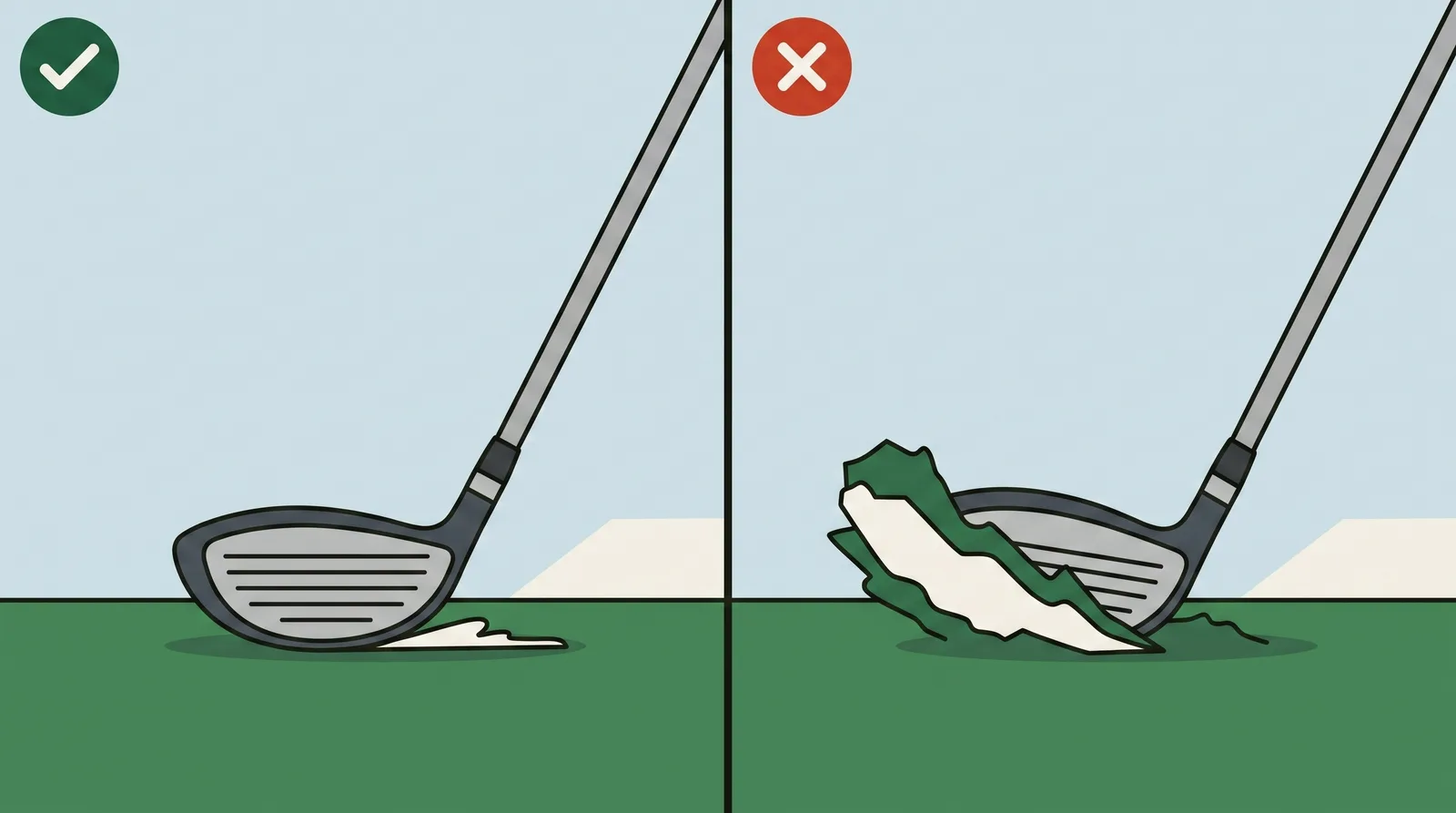
The evidence on the ground is the difference. A clean 6 iron leaves a strip of turf. A clean 3 wood leaves a pale scuff you have to look for, or nothing at all.
The setup that produces a sweep
None of this is a swing thought. It is where the ball sits and how wide you stand.
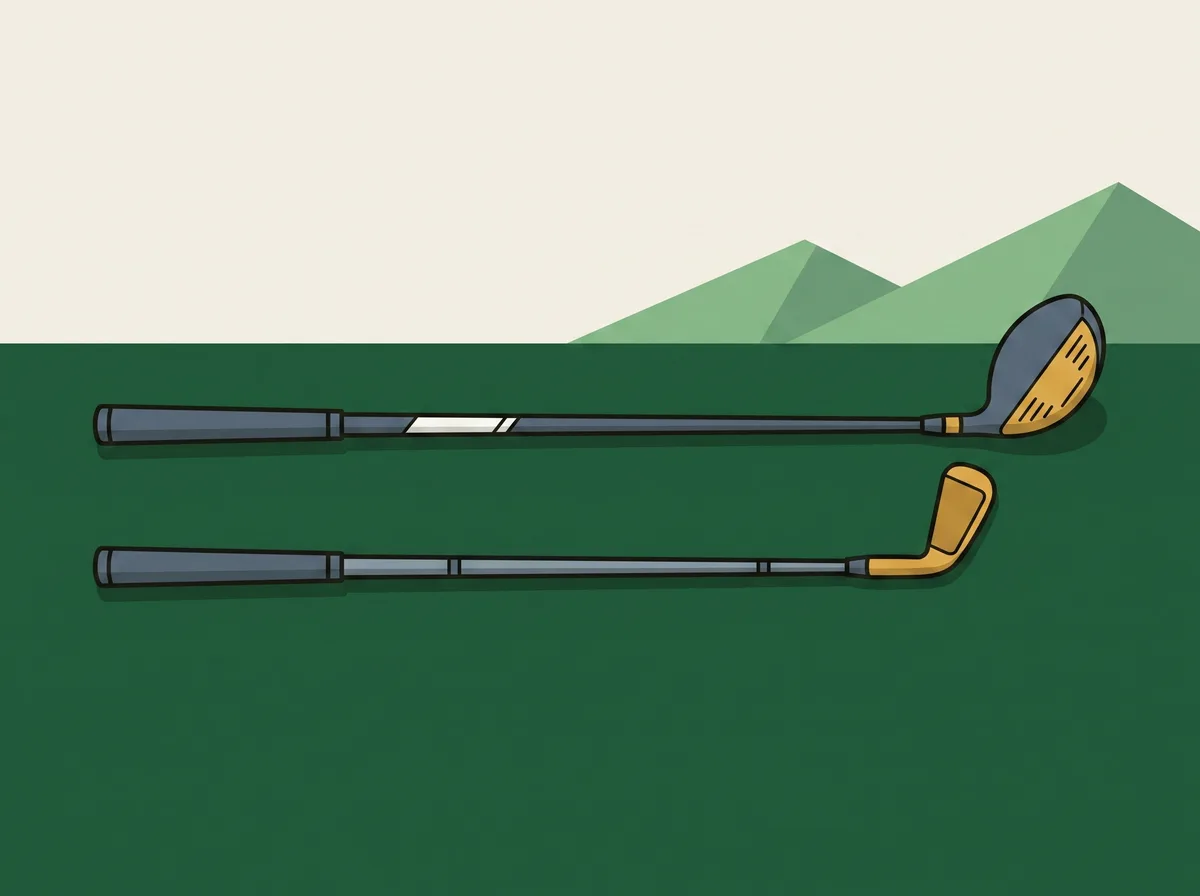
- Set your feet a little wider than for a mid iron, close to driver width. A longer club needs a broader base.
- Play the ball just inside your lead heel, which is roughly two to three balls forward of centre and slightly back of where a driver sits.
- Leave your hands level with the ball. Forward shaft lean strips loft off a club that has very little to spare and turns a sweep into a dig.
- Sole the club lightly behind the ball rather than pressing it into the turf, so you feel where the base of the head actually sits.
- Take the club back low and wide for the first foot or so. Width in the backswing is what produces width coming down, and width is what keeps the arc shallow.
The contrast with the two clubs either side of it is the fastest way to hold all of this in your head.
| Setup point | Driver | Fairway wood off the turf | 7 iron |
|---|---|---|---|
| Ball position | Opposite the lead heel | Just inside the lead heel | Middle of the stance |
| Stance width | Just outside shoulder width | Close to driver width | About shoulder width |
| Hands at address | Level with the ball | Level with the ball | Slightly ahead of the ball |
| Club at the ball | Travelling upward | Close to level | Still descending |
| What it leaves behind | Nothing, the ball is teed | A faint scuff or nothing | A divot starting past the ball |
Ball position is doing most of the work in that table, and it is free. The full chart across every club is in ball position by club.
Off the deck is the hard version
There are two fairway wood shots and golfers talk about them as one. Off a tee, the ball is sitting up, the margin for error is generous, and most golfers can hit it. Off the deck, the ball is on the ground, the club has almost no loft, and the strike has to be very close to perfect.
That is why the shot has a reputation. It is not that the swing is different. It is that a 3 wood off tight turf punishes a low point half an inch out of place far more visibly than a 7 iron does, because there is no loft to rescue a strike a groove or two low.
If topping is your recurring miss rather than an occasional one, it has its own causes and its own fixes in how to stop topping the ball, and they are worth working through before you spend a range session on this club.
The 3 wood off the tee, and when it is actually right
Most golfers reach for a 3 wood on a tight hole because it feels safer. The tracked data says the safety is smaller than it feels.
Read that carefully before you act on it. It does not say the 3 wood is never the right club. It says that for the average tracked golfer, swapping down costs about 22 yards to buy roughly one extra fairway in a hundred, which is a bad trade on most holes. Where it becomes a good trade is where the penalty for missing changes rather than the odds: water down one side, out of bounds, a hole where the fairway runs out at 240.
That decision is course management rather than technique, and the framework for making it consistently is in golf course management. The tee shot itself, if you do keep reaching for the big one, is covered in how to hit a driver.
The lie decides before you do
A fairway wood off the ground needs the ball sitting cleanly on a decent surface. It is the least forgiving lie test in the bag, and getting it wrong is how a recoverable position becomes a lost hole.
| Lie | Fairway wood off the deck? | Better option |
|---|---|---|
| Fairway, ball sitting up on short grass | Yes | None needed |
| Light semi rough, ball sitting on top | Usually yes, expect less spin | A hybrid if it is borderline |
| Ball sitting down in thicker grass | No | A hybrid or a mid iron |
| Bare, hard or thin turf | Rarely, the sole tends to bounce | A hybrid played back a fraction |
| Divot or an uneven patch | No | Anything with more loft |
The pattern is that a fairway wood needs air underneath the ball. The wide sole that makes it glide on a good lie is exactly what makes it skid into the back of the ball on a bad one. What to do instead when the grass is heavy is in how to hit out of the rough.
How far it should actually go
The honest answer is that a fairway wood is a carry club with a job, not a distance record. Golfers who chase the 3 wood as a second driver end up with a club they can only use off a tee.
Work out what yours carries from a decent lie, not what it went once downwind on a firm fairway, and treat that as the number. Benchmarks by club and how to build your own set are in the golf club distance chart. If the 3 wood and the driver are within fifteen yards of each other, one of them is not earning its place.
Three drills with a dose
Each one attaches something you can see to a low point you cannot feel.
Key takeaways
- A fairway wood off the turf is the shallowest strike in the bag, close to level rather than descending.
- Ball just inside the lead heel, stance close to driver width, hands level with the ball.
- A good one leaves a faint scuff or nothing at all, never a divot.
- Trying to help the ball up moves the low point behind it and produces the top.
- Off a tee is a different shot from off the deck, and only the second one is genuinely hard.
- Tracked data has the driver about 22 yards longer than the 3 wood and no less accurate.
- Golfers hit more greens after a driver than after a 3 wood, because the approach is shorter.
- The lie test comes first. A ball sitting down is not a fairway wood shot.
- A 5 wood or 7 wood is shorter, more lofted and easier to launch than a 3 wood.
Common questions
How do you hit a fairway wood off the deck?
Play the ball just inside your lead heel, stand a little wider than you would for an iron, and keep your hands level with the ball rather than ahead of it. Then swing wide and let the club brush the grass. You are looking for a faint scuff on the turf, not a divot.
Where should the ball be in my stance for a fairway wood?
Just inside the lead heel, which is roughly two to three balls forward of centre. That is slightly back of a driver and well forward of a mid iron. Any further back and the club arrives too steeply for the sole to work.
Do you hit down on a fairway wood?
Only just. The ball is on the ground so the club cannot be rising, but the strike is far shallower than an iron. Think of brushing the grass rather than hitting down into it. A deep divot with a fairway wood means the arc was too steep and most of the club speed went into the ground.
Why do I keep topping my 3 wood?
Almost always because you are trying to lift the ball. That hangs your weight on the trail foot, drags the low point of the swing behind the ball and leaves the club climbing by the time it arrives, so the leading edge catches the top of the ball. Trust the loft and keep turning through.
Should I take a divot with a fairway wood?
No. A faint scuff or a bruise on the top of the grass is right. The wide sole is built to slide along the surface, and a real divot means the leading edge dug in before the sole could do its job.
Is a 3 wood or a 5 wood easier to hit?
A 5 wood, clearly. It is shorter, which makes the strike easier to control, and it has more loft, which launches the ball off tight turf far more reliably. Many golfers score better carrying a 5 wood and a hybrid than a 3 wood and a 4 iron.
Should I hit 3 wood off the tee instead of driver?
Usually not, on the tracked numbers. Shot Scope has the driver roughly 22 yards longer with essentially the same fairway hit rate, and golfers hit more greens after a driver because the approach is shorter. The 3 wood earns its place where the penalty for missing is severe rather than where the fairway is merely narrow.
Can I hit a fairway wood out of the rough?
From light rough with the ball sitting on top, yes, and expect less spin and a lower flight. From anything where the ball is sitting down, no. The wide sole skids off the grass behind the ball instead of cutting through it, and a hybrid or a mid iron will do the job with far less risk.
How far should a fairway wood go?
Use your own carry number from a decent lie rather than a chart. What matters more is the gap. If your 3 wood is within fifteen yards of your driver, it is not covering any ground that another club could not.
Does fairway wood setup change for left-handed golfers?
Only in the names. Lead heel means the foot nearest the target, so a left-handed golfer plays the ball just inside the right heel. Stance width, hand position, the shallow strike and every drill are identical.
Why do I hit my 5 wood better than my 3 wood?
Shorter shaft and more loft. The shorter club is easier to deliver on a repeatable arc, and the extra loft gives the strike more margin, so a contact that would come out low and along the ground with a 3 wood still gets airborne. That is a good reason to carry the 5 wood rather than a reason to practise the 3 wood harder.
Tom Ashworth
Tom Ashworth is a PGA Professional who has taught golf since 2012, working mainly with beginners and mid-handicappers at club level in Surrey. He reviews the instruction guides on Learn Golf for technical accuracy before they publish.
Most of his teaching is with players in their first three years of the game, and most arrive having been told too much: six swing thoughts collected from videos, half of them contradicting each other. His approach is to check the grip and the alignment before touching the swing, on the basis that most bad ball flight is decided at address.