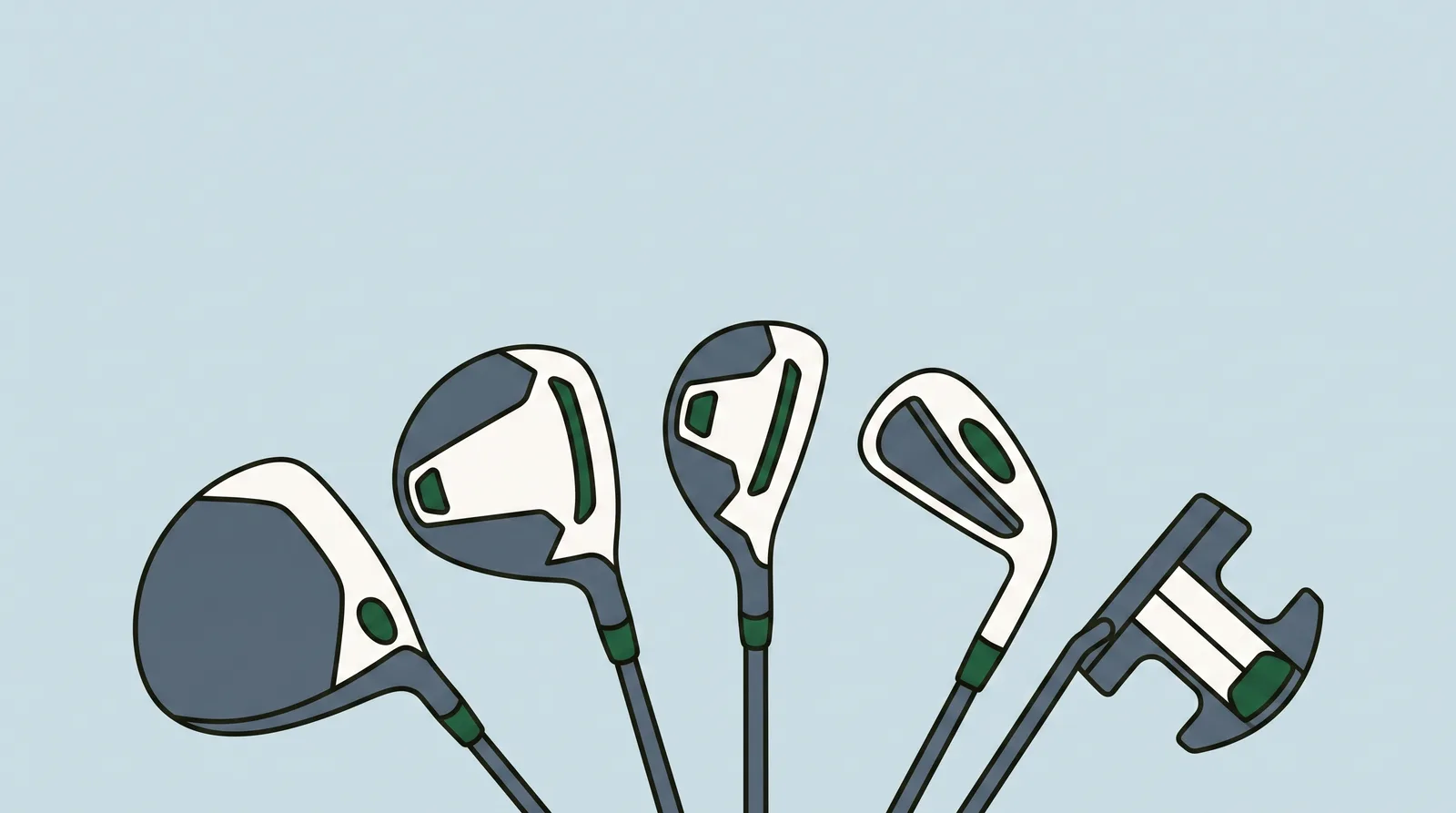
Fourteen clubs, six families, and almost no explanation on the shop wall of what separates them. Most of golf's equipment vocabulary is inherited rather than descriptive, which is why a beginner can own a 5 wood and a 5 hybrid and have no idea why both exist. Here is what each family does, when you would reach for it, and how a bag gets built.
The three things that separate every club
Strip the marketing away and clubs differ in three measurable ways.
Loft is the angle of the face, and it is the main one. More loft sends the ball higher and shorter, less loft sends it lower and further. A driver sits around 9 to 12 degrees, a 7 iron around 29 to 34, a lob wedge around 60. Everything else follows from that number.
Length is the second. A driver is roughly 45 to 46 inches, a 7 iron about 37, a wedge about 35. A longer club moves faster at the same effort, which is why the driver goes furthest, and it is also harder to strike out of the middle.
Head design is the third and the least understood. The same loft on a wide, hollow head launches the ball far more easily than on a thin blade, because mass sitting low and toward the back of the head raises flight and reduces the punishment for a strike away from centre.
| Family | Rough loft | What it does | When you reach for it |
|---|---|---|---|
| Driver | 8 to 12 degrees | Maximum distance, from a tee only | Tee shots on par 4s and par 5s |
| Fairway woods | 13 to 21 degrees | Long distance off the turf or a tee | Second shots on par 5s, tight tee shots |
| Hybrids | 17 to 27 degrees | Long shots that need to get airborne | Long approaches, awkward lies, bad tee shots |
| Irons | 19 to 45 degrees | Controlled approach shots | Most shots from 100 to 190 yards |
| Wedges | 46 to 60 degrees | Height, spin and precision | Anything inside about 120 yards, bunkers, chips |
| Putter | 3 to 4 degrees | Rolling the ball on the green | Around a third of every round |
The driver
The longest club in the bag and the only one designed to be hit on the way up, off a tee. The head is capped at 460cc by the Equipment Rules, which is why every driver on the market is the same size, and modern heads are almost entirely hollow titanium and carbon.
It is also the club most golfers overrate. Across Shot Scope's driver and 3 wood comparison, drawn from a database of 80 million shots, the average golfer hits their driver 225 yards and their 3 wood 203, and finds the fairway 46.6% of the time with the driver against 47.4% with the 3 wood. The extra 22 yards costs almost nothing in accuracy, which is a decent argument for hitting driver more, not less.
What matters when choosing one is loft, shaft weight and where the mass sits in the head, not the badge on the crown. Which driver loft to play covers that decision, and most amateurs play less loft than suits them.
Fairway woods
Smaller heads, shorter shafts and more loft than a driver, built with a flat sole that lets the club skim off turf rather than dig. A 3 wood runs around 15 degrees, a 5 wood around 18, a 7 wood around 21.
The higher-numbered ones are quietly the useful ones. A 3 wood off the deck is genuinely hard, because 15 degrees of loft on a 43 inch shaft asks for a clean strike from a lie that rarely offers one. A 5 or 7 wood does most of the same job at a fraction of the difficulty, which is why the 3 wood spends most of its life as a fallback tee club.
Hybrids
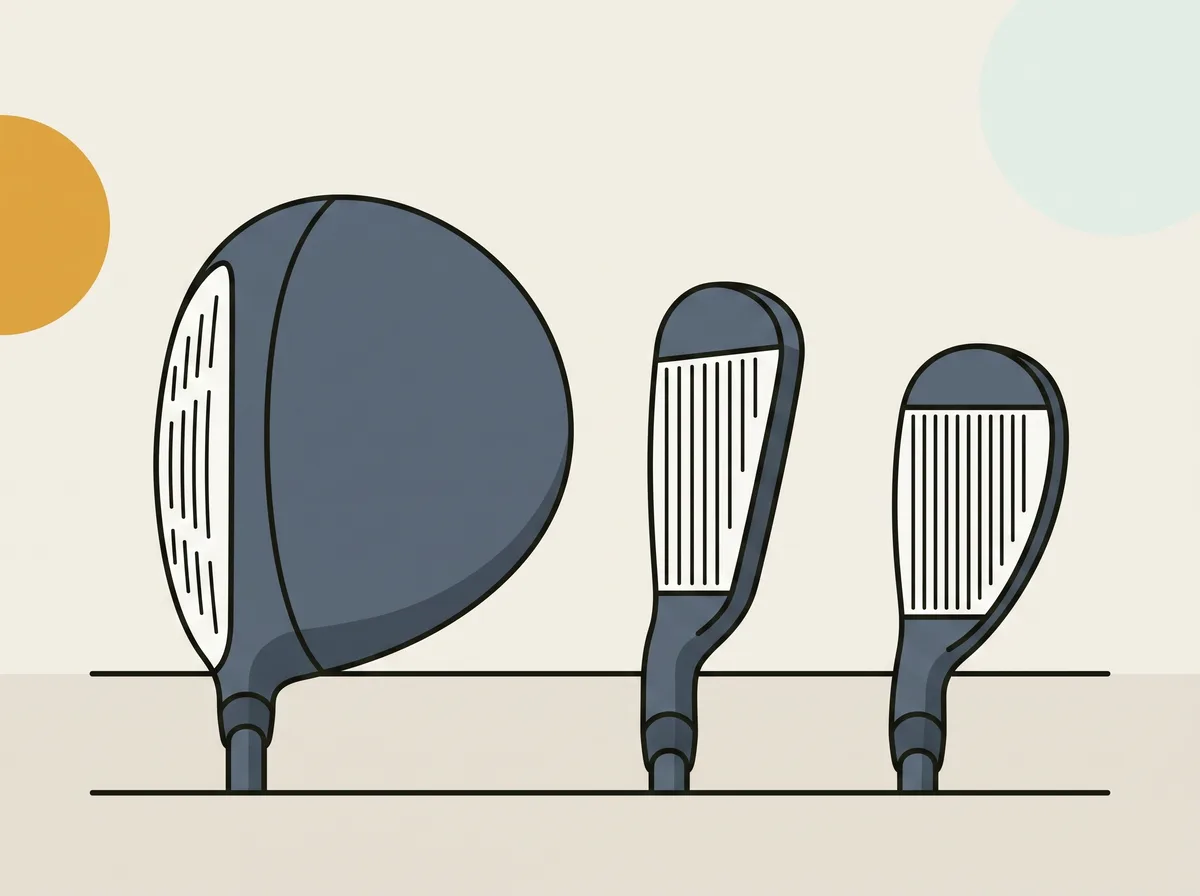
The newest family and the one that has changed club golf most. A hybrid carries a long iron's loft on a wider, deeper, lower-slung head, so the ball launches high without needing the clubhead speed a long iron demands.
The data is unusually clear on this. Shot Scope's iron and hybrid comparison found that a hybrid travels 8 to 12 yards further than the equivalent iron, and that from over 200 yards a hybrid is almost twice as effective at finding the green as a long iron. That gap closes inside 180 yards, which tells you where the swap stops being worth it.
Numbering is where hybrids confuse people. A 4 hybrid replaces a 4 iron, a 5 hybrid replaces a 5 iron, and so on. Some manufacturers number by degrees instead, so a 22 degree hybrid is roughly a 4 hybrid. How to hit a hybrid covers the technique, which is closer to an iron swing than most people expect.
Irons
The largest family and the one you will use most between tee and green. Irons run from the 4 iron at around 19 to 20 degrees to the pitching wedge at around 42 to 45, with roughly four degrees between each.
They split into two broad shapes. Cavity-back irons hollow out the back of the head and push the mass to the perimeter, which makes off-centre strikes lose less speed and stay closer to line. Blades keep the mass behind the centre of the face, which gives a better player more feedback and more control over shape, and gives everyone else a very short lesson in humility.
Iron lofts have also been strengthening for twenty years. A modern 7 iron is frequently 29 degrees where the traditional figure was around 34, which is why the number stamped on the sole tells you less than it used to. Standard iron lofts sets out how far the whole category has drifted and what it means for the gaps in your bag.
Wedges
Four clubs share the name and they are not interchangeable.
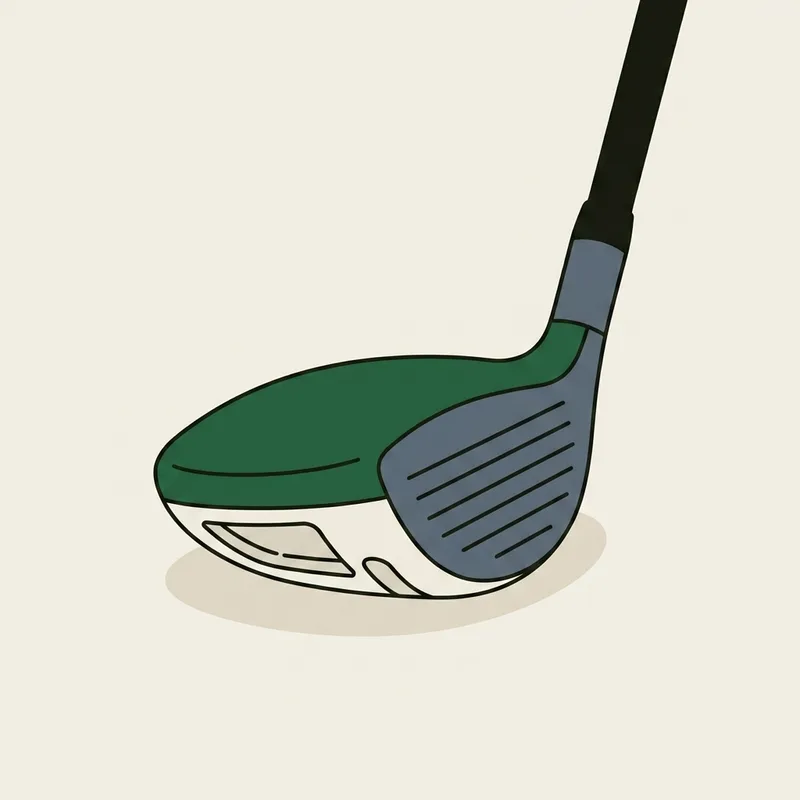
The pitching wedge comes with an iron set and is really the last iron, at 42 to 45 degrees. The gap wedge, sometimes stamped A or U, fills the hole between the pitching wedge and the sand wedge at around 48 to 52. The sand wedge sits around 54 to 56 with a wide, rounded sole built to bounce through sand rather than dig. The lob wedge is 58 to 60 and exists for shots that need to go up more than out.
Bounce is the specification nobody mentions in a shop and the one that decides whether a wedge suits your turf and your swing. It is the angle between the leading edge and the lowest point of the sole, and more of it stops the club digging. Wedge lofts and gapping works through how many wedges you actually need and which lofts to pick.
The putter
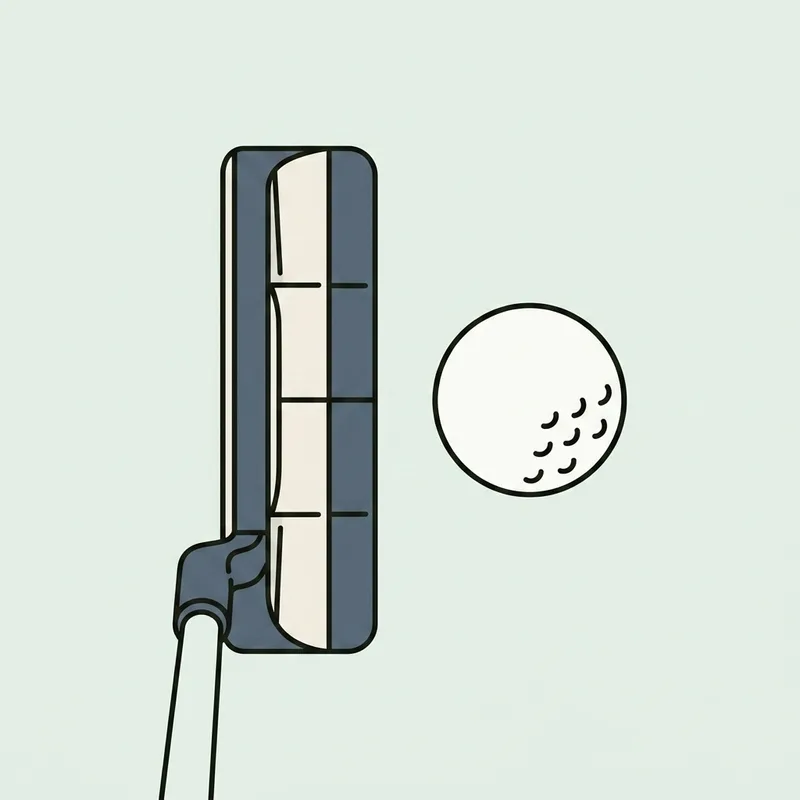
The most used club in the bag by a distance, and the one that gets the least thought. Around three degrees of loft, a flat face, and the only club where a golfer's preference genuinely outranks the specification sheet.
Putters split into blades, which are small and rely on the stroke being repeatable, and mallets, which spread mass wide and resist the head twisting on an off-centre strike. Neither is better. The choice usually comes down to what looks square to you when you set it down, which is not a joke and is the reason fittings for putters start with alignment rather than physics.
Shot Scope's benchmark data puts a golfer who shoots in the 100s at 3.2 three-putts a round, against 1.5 for someone shooting in the 80s. That difference alone is most of a handicap bracket, and it is bought with practice rather than equipment.
How fourteen clubs get chosen
Rule 4.1b of the Rules of Golf caps you at fourteen clubs and sets no minimum, so the number is a ceiling rather than a target. A conventional fourteen looks like this: driver, a fairway wood or two, one or two hybrids, six or seven irons, three or four wedges, and a putter.
The logic is gapping. Each club should cover a distance the next one does not, and a sensible bag has roughly ten to fifteen yards between neighbouring clubs through the irons. Two clubs that go the same distance are one wasted slot. How many clubs you can carry covers the rule and the penalty for getting it wrong.
Where your own distances actually fall is worth measuring rather than assuming. Our golf club distance chart sets out what tracked amateur data shows for each club, by handicap, and it is usually shorter than people expect.
Which of these you actually need
Not all fourteen, and not at first. Clubhead speed decides more than most beginners realise: TrackMan's published benchmarks put the average male amateur at 94 mph with a driver and a scratch player at 110, and long irons need speed to work at all. Below about 90 mph, a 4 iron is close to unusable and a hybrid is not a compromise but an upgrade.
A first bag of seven clubs covers every situation a new golfer meets, and what a beginner actually needs sets out which seven and what to skip. When you do buy, the specification that matters most after loft is the shaft, and which flex you need is worth reading before you spend anything. If you want models rather than principles, our beginner club picks start there.
Key takeaways
- Six families: driver, fairway woods, hybrids, irons, wedges, putter. Everything that separates them is loft, length and head shape.
- The driver goes about 22 yards further than a 3 wood for almost identical accuracy across tracked amateur data.
- Hybrids carry a long iron's loft on an easier head, and travel 8 to 12 yards further than the equivalent iron.
- Never carry a long iron and the hybrid that replaces it. Same loft, same distance, one wasted slot.
- Modern iron lofts are around five degrees stronger than traditional ones, which has opened a large gap above the sand wedge.
- Bounce, not loft, is what makes a wedge suit your turf and your swing.
- Fourteen clubs is a legal maximum with no minimum. Gapping, not completeness, is what makes a bag work.
Common questions
What are the different types of golf clubs?
Six families: the driver, fairway woods, hybrids, irons, wedges and the putter. A full bag holds up to fourteen clubs drawn from those groups, usually one driver, one or two woods, one or two hybrids, six or seven irons, three wedges and a putter.
What is each golf club used for?
The driver is for tee shots, fairway woods for long shots off the turf, hybrids for long approach shots and awkward lies, irons for most approaches between roughly 100 and 190 yards, wedges for anything shorter plus bunkers and chips, and the putter for the green.
What is the difference between a hybrid and an iron?
They carry similar loft on very different heads. A hybrid's head is wider, deeper and lower-slung, so it launches the ball higher with less clubhead speed. Tracked amateur data shows a hybrid going 8 to 12 yards further than the iron it replaces, and finding the green nearly twice as often from over 200 yards.
What is the difference between a fairway wood and a hybrid?
A fairway wood has a bigger head and a longer shaft, so it goes further and is harder to control. A hybrid is shorter, more compact and easier to hit from rough or a poor lie. Most golfers who own both use the wood off a tee and the hybrid off the turf.
How many wedges should I carry?
Two is fine to begin with, three suits most golfers once distance control improves. A pitching wedge and a sand wedge cover the basics, and a gap wedge fills the hole between them that modern strong lofts have opened up. A lob wedge is a specialist club and the last one worth adding.
What is the easiest golf club to hit?
For most people a 7 iron or a hybrid. Both have enough loft to get the ball airborne without demanding much speed, and both sit on a shaft short enough to strike consistently. The hardest are the long irons and, off the turf, the 3 wood.
Do I need a driver?
Not immediately. A 3 wood is shorter, has more loft and is easier to hit straight, and at beginner swing speeds it costs surprisingly little distance. Plenty of golfers score better leaving the driver at home for their first season.
What does the number on a golf club mean?
It is a shorthand for loft, and a higher number means more loft and less distance. A 9 iron has more loft than a 7 iron, so it goes higher and shorter. The numbering is a manufacturer convention rather than a standard, which is why one brand's 7 iron can be two degrees stronger than another's.
What is bounce on a wedge?
The angle between the leading edge of the club and the lowest point of the sole. More bounce stops the club digging into sand or soft turf, less bounce suits firm ground and a shallow strike. It matters more than loft for how a wedge behaves under your particular swing.
Are blades or cavity back irons better?
Cavity backs are better for almost everyone. Moving mass to the perimeter of the head means an off-centre strike loses less ball speed and finishes closer to line. Blades give a repeatable striker more feedback and more control over shape, and give everyone else worse results.
Can I carry more than 14 clubs?
No. Rule 4.1b caps you at fourteen for a round, and carrying more brings a penalty of two strokes per hole up to a maximum of four. There is no minimum, so a round played with seven clubs is entirely legal.

Tom Ashworth
Tom Ashworth is a PGA Professional who has taught golf since 2012, working mainly with beginners and mid-handicappers at club level in Surrey. He reviews the instruction guides on Learn Golf for technical accuracy before they publish.
Most of his teaching is with players in their first three years of the game, and most arrive having been told too much: six swing thoughts collected from videos, half of them contradicting each other. His approach is to check the grip and the alignment before touching the swing, on the basis that most bad ball flight is decided at address.