
Walk into a shop and ask for a driver and you will be handed 10.5 degrees. Ask a golfer what they play and a surprising number will say nine, because nine is what good players are assumed to play. The measured evidence points hard the other way: the slower the swing, the more loft it wants, and the golfer who most needs 12 degrees is the one least likely to buy it.
What loft is doing on a driver
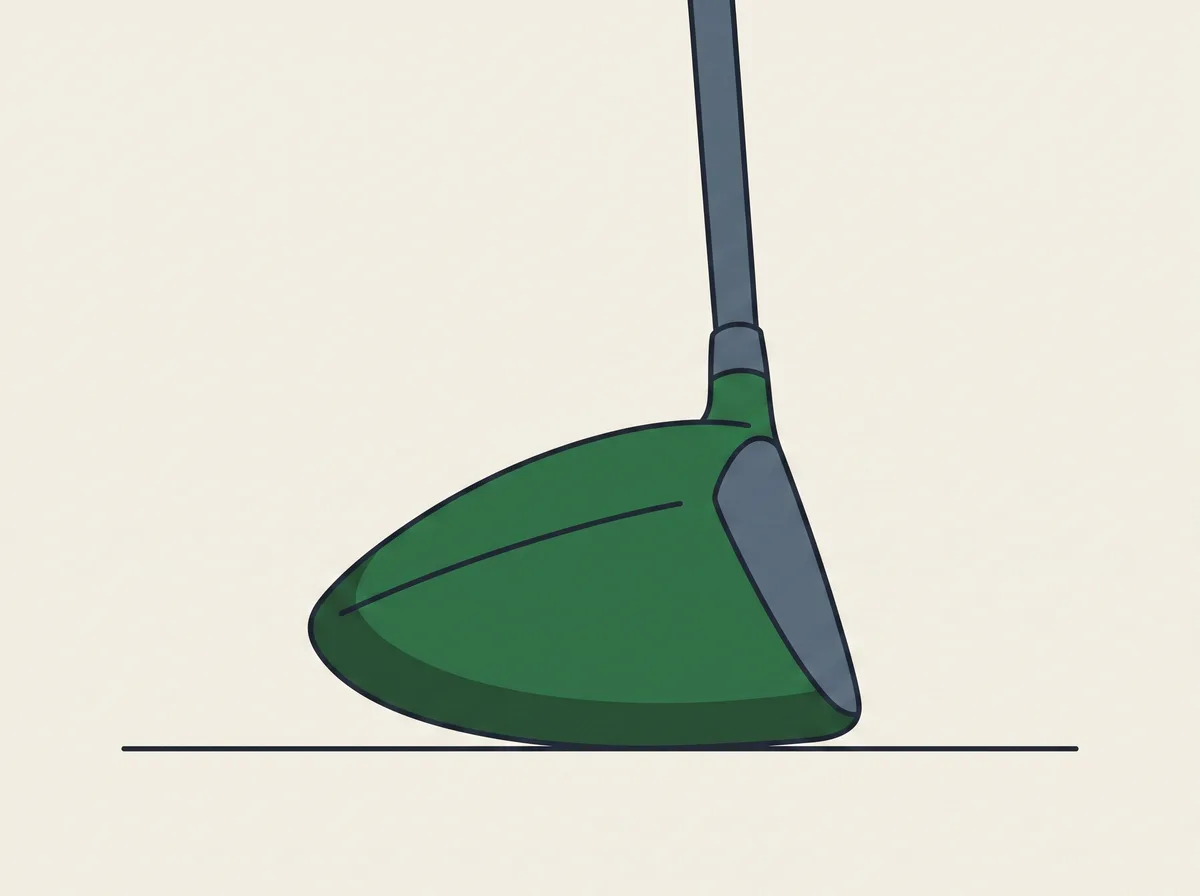
Loft is the angle the clubface leans back from vertical. On an iron it mostly decides how far the ball goes. On a driver it decides something more specific: how the ball gets into the air, and how much of your clubhead speed survives the trip.
The ball leaves the face at a launch angle and with a spin rate, and those two numbers together set the shape of the flight. Too little launch and the ball never gets high enough to stay airborne. Too much spin and it climbs, stalls and drops out of the sky short. Loft moves both at once, which is why it cannot be chosen in isolation.
TrackMan's launch angle work makes the mechanism plain: launch angle tracks closely with dynamic loft, the loft actually presented to the ball at impact, and always sits a little under it. The loft stamped on the head is the starting point for that number, not the number itself.
The lofts you can actually buy
Driver heads are sold across a narrow band. Most manufacturers stock roughly 8 to 12 degrees, with 9, 10.5 and 12 the three that account for nearly all sales, and a handful of higher lofted models above that aimed at slower swings. Ping, for example, publish the G440 Max driver in 9, 10.5 and 12 degrees, each with an adjustable hosel offering plus or minus 1.5 degrees.
| Stated loft | Commonly sold as | Realistic fit |
|---|---|---|
| 8 to 9 degrees | Low spin, tour | High speed with a level or upward strike |
| 9.5 to 10 degrees | Standard | Fast swings that still hit slightly down |
| 10.5 degrees | The default stock loft | The majority of male club golfers |
| 11 to 12 degrees | High launch | Under roughly 90 mph, or a steep strike |
| 12 degrees and above | Senior, ladies, high launch | Slower speeds and anyone struggling to get the ball up |
Two things are worth noticing about that table. The first is that the useful range is only about four degrees wide, so the decision is smaller than it feels. The second is that the adjustable hosel on almost every current driver moves the loft by more than the gap between two stock heads, which means the number etched on the sole is a starting position rather than a specification.
Attack angle changes the answer as much as speed does
This is the part the shop conversation usually skips, and it is the reason two golfers with identical clubhead speed can need different lofts.
Attack angle is whether the clubhead is travelling downward or upward at impact. TrackMan's attack angle benchmarks put the PGA Tour at minus 0.9 degrees with a driver and the LPGA Tour at plus 2.8, and they are direct about what that is worth: hitting up on the ball is treated as a requirement for maximising driver distance, not a stylistic preference.
Hit down on the ball and you need more loft on the club to reach a usable launch angle. Hit up on it and you can reach the same launch angle with less. The two specifications are answers to the same question, which is why a fitter measures one before recommending the other.
TrackMan publish tour averages for every metric they measure, and separately a baseline for the average male amateur. Set the two side by side and the loft argument reorganises itself.
| Driver | Average male amateur | LPGA Tour |
|---|---|---|
| Clubhead speed | 93.4 mph | 96 mph |
| Attack angle | minus 1.6° | plus 2.8° |
| Launch angle | 12.6° | 12.6° |
| Spin rate | 3,275 rpm | 2,506 rpm |
| Carry | 204 yds | 223 yds |
The LPGA column is TrackMan's published tour average for club speed, spin rate and driver carry, alongside the attack and launch figures above.
Read those two rows against each other and the reason becomes visible. Both golfers launch the ball at 12.6 degrees. The LPGA player gets there by swinging up at the ball, so very little of the launch comes from spin-generating loft. The amateur gets there by swinging down and presenting extra loft at impact, which produces the same launch with a great deal more spin behind it.
Spin is the tax. TrackMan define spin loft as the gap between where the head is travelling and where the face is pointing at impact, and the wider that gap, the more the ball spins. A downward strike widens it automatically, before the golfer has chosen a single specification.
Where to start, by speed and strike
Nothing below is a measurement. It is the fitting trade's working convention for where to begin, and the only honest use of it is to pick the head you try first.
| Driver clubhead speed | Hits down on it | Level | Hits up on it |
|---|---|---|---|
| Under 85 mph | 12 degrees or more | 12 degrees | 10.5 to 12 degrees |
| 85 to 95 mph | 12 degrees | 10.5 to 12 degrees | 10.5 degrees |
| 95 to 105 mph | 10.5 degrees | 9.5 to 10.5 degrees | 9 to 10.5 degrees |
| Over 105 mph | 10.5 degrees | 9 to 10.5 degrees | 8 to 9.5 degrees |
Notice that the downward-strike column never drops below 10.5. That is not a rounding artefact. A golfer who delivers the club on a descending path is already adding effective loft and spin, and taking loft off the head makes the launch worse without taking the spin away.
Notice also that the low lofts only appear in the bottom right corner. Nine degrees is a specification for a fast swing that arrives level or rising, and Shot Scope's benchmark data suggests how few golfers that describes: a golfer who shoots in the 90s averages 225 yards off the tee and a golfer in the 100s averages 204. Neither of those is a nine degree driver.
The hosel setting changes more than loft
Almost every adjustable driver moves loft and face angle together, and the second half of that is rarely explained at the point of sale.
Turning the hosel to add loft typically closes the face a little at address. Turning it down to reduce loft typically opens it. So a golfer who adds loft to get the ball in the air also nudges their start line left, and a golfer who takes loft off nudges it right, both for a right-hander. If a loft change makes your ball flight move sideways rather than up, that is the reason, and it is not a fault in the club.
Manufacturers also publish a lie angle for each hosel position, and some adjustable systems offer an upright setting that changes lie without changing loft. What that specification does to a strike is covered in lie angle and why it matters.
How to tell your loft is wrong without a launch monitor
A launch monitor answers this in five minutes, and what a club fitting covers sets out what else gets measured while you are there. Failing that, the flight itself is readable.
Too little loft looks like a drive that comes off low and hard, holds its line for a while, then stops climbing early and drops with almost no carry left in it. Into a headwind it collapses. The tell is that your best strikes do not fly noticeably higher than your poor ones.
Too much loft looks like a ball that climbs steeply, hangs, and lands almost vertically with very little roll. Downwind it balloons and goes nowhere. The tell is that the flight peaks well before the ball starts coming down.
The commonest amateur pattern is neither of those. It is a ball that starts low and then climbs late, which is the signature of a downward strike with high spin, and the fix for it is usually attack angle rather than loft. Teeing the ball higher and playing it further forward in the stance are the two changes that move it, and where the ball sits in your stance covers the second properly. If the ball is coming off the top edge instead, skying your drives is a different problem with a different cause.
Loft is not the first thing to fix
If the driver is the club going wrong, loft is rarely the whole story and often not the start of it.
Strike location moves launch and spin more than a degree of loft does. A ball struck low on the face launches lower and spins more, and one struck high does the reverse, which is why two swings with the same club can produce two completely different flights. Hitting a driver covers the setup that makes a high, central strike likely rather than accidental.
Shaft weight and flex change delivery as well, and working out which flex you need explains how to estimate that without a launch monitor. Speed itself is the other lever, and what actually increases clubhead speed is honest about how much of it is available.
Once the specification is settled, the head itself matters less than the marketing suggests. Current driver picks by ability works through the models, and what a realistic driver distance looks like puts tracked amateur numbers around the whole conversation. A correctly lofted driver flies better than a badly lofted one. It does not turn a 200 yard carry into a 260 yard one.
Key takeaways
- Loft on a driver controls launch and spin together, and both have to land in a usable range for the ball to carry.
- The commonly stocked range is about 8 to 12 degrees, with 9, 10.5 and 12 covering almost every sale.
- Attack angle changes the correct loft as much as clubhead speed does. Hit down on the ball and you need more loft to reach the same launch.
- TrackMan's figures put an average male amateur at 93.4 mph with a minus 1.6 degree attack angle and 3,275 rpm, against an LPGA player at 96 mph, plus 2.8 degrees and 2,506 rpm.
- More loft raises launch and spin at once. That helps a slower swing, where flight is limited by height, and hurts a fast one already spinning too much.
- Nine degrees is a fit for high speed with a level or rising strike, which describes very few club golfers.
- Adjustable hosels move face angle along with loft, so adding loft tends to close the face and taking it off tends to open it.
- Under the Rules, set the hosel before the round and leave it there.
Common questions
What driver loft should I use?
Start at 10.5 degrees unless you have measured a reason not to. Below about 90 mph of clubhead speed, or if you hit down on the ball, 12 degrees is more likely to be right. Nine degrees only makes sense with high speed and a level or upward strike.
Is 9 or 10.5 degrees better?
For almost every club golfer, 10.5. Nine degrees suits a fast swing that arrives level or rising at the ball, which is a professional pattern rather than an amateur one. The gap between the two heads is smaller than the adjustment range on the hosel, so it is not a decision worth agonising over.
Does more loft mean less distance?
No, and this is the assumption that costs golfers the most. Distance comes from a combination of ball speed, launch angle and spin, and a driver with too little loft for your delivery launches the ball too low to carry. Adding loft in that situation adds carry rather than removing it.
What loft driver for a slow swing speed?
Twelve degrees or more. Slower swings produce lower ball speeds, and a lower ball speed needs a higher launch angle to stay airborne long enough to carry. High launch heads and higher lofts exist precisely for this, and they are the least ego-flattering shelf in the shop.
How does attack angle affect driver loft?
A downward attack angle adds effective loft and spin at impact, so a golfer who hits down needs more loft on the head to launch the ball properly, not less. An upward attack angle does the opposite. TrackMan's benchmarks show the LPGA Tour averaging plus 2.8 degrees with a driver against the PGA Tour's minus 0.9.
Can I change the loft on my driver?
On most drivers sold in the last decade, yes. The adjustable hosel typically offers around plus or minus 1.5 degrees, which is more than the gap between two stock heads. It has to be set before the round starts, because deliberately changing a club's playing characteristics mid round is a breach of the Rules.
Does changing loft change the face angle?
Usually. Most adjustable hosels tilt the shaft in the head, so adding loft closes the face slightly and reducing loft opens it. If a loft change moves your start line sideways rather than changing your trajectory, that interaction is why.
What loft do tour players use?
Typically between 8 and 10.5 degrees, and it has been creeping upward as launch monitor fitting has become universal. It is also the least useful benchmark available, because tour players pair those lofts with clubhead speeds and strike quality that almost no amateur produces.
Will a higher lofted driver make me slice it less?
It can help a little. More loft means more backspin relative to sidespin, which reduces how much the ball curves for a given amount of face-to-path mismatch. It treats the symptom rather than the cause, so it is worth doing alongside a fix rather than instead of one.
Should I just use a 3 wood off the tee instead?
If your driver flight is low and spinning, a 3 wood will often carry further, and that is a legitimate answer while you sort the driver out. It is also a sign the driver loft is wrong, because a correctly fitted driver should out-carry a fairway wood comfortably at the same swing.
How much loft is too much?
When the ball starts ballooning, peaking early and landing steeply with no roll, particularly downwind. That is the point where extra height has stopped buying carry and started costing it. In practice very few amateurs reach it, and far more are on the other side of the line.

Tom Ashworth
Tom Ashworth is a PGA Professional who has taught golf since 2012, working mainly with beginners and mid-handicappers at club level in Surrey. He reviews the instruction guides on Learn Golf for technical accuracy before they publish.
Most of his teaching is with players in their first three years of the game, and most arrive having been told too much: six swing thoughts collected from videos, half of them contradicting each other. His approach is to check the grip and the alignment before touching the swing, on the basis that most bad ball flight is decided at address.