
Fifteen yards short of the green, flat clear ground all the way to a flag at the back, and the sand wedge comes out of the bag again. The bump and run is the shot that situation is asking for, it is the easiest shot in the short game to repeat, and most golfers play it about a tenth as often as they should. This guide covers how to pick the club, how to read the run out, and the longer versions of the same shot.
What a bump and run is
A bump and run is a low shot played with a straight-faced club that carries a small part of its distance and rolls the rest. The bump is the short carry that gets the ball onto the putting surface. The run is everything that happens afterwards, which is most of the shot.
It sits at the lowest end of the short game range and it covers more ground than golfers expect. A short one is a chip from the fringe. A long one is a 40 yard shot played with a 7 iron up a slope onto a links green. The idea does not change with distance, only the club and the length of the stroke do.
Why the ground beats the air
The case for this shot is not stylistic. It is the strongest piece of tracked evidence in the amateur short game.
Six feet closer is not a rounding error, because of what happens next. Shot Scope's putting make percentages by handicap have every handicap group holing between 82.5 and 92.8 percent from inside six feet, and between 35.0 and 42.8 percent from six to twelve feet. The club you play the running shot with decides which of those two brackets your next putt comes from.
There is a mechanical reason the running shot behaves as it does. TrackMan defines carry as the distance the ball flies before it first touches down at the height it was struck from, with total distance being carry plus everything afterwards, and notes that a flatter landing angle produces more bounce and roll. A bump and run is a shot deliberately built to land flat, which is why the roll is long and, more usefully, consistent.
Choosing the club by how far it has to run
The whole shot is decided by one measurement, and it is not the distance to the hole. It is how much putting surface sits between the front edge of the green and the flag.
Walk to the side of the shot, pace it if you can, and pick the club whose roll fills that gap. The landing spot barely moves between clubs. The club is doing the work.
| Green between the front edge and the hole | Club | What the ball does |
|---|---|---|
| 25 paces or more | 7 iron | A small hop on, then a long steady roll |
| 18 to 25 paces | 8 iron | A short carry and a long run out |
| 12 to 18 paces | 9 iron | Roughly a third in the air, two thirds along the ground |
| 6 to 12 paces | Pitching wedge | About half and half |
| Under 6 paces | Not a bump and run | Too little green to run the ball out on |
The stroke, briefly
There is almost nothing to the motion, which is the point. It is the chipping action, and the full treatment of the setup and stroke is in the chipping guide rather than repeated here.
The short version is four positions. Grip down the handle until your lower hand is near the steel. Narrow the stance to about the width of one foot. Put roughly two thirds of your weight on your lead foot and leave it there. Play the ball just back of centre with the handle leaning toward the target.
Then rock your shoulders and let the arms and club go with them, keeping whatever wrist angle you set at address. Length of stroke controls distance and the speed of the stroke never changes. That is the entire technique.
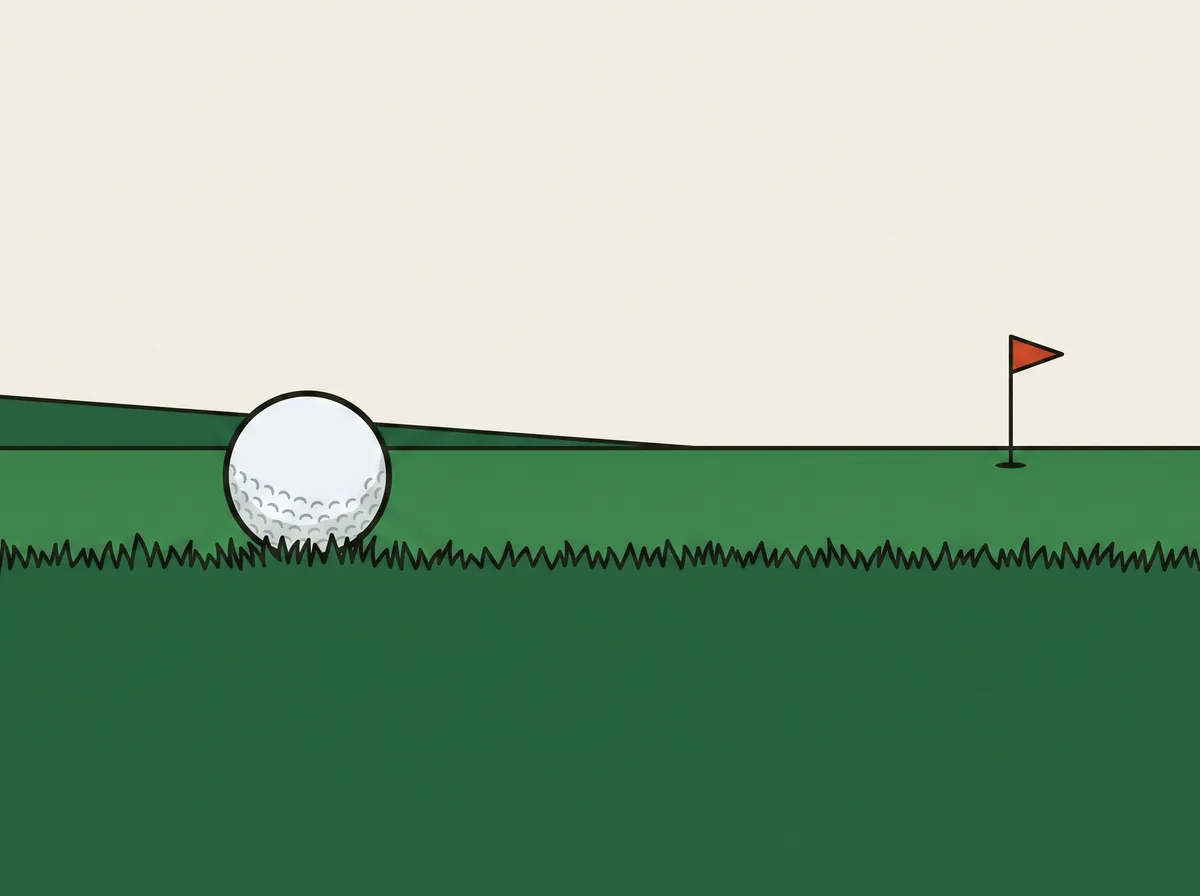
Reading the run out
Because most of the shot happens on the ground, the ground is where the information is. Four things change how far the ball runs, and all four are visible before you play.
Slope is the largest. A ball running uphill can lose a third of its roll and a ball running downhill can gain half again, which is far more than any club change would give you. Look at the run out as a putt, because that is what it becomes after the first bounce, and the reference points for reading it are in how to read greens.
Firmness is the second. A green that has been watered overnight will take a print from your shoe and will kill roll on everything. A firm one in high summer will not, and the same shot goes a third further.
Grain is the third and the one most golfers in temperate climates ignore. Grass leaning away from you speeds the ball up and grass leaning toward you slows it down, and the effect is strongest on the collar in front of the green because the grass is longest there.
The collar is the fourth. A ball landing in the fringe rather than on the putting surface loses a surprising amount of speed, which is why the landing spot is a pace or two onto the green rather than short of it.
Take those four together and the same club can produce a run out that varies by half its length between two greens on the same course. That is why the club table is a starting point and the first shot on a given green is your best information.
The longer version
Most descriptions of this shot stop at the fringe, which leaves out where it is most valuable. From 25 to 40 yards on open ground, a running shot with a 7 or 8 iron is far more forgiving than a wedge, because the swing is shorter and the ball spends less time in the air.
The setup barely changes. The stance widens slightly, the stroke gets long enough that the wrists set a little on their own, and the ball stays back of centre with the hands ahead. What must not happen is a conscious wrist hinge, which adds height and turns the shot into something else.
This is the standard play on firm ground, on links courses, and any time the green is running fast. It is also the correct shot into a strong wind, where a lofted ball is at the mercy of the air and a low one is not, which is part of the wider argument in playing golf in the wind.
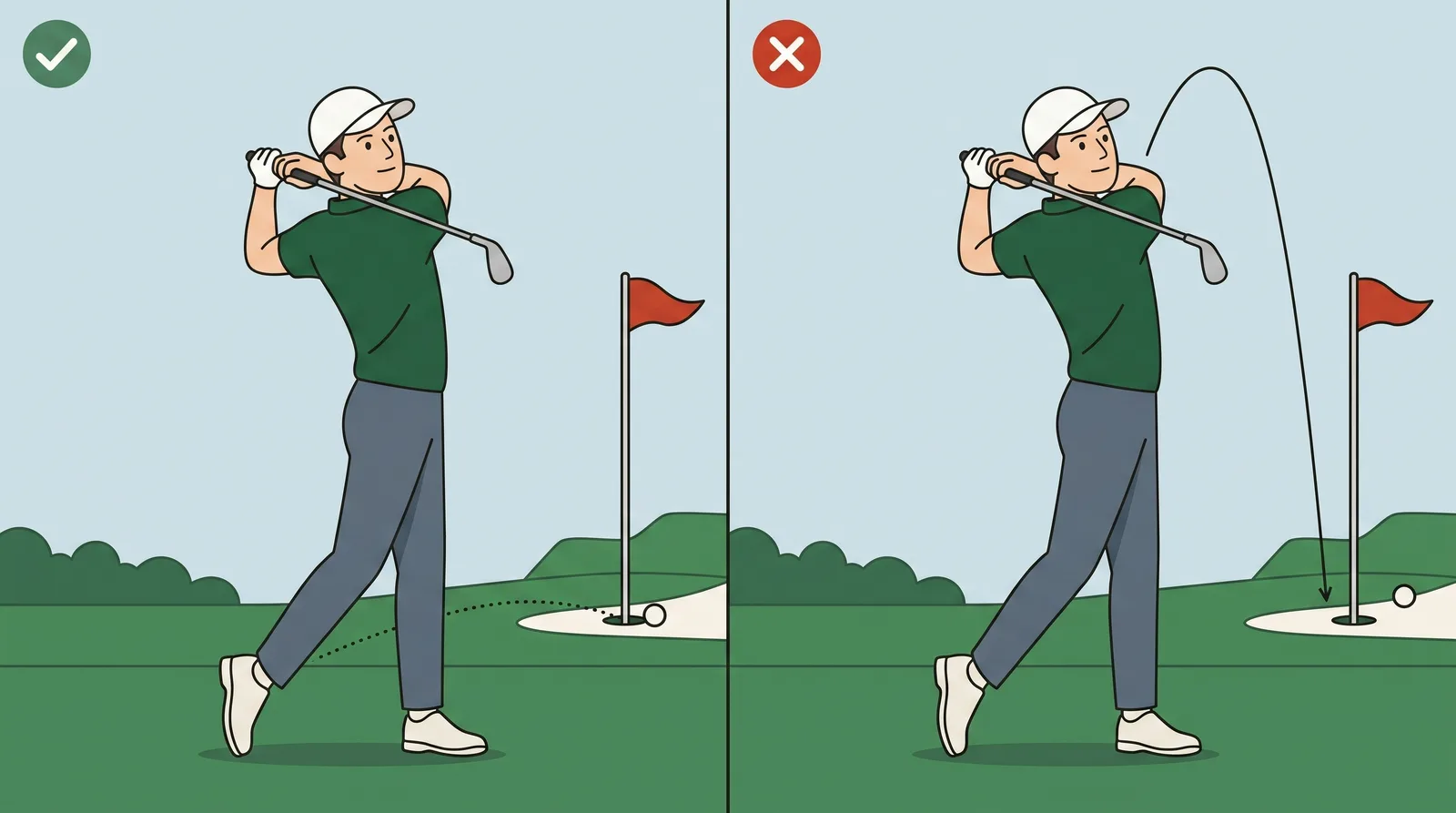
When it is the wrong shot
Three situations rule it out, and recognising them takes about two seconds.
Something in the way is the obvious one. A bunker, a steep bank, a ditch or a thick collar of heavy rough all mean the ball has to fly, and no amount of preference for the ground changes that.
Being short-sided is the second. If the flag sits a few paces from the edge you are approaching from, there is nowhere for the ball to run out and a running shot will finish long every time. That is the situation the lofted shot exists for, and at its most extreme it becomes the flop shot, which is the exact opposite of this page in technique, risk and purpose.
A green running away from you is the third. Downhill, a running ball does not slow down in time, so the shot has to be flown and landed softly rather than rolled.
Everything else is a bump and run, and the boundary between it and the flying shot is set out properly in chipping and pitching compared.
When the putter is better still
There is a shot below this one. If the ball is on the fringe or the first cut with smooth clear ground ahead, a putter removes the fat and the thin miss entirely, and a poor putt from off the green finishes ten feet away where a poor chip can finish anywhere.
The rule of thumb worth carrying is to use the least lofted club that can do the job, and the putter is the least lofted club in the bag. Speed control from off the surface is the only difficulty, and the way to build it is covered in the putting guide.
Practising it
This is the cheapest skill in golf to build because the motion is small, the club is forgiving, and you can practise most of it on any patch of grass.
Neither drill is about the swing. The swing is not the hard part of this shot and never was, which is why fifteen minutes three times a week does more here than an hour anywhere else.
What it is worth
The value of this shot is not that it produces spectacular results. It is that it produces boring ones, reliably, from the situation golfers face most often.
Shot Scope's five key scoring stats put the average golfer's chance of getting up and down from inside 50 yards at roughly one in three, and have a 15 handicap missing the green short on 54 percent of approach shots beyond 50 yards. Missing short leaves clear ground between the ball and the flag, which is exactly the shot this page describes, and it is the most common recovery in amateur golf.
The mis-hit is rarer here than on any other short game shot because the swing is small and the club has a wide sole, but it still happens, and a chunked running shot has the same cause as every other fat one. The diagnosis is in how to stop chunking chips. Keeping the ball low is also the simplest piece of course management available to a beginner: it costs nothing, requires no new skill, and improves the average outcome of a shot that comes up several times a round.
Key takeaways
- A bump and run carries a small part of its distance and rolls the rest, using a straight-faced club.
- Choose the club by how much green sits between the front edge and the hole, not by distance to the flag.
- The landing spot stays roughly the same for every club. The club changes how far the ball runs from it.
- Land the ball a pace or two onto the putting surface. The fringe takes far more speed off than expected.
- Slope, firmness, grain and the collar all change the run out more than a club change does.
- Shot Scope has amateurs getting up and down 8 percent more often and finishing 6 feet closer with an 8 iron, 9 iron or pitching wedge.
- Every handicap group holes over 82 percent from inside six feet and under 43 percent from six to twelve.
- The long version, played with a 7 or 8 iron from 25 to 40 yards, suits firm ground and into wind.
- It is the wrong shot when something must be flown, when you are short-sided, or when the green runs away.
Common questions
What is a bump and run in golf?
A low shot played with a straight-faced club that carries a short way onto the putting surface and rolls the rest. The carry is the bump and the roll is the run, usually two thirds or more of the total. It is the lowest risk shot in the short game because most of the journey happens on the ground.
What club should I use for a bump and run?
Anything from a 7 iron to a pitching wedge, chosen by how much green lies between the front edge and the hole. More green means less loft: a 7 iron for a long run out, a 9 iron for a medium one, a pitching wedge when the flag sits closer to the front.
Is a bump and run the same as a chip?
They overlap almost completely. A chip is the general term for a short low shot around the green and a bump and run is the version played with a deliberately straight-faced club and a long run out. The name also covers the longer 25 to 40 yard running shot.
Where should a bump and run land?
A pace or two onto the putting surface, never on the fringe. The collar in front of a green is longer grass and takes far more speed off a ball than the putting surface does, so a ball landed short of the green finishes well short of where you expected.
Can you play a bump and run with a wedge?
A pitching wedge works well when there is roughly six to twelve paces of green to work with. A sand or lob wedge does not, because there is not enough run in them to make the shot worth playing, and at that point you are simply pitching with extra steps.
When should I not play a bump and run?
When something has to be flown, when you are short-sided with only a few paces of green, or when the green slopes away so a rolling ball cannot stop. In all three the ball has to be flown and landed softly, which is a different shot.
How far back should the ball be in my stance?
Just back of centre in a narrow stance. That puts the low point of the swing in front of the ball so the club is still descending at impact, which produces the clean strike and the low flight. Too far back delofts the club so much the ball comes out hot.
Do I hinge my wrists on a bump and run?
No on the short version, and only as much as the stroke length naturally produces on the long one. A conscious hinge adds height and turns the shot into a pitch, which removes the whole advantage. Keep the angle you set at address and let the shoulders drive it.
Why does my bump and run come up short?
Usually one of two things. Either the ball landed in the fringe rather than on the putting surface, which kills a surprising amount of speed, or the stroke decelerated because the backswing was too long. Shorter back and the same speed through fixes the second.
Can I bump and run from the rough?
From light rough, yes, though the ball comes out slower with less spin and more run, so expect a longer roll and take a little less club. From thick or wet grass the club snags and the strike becomes unpredictable, and the ball needs more loft to get out cleanly.

Tom Ashworth
Tom Ashworth is a PGA Professional who has taught golf since 2012, working mainly with beginners and mid-handicappers at club level in Surrey. He reviews the instruction guides on Learn Golf for technical accuracy before they publish.
Most of his teaching is with players in their first three years of the game, and most arrive having been told too much: six swing thoughts collected from videos, half of them contradicting each other. His approach is to check the grip and the alignment before touching the swing, on the basis that most bad ball flight is decided at address.