Best Golf Push Carts: Folded Size Against a Real Boot
A push cart is chosen on how it looks open and lived with folded, in a car boot, twice a round. Here is what four of them publish, what they leave out, and which numbers actually decide it.
Some links here earn us a commission at no extra cost to you. It never changes what we recommend or the order we rank it. How this works.
A push cart is chosen on how it looks open and lived with folded, in the back of a car, twice a round. The specification that decides whether you keep using it is the folded size, and it is the one figure several makers do not print. Here are four carts, what each one actually publishes, and how to check a folded size against a boot you already own.
The four, compared
Two three-wheel carts and two four-wheel carts, which is the split that matters most on the course, and a weight range from 14.77 lb to 21 lb, which is the split that matters most in the car park.
| Pick | Best for | Wheels | Weight | Folded | Brake | Price |
|---|---|---|---|---|---|---|
| BIG MAX Blade IP 2 | The flattest fold and the lightest lift | 3, ball bearing | 14.77 lb, about 6.7 kg | 31.1 x 23.6 x 4.92 in | Double footbrake | Around £240 to £320 |
| Clicgear Model 4.5 | Fitting any bag you will ever own | 3 | 21 lb, about 9.5 kg | 13 x 15 x 23 in | Front wheel hand brake, internally routed | Around £279 at UK retail |
| Bag Boy Quad XL | Four wheels and a bag that locks on | 4, maintenance-free solid foam tyres | 16 lb, about 7.27 kg | 61 x 43 x 41 cm, about 24 x 17 x 16 in | Not published | Around £259 to £275 |
| Sun Mountain PX4 | Bungee simplicity, if you can find the folded size | 4 | 17.2 lb, about 7.8 kg | Not published | Not published in the spec block | Around £160 to £220, on run-out |
Folded size is the specification retailers quote and manufacturers frequently skip. Listings will give you a folded figure to a decimal place for carts whose makers state nothing at all, and those numbers move between sites without anyone measuring anything. Where a figure below is missing, it is missing because it was not published.
Three wheels or four
This is the first decision and it is not a close call in either direction. It depends entirely on the ground you play on.
| Three wheels | Four wheels | |
|---|---|---|
| Across a slope | Wants to turn downhill, needs steering pressure | Tracks straighter with less correction |
| Turning | Pivots on the spot | Wider arc, needs more room |
| Rough ground | The single front wheel drops into anything it meets | Two front wheels bridge small holes |
| Folded shape | Usually flatter or narrower | Usually a chunkier block |
| Weight | Usually lighter | Usually heavier |
| Pushing one-handed | Easier | Easier still, because it does not wander |
The short version: if your course is flat parkland, three wheels are lighter, fold smaller and turn more sharply, and there is no reason to carry the extra. If it is a hillside, four wheels stop the cart trying to run away sideways across every traverse, and that is worth the weight and the boot space.
The second half of it is that a three-wheel cart puts one wheel out in front where it meets every rut first. A four-wheel cart spreads that across a pair. On a course with rough paths between holes that difference is felt on every walk to the next tee.
BIG MAX Blade IP 2: the flat fold
BIG MAX publish three ball-bearing wheels, 14.77 lb, a folded size of 31.1 by 23.6 by 4.92 inches, a double footbrake, an adjustable upper bag bracket, PU and custom foam tyres with 11.6 inch rears, and a height-adjustable handle. That is a fuller sheet than any other cart here manages.
The number that matters on the BIG MAX Blade IP 2 is 4.92 inches. Folded, this is a slab rather than a box, and a slab goes flat on the floor of a boot with the clubs on top of it. A cube-shaped cart claims the same volume and none of it is usable, because everything else has to go around it rather than on it.
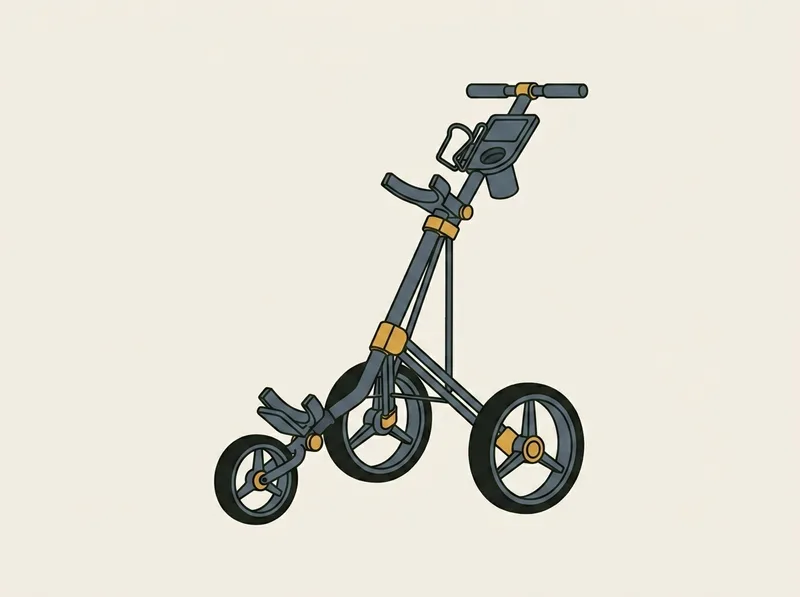 Around £240 to £320
BIG MAX Blade IP 2
- Wheels
- 3, ball bearing
- Weight
- 14.77 lb, about 6.7 kg
- Folded
- 31.1 x 23.6 x 4.92 in
- Brake
- Double footbrake
- Bag bracket
- Adjustable upper bracket
- Tyres
- PU and custom foam, 11.6 in rear
- Handle
- Height adjustable
- Max load
- Not published
- Under five inches deep folded, which is the difference between a cart that lies flat under the clubs and one that owns the boot.
- The lightest here at 14.77 lb, and weight is felt in the two lifts rather than in the pushing.
- Publishes wheels, weight, folded size, brake type, tyre material and handle adjustment, which is a full sheet by the standards of this category.
- Folded it is 31 by 24 inches, so it is flat rather than small. A deep narrow boot suits it worse than a wide shallow one.
- No published maximum load, which is the figure that would settle whether a heavy cart bag is fair game.
- The flat-fold mechanism has more moving parts than a simple two-step fold and more places to collect grit.
VerdictThe right buy for anyone whose cart has to share a boot with clubs, shoes and a trolley bag, because a four inch slab stacks in a way a fifteen inch block never will. Anyone with a tall square boot may prefer a cart that folds into a cube instead.
The trade is that flat is not the same as small. Thirty-one by twenty-four inches is a large footprint, and in a deep narrow hatchback boot a compact block can actually be easier to place. Measure the floor of your boot, not its volume, before deciding which shape you want.
What BIG MAX do not publish is a maximum load, which is a real gap. A loaded cart bag is a heavy object, and without a stated limit there is nothing to check it against.
Clicgear Model 4.5: the one that fits everything
Clicgear publish three wheels, 21 lb, folded at 13 by 15 by 23 inches, open at 51 by 31 by 45 inches, a front-wheel hand brake with internally routed cable, an aircraft-grade aluminium frame, and a silicone strap system with an adjustable upper saddle and a lower saddle support.
Publishing both folded and open dimensions is unusual and useful. Folded tells you whether it goes in the car; open tells you whether it fits through a side gate and down the side of a shed, which most people discover after buying.
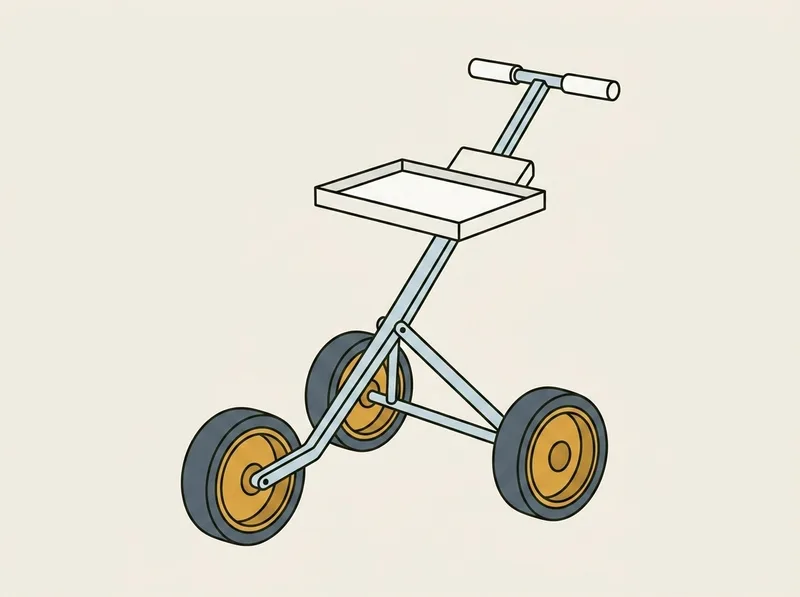 Around £279 at UK retail
Clicgear Model 4.5
- Wheels
- 3
- Weight
- 21 lb, about 9.5 kg
- Folded
- 13 x 15 x 23 in
- Brake
- Front wheel hand brake, internally routed
- Bag bracket
- Silicone straps, adjustable upper saddle
- Open
- 51 x 31 x 45 in
- Frame
- Aircraft-grade aluminium
- Tyres
- Not published
- The silicone strap system and adjustable upper saddle will hold a slim carry bag or a wide cart bag without an adapter.
- Publishes both folded and open dimensions, which almost nobody else does and which is what lets you plan a boot and a shed.
- An internally routed hand brake keeps the cable out of the way, and it is the easiest brake here to use mid-slope.
- 21 lb is the heaviest cart on this page, nearly four pounds more than the next heaviest and over six more than the lightest.
- Folds into a 13 by 15 by 23 inch block, which is compact in volume and awkward in shape.
- No published tyre specification on a cart whose price is largely about build quality.
VerdictThe pick if you want one cart that will still fit whatever bag you buy in five years, because the universal strap system is the one attachment here with no brand attached to it. The cost is weight, and you will notice it every time it goes into the car.
The attachment system is the reason the Clicgear Model 4.5 has the following it does. There is no bracket to match and no proprietary base: the upper saddle adjusts to the width of the bag and silicone straps do the holding, which means a slim carry bag and a wide cart bag both go on the same frame. Every other system on this page has a size, a shape or a brand attached to it.
The cost is 21 lb, and it is the heaviest thing here by a clear margin. It pushes beautifully and it is the one you notice going into the car.
Bag Boy Quad XL: four wheels, and a bag that locks
Bag Boy publish four wheels on maintenance-free solid foam tyres, 7.27 kg, a folded size of 61 by 43 by 41 centimetres, a one-step handle adjustment, a twelve month warranty, and TOP-LOK, a patented attachment that lets most Bag Boy and Datrek bags lock directly to the cart without straps.
The quiet advantage on the Quad XL is the upper bracket. Its support arms adjust across the range from a slim stand bag to a wide cart bag, which is the incompatibility that catches people out after both items have been bought, and it is the only bracket here besides the Clicgear that is built to stretch that far.
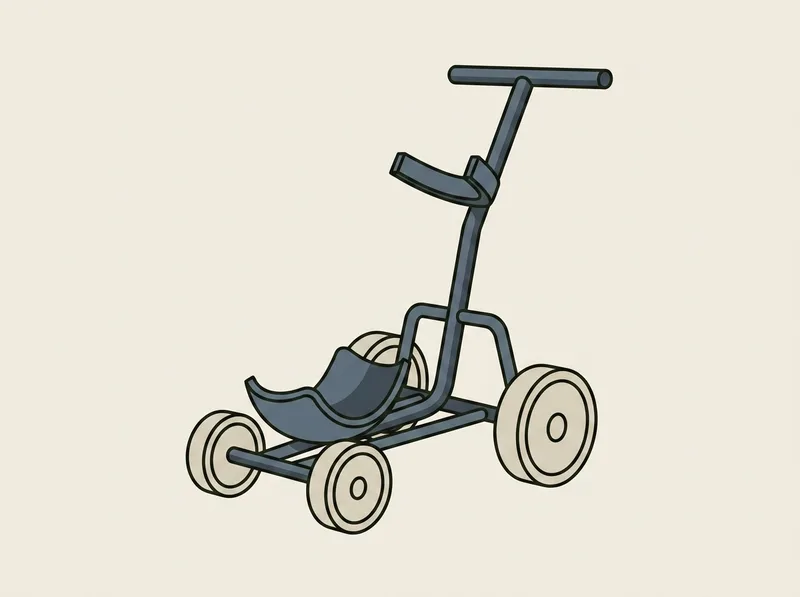 Around £259 to £275
Bag Boy Quad XL
- Wheels
- 4, maintenance-free solid foam tyres
- Weight
- 16 lb, about 7.27 kg
- Folded
- 61 x 43 x 41 cm, about 24 x 17 x 16 in
- Brake
- Not published
- Bag bracket
- TOP-LOK, with adjustable support arms for other bags
- Open
- Not published
- Wheel sizes
- Not published
- Warranty
- 1 year
- Four wheels track straighter across a slope, which is where a three-wheel cart wants to turn downhill.
- TOP-LOK locks a compatible bag directly to the frame with no straps at all, and the bag cannot rotate.
- The upper bracket has adjustable support arms sized for stand and cart bags alike, so a wide bag is not an argument.
- TOP-LOK only locks Bag Boy and Datrek bags. Everything else goes on with straps like any other cart.
- Bag Boy do not state a brake type anywhere in the specification, on a cart you will park on slopes.
- No published open dimensions or wheel sizes, and a four-wheel frame folds into a chunkier block than a flat-fold three-wheeler.
VerdictThe sensible four-wheel choice for a golfer on an undulating course who is tired of a cart that steers itself downhill, and the one here whose bracket will take the widest range of bags. The locking system is a real advantage only if your next bag is the same brand, and the unstated brake is a gap on a cart of this money.
TOP-LOK is worth understanding rather than being impressed by. With a compatible bag it is genuinely better than straps: nothing to tighten, nothing to work loose, and the bag cannot rotate on the frame. With any other bag it is a normal strapped cart, and it quietly ties your next bag purchase to one company. That is the trade every proprietary lock makes, and it is not always a bad one.
What Bag Boy do not publish is the brake. There is no brake type anywhere in the specification for a cart that will spend its life being parked on slopes, and open dimensions and wheel sizes are missing too, all of which are on the sheet for at least one other cart here.
Sun Mountain PX4: stable, and under-documented
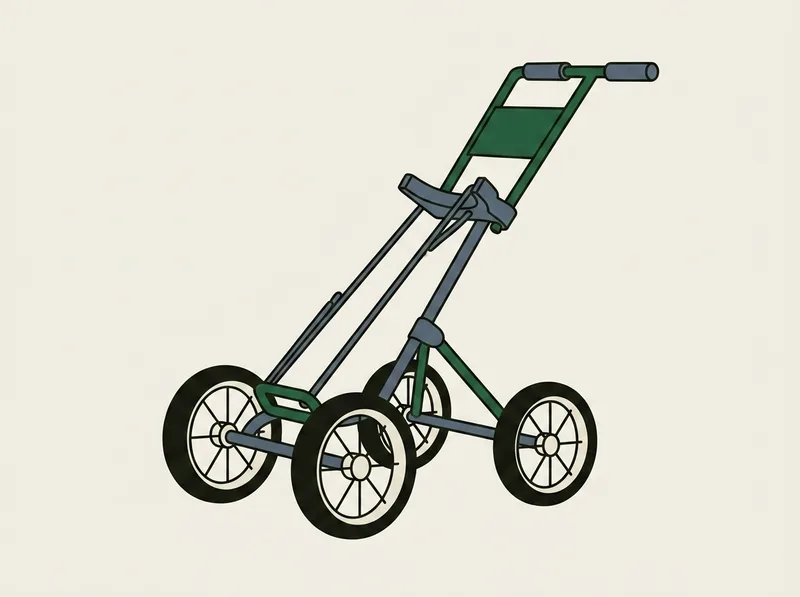
Sun Mountain publish four wheels, 17.2 lb, and that bags are secured with adjustable length bungee cords. The specification block does not contain a folded size, an open size, a brake type, a frame material or a warranty.
That is the gap this page exists to point at. Folded dimensions are the single most useful number on a push cart, because the cart spends more of its life in a car than on a fairway, and it is the one thing you cannot assess from a photograph or a shop floor with the cart set up.
 Around £160 to £220, on run-out
Sun Mountain PX4
- Wheels
- 4
- Weight
- 17.2 lb, about 7.8 kg
- Folded
- Not published
- Brake
- Not published in the spec block
- Bag bracket
- Adjustable length bungee cords
- Open
- Not published
- Frame
- Not published
- Warranty
- Not published
- Bungee cords hold any bag shape without a bracket to size or a lock to match.
- Four wheels and a low frame, which is the stable end of the format.
- 17.2 lb published, so at least the number that decides the lift is on the page.
- No published folded dimensions at all, on the specification that decides whether it fits your car.
- The brake type is described in the marketing copy and left out of the specification block.
- Sold in the UK as the Pathfinder PX4 and now on run-out, with both retailers checked showing it sold out at clearance prices, so the figures above are not a standing price.
VerdictA genuinely stable four-wheel cart with an attachment system that will never argue with a bag, and the cheapest thing here while the last of it lasts. Two problems: Sun Mountain publish neither the folded size nor the brake type, so the things you most want to know have to be measured after it arrives, and UK stock is now run-out rather than current, with the Ridgeline the trolley Sun Mountain actually sell here.
The cart itself is sound. Four wheels on a low frame is the stable configuration, bungee cords will hold any bag shape without a bracket to size, and 17.2 lb is reasonable for the format. The listing simply asks you to buy the two most important specifications unseen.
Folded size, and the boot it has to go in
Carts are sold on the size of the opening they fold to and used in the shape of a car boot, and those are different problems. Work in three dimensions and one order of operations.
The cart goes in first, then the clubs. That is the actual sequence, and it means the cart's footprint on the boot floor matters far more than its total volume. A 4.92 inch slab that covers most of the floor still leaves you the whole height of the boot. A 15 inch block that covers a third of the floor takes the height with it.
Measure the boot floor, not the boot. Length and width at the level of the lip, because that is what you can actually slide something onto. Then compare it against the two largest of the three folded figures.
Check the parcel shelf. A folded cart standing 23 inches tall does not go under one, which turns every round into a shelf that lives in the garage.
And check the lift height. A high boot lip on an estate or an SUV changes what a 21 lb cart feels like, because the weight is lifted at arm's length rather than close to the body. This is the part that eventually decides whether a cart gets used or resented, and it is also why anyone with a history of back trouble on the golf course should weight the lift more heavily than the push.
Brakes, and why the type matters
Every cart here has a brake of some sort, they are not the same product, and half of these makers do not tell you which one you are getting.
A footbrake is a pedal near a rear wheel. Cheap to build, reliable, and it requires you to look down, find it and press it accurately, which is harder on a slope with a loaded cart leaning downhill. A double footbrake, as on the Blade IP 2, locks both rear wheels rather than one, which is what stops a cart pivoting slowly around a single braked wheel on a gradient.
A handle-mounted brake goes on with the hand already on the cart. It is the easiest to use and the most exposed to being knocked, and on some designs it parks rather than locks.
A front-wheel hand brake, as on the Clicgear, brakes the wheel that is doing the steering. Internally routing the cable, which Clicgear publish, keeps it out of the way of everything else.
Will it hold your bag?
This is the part people get wrong, and they get it wrong after both items have been bought.
Two practical checks. If you already own a wide cart bag, confirm the upper bracket adjusts rather than assuming, because that is where the incompatibility lives. And if you own a stand bag with legs, check that the legs fold flat against the body when strapped, because a leg that hangs will catch every kerb and gatepost you push past.
Push cart or electric trolley
Worth one line so the page is honest about its own scope. If you want powered, this is not the page: an electric trolley costs roughly three to five times what these do, weighs more, needs charging, and solves a different problem, which is the walk rather than the load. Nothing below ranks one, and anyone leaning that way should be comparing battery range and hill performance rather than folded dimensions.
What a push cart actually does for your golf
The usual objection to a trolley is that it takes the exercise out of the round. The measured answer is that it does not.
The reason is simple enough. The walking is what costs the energy, and a golfer with a push cart walks further, not less, because they are more willing to go and look. Whether golf counts as exercise turns on walking versus riding in a buggy, not on carrying versus pushing.
There is a step count to put next to it. A study in Mayo Clinic Proceedings of 42 golfers walking 18 holes recorded a mean of 11,948 steps per round, which clears the usual daily activity target on its own. A push cart does not remove those steps. It removes about fifteen pounds from your shoulders while you take them.
The pace argument is the underrated one. The R&A's pace of play work reports that 60% of the 56,000 golfers surveyed would enjoy the sport more if a round took less time, and that respondents said they would pay around 9.1% more in green fees for a round 15 to 30 minutes quicker, rising to 14.2% among golfers under 40. A cart you can park beside the green and push straight to the next tee removes a surprising number of the small backtracks that build into that. How long a round actually takes is mostly made of those.
What to spend
Push carts run from about £100 to about £320 in the UK, and the money buys durability and folded engineering rather than anything that shows up on a scorecard.
- £100 to £170: a functional three-wheel cart. Basic bearings, a single footbrake, a bigger folded package, and a frame that will eventually develop play in the joints.
- £180 to £250: better wheels, a proper adjustable bracket, published dimensions, and a fold that takes two motions rather than five.
- £260 to £320: flat-fold or engineered compact folding, a double or hand brake, an aluminium frame, and a build that survives being left wet and folded for a fortnight.
There is no performance argument anywhere on that list. A cart does not affect a single shot, so the case for spending more is that it folds better, lasts longer and annoys you less. That puts it alongside a proper golf shoe: kit that changes whether the round is pleasant rather than what you score. What golf costs in the first year sets it against green fees, which are the larger line.
Key takeaways
- The BIG MAX Blade IP 2 is the pick for most golfers: 14.77 lb, a double footbrake, and a folded depth of 4.92 inches that lies flat under the clubs.
- The Clicgear Model 4.5 fits any bag through silicone straps and an adjustable saddle, publishes both folded and open dimensions, and costs you 21 lb of weight.
- Four wheels track straighter across a slope and bridge rough ground. Three wheels are lighter, turn tighter and fold smaller.
- Folded size is the number that decides whether a cart gets used, and one of these four publishes none at all.
- Measure the boot floor rather than the boot, because the cart goes in first and the clubs go on top of it.
- Brake type is not a detail. A double footbrake locks both rear wheels; a single one lets a loaded cart pivot on a gradient.
- Proprietary locking bases only work within their own brand and quietly constrain your next bag purchase. Universal straps do not.
- Pushing a trolley measured slightly higher for energy expenditure than carrying in a peer-reviewed study, so a cart is not the soft option.
- Weight is felt in the two lifts into and out of the car, not in the pushing.
Common questions
What is the best golf push cart?
For most golfers the BIG MAX Blade IP 2, because it is the lightest here at 14.77 lb, folds to under five inches deep and publishes a full specification including its brake type. If you want a cart that will hold any bag you ever buy, the Clicgear Model 4.5 and its universal strap system is the better answer.
Are three-wheel or four-wheel push carts better?
Four wheels track straighter across a slope and handle rough ground better, because two front wheels bridge what a single one drops into. Three wheels are usually lighter, turn more tightly and fold smaller. Flat parkland favours three; a hillside course favours four.
How much does a golf push cart weigh?
Between about 14 lb and 21 lb for the carts on this page. The weight barely matters while pushing and matters a lot in the two lifts into and out of a car boot, which is where a heavy cart is actually felt, especially with a high boot lip.
What folded size do I need for my car?
Measure the boot floor at the level of the lip, then compare that against the two largest of the three folded figures. Check parcel shelf clearance separately, because a cart that folds 23 inches tall will not go under one. A flat fold uses boot floor and leaves the height; a cube fold takes both.
Will any golf bag fit on any push cart?
Mostly, with two exceptions. Wide cart bags can sit proud of the upper bracket on smaller frames, so check the bracket adjusts. And proprietary locking bases such as TOP-LOK or EASILOCK only work with bags from the same brand, which means everything else goes on with ordinary straps.
Do push carts damage the course?
Not if they are kept off greens, tees and the fringe collar, which is where the turf is thinnest and most easily rutted. Most clubs post trolley restrictions after heavy rain and some run a temporary ban. Following those is the entire obligation.
Is a push cart better than carrying?
For your shoulders and your back, clearly. For your energy expenditure, the difference is negligible, and one peer-reviewed study measured the push trolley condition slightly higher than carrying. The reason to carry is convenience and the reason to push is comfort, not fitness.
Should I buy a push cart or an electric trolley?
Buy a push cart unless the walk itself is the problem. An electric trolley costs roughly three to five times as much, is heavier to lift into a car, and needs charging between rounds. What it removes is the effort of pushing up hills, which is a genuine issue for some golfers and no issue at all for most.
How long does a golf push cart last?
No manufacturer publishes a figure. What fails is predictable: wheel bearings first, then the fold mechanism developing play, then brake cables. Rinsing the wheels after a wet round and folding it dry rather than wet is most of the difference between three seasons and ten.
Can I take a push cart on a plane?
Not as cabin baggage and rarely without a case. Folded dimensions are the first thing to check against the airline's hold baggage limits, and most carts exceed the standard size allowance in at least one direction. A hard travel case is the usual answer and it adds weight of its own.
How we put this together
- Published manufacturer specifications for each cart, taken from the maker's own listing rather than a retailer's summary, because folded dimensions are quoted more often by shops than by the companies that build them.
- Where a maker publishes no folded size or no brake type, this page records that as Not published and counts it against the product, because folded size is the specification a buyer most needs and cannot check until the box is open.
- How the bag attaches: universal straps, an adjustable bracket or a proprietary locking base, since a lock that only works within one brand's range is a constraint on the next bag you buy.
- Peer-reviewed measurement of activity energy expenditure across carrying, manual trolley and electric trolley conditions, because the usual objection to a trolley is that it costs you the exercise.
- The R&A's published pace of play survey data, which is what makes the case for anything that stops a golfer walking back to a bag they left in the wrong place.
- Weight, because a cart is lifted into and out of a boot twice a round and that is where a heavy one is actually felt.
On this page
- The four, compared
- Three wheels or four
- BIG MAX Blade IP 2: the flat fold
- Clicgear Model 4.5: the one that fits everything
- Bag Boy Quad XL: four wheels, and a bag that locks
- Sun Mountain PX4: stable, and under-documented
- Folded size, and the boot it has to go in
- Brakes, and why the type matters
- Will it hold your bag?
- Push cart or electric trolley
- What a push cart actually does for your golf
- What to spend
- How we put this together
Tom Ashworth
Tom Ashworth is a PGA Professional who has taught golf since 2012, working mainly with beginners and mid-handicappers at club level in Surrey. He reviews the instruction guides on Learn Golf for technical accuracy before they publish.
Most of his teaching is with players in their first three years of the game, and most arrive having been told too much: six swing thoughts collected from videos, half of them contradicting each other. His approach is to check the grip and the alignment before touching the swing, on the basis that most bad ball flight is decided at address.