Best Golf GPS Watches: Four Picks and How to Choose
A GPS watch gives you the front, middle and back of the green without aiming at anything. Here are four worth buying, what each specification changes on a golf course, and the numbers the makers quietly leave off the listing.
Some links here earn us a commission at no extra cost to you. It never changes what we recommend or the order we rank it. How this works.

A GPS watch answers the question before you ask it. Glance down and you have the front, middle and back of the green, with no aiming, no line of sight and no breaking stride. Every model here gets that number close enough to play off. What separates them is how much of the rest of your golf they quietly record, and whether the thing is still on your wrist on Wednesday.
The four, compared
All four read a satellite fix against a pre-mapped course and give you distances without you pointing at anything. That is a different job from a laser, which measures the exact distance to whatever you aim it at and is useless on a blind shot. The laser rangefinder picks cover that side, and the head to head between a rangefinder and a GPS works through which one suits how you play.
| Pick | Best for | Courses | Golf battery | Watch battery | Shot tracking | Price |
|---|---|---|---|---|---|---|
| Garmin Approach S50 | The one to buy if you only buy one | More than 43,000 preloaded | Up to 15 hours in GPS mode | Up to 10 days in smartwatch mode | AutoShot, with CT1 or CT10 club tags sold separately | Around £320 to £350 |
| Shot Scope X5 Track | Getting every shot recorded without a subscription | 36,000 or more preloaded | 2 or more rounds in GPS mode | Not published | Automatic, 16 club tags included | Around £270 to £280 |
| Bushnell iON Elite | Walkers, and anyone who wants one screen and no menus | More than 38,000 preloaded | 12 or more hours, 2 or more rounds | Not published | Manual scoring and a shot distance tool, no club tags | Around £170 to £200 |
| SkyCaddie LX5C | Ground-verified maps and the sharpest screen | More than 35,000 ground-verified maps | Up to two rounds | Not published | Digital scorecard and cloud sync, no club tags | Around £250 to £300 |
Street prices in this category move a long way between launch and the following spring, and the previous generation of any of these watches finds the same greens. There is no urgency to buy the newest thing.
Garmin Approach S50: the one to buy if you only buy one
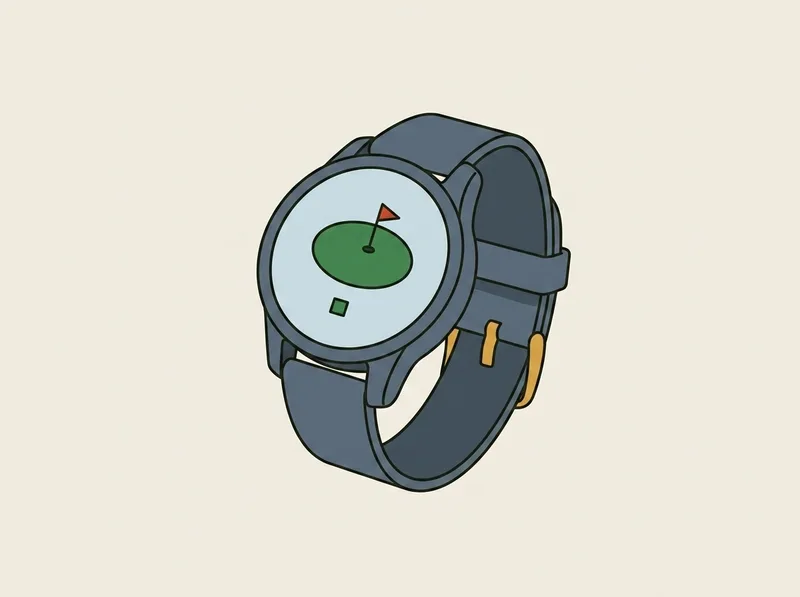
The Garmin Approach S50 is the model that stopped golf watches being a compromise. It carries a 1.2 inch colour AMOLED touchscreen, maps of more than 43,000 courses, and the full Garmin health stack underneath: wrist heart rate, Pulse Ox, sleep tracking, Body Battery, contactless payment and music from the usual services. Garmin rate it at up to 15 hours in GPS mode and up to 10 days in smartwatch mode, and the owner's manual puts the water rating at 5 ATM.
Those two battery figures are the specification to understand, because they pull in opposite directions. AMOLED is what makes the watch pleasant to wear all week and it is also what caps the golf mode at 15 hours. That is two full rounds and a range session, which is enough, and it is fewer rounds than a dimmer screen would manage.
 Around £320 to £350
Garmin Approach S50
- Courses
- More than 43,000 preloaded
- Golf battery
- Up to 15 hours in GPS mode
- Watch battery
- Up to 10 days in smartwatch mode
- Shot tracking
- AutoShot, with CT1 or CT10 club tags sold separately
- Display
- 1.2 inch colour AMOLED touchscreen
- Water rating
- 5 ATM
- The only one of the four that is a genuine everyday smartwatch, with wrist heart rate, sleep, Body Battery, contactless payment and music.
- More than 43,000 courses, the largest database here, and the one least likely to miss a small club.
- Garmin publish both battery figures separately, so you know what the watch costs you in golf mode and what it costs you the rest of the week.
- Club tracking tags are an extra purchase, where one rival puts them in the box.
- An AMOLED screen is beautiful and thirsty, and 15 hours is fewer rounds than a memory-in-pixel display gets.
- Some of the deeper course data sits behind a Garmin Golf membership rather than in the price.
VerdictThe default recommendation for a golfer who wants one device on their wrist all week rather than a golf gadget they remember to charge on Friday. The compromise is that the specification that makes it a good watch, the AMOLED screen, is the same one that shortens the golf battery.
Shot tracking is where Garmin ask for more money. AutoShot detects and records full shots on its own, but knowing which club hit them means the Approach CT1 or CT10 tags, and those are a separate purchase. Garmin list the CT1 set of 16 at a little over a quarter of the price of the watch, which is a real cost on top of an already premium device.
Shot Scope X5 Track: the one that records everything
The Shot Scope X5 Track is the strongest argument on this page for buying the less shiny screen. The display is a 1.2 inch daylight-readable memory-in-pixel panel at 240 by 240, which is dimmer and flatter than an AMOLED and lasts a great deal longer, and Shot Scope rate it at two rounds or more per charge. It ships with 36,000 or more preloaded courses and, in the box, 16 second-generation tracking tags that screw into the butt of every club.
That is the whole pitch. Every shot you hit gets a club and a distance attached to it automatically, and the platform behind it carries no subscription. Shot Scope publish more than 100 tour-level statistics off the back of it, including strokes gained. Nothing else here does that at any price without an add-on.
 Around £270 to £280
Shot Scope X5 Track
- Courses
- 36,000 or more preloaded
- Golf battery
- 2 or more rounds in GPS mode
- Watch battery
- Not published
- Shot tracking
- Automatic, 16 club tags included
- Display
- 1.2 inch daylight-readable memory-in-pixel, 240 x 240
- Water rating
- Not published
- Sixteen tracking tags in the box and no subscription charge on the stats platform, which is unique among the four.
- A memory-in-pixel display is dimmer than AMOLED and lasts far longer between charges.
- Green view lets you drag the pin to where it actually is rather than aiming at a green outline.
- No published water rating, so the weather sealing is a claim rather than a number.
- Shot Scope publish a golf-mode battery figure and no smartwatch-mode figure at all.
- At 50 grams and with a screen built for daylight rather than for looks, it is a golf watch first and an everyday watch second.
VerdictThe pick for anyone who wants the watch to build their own distance data rather than just read a yardage off a map. The tags do genuinely useful work and cost nothing extra, which is the whole argument. The gaps are on the durability side of the spec sheet.
The gaps are on the spec sheet rather than in the experience. Shot Scope publish a golf-mode battery figure and no smartwatch-mode figure, and they publish no water rating at all, which is the same omission their laser rangefinder carries. An unrated claim is not the same as a tested one, and for a device you will wear through a wet February that is worth weighing.
Bushnell iON Elite: the light one
Bushnell's answer is to do less and weigh almost nothing. The Bushnell iON Elite is a 1.28 inch colour touchscreen watch at 38 grams, sealed to IP67, with more than 38,000 preloaded courses, auto course recognition and auto hole advance. Bushnell quote 12 or more hours of operation and two or more rounds per charge.
Thirty eight grams sounds like a trivial number and is not. The Garmin and the SkyCaddie are watches you are conscious of at the eighteenth. This one you forget. Combine that with a watch that finds the course and advances the hole without being asked, and you have the least demanding device here by a distance.
 Around £170 to £200
Bushnell iON Elite
- Courses
- More than 38,000 preloaded
- Golf battery
- 12 or more hours, 2 or more rounds
- Watch battery
- Not published
- Shot tracking
- Manual scoring and a shot distance tool, no club tags
- Display
- 1.28 inch colour touchscreen
- Water rating
- IP67
- 38 grams, the lightest here by a wide margin, which is the difference between wearing it and taking it off at the turn.
- IP67 sealing and a published figure for it, where two rivals publish nothing.
- Auto course recognition and auto hole advance mean the watch is doing its job before you have touched it.
- No automatic shot tracking of any kind, so nothing builds your yardages for you.
- Bushnell publish no smartwatch-mode battery figure, which fits a device that is not really trying to be one.
- Slope Technology is the headline feature and the one you are not allowed to read during a competition round.
VerdictThe pick for a golfer who wants a yardage and nothing else, and the clear pick for anyone who walks and notices weight. It is not an everyday watch and does not pretend to be. Buy it for the 38 grams and the fact that it works the moment you reach the first tee.
Two things are missing. There is no automatic shot capture and no club tags, so the watch tells you the yardage and never learns what you do with it. And Bushnell publish no smartwatch-mode battery life, which is a fair reflection of a device that is a golf instrument rather than a wearable.
SkyCaddie LX5C: the best picture of the green
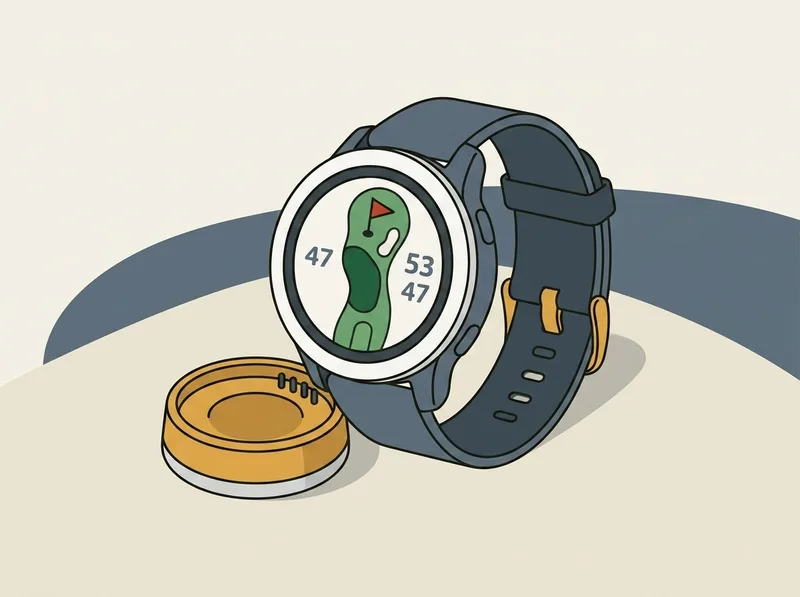
SkyGolf sell the LX5C on how the maps are made. Rather than tracing courses from aerial imagery, they survey them on the ground, and the product carries more than 35,000 of those maps. On the wrist that arrives as IntelliGreen, which draws the actual shape of the green with distances to the front, back and several points across it, and Dynamic HoleVue, which lets you zoom and pan the hole.
The screen supports it. At 1.39 inches and 454 by 454 it is the largest and sharpest here, and SkyGolf publish a 3 ATM water rating, a weight of 65.2 grams and a battery good for up to two rounds. There is a heart rate monitor and a step counter, so it is closer to an everyday watch than the Bushnell and a long way behind the Garmin.
 Around £250 to £300
SkyCaddie LX5C
- Courses
- More than 35,000 ground-verified maps
- Golf battery
- Up to two rounds
- Watch battery
- Not published
- Shot tracking
- Digital scorecard and cloud sync, no club tags
- Display
- 1.39 inch AMOLED touchscreen, 454 x 454
- Water rating
- 3 ATM
- The largest and sharpest screen of the four, at 1.39 inches and 454 by 454.
- SkyGolf map courses on the ground rather than from imagery, which is the strongest claim to green shape accuracy here.
- IntelliGreen and Dynamic HoleVue give the most detailed green and hole picture on this page.
- A three-year membership is included and the renewal cost is not published on the listing, so there is a recurring charge you cannot size before you buy.
- 65.2 grams, the heaviest here, and 3 ATM is the weakest published water rating.
- No club tags and no automatic shot capture, so the performance data stays thin.
VerdictThe pick for a golfer who cares most about what the green actually looks like from 140 yards, because the ground-verified maps and the big AMOLED screen are a genuinely different product from the rest. The trade is weight, water rating and a subscription whose price is not on the page.
The catch is the membership. A three-year plan comes in the box and the renewal price is not stated on the product listing, so you are buying a device with a recurring cost you cannot size in advance. Ask before you buy rather than in year four.
What the specifications actually change
Golf watch marketing leans on course counts and screen sizes. Here is what each specification does once you are standing over the ball.
| Specification | What it changes | What to look for |
|---|---|---|
| Course count | Whether your club is mapped at all | Any of these covers North America and Europe comfortably |
| Display type | Readability in flat light, and battery | AMOLED for looking at, memory-in-pixel for lasting |
| Golf-mode battery | How often you charge before a round | Two rounds is the practical floor |
| Smartwatch battery | Whether it lives on your wrist all week | Frequently not published at all, which tells you something |
| Green view | Whether you aim at the flag or at the middle | A pin you can move, not just a green outline |
| Shot tracking | Whether the watch builds your yardages for you | Tags in the box beats tags sold separately |
| Water rating | Whether it survives three winters | A published number, and be wary of unrated claims |
The specification most worth paying attention to is the one three of these four leave blank. A golf watch is bought as a wearable and sold on a golf figure, and if the maker will not say how long it lasts as a watch, assume that is not what they optimised it for.
Golf mode and smartwatch mode are not the same watch
Every device here quotes a golf-mode number because that is the number a buyer asks for. The more useful question is what the watch does for the rest of the week, when it is not on a golf course at all.
Garmin publish both figures and the difference is instructive: up to 15 hours with GPS running against up to 10 days with it off. That gap is the cost of a satellite fix and a bright screen, and it is why a watch that is genuinely wearable all week still needs charging before a Saturday medal. Shot Scope, Bushnell and SkyGolf publish only the golf figure, so the honest answer for those three is that nobody has told you.
Memory-in-pixel displays are the quiet reason the X5 lasts. They hold an image without redrawing it and are easiest to read in exactly the bright flat light where an AMOLED washes out. They look ordinary indoors, which is the trade, and it is the right trade for a golf watch and the wrong one for a watch you wear to work.
Green view is where a yardage becomes a decision
Front, middle and back is the reason to own one of these. A single yardage to the centre of the green is a number. Front, middle and back is a decision, because the gap between them tells you how much green you have to work with and where the trouble sits.
All four draw the green shape. What varies is what you can do with it. The Shot Scope lets you drag the pin to its actual position, Bushnell's GreenView adjusts for pin location, and SkyGolf's IntelliGreen gives distances to several points around the shape as well as front and back. That detail is what turns a 148 yard number into the recognition that the flag is at the back and the front edge is 134, so the shot is a club more than it looks.

None of this helps if the flag is not where the watch thinks it is. Course staff move pins daily, and a mapped green view shows you the shape, not today's position. That is the one thing a laser does better, and it is the honest reason plenty of golfers eventually carry both.
Shot tracking, and what the tags are actually for
Tags are the feature people skip and then wish they had bought. A screw-in tag in the butt of each club tells the watch which club hit which shot, and after twenty rounds you own something no launch monitor session gives you: how far you actually hit each club on a golf course, in wind, off imperfect lies, including the ones you caught thin.
That is the input that makes every other yardage useful. Knowing the flag is 147 changes nothing until you know what 147 is in your bag, and a distance chart for each club built from real rounds beats one built from a good hour at the range. The X5 includes the tags. Garmin sell them separately. The Bushnell and the SkyCaddie do not offer them.
What the Rules let you switch on
This is the part the packaging does not lead with, and it applies to a watch exactly as it does to a laser.
In practice that makes the settings menu matter. A watch where slope adjustment is a clearly labelled toggle is one you can turn off on the first tee and prove you turned off. A watch where it is buried is one you will eventually forget about in a competition. Committees can also prohibit distance devices entirely by Local Rule, so the notice board outranks anything written here.
Do you need one yet?
Here is the question a gear page is not supposed to ask.
That does not make a GPS watch pointless. It makes it a device for narrowing decisions rather than one for finding shots. Knowing the front edge is 134 and the flag is 148 changes which club you pull and where you aim, which is what course management is built on, and it does that whether or not the strike is good.
A watch is also the better tool for pace of play, because reading a wrist takes a second and does not need you to stop, aim and re-aim. On the green the numbers stop helping and judgement takes over, which is what reading greens is about. And if you would rather not wear anything at all, the golf apps worth having covers what a phone can and cannot do in place of one.
Key takeaways
- The Garmin Approach S50 is the default pick: 43,000 courses, a 1.2 inch AMOLED screen, and the only one here that works as a genuine everyday watch.
- The Shot Scope X5 Track is the value pick and the one that records the most, with 16 club tags in the box and no subscription on the stats.
- The Bushnell iON Elite is the pick for walkers, at 38 grams with a published IP67 rating, and it makes no attempt to be a smartwatch.
- The SkyCaddie LX5C has the best screen and the most detailed green view, paid for in weight and in a membership renewal that is not priced on the listing.
- Golf-mode battery and smartwatch-mode battery are different numbers. Only Garmin publish both, and three of the four publish neither a smartwatch figure nor much else about all-week use.
- Green view with a movable pin is worth more than a bigger course count. Every database here already has your club.
- Slope, PlaysLike and green slope readings may be carried and must not be used during a round.
- Club tags turn a yardage device into a distance chart, which is the thing that actually changes club selection.
Common questions
Are golf GPS watches allowed in competition?
Yes, by default. Rule 4.3a permits a device giving distance and direction, and a GPS watch is exactly that. What you must not use during a round is any function that measures elevation change, measures wind, or interprets the data into a club recommendation. A Committee can also ban distance devices entirely by Local Rule, so check the notice board.
Is a GPS watch or a rangefinder better?
They answer different questions. A GPS gives front, middle and back without aiming and works on blind shots and doglegs. A laser gives an exact number to anything you can see, including today's pin position, and is useless when you cannot see the target. Golfers who play a lot of unfamiliar courses tend to prefer GPS; those who play one course they know tend to prefer a laser.
How accurate are golf GPS watches?
Accurate to a handful of yards, which is inside the error of almost every amateur golf shot. The larger variable is not the satellite fix but the map: the watch shows you where the green is, not where the flag was moved to this morning. That is the gap a laser fills.
How much should I spend on a golf GPS watch?
Somewhere between about £150 and £400 buys everything that matters. Below roughly £120 you tend to lose green view detail and get a monochrome screen. Above £400 you are buying smartwatch features and finish rather than better yardages.
Do I need to pay a subscription for a golf GPS watch?
It depends on the maker and it is the cost buyers most often miss. Shot Scope charge nothing for the stats platform. Garmin put some course data behind a Garmin Golf membership. SkyGolf include three years and do not publish the renewal price on the listing. Ask what happens in year four before you buy.
Can a golf GPS watch be worn as an everyday watch?
One of these four properly can. The Garmin Approach S50 has heart rate, sleep, payments and music and quotes up to 10 days in smartwatch mode. The SkyCaddie adds heart rate and steps. The Shot Scope and the Bushnell are golf instruments with a clock on them, and neither maker publishes a smartwatch-mode battery figure.
How long does a golf GPS watch battery last?
In golf mode, expect two rounds from most of these and a little more from a memory-in-pixel display. Bushnell quote 12 or more hours, Shot Scope two or more rounds, SkyGolf up to two rounds and Garmin up to 15 hours. Away from the course the figures are mostly unpublished, which is worth knowing before you rely on one as a daily watch.
What is green view on a golf watch?
A drawing of the green's actual shape rather than a single distance to its centre, usually with distances to the front and back and sometimes to points across it. The better implementations let you drag the pin to where the flag is today, which turns a yardage into a club decision.
Do golf GPS watch tags work with any clubs?
The tags screw into the hole in the butt end of the grip, which almost every modern club has, and they are club-specific to the brand of watch. Shot Scope supply 16 with the X5 Track. Garmin sell the Approach CT1 and CT10 separately. The Bushnell and SkyCaddie do not offer them at all.
Do I still need to know my club distances if the watch tells me the yardage?
More than ever. A yardage is only useful against a bag you know. This is the reason club tags matter: after a season of tracked rounds you have real on-course distances for every club rather than the flattering ones from a range mat, and that is what makes the number on the screen worth reading.
Will a golf GPS watch work abroad?
On any course in its database, which for these four runs from 35,000 to more than 43,000 worldwide. Coverage in North America, Britain, Ireland and Europe is comprehensive. The one to check is a small or new course anywhere, and every maker has a course search on their site for exactly that.
How we put this together
- Published manufacturer specifications for each watch, taken from the maker's own listing, press material or owner's manual rather than a retailer's summary.
- Where a maker does not publish a figure, the gap is recorded as unpublished rather than filled in from a review site. Smartwatch-mode battery life is the specification most often missing.
- What each specification changes on a golf course: course count against where you actually play, display technology against battery, and green view detail against whether the yardage becomes a decision.
- The Rules of Golf position on distance-measuring devices, which decides which of these features may be switched on during a round rather than only owned.
- Shot Scope's published amateur approach data, because that is what sets how much an exact yardage is worth at a given standard.
On this page
- The four, compared
- Garmin Approach S50: the one to buy if you only buy one
- Shot Scope X5 Track: the one that records everything
- Bushnell iON Elite: the light one
- SkyCaddie LX5C: the best picture of the green
- What the specifications actually change
- Golf mode and smartwatch mode are not the same watch
- Green view is where a yardage becomes a decision
- Shot tracking, and what the tags are actually for
- What the Rules let you switch on
- Do you need one yet?
- How we put this together

Tom Ashworth
Tom Ashworth is a PGA Professional who has taught golf since 2012, working mainly with beginners and mid-handicappers at club level in Surrey. He reviews the instruction guides on Learn Golf for technical accuracy before they publish.
Most of his teaching is with players in their first three years of the game, and most arrive having been told too much: six swing thoughts collected from videos, half of them contradicting each other. His approach is to check the grip and the alignment before touching the swing, on the basis that most bad ball flight is decided at address.