Almost nobody quits golf because they played badly. They quit because they felt conspicuous and permanently one step behind what everyone else seemed to know. Most of that anxiety attaches to etiquette, and most of golf etiquette turns out to be a handful of practical habits that exist for safety, speed and keeping the course playable.
Which parts are actually rules
The Rules of Golf carry a conduct standard, and it is short enough to read once. Rule 1.2a expects every player to act with integrity, show consideration to others by playing at a prompt pace and looking out for their safety, and take good care of the course by replacing divots, smoothing bunkers and repairing ball marks.
That is the whole of etiquette in one paragraph, and no penalty attaches to it. Rule 1.2a is a standard, not a penalty rule. A committee can disqualify someone for serious misconduct or adopt a code of conduct with its own penalties, but nobody is docking you two strokes for a rake left in the wrong place.
A few things people file under etiquette do carry a penalty, and those are worth separating out.
| What you get told | Rule or convention | Where it comes from |
|---|---|---|
| Play at a prompt pace | Both | Rule 1.2a expects it, Rule 5.6a penalises unreasonable delay |
| Stay quiet and still while someone plays | Convention | Named in Rule 1.2a, no penalty attached |
| Repair your pitch mark | Convention, explicitly named | Rule 1.2a, and Rule 13.1c permits the repair |
| Rake the bunker behind you | Convention, explicitly named | Rule 1.2a, and Rule 12.2b(3) lifts all restrictions once your ball is out |
| Replace your divot | Convention, explicitly named | Rule 1.2a |
| Furthest from the hole plays first | Rule, but deliberately relaxed | Rule 6.4b allows and encourages ready golf in stroke play |
| Do not advise another player on their swing or club | Rule, with a real penalty | Rule 10.2a, the general penalty |
| Let a faster group play through | Convention | Committee pace of play policy, not the Rules |
| Take the flagstick out before putting | Neither | Rule 13.2a leaves it entirely to you |
The practical read: the only piece of etiquette that routinely costs strokes is giving or asking for advice, and only in competition. Everything else is social, which does not make it optional, just differently enforced.
Safety is the part that is not negotiable
A golf ball leaving a driver travels fast enough to fracture a skull, and beginners are the most likely to send one somewhere nobody expected. Two habits cover it.
Never swing while anyone is in front of you, including the group ahead. If you cannot see where they are, wait. Beginners assume they cannot reach the group ahead and are frequently wrong, because a thinned shot runs a long way.
If a ball heads anywhere near a person, shout "fore" immediately and loudly. It is not embarrassing, it is the entire warning system golf has. Then watch where the ball lands, because a ball tracked by three sets of eyes is rarely a lost ball.
Pace of play, where etiquette and the Rules meet
This is the part of etiquette that generates real friction, and the part with a rule number attached. Rule 5.6a prohibits unreasonably delaying play, with penalties escalating from one stroke to disqualification. Rule 5.6b then recommends making the stroke within forty seconds of being able to play, and adds that a player should usually be quicker.
Forty seconds is far longer than beginners fear and far shorter than they take, because the time goes on everything except the swing. The R&A's pace of play guidance on player behaviour puts the arithmetic plainly: shaving five seconds per shot across a four-ball playing eighty shots each saves twenty-six minutes and forty seconds over a round. Nobody is slow because of one long pre-shot routine. They are slow because of five seconds on every shot.
Three habits recover almost all of it:
- Walk to your ball while others are playing, working out the distance and picking a club on the way, so you are ready when it is your turn.
- Play ready golf. Rule 6.4b explicitly allows and encourages playing out of turn in stroke play when it is safe, so hit when you are ready.
- Park your bag or trolley on the side of the green nearest the next tee, so you walk off in the right direction instead of doubling back.
Being slow is not the same as being bad. A high handicapper who keeps up is welcome anywhere, and a low handicapper who reads every putt from four sides is not. How long a round of golf takes breaks the time down by format and group size.
Leaving the course as you found it
Courses are maintained by a small greenkeeping team and damaged by hundreds of golfers a day. The three repairs everyone is expected to make take about fifteen seconds combined.
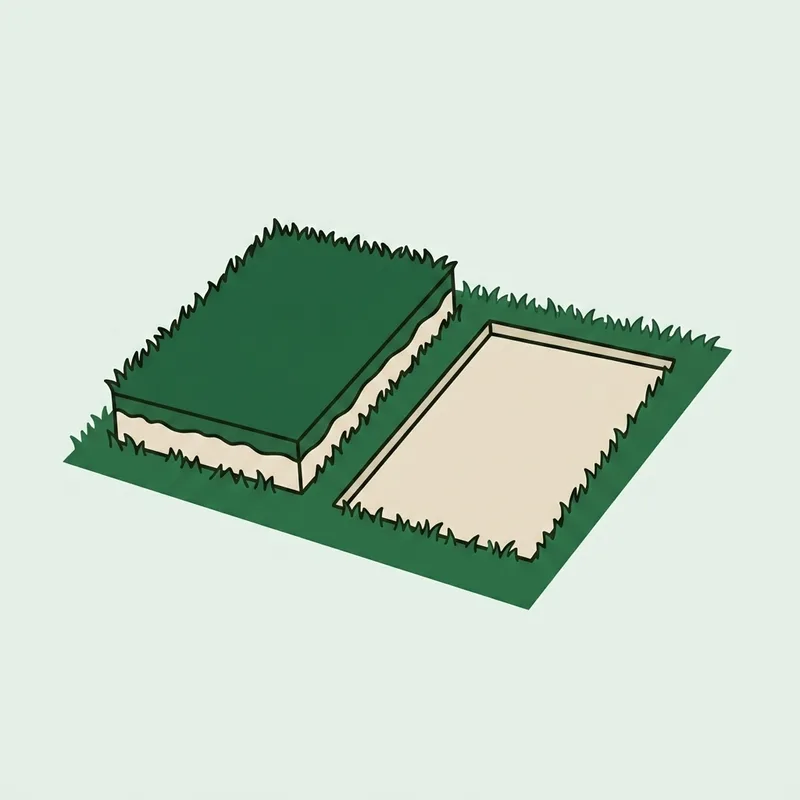
Divots are the strips of turf an iron removes. Replace the piece if it came out whole, or fill the scar from the seed and sand box on the tee. Clubs prefer different methods, so copy what the members do.
Bunkers get raked because the next person in there deserves the lie you had, not your footprints. Enter from the low side nearest your ball and rake on the way out. Once your ball is out, Rule 12.2b(3) removes every restriction on touching the sand, so smooth it as thoroughly as you like. Leave the rake where your club asks for it, usually outside the bunker and parallel to the line of play. Getting out in the first place is covered in greenside bunker play.
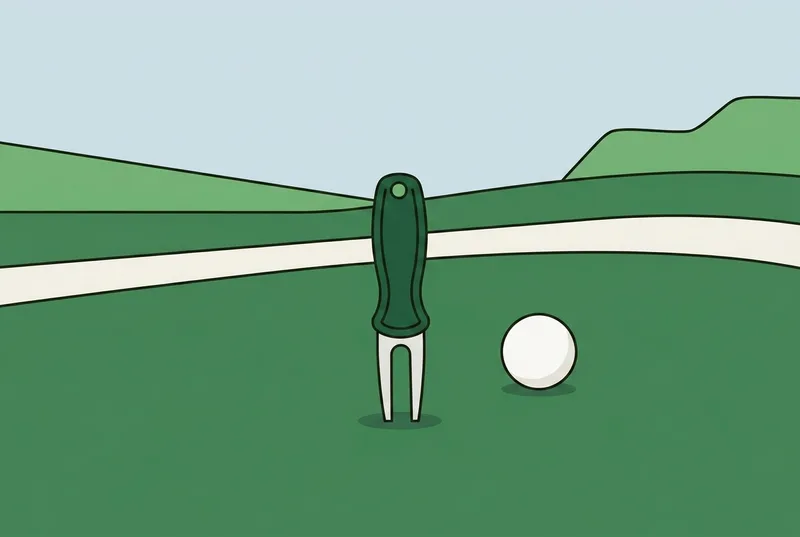
Pitch marks are the small craters an approach shot leaves on the green. An unrepaired one takes weeks to heal and leaves a scar that deflects putts for the rest of the season. Rule 13.1c lets you repair ball marks, shoe damage, old hole plugs and animal tracks, and it does not restrict you to your own. Push the turf in from the edges of the depression towards the middle, then tap the surface flat with the sole of your putter. Do not lever the centre upwards, because that tears the roots and kills the patch.
On the green
The green is where etiquette gets most detailed, because the surface is delicate and everyone is standing on it at once.
Walk around the line between another player's ball and the hole rather than across it, because spikes leave marks the putt has to roll over. Do not stand behind someone as they putt, or behind the hole in their eyeline, and keep your shadow off their line when the sun is low.
Mark your ball with a small flat marker or a coin when it sits on somebody else's line, which is exactly what Rule 13.1b allows. Whoever is furthest from the hole putts first, though most friendly groups let people finish out rather than mark a two-footer and hold everyone up.
When everyone has holed out, walk off. Cards get marked on the next tee, not on the green with a group waiting in the fairway behind you.
Before and after the round
Most first-timer anxiety is about the clubhouse rather than the course, and it is largely misplaced.
Arrive around thirty minutes before your tee time. That covers checking in at the pro shop, paying, and hitting a few putts. Booking a tee time covers what the shop will ask you.
Dress codes range from strict at older private clubs to almost nonexistent at municipal courses. A collared shirt with tailored shorts or trousers will get you onto essentially any course in the country. What to wear golfing has the detail, including the shoe and denim rules that catch people out.
Phones on silent, and take calls away from other players. Introduce yourself on the first tee if you are playing with strangers, which happens whenever a club pairs up singles. Shake hands and take your cap off at the eighteenth green, one of the few genuinely universal customs left. Buying a drink afterwards is normal and optional.
When it is going badly
The most useful thing a beginner can know is that everyone expects you to be bad and nobody expects you to be slow. If a hole falls apart, pick the ball up and walk to the next tee. In a casual round that costs nothing, and the beginner rules guide explains why it costs nothing for a handicap either.
If your group falls a hole behind and the group behind is waiting, wave them through. Stand to the side, let them play, carry on. It happens to good players too, and it removes the pressure that makes you play worse.
If you genuinely do not know what to do, ask whoever you are playing with. Golfers are almost uniformly happy to explain, and asking reads far better than guessing wrong. The one thing to avoid is offering unsolicited swing advice, because in a competition Rule 10.2a makes that a two-stroke penalty for both of you, and in a casual round it is simply unwelcome.
If the whole prospect still feels daunting, a bucket of balls at the range is a low-stakes way to get used to being around golf. Using a driving range covers how that works, and what a first round involves walks through the day itself.
Key takeaways
- Rule 1.2a names the whole of etiquette: integrity, consideration to others, and care of the course. It carries no automatic penalty.
- The only etiquette breach with a routine penalty is giving or asking for advice under Rule 10.2a.
- Safety comes first. Never swing while anyone is in front of you, and shout "fore" immediately if a ball goes near someone.
- Pace is judged against the group in front, not the group behind.
- Five seconds saved per shot is twenty-six minutes across a four-ball round, which is where pace actually comes from.
- Ready golf is expressly allowed and encouraged in stroke play under Rule 6.4b.
- Replace divots, rake bunkers, and repair pitch marks by pushing in from the edges rather than levering up the middle.
- Park your bag on the side of the green nearest the next tee, and mark cards on the next tee rather than on the green.
- Being a bad golfer is fine. Being a slow one is the thing people notice.
Common questions
What is golf etiquette?
It is the set of conventions that keep a round safe, quick and playable for everyone else: staying quiet and still while others play, keeping up with the group in front, and repairing the damage your shots do. Rule 1.2a of the Rules of Golf names all three without attaching a penalty.
Is golf etiquette part of the Rules of Golf?
Partly. Rule 1.2a sets out the conduct expected of every player but carries no automatic penalty. A few things commonly filed under etiquette are genuine penalty rules, notably unreasonable delay under Rule 5.6a and giving or asking for advice under Rule 10.2a.
What are the unwritten rules of golf?
Keep up with the group ahead, stay out of a player's eyeline and shadow, do not walk on the line of a putt, leave the course as you found it, and let faster groups through. None carry a penalty, and all of them are noticed.
How fast should I be playing?
Rule 5.6b recommends making your stroke within forty seconds of being able to play, and suggests you should usually be quicker. The practical test is simpler: stay in touch with the group in front. An empty hole ahead of you means speed up or let people through.
What does "fore" mean in golf?
It is the warning shout used when a ball heads towards anyone. Shout it immediately and loudly rather than waiting to see what happens. Anyone who hears it should turn away and cover their head rather than looking up to find the ball.
Do I have to rake a bunker after playing from it?
You are expected to and every course asks for it, but there is no penalty in the Rules for failing to. Rule 12.2b(3) removes all restrictions on touching the sand once your ball is out, so you can smooth it thoroughly. Enter and leave from the low side nearest your ball.
How do I repair a pitch mark properly?
Push the turf in from the edges of the depression towards the centre with a repair fork or a tee, then tap the surface flat with your putter sole. Do not lever the middle upwards, because that tears the roots and the patch dies. Rule 13.1c permits the repair anywhere on the green.
Is it rude to play out of turn?
No, and in stroke play it is encouraged. Rule 6.4b allows and encourages ready golf when it is safe, because waiting for a strict order costs time. In match play the order still matters, and an opponent can make you replay a stroke played out of turn.
Can I talk while someone else is hitting?
No. Stay still and silent from the moment a player settles over the ball until the swing is finished. This is the convention golfers enforce most consistently, and the one beginners breach most often just by moving at the wrong moment.
What should a beginner wear to a golf course?
A collared polo shirt with tailored shorts or trousers is accepted almost anywhere. Older private clubs are stricter about denim, football shirts and untucked tops, and municipal courses generally are not. Golf shoes are useful but rarely mandatory for a first round.
What if I am too slow and holding people up?
Wave the group behind through, then carry on. It happens to experienced golfers too. Picking your ball up on a hole that has gone wrong is the fastest single fix, and in a casual round it costs you nothing at all.
Tom Ashworth
Tom Ashworth is a PGA Professional who has taught golf since 2012, working mainly with beginners and mid-handicappers at club level in Surrey. He reviews the instruction guides on Learn Golf for technical accuracy before they publish.
Most of his teaching is with players in their first three years of the game, and most arrive having been told too much: six swing thoughts collected from videos, half of them contradicting each other. His approach is to check the grip and the alignment before touching the swing, on the basis that most bad ball flight is decided at address.