
Golf gets dismissed as a walk with equipment, usually by people who have not done the walk. It also gets oversold, usually by the golf industry. The useful answer sits between the two, and unusually for a golf question there is real published research behind it. This page covers what the evidence says, how far you actually go, what riding costs you, and what golf does not provide.
What the published evidence says
Golf has a body of health research behind it, which is not something most recreational sports can claim. The R&A runs a Golf and Health project in collaboration with the World Health Organization, and its headline positions are that golfers live on average five years longer than non-golfers, that golf can help prevent and treat 40 major chronic diseases, and that playing for at least 150 minutes a week meets WHO global exercise guidelines.
The peer-reviewed underpinning is a scoping review published in the British Journal of Sports Medicine by Murray and colleagues, which screened 4,944 records and included 301 studies. Its conclusion is more measured than the headline version and worth reading closely: golf can provide moderate intensity physical activity and is associated with improved cardiovascular, respiratory and metabolic profiles, and improved wellness. It also found the incidence of golfing injury moderate, with back injuries the most frequent, and specifically noted limited evidence relating golf to mental health.
The mental health finding is the one that most contradicts how golf is usually marketed. It is not that golf is bad for mental health. It is that the research supporting the claim is thin, and a scoping review of 301 studies saying so is a reasonable place to take that from.
How far you actually walk
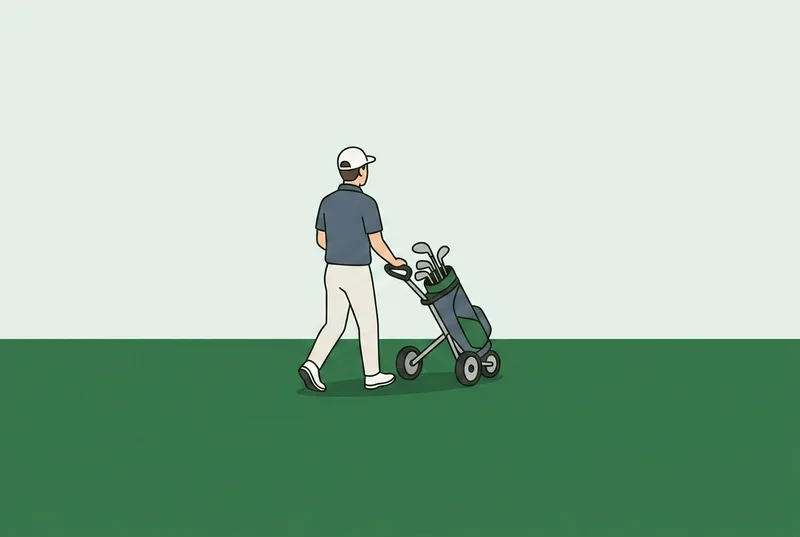
Two independent measurements agree that a walked round is a substantial amount of activity, and they land at different numbers for reasons worth understanding.
The gap between the two studies is course length and player type rather than a contradiction. The Mayo Clinic Proceedings work used ordinary golfers of both sexes on municipal courses, and concluded that walking 18 holes meets the recommendation to accumulate 10,000 steps a day for most players regardless of handicap, sex or course. The 2025 study used low-handicap men on a longer championship layout.
For an ordinary club golfer, four to five miles and something around 12,000 steps is the realistic expectation.
Walking versus riding, with numbers
This is the decision that determines whether the answer to the title question is yes or no, and there is now a direct measurement of it.
A 2025 randomised crossover study published in the European Journal of Sport Science had sixteen experienced male golfers, mean age about 21 and mean handicap 2.3, play two competitive 18-hole rounds on the same championship course, once walking with a caddie and once riding a cart. The full results are available on PubMed Central.
| Measure | Walking | Riding a cart |
|---|---|---|
| Steps over 18 holes | 17,007 (SD 1,708) | 6,274 (SD 1,111) |
| Activity energy expenditure | 880 kilocalories (SD 279) | 456 kilocalories (SD 155) |
| Carry distance, clubhead speed, ball speed | No difference between conditions | No difference between conditions |
Two things stand out. The step difference is close to threefold, which is larger than most golfers would guess. And the performance measures did not differ, so on this evidence the walkers gave up nothing in ball striking for it. The study did find that neuromuscular performance, measured by jump testing, declined more after the walked round, which is what you would expect from having done considerably more work.
Riding is a legitimate choice, and for plenty of golfers it is the difference between playing and not playing. Nothing here is an argument against carts. It is an argument against believing you got the exercise when you did not. The middle option that keeps the walk and removes the load is a trolley, and the shortlist is in golf push carts.
The calorie question, honestly
Calorie figures for golf vary wildly between sources, and the honest position is that most of them are estimates rather than measurements.
The R&A's Golf and Health material states that a player walking a regular 18-hole course burns up to 2,000 calories. That is an upper bound rather than a typical round, and the phrase doing the work is "up to". The directly measured figure from the 2025 study is 880 kilocalories of activity energy expenditure for a walked round, which counts the energy cost of the activity itself rather than everything the body burned over four hours.
Both can be true. Total energy expenditure over four hours, including what you would have burned sitting still, is a larger number than activity expenditure alone, and a heavier golfer carrying a bag on a hilly course is doing far more work than a light one walking a flat parkland course with a trolley. What is not defensible is quoting any single figure as the calorie cost of a round.
What golf does not give you
The case for golf is strong enough that it does not need overstating, so here is the other side of it.
Almost no strength stimulus. Walking maintains what you have and adds very little. Carrying a bag is the only meaningful resistance in the sport, and it is a light asymmetric load rather than training. Strength has to come from somewhere else, and the structure for that is in the golf fitness guide.
No vigorous intensity. The scoping review's phrase is moderate intensity, and that is accurate. Golf sits in the same category as brisk walking, which is genuinely valuable and is not the same thing as interval training.
Very little for flexibility. Playing does not make you more mobile. If anything the swing rewards range you already have rather than building it, which is why mobility is treated separately in golf stretches.
A significant time cost per unit of exercise. Four to five hours for the physical equivalent of an hour of walking is a poor exchange rate if exercise is the only goal, and an excellent one if you also want to be outside, with people, doing something absorbing. Why a round takes as long as it does is covered in how long a round of golf takes.
A load pattern that is not risk free. The same review that found the health benefits also found injury incidence moderate, with back injuries the most frequent. That has its own treatment in golf back pain.
How to make a round count for more
None of these turn golf into a workout, and all of them move the number in the right direction.
- Walk. It is worth more than everything else on this list combined.
- Carry, or use a push cart on the days carrying is too much. Both keep the walk. A push cart keeps it without the shoulder load.
- Walk at your own pace between shots rather than standing and waiting. On a slow course this alone adds meaningful time on your feet.
- Play a hilly course when you have the choice. Elevation change does more to the energy cost of a round than anything else about the layout.
- Play nine holes twice a week rather than eighteen once, if the calendar allows it. Two shorter walks beat one long one for consistency, and the WHO threshold is about weekly minutes rather than single sessions.
The gear that makes walking sustainable matters more here than anything in the bag. Shoes are the whole of it for most golfers, and the options are in golf shoes. Being dressed for four hours outdoors in whatever the day turns into is the other half, covered in what to wear golfing.
So is it good exercise
For a golfer who walks, yes, on the terms the evidence supports. An 18-hole round clears most daily activity targets on its own, it is moderate intensity aerobic activity of the kind associated with better cardiovascular and metabolic health, and it is repeatable into a person's seventies and eighties in a way very little else is. Two rounds a week clears the WHO threshold comfortably.
For a golfer who rides, it is a pleasant afternoon outdoors with a modest amount of walking attached, and that is fine as long as it is not being counted as the week's exercise.
For anyone weighing it up as a way to get active, the barrier is more often cost and time than fitness. Both are covered in what golf costs, and the practical shape of a first round is in your first round of golf.
Key takeaways
- Walked, golf is genuine moderate intensity exercise. Ridden, most of the benefit disappears.
- The R&A's Golf and Health project puts a typical 18-hole walk at four to five miles.
- A Mayo Clinic Proceedings study of 42 golfers measured a mean of 11,948 steps per walked round.
- A 2025 study measured 17,007 steps walking against 6,274 riding, close to a threefold difference.
- Measured activity energy expenditure in that study was 880 kilocalories walking against 456 riding.
- Ball striking did not differ between walking and riding in that study.
- The R&A states golfers live on average five years longer, and that association cannot separate the golf from the golfers.
- A BJSM scoping review of 301 studies found moderate intensity activity, improved cardiovascular and metabolic profiles, and limited evidence on mental health.
- Golf provides almost no strength stimulus and does not build flexibility.
Common questions
Is golf good exercise?
If you walk, yes. A walked 18-hole round covers four to five miles and clears 10,000 steps in measured studies, which is moderate intensity activity associated with better cardiovascular and metabolic health. If you ride, the exercise value drops sharply and the round becomes a pleasant afternoon rather than a session.
How many steps do you take in 18 holes of golf?
Around 12,000 for an ordinary golfer walking an ordinary course, based on a Mayo Clinic Proceedings study of 42 players that measured a mean of 11,948. A 2025 study of low-handicap men walking a championship course recorded 17,007, and riders in the same study recorded 6,274.
How many calories does a round of golf burn?
Nobody can give you one honest number. The R&A states up to 2,000 calories for a walked round, which is an upper bound. A 2025 study directly measured 880 kilocalories of activity energy expenditure for a walked round and 456 for a ridden one. Body weight, terrain and whether you carry all move it a lot.
How far do you walk in a round of golf?
Between four and five miles on a regular 18-hole course, according to the R&A's Golf and Health project. Longer championship courses and hillier layouts push it further, and the walking between shots, to and from the car and around the green adds more than the hole yardages suggest.
Is walking or riding better for you in golf?
Walking, and the gap is larger than most golfers expect. A 2025 randomised study measured close to three times the steps and nearly double the activity energy expenditure for walking, with no difference in carry distance, clubhead speed or ball speed between the two conditions.
Do golfers really live longer?
Golfers are associated with living longer, and the R&A puts the figure at five years on average. The scoping review underpinning that work is more careful, describing it as a potential contribution to increased life expectancy. Population comparisons cannot separate golf from the sort of person who plays it.
Is golf enough exercise on its own?
For general activity guidelines, two walked rounds a week is enough. As a complete fitness plan it is not, because it provides almost no strength stimulus, nothing at vigorous intensity, and no flexibility work. Most golfers get more from adding two short strength sessions than from playing a third round.
Does carrying my golf bag make the round better exercise?
It increases the energy cost, yes, and it also puts an asymmetric load on your shoulders for four miles. Using both straps rather than one splits it. A push cart keeps the entire walking benefit and removes the load, which is why it is the usual recommendation for anyone with a history of back trouble.
Is golf good exercise for older adults?
It is one of the better options available, precisely because the intensity is moderate and the activity is sustainable for decades. Walking four miles at a comfortable pace, outdoors and in company, is close to the ideal shape for activity in later life. Anyone with existing joint or heart conditions should confirm that with their doctor rather than with a golf site.

Tom Ashworth
Tom Ashworth is a PGA Professional who has taught golf since 2012, working mainly with beginners and mid-handicappers at club level in Surrey. He reviews the instruction guides on Learn Golf for technical accuracy before they publish.
Most of his teaching is with players in their first three years of the game, and most arrive having been told too much: six swing thoughts collected from videos, half of them contradicting each other. His approach is to check the grip and the alignment before touching the swing, on the basis that most bad ball flight is decided at address.