By the time the follow through happens the ball has been gone for a hundredth of a second, so nothing you do after impact can change the shot. That is exactly why most golfers never think about it. It is also why the finish is the most honest piece of information in your swing, because it is the only part you can hold still and look at.
Left and right assume a right-handed golfer throughout, and every reference to a lead or trail side inverts if you play left-handed. The whole motion in sequence is covered in golf swing basics, and this page is the last quarter of it.
The follow through is a symptom, not a cause
This is the single most important idea on the page and it saves an enormous amount of wasted practice. You cannot fix a swing by posing the finish, because the finish is produced by everything that came before it. A golfer who stops at hip height did not choose to stop there. Something ran out of speed, balance or rotation before that point, and the club simply had nowhere left to go.
There is one narrow exception, and it is worth knowing because it looks like a contradiction. Asking a golfer to hold a balanced finish is a useful drill, not because balance at the end creates a good swing, but because a swing that is out of control cannot produce a still finish. The instruction is a constraint on effort, not a position to hit.
What a complete follow through actually contains
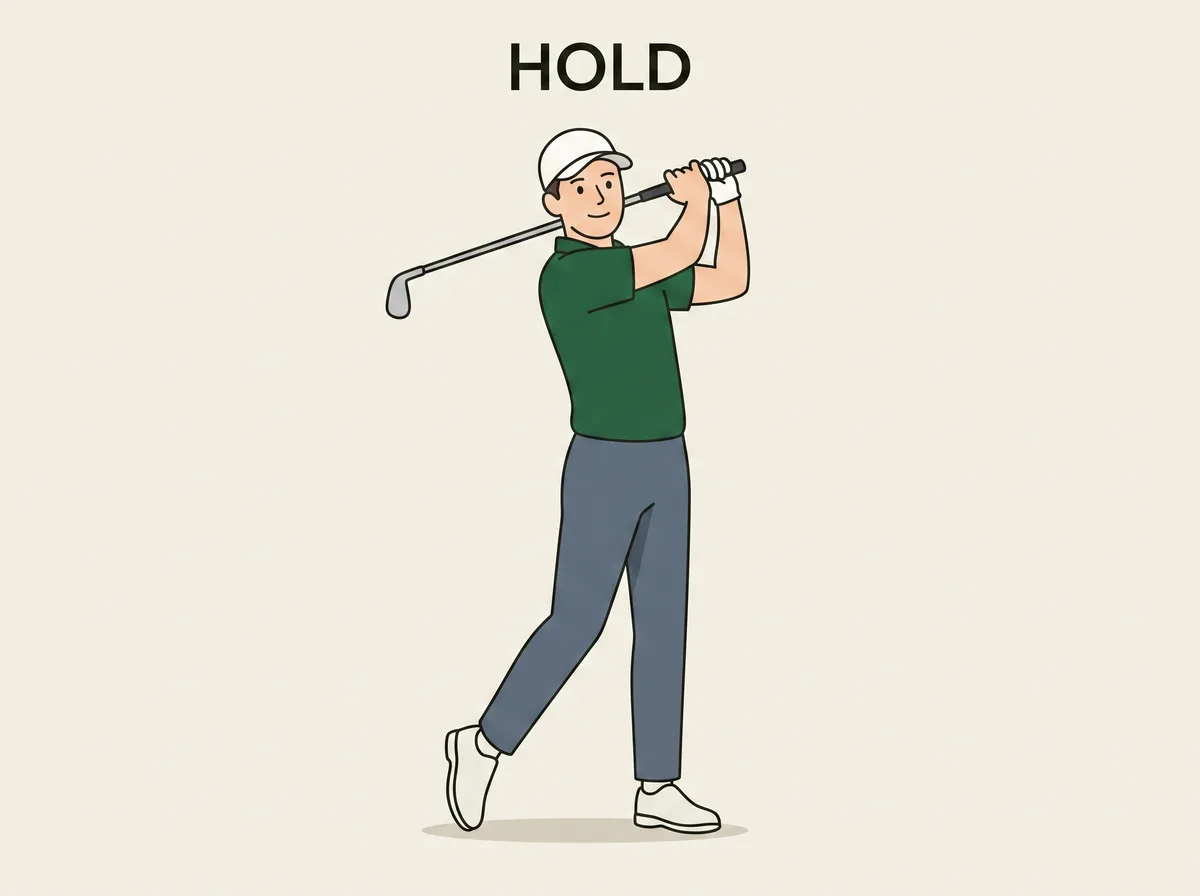
Four things happen after impact, and they happen in an order rather than at once.
The club keeps travelling low and long past the ball for the first foot or so. Both arms straighten, briefly, at roughly the point where the club is level with the ground on the target side. The body keeps rotating so the chest and belt buckle end up facing the target. Then the club folds up and over the trail shoulder as the arms run out of room.
| Moment after impact | What you should see | What it proves |
|---|---|---|
| First foot past the ball | Club still low, both arms extending | Nothing pulled up or in at impact |
| Shaft level with the ground | Both arms straight, chest already turning | The body kept moving, the hands did not flip |
| Hands at chest height | Trail heel starting to release off the ground | The weight arrived at the front foot in time |
| Full finish | Chest facing the target, spine tall, weight stacked | Rotation ran to the end rather than stalling |
The one people miss is the second row. Full extension of both arms happens after the ball is struck, not at it, and a golfer who tries to be wide at impact usually adds a scoop instead.
The chicken wing, and why it is a lower body problem
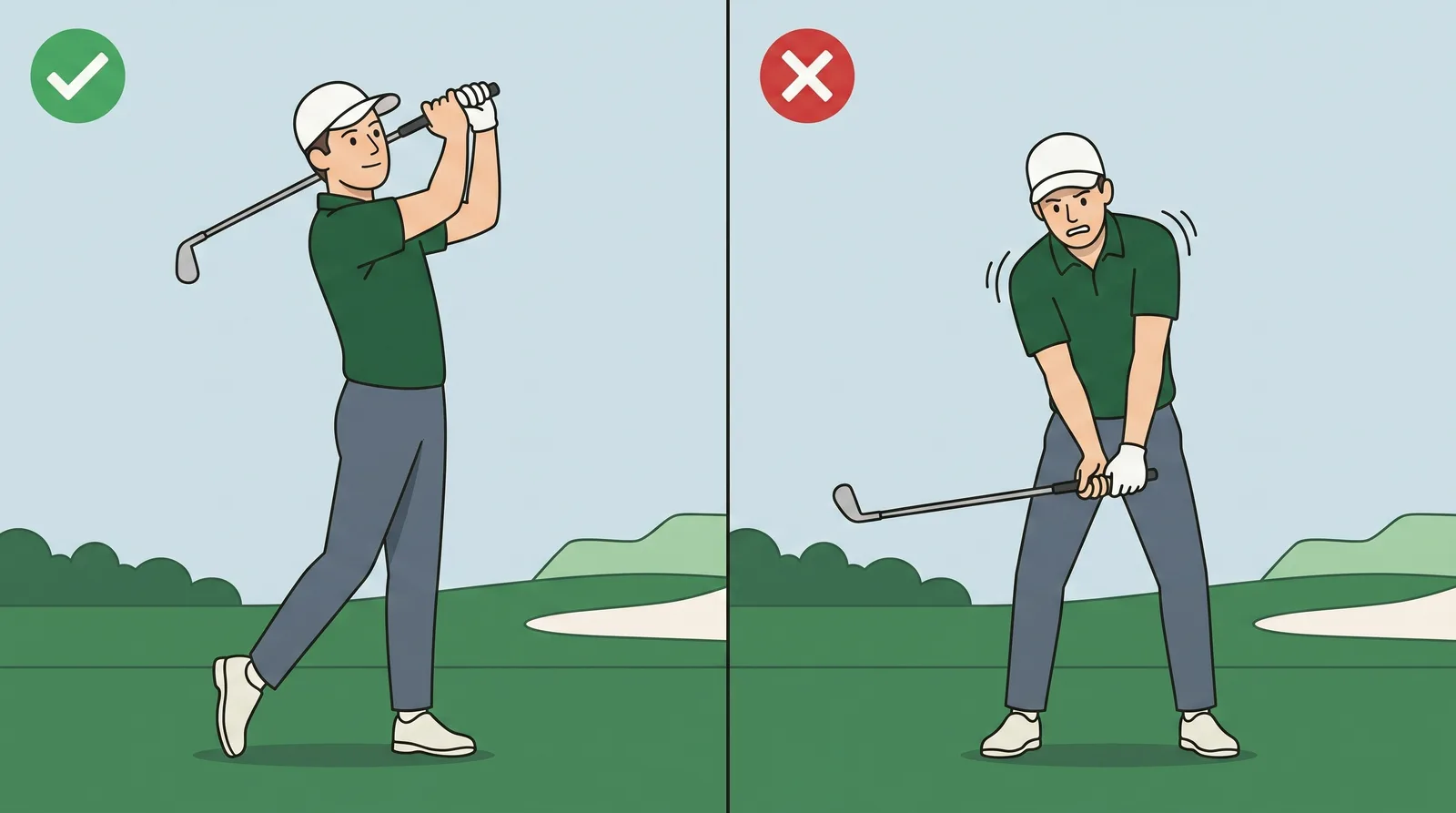
The most recognisable follow through fault is the lead elbow bending and pulling in shortly after impact, with the lead wrist cupping. It looks like an arm fault and it is almost never caused by the arms.
The Titleist Performance Institute describes chicken winging as the appearance of the lead arm on players who bend their lead elbow and cup their lead wrist through impact, and lists inefficient lower body mechanics as the primary cause. When the lower body does not generate enough speed, or does not pass what it generates up the chain, the arms take over and break down. They also flag loss of external rotation in the lead shoulder as a physical restriction behind it.
The consequences are worth spelling out because they explain a very common ball flight. A bent lead arm through impact adds loft, adds spin and costs club head speed, which is the recipe for a high, short, weak shot that feels like it came off the middle of the face.
Release: the word that means four different things
Release is used so loosely in golf instruction that it has stopped carrying information. Coaches use it to mean the wrists unhinging, the forearms rotating, the trail arm straightening, or the whole club being allowed to run past the hands. All four are real, and they are not the same event.
The useful definition for an amateur is the third and fourth together: the trail arm straightens and the club is allowed to overtake the hands after the ball, rather than being held off. A golfer who holds the club face open through impact and steers it toward the target has not released it, and no amount of finish work will hide that.
Forearm rotation is where the argument sits. Some coaches teach an active roll of the forearms through the ball, others teach that the rotation is a by-product of the arms simply straightening and the body turning. Both produce good golfers, and the honest position is that the active version gives a fast fix for a chronic slicer while the passive version repeats better under pressure. What neither camp defends is a golfer holding the face open and hoping.
What the finish tells you, fault by fault
This is where the follow through earns its place. Film one swing from face on and one from down the line, then look at the last frame only.
| What the finish looks like | What almost certainly happened | Where to fix it |
|---|---|---|
| Weight still on the back foot, back heel flat | The pressure never moved forward in the downswing | Weight transfer |
| Falling backward away from the target | Too much side bend, usually chasing height | Setup and downswing |
| Lead elbow bent, hands low and close to the body | Rotation stalled and the arms absorbed it | Body rotation |
| Finishing with the chest short of the target | The pelvis stopped rotating early | Hip clearance |
| Off balance toward the toes | Posture lost, the body drifted toward the ball | Posture |
| Club wrapped low around the back, spine tilted hard | Swinging around the body rather than through the ball | Swing plane |
The first row is the most common by a distance, and it has its own page in weight shift in the golf swing. The last row is a plane problem rather than a finish problem, and the down-the-line view is the only place it shows up clearly, which is covered in golf swing plane.
Two drills that build a finish worth reading
Neither of these asks you to pose. Both remove the thing that was stopping the swing from finishing on its own.
Balance is the test, not the goal
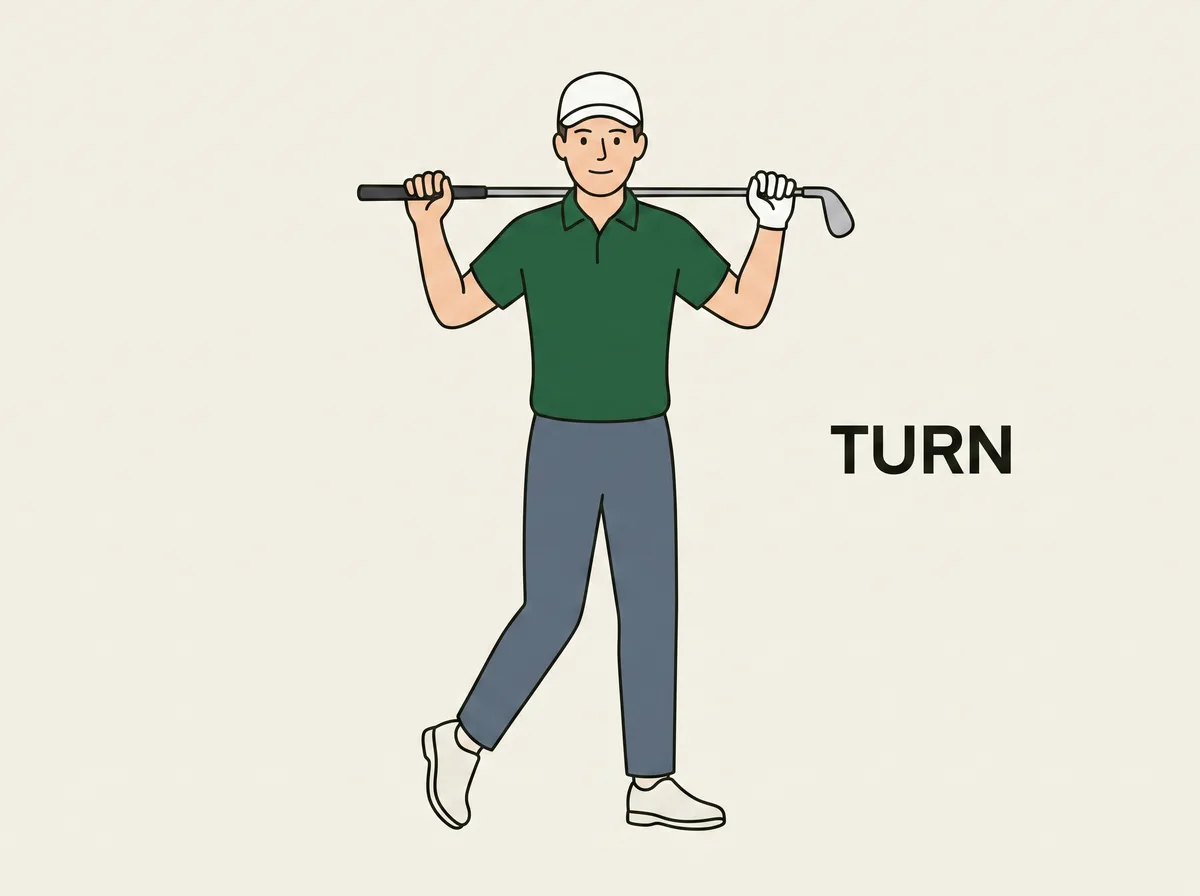
Holding a finish is worth doing for one reason: it is a pass or fail test of how hard you swung.
The Titleist Performance Institute's work on the kinematic sequence describes speed transferring up a chain, with each segment of the chain slowing down once the next segment begins to accelerate. That handover is what a balanced finish is really testing. A golfer who is still accelerating everything at once when the club reaches the ball has nothing left to stabilise on, and falls off the shot.
So the test is simple. Hit a shot, and do not move until the ball lands. If you have to take a step, hop, or put the back foot down to stay up, you swung harder than you can currently control. That is a legitimate reason to swing softer, and it is a different argument from the one about tempo, which is covered in golf swing tempo.
Does the follow through change from club to club
Slightly, and not in a way that needs managing.
A driver finish tends to be a touch more around the body and a touch flatter, because the club is longer and the swing is naturally shallower. A wedge finish is shorter and more upright, because the swing is steeper and the shaft is shorter. Both happen on their own as a consequence of the club in your hands, which is the same principle covered in how to hit irons.
Where it does change deliberately is in the short game. A pitch or a chip has a deliberately shortened follow through matched to the length of the backswing, and a full uncontrolled finish on a 30 yard shot is a distance control problem. That is a separate skill with separate rules.
How long before it changes
Extension through the ball is a two to three week change if the cause is habit, and a two to three month change if the cause is the lead shoulder or the lower body, because you are then waiting on strength and mobility rather than technique.
Film the finish once a week rather than every session. The variation between two swings on the same day is larger than any change you made, so the last frame in week one against the last frame in week four is the only readable measurement.
Key takeaways
- The follow through cannot change the shot. It reports on it, which makes it a diagnostic rather than a technique.
- A full finish contains four things in order: extension, rotation, the weight arriving forward, and the club folding away.
- Both arms straighten after impact, not at it. Trying to be wide at the ball adds a scoop.
- A chicken wing is usually a lower body speed and sequencing problem, not an arm problem.
- Release has four common meanings. The one that matters is letting the club overtake the hands past the ball.
- Weight still on the back foot at the finish is the single most common fault in the last frame.
- Balance is a test of effort, not a position to pose. If you cannot hold it, you swung too hard.
- Short game follow throughs are deliberately shortened. Full swing follow throughs are not managed at all.
Common questions
Does the follow through actually matter if the ball has gone?
Not as a cause, but very much as information. Nothing you do after impact can affect the ball, so the finish cannot be the reason a shot was good. What it can do is show you, in one still frame, whether the body rotated, whether the weight moved, and whether the arms kept up.
What should a golf finish position look like?
Standing tall, chest and belt buckle facing the target, the club folded over the trail shoulder, and effectively all the weight on the front foot with the back heel pulled up so only the toe touches the ground. You should be able to hold it without wobbling until the ball lands.
Why do I stop my swing at hip height?
Because something ran out before that point. The usual causes are the body stopping its rotation, the weight staying on the back foot, or a deliberate attempt to steer the ball at the target. A swing that is genuinely accelerating through the ball is very hard to stop early.
What causes a chicken wing in the golf swing?
Most often a lower body that does not generate or transfer enough speed, so the arms take over and break down through impact. Limited external rotation in the lead shoulder is the other common cause. Both mean the lead elbow bends to create room the body should have created by turning.
Should I try to extend my arms through impact?
Not at impact. Full extension of both arms belongs just after the ball, roughly where the shaft reaches horizontal on the target side. Golfers who chase width at the ball itself tend to add loft and scoop it instead, which is the opposite of what they wanted.
What does releasing the club mean?
Usually it means letting the club head overtake the hands after impact rather than holding the face open and steering. The word is also used for the wrists unhinging and the forearms rotating, which is why it causes confusion. Pick one meaning and be specific about it.
Why do I fall backwards at the finish?
Because the weight never moved to the front foot during the downswing, or because you added backward side bend trying to help the ball into the air. Both leave you finishing on the back foot with the body tilted away from the target, which also moves the low point behind the ball.
Should I hold my finish on every shot?
On the range, yes, because it is a free test of whether you are swinging within yourself. On the course it is optional and slightly theatrical, but it does nothing harmful. If you cannot hold it on more than one shot in three, swing softer until you can.
Is a shorter follow through ever correct?
In the short game, yes, and deliberately so. A chip or a pitch matches the length of the follow through to the length of the backswing for distance control. In a full swing there is no reason to shorten it, and doing so means you decelerated.
How do I film my own finish properly?
Face on for weight and balance, down the line for plane and body rotation, with the phone at hip height and steady on a bag. Look at the last frame only, once a week. Comparing consecutive swings on the same day mostly measures normal variation, not change.
On this page
- The follow through is a symptom, not a cause
- What a complete follow through actually contains
- The chicken wing, and why it is a lower body problem
- Release: the word that means four different things
- What the finish tells you, fault by fault
- Two drills that build a finish worth reading
- Balance is the test, not the goal
- Does the follow through change from club to club
- How long before it changes
Tom Ashworth
Tom Ashworth is a PGA Professional who has taught golf since 2012, working mainly with beginners and mid-handicappers at club level in Surrey. He reviews the instruction guides on Learn Golf for technical accuracy before they publish.
Most of his teaching is with players in their first three years of the game, and most arrive having been told too much: six swing thoughts collected from videos, half of them contradicting each other. His approach is to check the grip and the alignment before touching the swing, on the basis that most bad ball flight is decided at address.