How to Hit Your Driver Further: Strike, Launch and Spin
Speed is the lever everybody reaches for and the slowest one to move. The three that respond faster are where the ball meets the face, which way the club is travelling, and whether the club in your hands suits either.
Most golfers who want a longer drive train the one variable that takes months to move and ignore the three that respond inside a session. Driver distance is made of ball speed, launch angle and spin rate, and the average amateur arrives at the ball in a way that compromises all three at once. This guide covers what each one responds to and the order to work through them.
Nothing here puts a number on what you will gain, because the honest answer depends on which of the three is currently costing you and by how much. What follows is what changes and why, not what you will get.
Distance is three numbers, not one
A drive is launched, not thrown. The ball leaves at a speed, at an angle, and with a rate of backspin, and those three decide the carry before the ball has travelled a yard.
The reason this matters is that they interact. A high launch with low spin flies a long way. The same launch with too much spin climbs, stalls and drops. Adding ball speed to a poor launch and spin combination adds less than it should, which is why the golfer who trains speed alone often finds the tape measure has barely moved.
TrackMan publishes averages by handicap from its Combine testing, and reading the three together is more useful than reading any one of them. The table below assembles the driver figures from their pages on attack angle, launch angle, spin rate and smash factor. The amateur rows are male.
| Player | Attack angle | Launch angle | Spin rate | Smash factor |
|---|---|---|---|---|
| PGA Tour | minus 0.9 deg | 10.4 deg | 2,545 rpm | 1.49 |
| LPGA Tour | plus 2.8 deg | 12.6 deg | 2,506 rpm | 1.49 |
| Scratch or better | minus 0.9 deg | 11.2 deg | 2,896 rpm | 1.49 |
| 5 handicap | minus 1.1 deg | 11.2 deg | 2,987 rpm | 1.45 |
| 10 handicap | minus 1.2 deg | 11.9 deg | 3,192 rpm | 1.45 |
| Average golfer, 14.5 | minus 1.8 deg | 12.6 deg | 3,275 rpm | 1.44 |
| Bogey golfer | minus 2.1 deg | 12.1 deg | 3,127 rpm | 1.43 |
Source: TrackMan Combine data, on the four pages linked in the header row.
Read across the average golfer's row and a picture assembles itself. The club is descending into a ball that was deliberately teed up, the launch is higher than tour players manage anyway, the spin is well above them, and the strike is returning less of the speed than it could. That is not a speed problem. That is a delivery problem, and it is the same one on nearly every row below scratch.
Lever one: where the ball meets the face
Ball speed is club speed multiplied by how efficiently the strike transfers it, which TrackMan calls smash factor. The table above puts a scratch amateur at 1.49 and the average golfer at 1.44, and that gap is a percentage taken off everything, every drive, forever.
TrackMan's own page notes that smash factor is often misread as being purely about centre contact, and lists face to path, spin loft and impact point together as the things to look at once the number is low. That is a fair correction, and it does not change the practical order: for a golfer who has never checked, impact point is the one that is both large and free.
Check it rather than assume it. Spray the face with foot powder or use impact tape, hit twenty drives, and reapply every four or five. A cluster low on the face is the single most common amateur pattern and it is what produces the low-launch, high-spin flight that goes nowhere in the air. A cluster toward the toe or heel costs speed directly.
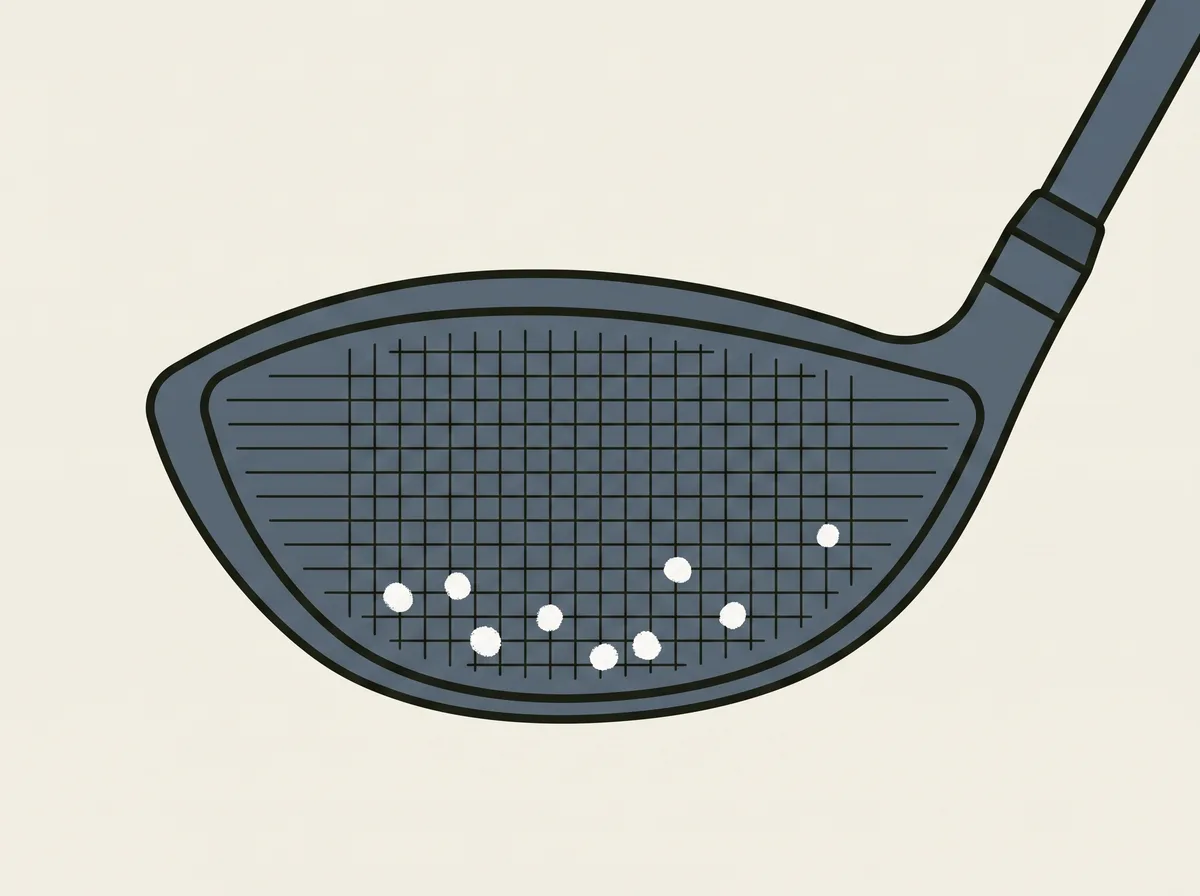
The reason a low strike hurts twice is that a driver face is curved from top to bottom, and a ball struck below centre both loses speed and gains spin. That is why the fix for a weak, climbing drive is often not more loft or a different ball, but the same swing meeting the ball an inch higher up the face.
Lever two: which way the club is travelling
Attack angle is whether the head is rising or falling when it reaches the ball, and it is the only one of these levers the driver was specifically designed around. The ball sits on a tee for exactly this reason.
Hitting up rather than down lets you produce launch with less loft delivered through the ball, and less delivered loft means less spin for the same height. That is the whole trade: a rising strike buys launch cheaply, while a descending strike buys the same launch by adding loft, and loft added at impact converts speed into spin.
TrackMan's attack angle page carries a coaching note from Mark Anderson listing ball position, movement of the swing centre, and hand position at impact as the three things that decide it. All three are setup and low point, not effort. The step by step version of that setup is in hitting a driver, and there is no reason to rebuild a swing to change it.
Lever three: launch and spin as a pair
Once the strike is centred and the club is arriving level or slightly upward, launch and spin stop fighting each other. Until then, adjusting either one alone tends to move the other in the wrong direction.
The two profiles worth recognising are common enough to name. A low launch with high spin is the classic descending strike low on the face, and it produces a drive that never gets up and never stops climbing at the same time. A high launch with high spin is the scooped version, which balloons. Both come from delivered loft doing work that attack angle should be doing.
| What you see | Usual cause | What to change first |
|---|---|---|
| Low flight, no carry, drops dead | Descending strike, low on the face | Ball position forward, tee height, strike location |
| Balloons and stalls into any wind | Scooped delivery, high delivered loft | Low point ahead of the ball, hands level at address |
| Flat and hot, then dives | Very low spin off a high strike | Usually fine, check loft is not too low for your speed |
| Fine in the air, short on the ground | Landing angle too steep from high spin | Spin, which means strike and attack angle again |
Numbers make this quicker to diagnose than feel does, because launch and spin are invisible from behind the ball. What each reading means and which order to read them in is set out in launch monitor numbers.
Lever four: whether the driver is helping
Equipment is the fastest lever and the one that disappoints most often, because it gets pulled first. Pulled last, after the strike and the attack angle have settled, it is genuinely worth something.
Loft is the piece most golfers get wrong, and the mistake is nearly always too little of it. A golfer with a descending attack angle and moderate speed launches too low and spins too much, and both improve with more loft rather than less. What the numbers on the sole actually do is covered in the driver loft guide.
Shaft weight and profile decide whether the head arrives where you aimed it, and the ball itself decides how much of the spin survives off the face. Both are real effects and both are smaller than a strike change, which is the reason they come after it rather than instead of it.
Speed is a separate project, and a slower one
Club speed genuinely matters and it belongs on the list. It just does not belong first, because it is the lever with the longest lead time and the highest injury risk, and because it multiplies whatever delivery you already have. Adding speed to a low strike and a descending attack angle mostly produces faster mishits.
The mobility, sequence, strength and equipment work that moves the number is set out in increasing swing speed, including where overspeed training is genuinely contested. If your distance has gone backwards rather than never having been there, the diagnostic order is different again and it starts in losing distance.

What the extra distance is actually worth
Worth naming, because it explains why this is worth doing at all and where it stops being worth doing.
That data supports hitting driver. It does not support hitting it at maximum effort, because the accuracy figures assume a swing you can repeat. A drive that could go either side is not aimable whatever its average length, and the benchmark for where your tee shots currently sit is in average driver distance.
Key takeaways
- Distance is ball speed, launch angle and spin rate together. Improving one while the other two fight it achieves very little.
- The average male amateur launches higher and spins more than a PGA Tour player while hitting almost two degrees down on the ball.
- Smash factor runs 1.49 for a scratch amateur against 1.44 for the average golfer, which is a percentage taken off every drive.
- Strike location is the largest free lever. Foot powder over twenty drives measures it in one session.
- A ball struck below centre on a driver loses speed and gains spin at the same time.
- Attack angle buys launch cheaply. Delivered loft buys the same launch by converting speed into spin.
- Hitting up is a ball position and low point change, not a scoop. Scooping produces exactly the flight it is trying to avoid.
- Most amateurs need more driver loft rather than less, and a fitting is worth having after the strike settles rather than before.
- Speed training works and belongs last, because it multiplies whatever delivery is already there.
Common questions
How do I hit my driver further?
Work in this order: strike location, then attack angle, then equipment, then speed. Centre contact raises ball speed for free, a level or rising attack angle produces launch without adding spin, a fitting matches loft and shaft to what you now deliver, and speed training multiplies whatever the first three have produced.
Does swing speed alone give you more distance?
It helps, and it helps less than the arithmetic suggests when the delivery is poor. Extra speed applied to a strike low on the face and a descending attack angle mostly turns into extra spin, so the ball climbs rather than carries. Speed is worth training once the club is arriving properly.
What is a good attack angle with a driver?
Level or slightly upward is the target, and almost every amateur is below it. TrackMan puts the LPGA Tour average at plus 2.8 degrees, the PGA Tour at minus 0.9, a scratch male amateur at minus 0.9 and the average male amateur at minus 1.8, which is a club still descending into a teed ball.
Why does my drive balloon?
Too much backspin for the launch, usually from delivered loft rather than from the club. A scooped release, a low point behind the ball or a strike low on the face all add spin. It feels powerful because the ball climbs quickly, and it costs carry because the ball stalls at the top of the flight.
Should I tee the ball higher to hit it further?
Higher helps if it moves your strike up the face and lets the club arrive later in its arc, which for most amateurs it does. It does not help on its own if the ball position and the low point stay where they were, because the club will simply pass under the ball. Change tee height and ball position together.
How much spin should a driver have?
TrackMan's Combine averages put a PGA Tour driver at about 2,545 rpm, a scratch male amateur at 2,896 and the average male golfer at 3,275. Higher is not automatically wrong, since slower speeds need some spin to stay airborne, but a golfer spinning above three thousand with a low launch is losing carry to it.
Will more loft cost me distance?
For most amateurs it does the opposite. Too little loft combined with a descending strike produces a low launch and high spin, which is the least efficient combination there is. More loft raises launch and, at a given attack angle, tends to make the flight more stable rather than higher and weaker.
Does a new driver add distance?
Rarely as much as the marketing implies, and almost never if the strike is off centre or the attack angle is steep. What a fitting genuinely changes is loft, shaft weight and head setting matched to your delivery, and that is worth having. A new head bolted onto an unchanged delivery is not.
How do I know where I am hitting the face?
Foot powder spray or impact tape, twenty drives, reapplying every four or five. It costs almost nothing and it answers a question no amount of feel will. Photograph the face between sets so you can compare a session in July against one in September rather than relying on memory.
Does the golf ball affect driver distance?
Some, and less than strike or attack angle. Ball construction changes how much spin survives off the driver and how the ball behaves into wind, and a mismatch between compression and swing speed is a real but modest effect. It is a refinement to make after the delivery is settled, not a substitute for it.
Is it worth hitting driver on every hole?
Not on every hole, and more often than most amateurs think. Tracked data has driver finding almost exactly as many fairways as a 3 hybrid while leaving a much shorter approach, so the default should be driver unless the hole genuinely punishes the miss. The exception is any hole where your one-way miss is out of bounds.

Tom Ashworth
Tom Ashworth is a PGA Professional who has taught golf since 2012, working mainly with beginners and mid-handicappers at club level in Surrey. He reviews the instruction guides on Learn Golf for technical accuracy before they publish.
Most of his teaching is with players in their first three years of the game, and most arrive having been told too much: six swing thoughts collected from videos, half of them contradicting each other. His approach is to check the grip and the alignment before touching the swing, on the basis that most bad ball flight is decided at address.