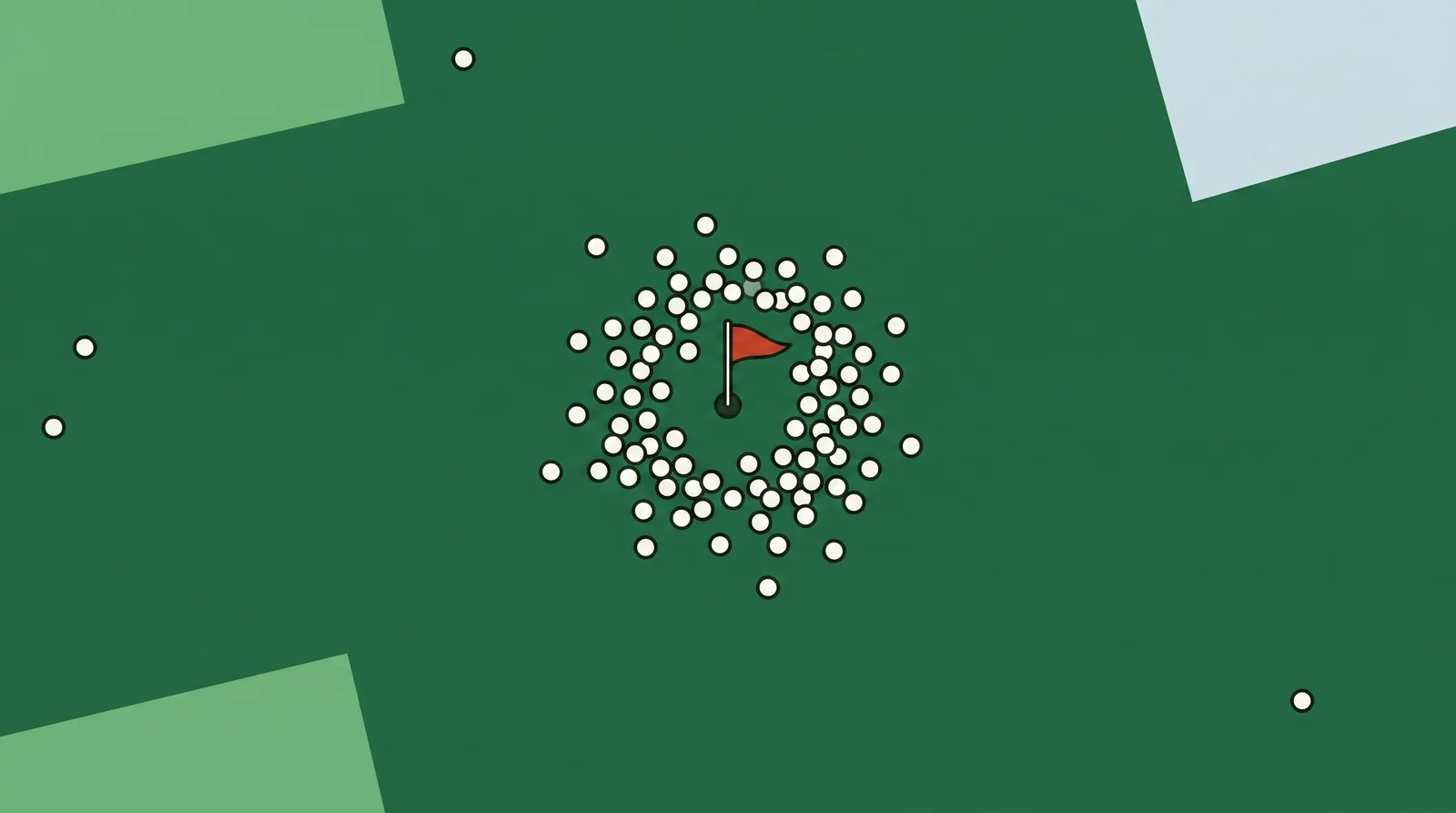
At single figures the swing stops being the problem and stops being the solution at the same time. You already strike the ball well enough to shoot the number you want, and you do it a few times a season, which is exactly what makes the rest so frustrating. What is left is scrambling, wedge proximity, producing a specific shape on request, and not giving three shots back on the closing stretch.
What actually separates a 5 from a scratch player
The comparison is more useful than it looks, because one of the numbers refuses to move and the rest do all the work.
Shot Scope's benchmark data for a scratch golfer and the equivalent figures for a 5 handicap sit side by side below.
| Metric | Scratch | 5 handicap |
|---|---|---|
| Average par 3 | 3.2 | 3.42 |
| Average par 4 | 4.2 | 4.53 |
| Average par 5 | 4.8 | 5.36 |
| Fairways in regulation | 50% | 51% |
| Greens in regulation | 59% | 41% |
| Up and down | 54% | 47% |
| Three-putt rate | 3% | 6% |
| Putts holed from 0 to 6 feet | 93% | 89% |
Read the fairway line twice. A 5 handicap hits marginally more fairways than a scratch player and gives away eighteen percentage points of greens in regulation. Whatever is happening between the tee and the green, it is not accuracy off the tee, and every hour spent grinding on driver accuracy at this level is an hour spent on the one number that is already fine.
The scratch player is in the fairway the same amount and then hits it closer, from further back, more often. Part of that is distance: the same dataset puts a scratch golfer's performance-average driver at 285 yards, which turns a 175-yard approach into a 150-yard one and moves two clubs down the bag. Most of it is iron proximity and the ability to leave the ball on the correct side of the hole.
Every left and right below assumes a right-handed golfer. If you play left-handed, swap them and everything else stands.
Scrambling is the scoring engine at this level
Getting up and down is the single most valuable skill an advanced golfer can improve, and it is the one almost nobody practises properly, because it is uncomfortable and it does not feel like progress.
The gap is large and it is measurable. Shot Scope's breakdown of what it takes to break 80 found that a golfer shooting in the 80s fails to get up and down 60% of the time, and needs two shots from inside 70 yards to reach the green on 2.7 holes a round. A golfer shooting in the 70s needs it on 1.6 holes. That single difference is worth more than a stroke a round.
| Metric | Shoots in the 80s | Shoots in the 70s |
|---|---|---|
| Greens in regulation | about 5 a round | about 9 a round |
| Three putts | 2.5 a round | 1.5 a round |
| Holes needing two shots from inside 70 yards | 2.7 | 1.6 |
Most scrambling failures are decisions rather than technique. The player has one shot they like and they play it from everywhere, so a third of the time they are attempting the hardest available version of an easy problem. Four shots cover almost every greenside situation: a putt, a low running chip, a standard chip and a high open-faced pitch. The skill is not owning all four, it is knowing which one the lie has already chosen for you.
The default should always be the lowest-risk shot the lie and the ground allow. Air is unpredictable and turf is not, so the ball spends as little time in the air as the situation permits.
| Situation | Default shot | Why |
|---|---|---|
| Fringe, flat, nothing in the way | Putter | Your worst putt beats your best chip |
| Short grass, plenty of green to work with | Low chip, 9 iron or pitching wedge | The ground is predictable, the air is not |
| Short grass, short-sided | Lowest shot that will still stop | Lower loft, lower variance, smaller miss |
| Fluffy rough, short-sided | Open-faced pitch, sand wedge | Loft is the only thing that stops it in time |
| Bare or tight lie | Ball back, hands ahead, no added loft | The leading edge has no margin to work with |
| Greenside bunker, decent lie | Standard splash, sand wedge | The sand carries the ball, not the strike |
Bunkers deserve their own note because they are the one greenside shot where the club never touches the ball. The club enters the sand behind the ball, the sand lifts it out, and the length of the shot is controlled by how much sand you take and how far through you swing.
| What the club does | What it means for the shot |
|---|---|
| Enters the sand about a hand's width behind the ball | The sand, not the face, lifts the ball out |
| Takes a long shallow cut rather than a deep scoop | Distance stays predictable |
| Keeps the face open all the way through | The bounce skids rather than digs |
| Finishes fully rather than stopping at the ball | Deceleration is what leaves it in the bunker |
Sand condition changes all four. Soft, deep sand takes more bounce and a longer cut; firm or wet sand takes a squarer face and a shallower one, because the bounce will otherwise skid the leading edge straight into the equator of the ball. You learn most of this from digging your feet in to take your stance, which is allowed, rather than from deliberately testing the sand, which is not. Judge the shot from what your feet tell you rather than from what the last bunker was like.
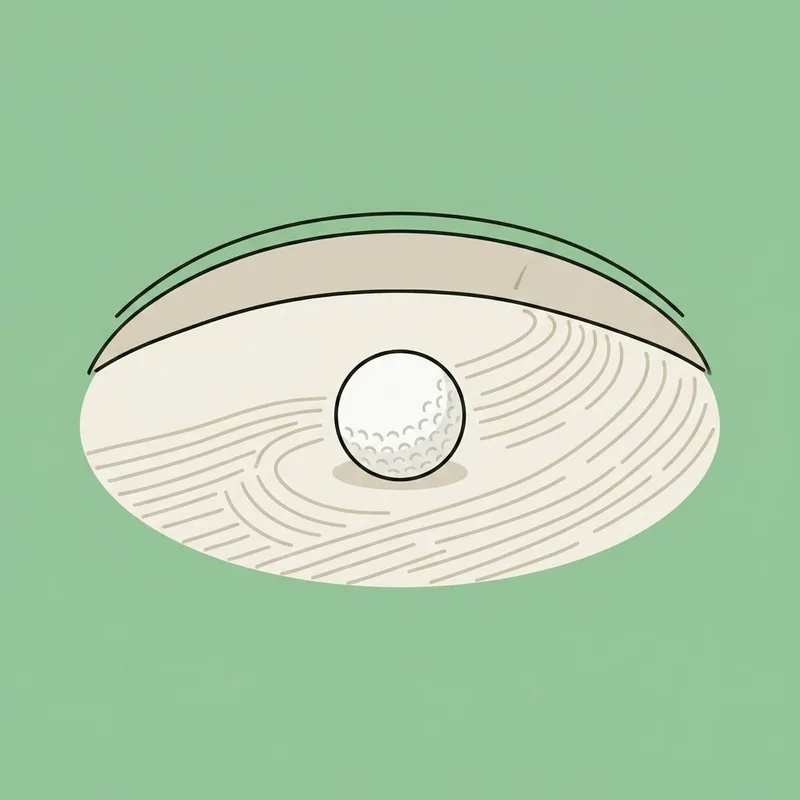
The two things that ruin advanced bunker play are both deceleration: quitting on the shot because the face is open and it feels like the ball will fly nowhere, and taking too much sand to compensate for a swing that has already slowed down. Full technique, including plugged lies and firm wet sand, is in how to hit out of a bunker.
Wedge proximity, not wedge distance
The intermediate version of this problem is knowing how far your wedges go. The advanced version is much narrower: reducing the size of the window your wedges land in, and controlling the trajectory that decides what happens after they land.
The numbers are unforgiving. Even a scratch player averages about 11 feet from inside 50 yards, and a 5 handicap averages about 10 feet from inside 25 yards, converting the up and down 56% of the time from there and finishing inside five feet on 45% of attempts. Those are good numbers achieved by very good players from very short range. Anyone promising to have you stiffing wedges is selling something.
What separates good wedge players from good ball strikers is not the average, it is the tail. One wedge a round that flies fifteen yards long into a back bunker costs more than a season of averaging two feet closer.
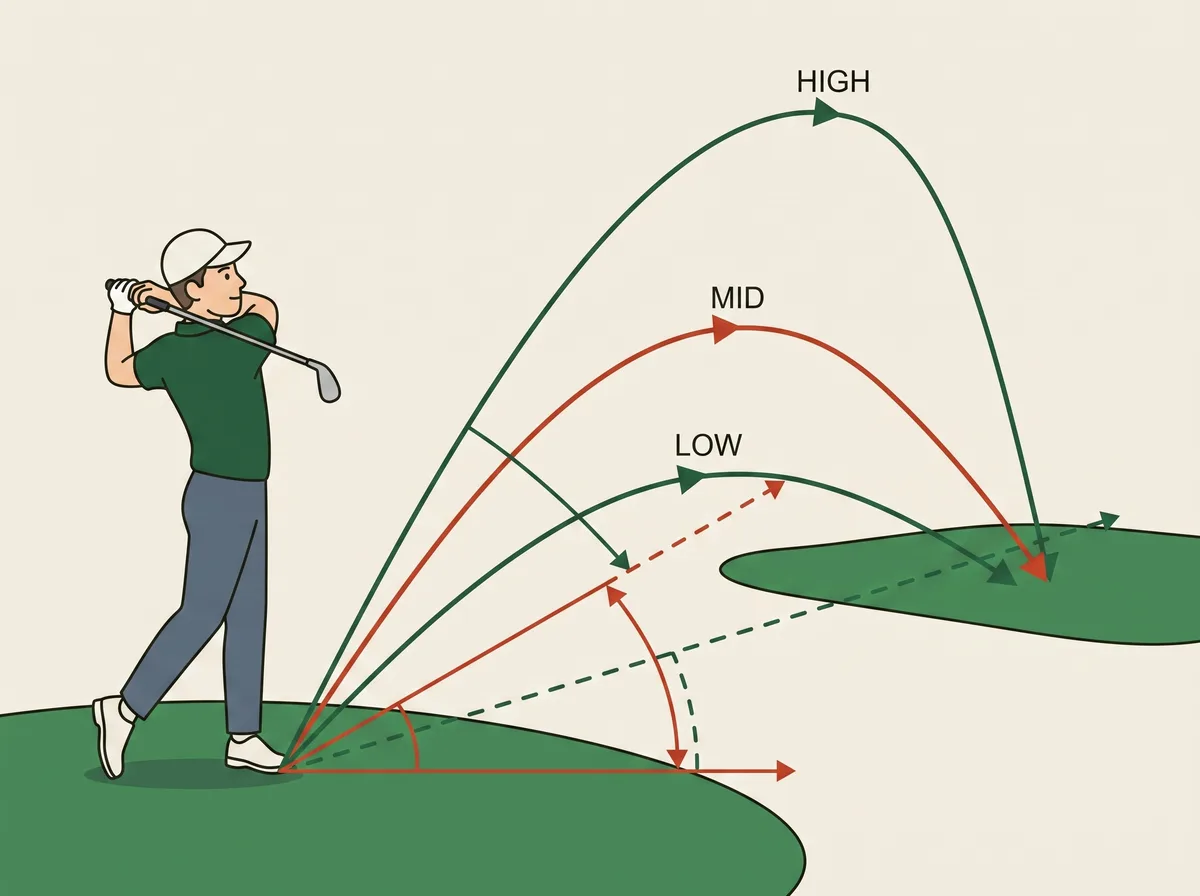
Three variables give you the whole matrix, and they are worth separating in your head because most players change all three at once and cannot tell which one produced the result.
| Change | Effect on flight | Effect on landing |
|---|---|---|
| Ball back, hands forward | Lower launch, less spin loft | More release, runs out |
| Ball centre, standard | Standard window | One hop and a short check |
| Ball forward, face slightly open | Higher launch, more spin loft | Lands steeply, stops quickly |
| Shorter backswing, same speed | Lower and shorter | Less spin, more roll |
| Longer backswing, softer speed | Higher and shorter | The least repeatable option, avoid it |
Note the last line. Adding length and taking off speed is the shot that feels most controlled and is the least repeatable thing you can do with a wedge, because deceleration through the ball changes both distance and strike quality at once. The system of fixed lengths at a constant speed is the foundation this all sits on, and it is covered in detail in wedge distance control.
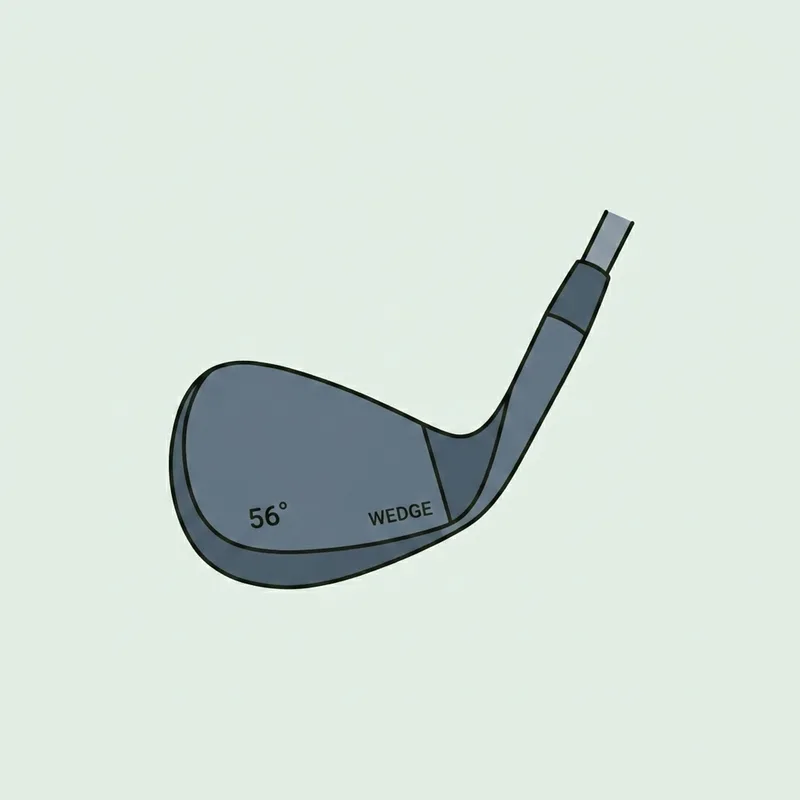
Lie quality matters more at this level than technique does, and it is the thing to check first when a wedge misbehaves. A ball sitting down in rough will come out with less spin and more distance than the same swing from the fairway. A ball on hardpan will come out lower and hotter. A tight lie into the grain gives the leading edge almost nothing to work with. Before changing anything about the swing, look at what the ball is sitting on.
Shaping the ball on demand
Every good player has a natural curve. What separates players who can score on an unfamiliar course is being able to produce the other one when the hole demands it, and knowing what it costs.
The mechanism is simple to state and takes a season to own. The clubface decides where the ball starts, and the difference between where the face points and where the club is travelling decides how much and which way it bends. A ball that starts right of target and bends back is a draw. A ball that starts left and bends back is a fade.
The practical version at address is that both shapes come from the setup rather than from a different swing. Aim the body where you want the ball to start, aim the face where you want it to finish, and then make your normal swing along your body line. That is a deliberately simplified description and it does not survive contact with extreme shapes, but it works for the ten to fifteen yards of movement that actually gets used on a golf course.
The trade-offs are worth stating plainly because the choice is usually strategic rather than aesthetic. A draw runs out more and is the shot for a long hole or a following wind. A fade lands softer and holds a green, and it costs a little carry. Neither is better. The technique for each is in how to hit a draw and how to hit a fade.
The strike quality number almost nobody checks
Advanced golfers measure club speed and carry distance. The number that actually explains why two players with the same speed hit it different distances is spin loft, and it is the one worth understanding.
Spin loft is the angle between where the club face is pointing and where the club head is travelling at impact, which is roughly the dynamic loft minus the attack angle. TrackMan's explanation of spin loft reports that a higher spin loft produces more spin and a lower smash factor, meaning less of the speed you generate reaches the ball.
| Player | Driver spin loft |
|---|---|
| PGA Tour average | 14.7 degrees |
| Scratch or better male amateur | 14.8 degrees |
| 5 handicap | 15.8 degrees |
| 10 handicap | 17.3 degrees |
| Average male amateur, 14.5 handicap | 18.3 degrees |
The practical use of this is narrow and specific. If your driver spins too much and flies too high, the answer is usually a shallower attack angle or less dynamic loft rather than a lower-spin shaft. If your irons balloon in wind, the same logic applies. Neither diagnosis is safe to make by feel, which is the argument for measuring rather than guessing.
Putting: where a good putter genuinely gains
There is a widely believed idea that low handicap players hole vastly more mid-range putts. The data does not support it, and believing it sends practice time to the wrong place.
Shot Scope's make percentages by handicap show the following.
| Distance | Scratch | 5 handicap | 10 handicap |
|---|---|---|---|
| 0 to 6 ft | 92.8% | 90.2% | 89.3% |
| 6 to 12 ft | 42.8% | 41.4% | 38.1% |
| 12 to 18 ft | 25.1% | 23.9% | 20.2% |
| 18 to 24 ft | 14.5% | 13.0% | 10.3% |
| 24 to 30 ft | 8.3% | 10.1% | 5.4% |
| 30 ft plus | 4.3% | 4.3% | 2.8% |
A scratch player makes one in four from 12 to 18 feet. Not one in two. From beyond 24 feet they make fewer than one in ten. The gains available in putting at this level are therefore in two narrow places: the three-putt rate, which is 3% for a scratch player against 6% for a 5 handicap, and the six-foot band, where three or four percentage points is the difference between saving par and not.
Both of those are proximity problems as much as stroke problems. Better lag putting produces shorter second putts, and better approach and wedge play produces shorter first putts. A putting stroke that holes 41% from six to twelve feet is already good enough.
The two things worth genuine work are start line and green reading. Start line is measurable at home with a gate of two tees just wider than the ball, set a foot in front of it. Green reading is the harder skill and the one that decays fastest on unfamiliar courses, because it is largely pattern recognition built on how water drains off the site rather than on what the putt looks like from behind the ball. The method is in how to read greens.
Strategy where the last three shots hide
At this level strategy stops being about avoiding disaster and becomes about which side of the hole to miss on.
The controlling idea is that every approach has a wrong side, and the wrong side is not always the obvious one. A flag on the right edge of a green that slopes right to left has a short-side miss right and an easy uphill chip left. Missing left is not conservative, it is correct, and it is a different decision from aiming at the centre.
- Find the pin's tier and which way the green falls away from it.
- Identify the short-sided miss and take it out of play entirely by adjusting your aim, not your effort.
- Pick the trajectory that suits the firmness, not the one you feel like hitting.
- Choose the club that puts your average miss on the safe side, which is often one more than the number suggests.
- If the flag is tucked and the lie is imperfect, aim at the fat of the green and accept a 25-foot putt.
The other advanced-specific point is that the reward for aggression rises as skill rises, which is the opposite of the advice given to higher handicaps. A player who hits 59% of greens genuinely does gain by taking on a flag that a 15 handicap should never look at, because their miss pattern is tight enough that the downside is a fringe rather than a bunker. The judgement is about your own dispersion, not about courage. The general framework sits in golf course management.
Two situational habits are worth building because they come up every round. First, on a par 5 you cannot reach, lay up to a full wedge number rather than as close as possible, because a full swing from 95 yards is a better shot than a half swing from 40. Second, on a downwind hole, take the lower-spinning shot rather than the higher one, because downwind reduces spin and lift and a high shot falls out of the sky short.
Holding a score together
The last barrier for most good players is not technical. It is what happens on the tee of the 15th when the round is going well and both of you know it.
The mechanism is well understood and it is not mysterious. Under pressure, tempo quickens, grip pressure rises, and the swing gets shorter and faster, which produces a strike low on the face and a shot that comes up short. Nothing about the technique changed. The rhythm did.
Two mechanical habits survive pressure better than any mental technique. Keep the pre-shot routine identical in length whether the shot matters or not, because a routine that shortens under pressure is the first observable sign that the rhythm has gone. And commit to a club before you address the ball, because changing your mind over the ball is what produces the tentative swing.
Scoring well also means treating the round as eighteen independent problems rather than one continuous one. A double on the 12th has no bearing on the 13th unless you carry it there. The full treatment of nerves, focus and recovering from a bad hole is in the golf mental game.
What to stop doing
Advanced golfers waste time in predictable places, and most of them feel productive.
Stop rebuilding a swing that already works. A swing that produces a 5 handicap is a swing that repeats, and rebuilding it costs a season during which the score gets worse before it gets better. If the ball flight is playable and the strike is centred, the swing is doing its job.
Stop hitting balls at the range without a target or a consequence. Beyond a certain standard, blocked repetition of a shot you can already hit produces almost no transfer. Every ball needs a target, a nominated shape, and ideally something riding on it.
Stop changing equipment to solve a technique problem. A new driver will not fix a spin loft two degrees too high, and swapping wedges will not fix a distance control problem that comes from decelerating.
And stop measuring progress by your best round. Your best round is the one where the variance ran in your favour. The number that tells you whether anything is improving is your median, and the way to move it is to raise the floor rather than the ceiling.
| Where to spend a season | What to measure | Realistic marker of progress |
|---|---|---|
| Scrambling from inside 30 yards | Up and down conversion | Moving from roughly two in five to roughly half |
| Wedge proximity from 50 to 110 yards | Proximity and the size of the miss | Fewer shots outside the green's depth |
| Start line and lag putting | Three-putt rate | Fewer than two a round |
| Playing under pressure | Score on the last six holes | Closing stretch no worse than the opening one |
None of those are promises and none of them are quick. They are the four places where the shots are actually sitting once ball striking is no longer the constraint.
Key takeaways
- A 5 handicap hits as many fairways as a scratch player and eighteen percentage points fewer greens. Driving accuracy is not the constraint.
- Getting up and down over half the time lets you miss seven greens and still play to par.
- The lowest-risk greenside shot the lie allows is nearly always the right one. The ball should spend as little time in the air as possible.
- Wedge play is judged by the size of the miss, not the average. One shot fifteen yards long costs more than a season of averaging two feet closer.
- Adding backswing length and taking off speed is the least repeatable wedge shot there is.
- Spin loft, not club speed, is what separates strike quality. A scratch amateur sits within a tenth of a degree of the tour average with a driver.
- Even a scratch player makes only about one putt in four from 12 to 18 feet, so putting gains live in three-putt rate and the six-foot band.
- Miss on the side the green gives you a shot from, which is often not the conservative-looking side.
- Under pressure it is tempo that fails, not technique. A routine that shortens is the first warning.
Common questions
What counts as an advanced golfer?
Broadly a single-figure handicap, or a player close enough to it that ball striking is no longer the limiting factor. The practical test is whether you can predict what a shot will do. If a 7 iron produces a usable result nine times in ten, the remaining shots are in scrambling, proximity and decisions.
I strike it well but I do not score. What is wrong?
Almost always scrambling and wedge proximity. Good ball strikers miss greens in the same places every round and then play the recovery badly, and they leave wedges in the middle of the green rather than inside fifteen feet. Neither shows up on the range, which is why the range does not fix it.
Should I be trying to hit a draw or a fade?
Own one and be able to produce the other on request. A draw runs out and suits long holes and following winds; a fade lands more steeply and holds firm greens. Neither is superior, and switching your natural shape at this level costs a season for no reliable gain.
How many greens should a single-figure golfer hit?
Recorded averages put a scratch player at about 59% and a 5 handicap at about 41%. If you are hitting eight or nine greens a round and scoring in the high 70s, the shots are being lost around the greens rather than into them.
Is it worth taking lessons as a low handicapper?
Yes, but for different reasons than a beginner. The useful lesson at this level is on-course, watching decisions and shot selection, or a launch monitor session diagnosing a specific delivery problem. A general swing lesson usually starts a rebuild that costs more than it returns.
How do I stop three-putting?
By hitting the first putt closer rather than by changing your stroke. A scratch player three-putts on about 3% of holes and a 5 handicap on about 6%, and nearly all of that gap is speed control on the long putt rather than accuracy on the short one.
Why do I play well until the last few holes?
Because tempo speeds up under pressure while technique stays the same. The observable symptom is a pre-shot routine that gets shorter, followed by strikes low on the face. Rehearsing with genuine mild consequence attached is the only practice that addresses it.
Do I need a launch monitor?
Not to own, but the numbers are worth checking once or twice a season. Carry consistency, spin and dispersion are the useful ones. Club speed is the number everyone looks at and the one that explains the least about scoring.
How much does distance actually matter at single figures?
More than short-game purists admit and less than the equipment market suggests. Scratch benchmark data puts a performance-average driver at 285 yards, and that length is what turns long approaches into short ones. It is worth pursuing only when it does not cost you dispersion.
Should I lay up to a full wedge or as close as possible?
To a full wedge, on almost every occasion. A full swing from 95 yards is more repeatable than a half swing from 40, and the half swing is exactly the shot where distance control breaks down. The exception is when laying back leaves you in rough or on an awkward lie.
What is the fastest way to lower a single-figure handicap?
Pick the weakest of scrambling, wedge proximity, putting and pressure, measure it honestly for a month, and work on that one for a season. Progress at this level comes from raising the floor rather than the ceiling, so the number to watch is your median score, not your best.
On this page
- What actually separates a 5 from a scratch player
- Scrambling is the scoring engine at this level
- Wedge proximity, not wedge distance
- Shaping the ball on demand
- The strike quality number almost nobody checks
- Putting: where a good putter genuinely gains
- Strategy where the last three shots hide
- Holding a score together
- What to stop doing

Tom Ashworth
Tom Ashworth is a PGA Professional who has taught golf since 2012, working mainly with beginners and mid-handicappers at club level in Surrey. He reviews the instruction guides on Learn Golf for technical accuracy before they publish.
Most of his teaching is with players in their first three years of the game, and most arrive having been told too much: six swing thoughts collected from videos, half of them contradicting each other. His approach is to check the grip and the alignment before touching the swing, on the basis that most bad ball flight is decided at address.