Best Golf Balls for Distance: Low Spin Off the Driver
Every ball on sale is built against the same distance ceiling, so no ball can be much longer than another. What a distance ball actually does is take spin off the driver, and that is a trade rather than a gift.
Some links here earn us a commission at no extra cost to you. It never changes what we recommend or the order we rank it. How this works.
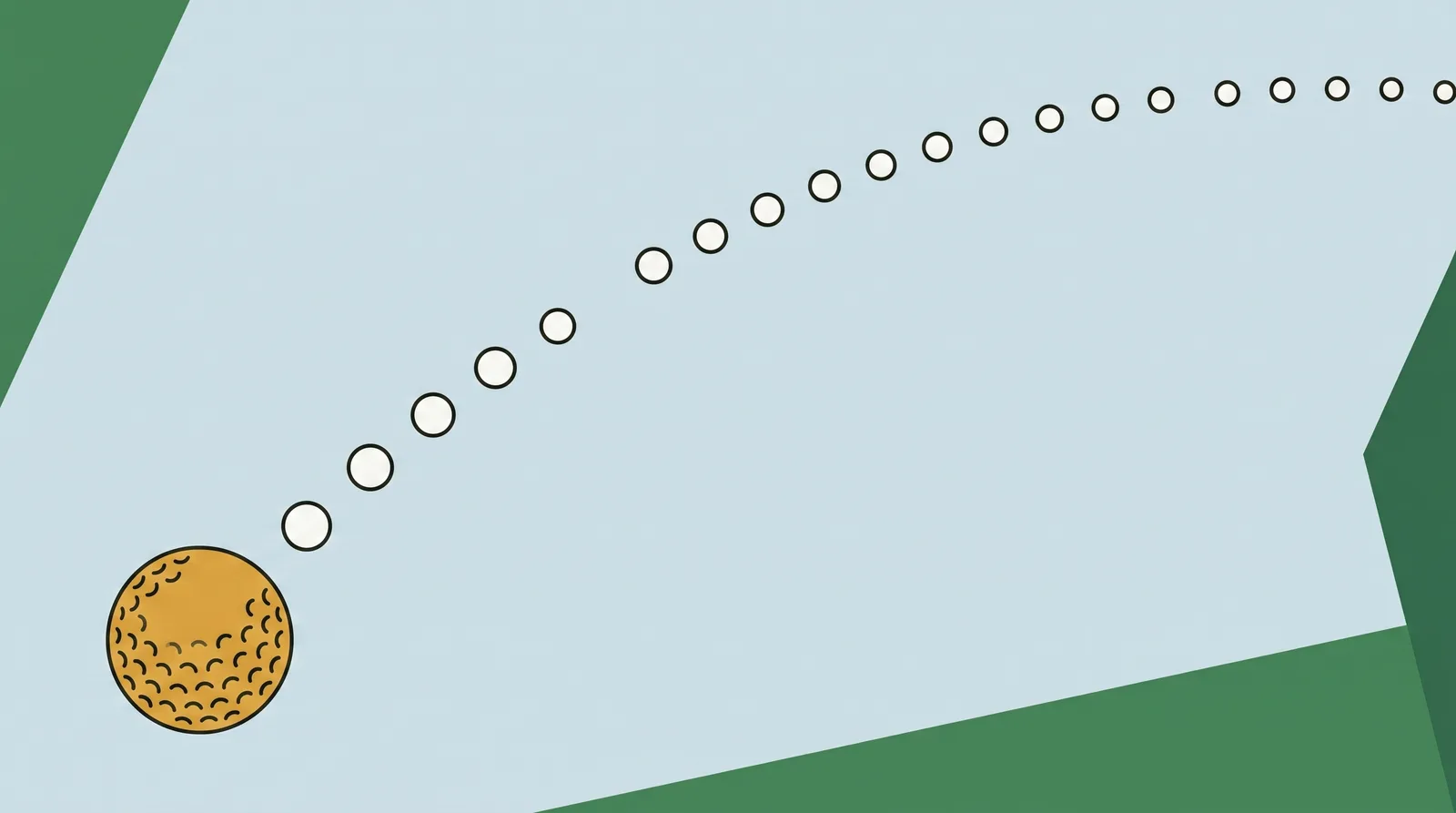
Every ball sold legally is built against the same distance ceiling, which is why no box on a shelf can be much longer than the box beside it. What a distance ball actually does is take spin off the driver and flatten the flight, and for most amateurs that is genuinely worth a few yards. It also costs you something on the green, and that half of the trade rarely gets printed.
The four, compared
All four are two-piece or simply built balls with an ionomer cover, which is the construction that produces low spin. That is not a coincidence and it is not a cost saving. It is the mechanism.
| Pick | Best for | Construction | Cover | Dimples | Compression | Price |
|---|---|---|---|---|---|---|
| Titleist Velocity | The most aggressive low spin flight in the group | Not published by Titleist | Firmer ionomer formulation | 350 octahedral | Not published by Titleist | Around £27 a dozen at UK retail |
| TaylorMade Distance+ | The softest published compression figure on the page | 2-piece | Soft ionomer | 342, TaylorMade's published figure | 77, TaylorMade's published figure | Around £22 a dozen at UK retail |
| Srixon Distance | Distance without giving up all greenside feel | 2-piece | Thin durable ionomer, 1.45 mm | 324 speed dimple pattern | 89, Srixon's published figure | Around £15 a dozen at UK retail |
| Callaway Warbird Distance+ | The largest core and the biggest core-to-price ratio | 2-piece | Not published by Callaway | HEX aerodynamic pattern, count not published | Not published by Callaway | Around £19 to £20 a dozen |
Note how little separates them on price. Three of the four sit within a few pounds of each other, which means the choice here is about flight shape rather than about value.
What actually produces distance
Three numbers decide how far a golf ball goes, and only one of them is meaningfully influenced by the ball.
Ball speed is the first and the largest. It comes from clubhead speed and from how centred the strike is, and the ball contributes at the margins through core and cover design. Launch angle is the second, and it is set by the club's dynamic loft and your attack angle rather than by the ball. Spin rate is the third, and this is where a ball genuinely moves the needle.
| What decides distance | How much the ball changes it |
|---|---|
| Clubhead speed | Nothing. This is entirely the golfer |
| Strike location on the face | Nothing. This is entirely the golfer |
| Launch angle | Very little. Set by loft and attack angle |
| Driver spin rate | Meaningfully. Cover firmness and construction both act on it |
| Aerodynamic drag in flight | Somewhat. Dimple pattern and depth act on it |
That is the whole honest picture. A distance ball is a spin reduction device with an aerodynamic package attached, and anyone selling it as anything else is selling a story. How to add distance off the tee is where the larger gains live, and none of them are in a box. It is also worth knowing what an average drive actually travels before deciding you are short.
Titleist Velocity: built to fly flat
The Titleist Velocity pairs a softer core formulation with a faster, firmer ionomer cover and a 350 octahedral dimple design. Titleist describe the goal directly: reduce long game spin, and deliver a more piercing flight with a lower peak height to gain every possible yard.
The soft core and firm cover combination is the interesting engineering. A softer core deforms more readily and returns speed, while a firmer cover reduces the friction that generates spin. Those two work in opposite directions on feel and in the same direction on distance, which is a deliberate design rather than a compromise.
 Around £27 a dozen at UK retail
Titleist Velocity
- Construction
- Not published by Titleist
- Cover
- Firmer ionomer formulation
- Dimples
- 350 octahedral
- Compression
- Not published by Titleist
- Colours
- White, green and orange
- Flight
- Lower peak height, reduced long game spin
- Titleist publish the dimple count and describe the design goal precisely: lower peak height to gain every possible yard.
- The softer core paired with a firmer cover is a genuine specification change aimed squarely at driver spin.
- Green and orange alongside white, which is unusual in a distance ball and useful if you hit it a long way offline.
- Titleist publish no compression figure for it, in common with every ball they make.
- No layer count published either, so there is no way to compare its construction against the others here.
- A lower peak height is a liability into a headwind, where a ball that climbs holds its line better.
VerdictThe pick if you want the flattest, most penetrating flight available in a two-piece ball and you are willing to accept a manufacturer who states almost nothing about construction. It is the most committed distance design here rather than the most balanced one.
A lower peak height is not free. A ball that flies flat holds its line into a headwind less well than one that climbs, and it lands at a shallower angle, which means more roll and less control on a firm fairway. That is fine on a wide course in summer and a genuine nuisance on a tight one in wind. Playing in wind covers when a flat flight helps and when it does not.
TaylorMade Distance+: the one with a number on it
The TaylorMade Distance+ is a two-piece ball built around a REACT speed core, wrapped in a soft ionomer cover, with an aerodynamic dimple pattern and a published compression of 77.
That published figure is the reason it sits second. TaylorMade are one of only two mainstream manufacturers who still state compression across their range, and 77 tells you something useful: this is a firm ball, firmer than most two-piece balls sold on softness, and it will feel that way off a putter.
 Around £22 a dozen at UK retail
TaylorMade Distance+
- Construction
- 2-piece
- Cover
- Soft ionomer
- Dimples
- 342, TaylorMade's published figure
- Compression
- 77, TaylorMade's published figure
- Colours
- White and yellow
- Core
- REACT speed core
- At a published 77 it is the softest of the two balls here that carry a stated compression, the Srixon being 89.
- A soft ionomer cover is a sensible middle position: tougher than urethane, softer than a pure distance cover.
- Cheaper than the Titleist by a clear margin, and stocked almost everywhere.
- At 77 it is firm, and a slower swing will find it harsh off the putter.
- A two-piece ionomer ball gives up greenside spin by design, so it runs out on a pitch where a urethane ball would check.
- It costs about seven pounds a dozen more than the Srixon below it, which is a closely comparable ball on every published number except compression.
VerdictThe one to choose if published numbers matter to you, and the compression figure is the whole argument for picking it. It is not the value buy at UK prices: the Srixon below it is a very similar ball for meaningfully less, so what the 77 is really buying you is the right to compare rather than guess.
The soft ionomer cover is the sensible part of the design. It is tougher than urethane, so it survives the strikes that produce a lot of amateur golf, and it is softer than the firmest distance covers, so the ball is not completely dead into a green. TaylorMade call the surface an Extended Flight Dimple Pattern and put the count at 342, aimed at lower drag off the tee. Older material for the same ball quotes 322, so ignore that figure: 342 is what the maker states on its own British product page today.
Srixon Distance: the least single-minded of the four
The Srixon Distance runs a FastLayer core that starts soft in the centre and firms gradually toward its edge, under a thin ionomer cover, with a 324 speed dimple pattern that Srixon describe as aerodynamically tuned to cut through wind.
The gradual core is the technical difference worth understanding. Most cores step from one hardness to another at a boundary. A gradient core has no boundary, which lets the designer chase speed at the outside and feel at the centre without a hard transition between the two.
 Around £15 a dozen at UK retail
Srixon Distance
- Construction
- 2-piece
- Cover
- Thin durable ionomer, 1.45 mm
- Dimples
- 324 speed dimple pattern
- Compression
- 89, Srixon's published figure
- Colours
- White and yellow
- Core
- FastLayer, soft centre firming outward
- The FastLayer core firms gradually outward rather than stepping, which gives speed without the harshest feel.
- Srixon describe the thin cover as delivering ample greenside spin, which is the least aggressive distance claim here.
- Aerodynamically tuned dimples aimed at wind performance, which is where most distance balls suffer.
- The cheapest ball here by a clear margin at UK retail, and by some way the cheapest per yard gained.
- At a published 89 it is a firm ball, so the greenside feel claim is relative to other distance balls rather than to a soft one.
- The greenside spin claim is relative to other two-piece balls rather than to a urethane one.
- Only two colours, and the yellow is not stocked everywhere.
VerdictThe balanced choice, and the one to buy if you want the extra yards without a ball that runs twenty feet past every pin. It is also comfortably the cheapest ball on this page at UK retail, which makes the balanced design the value option too. Least single-minded is either the point or the problem depending on why you are here.
Srixon are also the only maker here who describe their distance ball as delivering ample greenside spin, and that claim is relative rather than absolute. It means more than the Titleist, not more than a urethane ball. If you want the yards without a ball that releases through every green, this is the one to try first.
Callaway Warbird Distance+: the biggest core, the smallest price
The Warbird is built around an extra large, high energy core that Callaway describe as highly compressible, wrapped in a two-piece construction and finished with the HEX aerodynamic pattern rather than conventional round dimples.
A larger core is the most direct route to ball speed available in a simple ball, because there is more material doing the work of storing and returning energy. Callaway pair that with a design that promotes high launch and long carry, which is a different distance philosophy from the Titleist.
 Around £19 to £20 a dozen
Callaway Warbird Distance+
- Construction
- 2-piece
- Cover
- Not published by Callaway
- Dimples
- HEX aerodynamic pattern, count not published
- Compression
- Not published by Callaway
- Colours
- White and yellow
- Core
- Extra large high energy core
- The extra large core is the most direct route to ball speed available in a two-piece design.
- Callaway's HEX aerodynamics is a genuinely different surface pattern rather than a dimple count claim.
- Cheaper than both the Titleist and the TaylorMade at UK street price.
- Callaway publish no cover material, no dimple count and no compression figure.
- The design bias is toward launching high and staying up, which is not what a golfer already spinning the driver too much needs.
- Feel is firm and the ball is loud off a putter, which some players find genuinely off-putting.
VerdictThe buy when you want a distance ball rather than a soft one and do not want to pay Titleist money for it. It launches higher than the Titleist by design, so it is the wrong pick if your drives already balloon.
High launch is the thing to think about before buying it. If your drives already climb and stall, adding launch makes that worse rather than better, and the Velocity is the ball for you instead. If your problem is a low, running drive that never gets airborne, the Warbird is aimed at exactly that. What driver loft does to your flight is the more effective lever on the same problem.
Driver spin is the amateur's real distance problem
Here is where the published data earns its keep, and it points firmly toward a low spin ball for most club golfers.
Those two datasets tell one story. The average club golfer generates several hundred rpm more driver spin than a tour player at a lower clubhead speed, and the cause is spin loft, the gap between where the club is travelling and where the face is pointing. Three and a half extra degrees of it is the whole difference.
A ball cannot fix spin loft. What it can do is remove a slice of the spin that results, and on a swing already producing 3,275 rpm that slice is worth having. This is the one situation in golf equipment where the marketing and the data agree. What spin rate actually means sets out where your own numbers should sit.
What a low spin ball costs you
This is the half of the trade the boxes do not print, and it is worth being specific about.
Spin is what stops a ball on a green. A firm ionomer cover generates far less friction against a wedge groove than a urethane one, so an approach shot lands and runs rather than checking. On a soft green in spring that hardly matters. On a firm green in August it is the difference between a fifteen foot putt and a chip from the back fringe.
Spin is also what holds a ball in the air. TrackMan list a spin rate that is too low as a genuine fault, causing the flight to nose-dive and drop abruptly short of where it should. A very low spin ball in the hands of a golfer who already delivers low spin is a shorter ball, not a longer one.
| You gain | You give up |
|---|---|
| A few hundred rpm less driver spin, and the carry that comes with it | Greenside check on pitches and chips |
| A flatter, more penetrating flight | Line-holding into a headwind |
| A tougher cover that survives mishits | Soft feel off the putter |
| More run out on firm fairways | Control on firm greens |
The ceiling every ball on this page is built against
There is a hard limit on how far a conforming ball can go, and it is the reason this whole category is fighting over a handful of yards.
The R&A's Rules of Equipment require a ball to weigh no more than 1.620 ounces, measure no less than 1.680 inches in diameter, and stay inside both an Initial Velocity Standard and an Overall Distance Standard for combined carry and roll. Every ball on this page is tested against those limits, which caps the top end for all of them equally.
That is why claims of dramatic distance gains between conforming balls should be read carefully. The differences that survive the ceiling are about spin, flight shape and how the ball behaves in wind, not about a step change in yardage.
The testing conditions were due to change, and that has now been pushed back. In a joint statement issued in June 2026 with the PGA Tour and the DP World Tour, the governing bodies confirmed there will be no change to the Overall Distance Standard testing approach until January 2030 while alternatives are evaluated. Nothing bought this season stops conforming before then.
Who should not buy a distance ball
Three groups, and it is worth checking whether you are in one of them.
Anyone whose drives already fly low and run is adding a problem rather than solving one. Low spin plus low launch is the worst combination available and produces a shot that dives out of the air early.
Anyone whose scoring bottleneck is inside 100 yards is spending in the wrong place. If you are hitting greens and three-putting or chipping badly, a firmer cover makes the part of the game you are already losing marginally harder.
And anyone under about 85 mph of driver speed should read the swing speed page first, because at that speed the ball needs enough spin to stay airborne and stripping it out shortens the shot. That page works through the physics properly.
If the ball turns out not to be the problem, the club almost certainly is. Driver picks and what to look for is the larger decision by a wide margin, and how the layers inside a ball work explains why a two-piece build produces low spin in the first place.
Key takeaways
- Every conforming ball is built against the same Overall Distance Standard, which is why none of these can be dramatically longer than the others.
- A distance ball is a spin reduction device. That is the only mechanism by which the ball itself adds carry for most golfers.
- The Titleist Velocity pairs a softer core with a firmer ionomer cover and 350 dimples, aimed at a lower peak height and a flatter flight.
- The TaylorMade Distance+ publishes a compression of 77 and the Srixon Distance 89, so those two can be selected on a stated number rather than a description.
- Titleist and Callaway publish no compression figure for these models. Srixon publish 89 for the Distance and TaylorMade publish 77 for the Distance+.
- TrackMan put the average male amateur at 3,275 rpm of driver spin against 2,545 rpm on tour, so most club golfers have a spin surplus rather than a shortage.
- The cause is spin loft, at 18.3 degrees for the average male amateur against 14.7 on tour, and no ball can correct that.
- The trade is real: less greenside check, less line-holding into wind, and a firmer feel off the putter.
Common questions
What is the longest golf ball?
There is no single answer, because every conforming ball is tested against the same Overall Distance Standard and none can exceed it. The differences that survive that ceiling are a handful of yards from reduced driver spin and flight shape, not a step change.
Do distance golf balls actually work?
They work in one specific way: by reducing spin off the driver. Since the average club golfer already generates more driver spin than a tour player, removing some of it does add carry. The gain is measured in a few yards rather than tens of them.
What is the best golf ball for distance off the tee?
The Titleist Velocity has the most committed low spin, flat flight design of the four here. If you want a published compression figure to select on rather than a description, the TaylorMade Distance+ states 77 and costs less.
Do two-piece golf balls go further than three-piece?
Usually, off a driver, for a golfer with high spin. A two-piece ball is a core and a firm cover with nothing between them, which produces low spin everywhere. That helps on the tee and hurts on approach shots, which is why tour players do not use them.
Does a harder golf ball go further?
Not directly, and the belief comes from a misreading. Firmness affects feel, and it correlates with cover materials that reduce spin, which is where any distance gain actually comes from. Compression itself is not the mechanism.
Do low spin golf balls reduce a slice?
Marginally. Less total spin means less of every spin component, including the one that curves the ball, so the same swing finishes slightly less far offline. It does not change the face-to-path relationship that causes the curve in the first place.
Will a distance golf ball help a slow swing speed?
Often not. A slower ball needs more spin to generate the lift that keeps it airborne, and stripping spin out at low speed produces a flight that drops abruptly and lands short. The swing speed page covers what to buy instead.
What do I give up by playing a distance ball?
Greenside spin, mostly. A firm ionomer cover generates far less friction against a wedge groove than urethane, so pitches and chips land and run rather than checking. You also give up soft feel off the putter and some line-holding into a headwind.
Does the dimple pattern on a golf ball affect distance?
Yes, through aerodynamic drag and lift. Dimple depth, shape and coverage all change how the air behaves around the ball in flight. The count itself matters far less than the geometry, which is why a 324 dimple ball and a 350 dimple ball are not ranked by that number.
Are golf balls being made shorter by a rules change?
Eventually, and not before January 2030. The R&A and the USGA confirmed in June 2026 that the Overall Distance Standard testing change is postponed while alternatives are evaluated. The estimated effect on recreational golfers was always five yards or less.
Should I play a distance ball if I hit it a long way already?
Probably not. High clubhead speed with low spin loft is the combination that produces genuinely low driver spin without help, and adding a low spin ball to it can push the flight below the window that carries. A ball with a urethane cover will cost you almost nothing off the tee and give you a great deal back on approach shots.
How we put this together
- Published manufacturer specifications, read on the maker's own product page where that page could be reached, and recorded as unpublished where the maker states nothing.
- Cover material and construction against long game spin, because taking spin off a driver is the only mechanism by which a ball adds carry for most golfers.
- The R&A and USGA Overall Distance Standard, which caps every ball on this page and is the reason none of them can be meaningfully longer than the others.
- TrackMan's published driver spin and spin loft benchmarks by handicap, used to establish whether the average amateur has a spin surplus or a spin shortage.
- What a low spin, firm cover ball gives up on approach shots and around the green, set out rather than left implied.
On this page
- The four, compared
- What actually produces distance
- Titleist Velocity: built to fly flat
- TaylorMade Distance+: the one with a number on it
- Srixon Distance: the least single-minded of the four
- Callaway Warbird Distance+: the biggest core, the smallest price
- Driver spin is the amateur's real distance problem
- What a low spin ball costs you
- The ceiling every ball on this page is built against
- Who should not buy a distance ball
- How we put this together

Tom Ashworth
Tom Ashworth is a PGA Professional who has taught golf since 2012, working mainly with beginners and mid-handicappers at club level in Surrey. He reviews the instruction guides on Learn Golf for technical accuracy before they publish.
Most of his teaching is with players in their first three years of the game, and most arrive having been told too much: six swing thoughts collected from videos, half of them contradicting each other. His approach is to check the grip and the alignment before touching the swing, on the basis that most bad ball flight is decided at address.