Best Cheap Golf Balls: Price Per Dozen and the Trade
Below about twenty pounds a dozen the golf ball market splits into new balls from real manufacturers, balls somebody else already played, and balls that have been stripped and repainted. Only two of those three are worth your money.
Some links here earn us a commission at no extra cost to you. It never changes what we recommend or the order we rank it. How this works.
The cheap end of the golf ball market is not one market. It is new balls from real manufacturers, balls somebody already played that have been retrieved and graded, and balls that have been stripped back to the core and repainted. Those three things are sold under the same heading at similar prices, and one of them is not worth buying at any price.
The four, compared
One of these four has a urethane cover, which at this price is genuinely unusual. The other three use ionomer covers, which is the correct choice for durability and the reason they cost what they do.
| Pick | Best for | Construction | Cover | Dimples | Compression | Price |
|---|---|---|---|---|---|---|
| Kirkland Signature Performance+ | A urethane cover at an ionomer price, if you can get to a Costco | 3-piece | Urethane | 338 | Not published | £34.99 the twenty four box, about £17.50 a dozen, and Costco sell them two boxes at a time |
| Vice Drive | The most published specification of any ball at this end of the market | 2-layer | DuPont Surlyn, thin and cut resistant | 312 large dimple pattern | 95, Vice's published figure | Around £16 to £22 a dozen, less in bulk |
| Srixon Distance | A tour manufacturer's cheapest ball, with the numbers published to check it | 2-piece | Ionomer, 1.45 mm | 324 speed dimple pattern | 89, Srixon's published figure | Around £15 a dozen at UK retail |
| Pinnacle Rush | Fifteen balls in a box, which is the point | 2-piece | Soft ionomer | 332 icosahedral | Not published | Around £11 to £15 a dozen, sold in fifteen ball packs |
Note the price spread. There is barely more than ten pounds a dozen between the most and least expensive here, which means the decision is about cover material and how many balls come in the box rather than about money.
Kirkland Signature Performance+: urethane at ionomer money
The Kirkland Signature Performance+ is a three-piece ball with a urethane cover and a 338 dimple pattern, sold in two dozen boxes through a single warehouse retailer. That combination of specification and price does not otherwise exist.
Urethane is the whole argument. It is the cover material that grips a wedge groove and produces greenside spin, and it is the single largest difference between a fifty pound box and a twenty pound one. Getting it at this price means giving up brand availability rather than giving up construction. What each layer of a ball does explains why the cover matters more than the piece count.
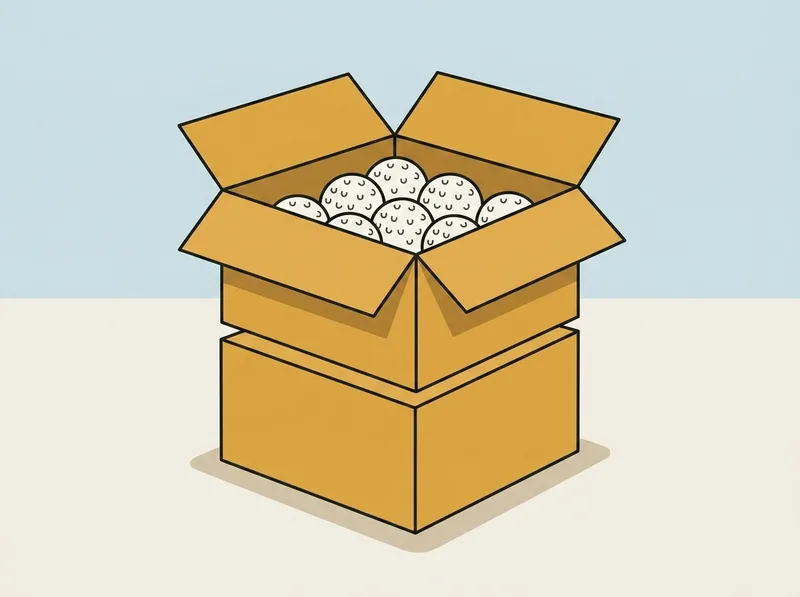 £34.99 the twenty four box, about £17.50 a dozen, and Costco sell them two boxes at a time
Kirkland Signature Performance+
- Construction
- 3-piece
- Cover
- Urethane
- Dimples
- 338
- Compression
- Not published
- Colours
- White and yellow
- Sold
- One retailer only, in two dozen boxes, minimum two boxes an order
- A genuine urethane cover at roughly a third of what the tour balls cost, which nothing else at this price offers.
- Three-piece construction with a mantle, so driver spin and wedge spin behave differently rather than identically.
- Sold in two dozen boxes, which is the right quantity if you are shopping at this end of the market anyway.
- Available from one retailer, which means a membership and a trip rather than a click.
- Costco will not sell you one box. The minimum order is two, so the real entry price is £69.98 for forty eight balls rather than the box price, and it goes in and out of stock.
- No compression figure published, and very little else beyond the headline construction.
- Urethane is soft by design, so it scuffs faster than every other ball on this page.
VerdictThe best value ball on sale, provided the retail model works for you. If you already shop there it is close to unarguable, and if you do not, the Vice Drive gets you a durable ball for the same money without the membership.
The catches are real and worth stating. You need a membership and a trip rather than a click. The specification beyond the headline construction is thin, with no compression figure published. And urethane is soft by design, so this ball scuffs faster than everything else on this page, which partly undoes the price advantage if you are cutting covers regularly.
Vice Drive: the most documented ball at the bottom of the market
The Vice Drive is a two-layer ball with an Energy Speed Core, a thin cut resistant DuPont Surlyn cover, 312 large dimples and a published compression of 95. Vice sell it direct, in white, yellow and pink, with the per-dozen price falling as the order grows.
Ninety five is a striking number and worth pausing on. That is firmer than the Vice Pro, firmer than most tour balls, and firmer than anything else on this page. Vice are entirely open about why: a high compression core paired with a firm cover produces fast ball speeds and a durable ball, and both of those are what a cheap ball is for.
 Around £16 to £22 a dozen, less in bulk
Vice Drive
- Construction
- 2-layer
- Cover
- DuPont Surlyn, thin and cut resistant
- Dimples
- 312 large dimple pattern
- Compression
- 95, Vice's published figure
- Colours
- White, yellow and pink
- Core
- Energy Speed Core
- Vice publish layer count, cover chemistry, dimple count and a compression figure, which nobody else here does in full.
- The per-dozen price falls by a quarter when you order three or four dozen, which is the largest bulk discount on this page.
- A cut resistant Surlyn cover is the most durable specification in the group.
- At 95 compression it is by far the firmest ball here and will feel hard to a slower swing.
- Sold direct only, so a mid-season top-up means waiting for a delivery.
- Very low greenside spin, which is the standing cost of a firm ionomer cover.
VerdictThe buy if you want to know exactly what you are getting and you play enough to order in bulk. The firmness is the thing to check before committing to three dozen, because at 95 it is firmer than most premium tour balls.
The bulk pricing is the genuine mechanism here rather than a marketing device. Three dozen costs less per dozen than one, and four dozen less again, which suits anyone who gets through a box a month. It also means committing to a lot of a ball you have not hit, and at 95 compression that is a real risk if you have a slower swing. What compression actually measures is worth reading before you order six dozen of anything.
Srixon Distance: a tour manufacturer at the bottom of its own range
The Srixon Distance is a two-piece ball with a FastLayer core, a thin 1.45 mm ionomer cover and a 324 speed dimple pattern. It is the cheapest ball Srixon make, and Srixon also build balls for tour players.
That heritage is not nothing. The manufacturing tolerances and quality control processes that produce a consistent tour ball apply, to a degree, across the whole factory. A ball made by a company with a tour programme is more likely to be round and evenly weighted than one made by a company without one.
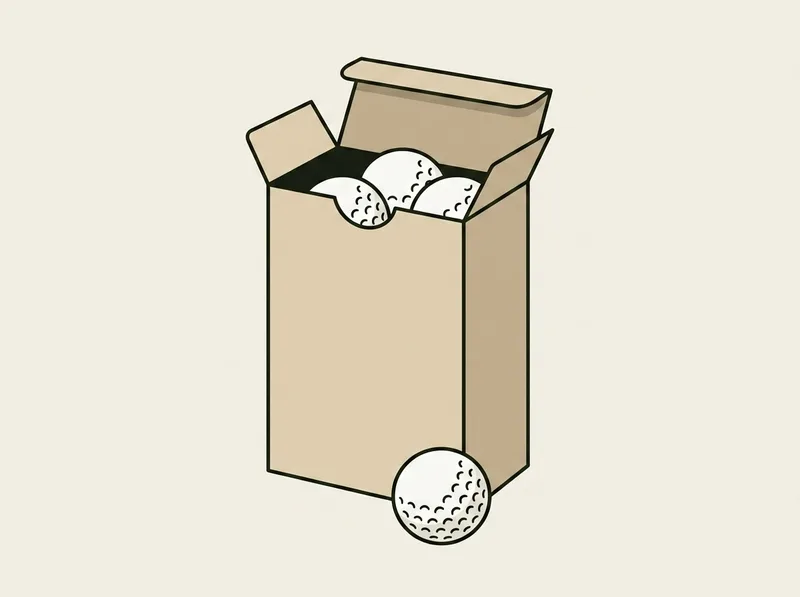 Around £15 a dozen at UK retail
Srixon Distance
- Construction
- 2-piece
- Cover
- Ionomer, 1.45 mm
- Dimples
- 324 speed dimple pattern
- Compression
- 89, Srixon's published figure
- Colours
- White and yellow
- Core
- FastLayer, soft centre firming outward
- The cheapest ball Srixon make, from a company that also builds balls for tour players.
- Srixon publish construction, cover thickness, dimple count and a compression figure, which is a fuller sheet than anything else at this money.
- The FastLayer core firms gradually outward rather than stepping, which buys speed without the harshest feel.
- At 89 it is firm, and firm at this price means loud off a putter as well as fast off a driver.
- Greenside spin is modest, as it is for every ionomer ball on this page.
- Two colours only, and the yellow is not stocked everywhere.
VerdictThe straightforward answer if you want a new ball from a serious manufacturer and do not want to think about it further. The Pinnacle undercuts it once you count the fifteen ball box, but the Srixon tells you exactly what is inside it and the Pinnacle does not. There is nothing clever about the ball itself, which at this money is exactly right.
What sets it apart at this price is that Srixon will tell you what is inside it. Construction, cover material, cover thickness, dimple count and a compression figure of 89 are all published on their European store, which is more than the Kirkland manages and roughly what the Vice manages. Buying the cheapest ball on a page does not usually mean buying the best documented one, and here it does.
Eighty nine is the number to sit with, because it runs against the instinct that a cheap ball is a soft one. This is a firm, fast ball built to hold up, and it will sound like one off a putter. The FastLayer core takes some of the edge off by firming gradually from the centre outward rather than stepping at a boundary, but nobody should buy this expecting the feel of the Kirkland.
Pinnacle Rush: fifteen in a box
The Rush is a two-piece ball with a high energy core, a soft ionomer cover and a 332 icosahedral dimple design, sold in fifteen ball packs rather than dozens. That packaging is the actual discount and it is easy to miss on a shelf.
Fifteen balls at the price of a twelve ball box is a twenty percent saving that nobody calculates. If you are shopping at this end of the market because you lose balls rather than because you are careful with money, the extra three are worth more than any specification difference between the four balls here.
 Around £11 to £15 a dozen, sold in fifteen ball packs
Pinnacle Rush
- Construction
- 2-piece
- Cover
- Soft ionomer
- Dimples
- 332 icosahedral
- Compression
- Not published
- Colours
- White and yellow
- Sold
- Fifteen ball packs rather than dozens
- Fifteen balls per box rather than twelve, which is the real discount and it is easy to miss.
- A 332 icosahedral dimple design is published, which is more than two of the others here manage.
- Yellow as well as white, which is the only visibility option in this group besides the Vice.
- Firm feel that a lot of players describe as harsh off the putter.
- Sold in fifteen packs, so comparing the price against a dozen takes arithmetic nobody does in a shop.
- Almost no greenside spin, even by the standards of this page.
VerdictThe straightforward answer if you want a lot of balls for very little money and do not care what they feel like. It is a distance ball at a budget price rather than a budget ball that happens to go far.
The cost is feel. This is a firm ball and a loud one, and a lot of players find it harsh on and around the greens. If you have never noticed what a ball feels like off a putter, that will not bother you. If you have, it will.
Recycled, refinished and X-out are three different things
They get sold under one heading, at similar prices, and they are not remotely the same product. This is the single most useful thing on this page.
| Term | What it actually is | Worth buying |
|---|---|---|
| Recycled or lake | Retrieved, washed, sorted and graded. Original cover intact | Yes, if graded and single model |
| Refinished or refurbished | Cover stripped, repainted, reprinted with a logo | No |
| X-out | A new ball rejected at the factory for a cosmetic fault | For practice only |
| Practice grade | Usually the worst grade of recycled, or an X-out | Range use only |
Recycled balls are a genuinely good answer at this end of the market. A ball that spent a fortnight in a pond and graded as top condition plays close enough to new that nobody at club level would identify it blind. Water does eventually work through a cover, but the timescale is far longer than most people assume, and grading sorts the ones where it has.
Refinished balls are the ones to avoid. The cover is stripped, repainted and reprinted, which changes the surface the ball flies on and the depth of its dimples. Whatever the model on the box, the ball you are holding no longer matches the specification that model was tested against. Buying one and expecting the original ball's behaviour is guesswork.
Grading, and what the letters mean
There is no industry standard for grading recycled balls, which means the letters mean whatever the seller says they mean. What is broadly consistent is the direction of travel.
| Common grade | Usually means |
|---|---|
| Mint, Pearl or AAAAA | No visible marks, no player pen marks, close to new |
| Near mint or AAAA | Very light scuffing, possibly a small logo or pen mark |
| Good or AAA | Visible scuffing and discolouration, still round and playable |
| Practice or below | Cuts, deep scuffs, heavy discolouration |
Buy mint or near mint of a single model and you have a genuinely good ball for half of new. Buy anything below good and you are buying range balls with a brand name on them. The one grade worth avoiding entirely is anything the seller declines to name.
What you actually give up
Three things, and only one of them is likely to cost you a stroke this season.
Greenside spin is the first and the biggest. A firm ionomer cover generates far less friction against a wedge groove than urethane, so pitches and chips land and run rather than checking. That matters if you can already control where a pitch lands, and not at all if you cannot. Shot Scope's approach proximity data puts the average amateur approach from 60 to 100 yards at 40 feet from the hole out of the fairway and 46 feet out of the rough, which is a long way from where spin decides the outcome.
Feel is the second. Cheap balls are usually firm, because a firm core is cheaper to manufacture consistently and produces the ball speed that budget balls are sold on. If you judge the pace of long putts by sound, a firm ball changes the information you are working from.
Consistency between balls is the third and the most overlooked. A tour ball is built to tolerances measured in fractions of a gram. A cheap ball is built to looser ones, so two balls out of the same box can behave slightly differently. That difference is smaller than the difference between two of your own swings, which is why it does not matter to most golfers.
The one thing a cheap ball must still be
Legal. Any ball played in a competition has to appear on the list of conforming golf balls that the R&A and the USGA maintain jointly, and it is republished regularly. Every branded ball named on this page is on it.
A share of the unbranded boxes sold very cheaply online is not, and some of those are sold specifically on the basis that they are longer than the rules allow. The R&A's Rules of Equipment set the weight, diameter, initial velocity and overall distance limits that a conforming ball has to sit inside. A ball that beats them is not a bargain, it is a ball you cannot post a score with.
When cheap stops being cheap
There is a point where buying down costs more than it saves, and it is worth knowing where yours is.
If you are losing several balls a round, the cheapest ball is almost always the right one, because the ball leaving the course is the dominant cost. If you are keeping the same ball for most of a round, the arithmetic flips: a slightly better ball played for eighteen holes costs very little per hole, and the greenside control starts to be worth something.
| Balls lost a round | Cost a round at £1 | At £2 | At £4 |
|---|---|---|---|
| 0.5 | £0.50 | £1 | £2 |
| 2 | £2 | £4 | £8 |
| 5 | £5 | £10 | £20 |
Read the top row and the bottom row together. A careful golfer saves about a pound fifty a round by buying the cheapest ball available, which is not worth giving up greenside spin for. A golfer losing five a round saves fifteen pounds, which is most of a green fee every couple of rounds. Your own number decides this, not a review.
Where the ball sits against the rest of a golf budget is worth keeping in proportion, and what golf actually costs sets out the full picture. If the reason you are here is that you are still finding the middle of the face, beginner ball picks is the better starting point, and high handicap picks covers the stage after that where durability starts to matter more than price.
If you have decided the trade is not worth it after all, the premium tier explained sets out what the extra thirty five pounds a dozen actually buys and the point at which it starts paying for itself.
Key takeaways
- The Kirkland Signature Performance+ is a three-piece urethane ball at roughly a third of tour ball money, which nothing else at this price matches.
- The Vice Drive publishes its full specification including a compression of 95, and its per-dozen price falls when you order three or four dozen.
- Recycled, refinished and X-out balls are three different products. Recycled is worth buying, refinished is not, and X-out is for the range.
- A refinished ball has been stripped and repainted, so it no longer matches the specification the model was tested against.
- Buy a single graded model rather than a mixed bucket, because a mixed bucket means playing a different ball on every shot.
- What you give up at this price is greenside spin, soft feel and ball to ball consistency, in that order of importance.
- Any ball used in competition has to appear on the R&A and USGA conforming list, and a share of the unbranded cheap boxes online does not.
- Cost per round is decided by how many balls you lose. Below about one a round, buying down saves too little to be worth the trade.
Common questions
Are cheap golf balls any good?
For most golfers, yes. A ball loses almost nothing over a round: the core does not soften and the aerodynamics do not change. What a cheap ball gives up is greenside spin and soft feel, and greenside spin needs a strike quality most club golfers have not built.
What is the best cheap golf ball?
The Kirkland Signature Performance+ is the strongest value on sale because it is a genuine three-piece urethane ball at about seventeen pounds fifty a dozen, roughly a third of tour ball money. Note that Costco sell it two boxes at a time, so the first purchase is forty eight balls and close to seventy pounds. If that or the membership does not work for you, the Vice Drive is the best documented alternative at similar money.
Are recycled golf balls worth buying?
Yes, if they are graded and you buy a single model. A ball retrieved from water and graded as mint plays close enough to new that nobody at club level would identify it blind. Avoid mixed buckets, and avoid anything sold without a stated grade.
What is the difference between recycled and refinished golf balls?
A recycled ball is retrieved, cleaned and graded with its original cover intact. A refinished ball has had that cover stripped, repainted and reprinted, which changes the surface and the dimple depth. The first is the ball it says it is, and the second is not.
Do cheap golf balls go shorter?
Not meaningfully off the driver. Every conforming ball is built against the same overall distance limit, and firm two-piece budget balls are often among the lower spinning ones, which helps rather than hurts. Where they lose is on approach shots and around the green.
Are X-out golf balls legal?
An X-out is a new ball rejected at the factory for a cosmetic fault, and because it was never certified as the finished model, it should be treated as unsuitable for competition. They are perfectly fine for practice, which is what most of them are sold for.
How much should I spend on golf balls?
It depends entirely on how many you lose. Below about one a round the saving from buying the cheapest available is under two pounds a round, which is not worth the trade. At five a round it is most of a green fee every couple of rounds, and the cheapest sensible ball is clearly right.
Do cheap golf balls scuff more?
Usually less, not more. Cheap balls almost always use ionomer or Surlyn covers, which are stiff and abrasion resistant. The exception on this page is the Kirkland, whose urethane cover is soft by design and scuffs faster than any of the others.
Are supermarket golf balls conforming?
Branded ones from real manufacturers generally are. Unbranded boxes sold very cheaply online often are not, and some are advertised on the basis of exceeding the distance limits. Check the model against the conforming list before playing one in a competition.
Is it worth buying golf balls in bulk?
If you lose several a round, yes. Direct sellers drop the per-dozen price at three and six dozen, which is a real saving for anyone getting through a box a month. The risk is committing to a lot of a ball you have not hit, so buy one dozen first.
What is the cheapest way to never run out of golf balls?
Graded recycled balls of one model, bought in a large lot. They cost roughly half of new, play close enough to new at club level that the difference does not show, and buying a single model means you are still learning your yardages against a consistent ball.
How we put this together
- Published manufacturer specifications, read on the maker's own product page where that page could be reached, and recorded as unpublished where the maker states nothing.
- Price per dozen as the primary sort, converted to a per-dozen figure where a ball is sold in fifteen or twenty four ball packs.
- Cover material against durability, since the cheapest way to lower cost per round is to play the same ball for more holes.
- The difference between recycled, refinished and X-out balls, which are three separate products routinely sold under the same heading.
- The R&A and USGA conforming ball list requirement, which rules out a category of unbranded boxes sold cheaply online.
On this page
- The four, compared
- Kirkland Signature Performance+: urethane at ionomer money
- Vice Drive: the most documented ball at the bottom of the market
- Srixon Distance: a tour manufacturer at the bottom of its own range
- Pinnacle Rush: fifteen in a box
- Recycled, refinished and X-out are three different things
- Grading, and what the letters mean
- What you actually give up
- The one thing a cheap ball must still be
- When cheap stops being cheap
- How we put this together

Tom Ashworth
Tom Ashworth is a PGA Professional who has taught golf since 2012, working mainly with beginners and mid-handicappers at club level in Surrey. He reviews the instruction guides on Learn Golf for technical accuracy before they publish.
Most of his teaching is with players in their first three years of the game, and most arrive having been told too much: six swing thoughts collected from videos, half of them contradicting each other. His approach is to check the grip and the alignment before touching the swing, on the basis that most bad ball flight is decided at address.