Stretching is the one piece of golf fitness advice everybody has heard and almost nobody has been given a timetable for. The result is a golfer holding a hamstring stretch on the first tee, which is the least useful version of a genuinely useful thing. This guide covers what stretching does, what the research says it does not do, and which movements belong before a round and which belong afterwards.
Nothing here is written for a golfer who is currently in pain. If a stretch reproduces a pain you already have, that is information for a clinician rather than a reason to push further into it.
What stretching actually does
Stretching increases how far a joint will move. That is the claim it can support, and it is worth caring about, because the swing asks for range at the hips, mid back and shoulders that most people's weeks do not otherwise demand.
What it does not reliably do is any of the other things it gets credited with. It does not warm you up on its own, because temperature comes from movement rather than from holding a position. And the injury case, which is the reason most golfers think they are doing it, is the shakiest part of the whole subject.
The injury-prevention evidence is thin, and worth knowing about
This is the part that usually gets left out, so it goes near the top.
The largest pooled analysis available is a systematic review and meta-analysis in the British Journal of Sports Medicine by Lauersen and colleagues, covering 25 randomised controlled trials, 26,610 participants and 3,464 injuries. Strength training reduced sports injuries to less than a third. Proprioceptive work produced a clear benefit. Stretching produced a relative risk of 0.963, with a confidence interval that crosses 1, which in plain terms means no detectable effect.
The consequence is not that you should stop stretching. It is that you should be honest about which job you are asking it to do, and not skip the strength work assuming stretching has that base covered. What that work looks like is in the golf fitness guide.
Dynamic before, static after
The timing question has better evidence behind it than the injury question, and it points clearly one way.
The Titleist Performance Institute's review of the science behind a golf warm up reports that static stretching reduces strength immediately by up to 28 percent, and still by around 9 percent an hour later, while dynamic movements increased power output by up to 14 percent across the studies reviewed. Hold a stretch in the car park and you can arrive at the first tee more flexible and measurably weaker.
| Dynamic movement | Static holds | |
|---|---|---|
| What it is | Taking a joint through its range repeatedly, never pausing at the end | Moving to the end of the range and holding, typically 30 seconds |
| When | Before you play or train | After you play, or in a separate session |
| What it is for | Raising tissue temperature, preparing the nervous system | Increasing range of motion over weeks |
| Dose | 8 to 12 repetitions per movement | 2 or 3 holds of 30 seconds per position |
| The cost of getting it wrong | None worth worrying about | Temporarily reduced strength if done immediately before playing |
The movements worth doing before you play
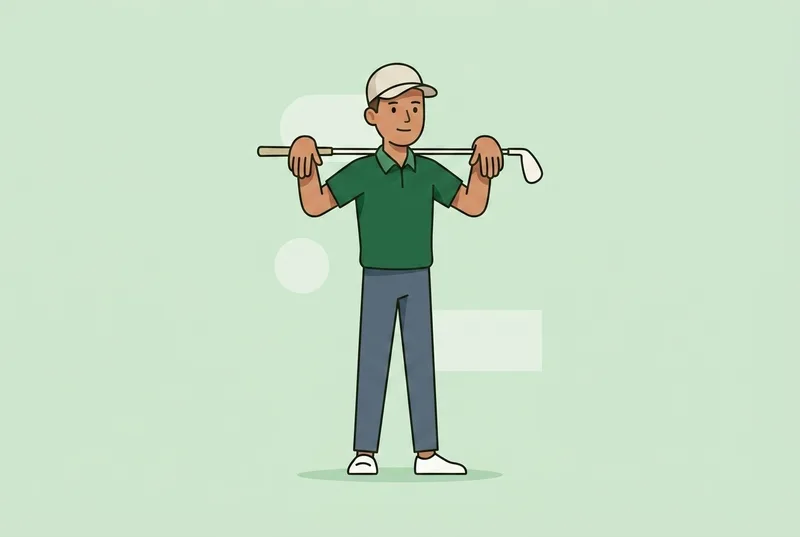
These are dynamic, which means you move into the range and straight back out again rather than settling into it. Eight to twelve repetitions each, no holds, and the whole set takes about three minutes.
Trunk rotations. Club across the shoulders, golf posture, turn left and right at a steady rhythm. The most golf-specific movement on the list, because it rehearses the exact motion you are about to make.
Leg swings, forwards and sideways. Hold something for balance and swing one leg like a pendulum, then across the body. It opens the hips in both directions the swing uses.
Arm circles and shoulder rolls. Large, slow, both directions. The shoulder is the joint most likely to be cold and least likely to get any attention.
Side bends. Reach one arm overhead and lean away from it, then come straight back up. Golf loads the body sideways as well as rotationally, and this is the only movement here that prepares for it.
Hip hinges. Push the hips back with a long back, then stand up. It rehearses the address position rather than stretching anything, which is why it belongs.
How these fit into a pre-round routine, and how many minutes to give them against putting and range balls, is covered in warming up before a round. This page is about the movements themselves.
The holds worth doing afterwards
Static stretching is not the villain. It is a tool with a time slot, and the slot is after you have played or in a session of its own.
Two or three holds of about 30 seconds per position, three or four days a week, is a reasonable dose. Range of motion generally starts to change within three or four weeks of consistent work, which is slower than most people expect and faster than most people persist for.
The positions worth the time map onto the joints the swing loads: the hip flexors at the front of the hip, the glutes behind it, the chest and front of the shoulder, and the lats. That last one matters more than golfers realise, because a short lat limits how far the arms travel and how much the trunk separates from the pelvis.
Where flexibility is not actually the problem
A large share of golfers who think they need to stretch need something else, and it is worth ruling out before committing to a routine.
The first alternative is strength. TPI's review of the research on strength training, flexibility and durability covers a 2015 study comparing five weeks of static stretching against five weeks of resistance training, which found no statistical difference between them on flexibility tests. Lifting through a full range produces range as well as force.
The second is control rather than range. Plenty of golfers have the movement available lying on the floor and cannot access it standing over a ball at speed, which stretching does not touch. If you can turn freely in a warm up and not in a swing, more stretching is not the answer.
The third is setup. A rounded upper back at address has already spent most of the available shoulder turn before the club moves, and no amount of stretching compensates for a position you are choosing. That case is made in golf posture, and the turn itself in the golf backswing.
That last case has its own page, because a back that aches after every round is a different conversation from a back that feels stiff on a Monday morning. It is covered in golf back pain, which starts with when to get looked at rather than with exercises.
Fitting it into a week
The routine that works is the one that is short enough to survive a bad week.
| When | What | How long |
|---|---|---|
| Before every round or range session | Dynamic movements, no holds | 3 minutes |
| After a round | Two or three static holds on the hips and chest | 4 minutes |
| Two or three evenings a week | Full static session covering hips, chest, lats and mid back | 10 minutes |
| Daily if you sit for work | Hip flexors and mid back, whichever is worse | 3 minutes |
The ten minute session slots naturally onto the end of a mat session, and ideas for that are in practising golf at home. If your practice happens at a range, the same work goes at the end rather than the beginning, which is what a driving range routine assumes.
How much range do you need
Enough is a lower bar than golfers assume, and chasing more past that point stops paying. Extreme flexibility is not a golf advantage, and there are plenty of very stiff professionals playing well by building a swing that respects what their body does. What limited hip range in particular costs you is covered in hip rotation in the golf swing.
If you want the round itself to do some of the work, walking rather than riding is the single biggest lever available, and the evidence for that is in is golf good exercise.
Key takeaways
- Stretching increases range of motion. That is the claim it can support.
- Pooled trial evidence found no detectable injury-prevention effect from stretching, while strength training cut injuries to less than a third.
- Dynamic movement before you play, static holds afterwards or in a separate session.
- Static stretching reduced strength by up to 28 percent immediately in the research TPI reviews, and by around 9 percent an hour later.
- Dynamic movement increased power output by up to 14 percent in the same body of work.
- Three minutes of movement covers the pre-round case: trunk rotations, leg swings, arm circles, side bends, hip hinges.
- Static dose is two or three holds of 30 seconds, three or four days a week, expecting change in three to four weeks.
- Resistance training through a full range produced flexibility gains comparable to stretching in one study TPI reviews.
- Tightness is a sensation rather than a measurement, and it sometimes reports instability rather than shortness.
Common questions
Should I stretch before playing golf?
Not by holding stretches. Move instead: take the hips, mid back and shoulders through their range repeatedly without pausing at the end. Research reviewed by TPI found static stretching reduced strength by up to 28 percent immediately, while dynamic movement raised power output by up to 14 percent.
Do golf stretches prevent injury?
The evidence is weak. The largest pooled analysis of randomised trials found no detectable injury-prevention effect from stretching, while strength training reduced injuries to less than a third. Stretch for range of motion, and do strength work if injury resilience is what you are after.
How long should I hold a golf stretch?
About 30 seconds, two or three times per position, three or four days a week. Shorter holds do less, and much longer holds do not add much. Do them after a round or in a separate session rather than immediately before you play.
What are the best stretches for golf?
The ones covering the three areas the swing loads: the front and back of the hips, the chest and front of the shoulder, the lats, and rotation through the mid back. Beyond those four, extra positions add variety rather than benefit.
Why does my back feel tight after golf?
Commonly because it has been supplying rotation the hips and mid back did not, which leaves it working harder than it was built to. Stretching it further does not address the reason. If the tightness is an ache that arrives after every round, that is worth getting looked at properly.
Is dynamic stretching better than static stretching?
Neither is better in general. They do different jobs at different times. Dynamic movement prepares the body to perform and belongs before play. Static holds build range over weeks and belong after play or in their own session.
How often should I stretch for golf?
Three or four sessions a week of about ten minutes for the static work, plus three minutes of dynamic movement before every round. Consistency matters more than length, and a daily three minutes on your worst joint beats a weekly half hour.
Can stretching help me swing further?
Only if range of motion is what limits you, which is not always the case. A golfer restricted by a genuinely stiff mid back may find more available. A golfer who already has the range and cannot use it at speed needs coordination and strength work instead.
Do I need to stretch if I go to the gym?
Less than you might think. Resistance training through a full range produces flexibility gains comparable to stretching in the research TPI reviews, so a well-built lifting programme already does part of this job. Add targeted holds for whichever position your training does not reach.
Should older golfers stretch more?
Range of motion tends to become the binding constraint sooner, so the daily mobility habit matters more with age. That is an argument for consistency rather than intensity. Anyone with existing joint problems should have the routine checked by a physiotherapist rather than assembled from a list.

Tom Ashworth
Tom Ashworth is a PGA Professional who has taught golf since 2012, working mainly with beginners and mid-handicappers at club level in Surrey. He reviews the instruction guides on Learn Golf for technical accuracy before they publish.
Most of his teaching is with players in their first three years of the game, and most arrive having been told too much: six swing thoughts collected from videos, half of them contradicting each other. His approach is to check the grip and the alignment before touching the swing, on the basis that most bad ball flight is decided at address.