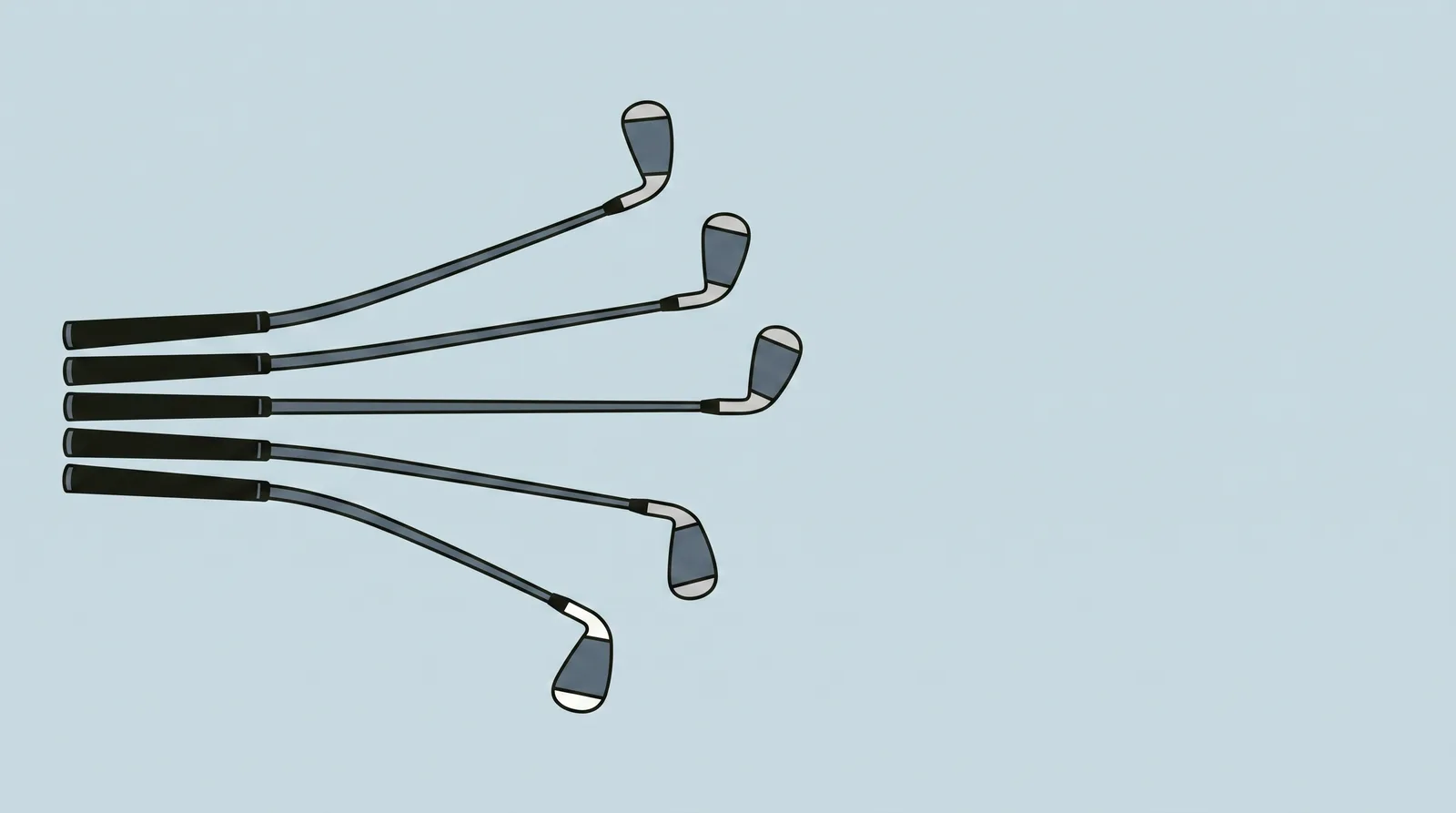
There is an enormous amount written about women's golf and almost none of it is about golf. It is about colour, and about shorter courses, and about being made welcome. The parts that actually differ are narrower and more technical: how equipment is specified and sold, how tees should be chosen, and how the culture of a club works in practice. This page covers those.
The equipment problem, stated properly
A set sold as women's clubs is not a fitted set. It is a set built to one pre-decided specification: shorter than men's standard, softer flex, lighter shaft weight, thinner grips, and usually more loft. Those choices are reasonable defaults for a golfer with less speed and smaller hands. They are still defaults, applied to every buyer regardless of what she measures.
The problem shows up in two directions and both are common. A woman who swings faster than the assumed baseline ends up in a shaft too soft to control, which produces high, left-drifting shots and a face she cannot square consistently. A woman who is tall ends up with clubs an inch or more short, which forces her to stoop, which changes the low point of the swing.
Neither of those is a swing fault. Both get treated as one.
Flex is the single most misunderstood specification, because the letters look like sizes and are not. There is no published industry standard behind them, so one manufacturer's ladies flex can measure stiffer than another's senior. Our golf shaft flex guide has the bands and how to translate a carry distance into a starting point.
| Specification | Decided by | Not decided by |
|---|---|---|
| Shaft flex | Measured driver clubhead speed and tempo | Gender, or the letter on the box |
| Shaft weight | Speed and how much mass you can accelerate | The colour of the shaft band |
| Club length | Height and wrist-to-floor measurement | Gender defaults |
| Grip size | Hand and finger length | Whether the set is marketed to men or women |
| Loft | Speed, because launch angle has to come from somewhere | Marketing tier |
| Ball compression | Speed, again | Price or the word "soft" on the box |
Grip size is the one that genuinely does trend differently, and it is easy to check. Standard men's grips measure about 0.900 inches across and standard women's about 0.850, and the whole usable range from undersize to the largest oversize is under a tenth of an inch. Our golf grip sizes guide has the measured table and the thirty-second check for whether yours fits.
Ball choice, which follows speed and nothing else
Golf balls marketed to women are, with very few exceptions, ordinary low compression balls with different packaging. That is not a scandal, because low compression is genuinely the right answer for most amateur swing speeds. It is worth knowing so you can buy the same construction without the premium.
Compression describes how much the ball deforms at impact, and a ball that does not deform at your speed is leaving distance behind. TrackMan's explanation of ball speed sets out why ball speed rather than club speed is the biggest single factor in carry distance, and getting the ball to compress properly is how a slower swing produces more of it. Our guide to golf ball compression has the numbers and what they mean in practice.
Tees: choose by distance, never by which set is marked forward
Tee sets on a US course are usually labelled by colour and often described by gender, which is the least useful way to decide.
The right question is which club you are left with into a par 4. Shot Scope's data, referenced in its analysis of amateurs on the professional tees, has a 15 handicap hitting the green just 2% of the time from over 200 yards and missing short 92% of the time. From 80 yards, that same golfer hits the green 58% of the time. No swing change closes a gap of that size. Tee selection does, in one decision.
That cuts both ways, and this is where the "shorter courses for women" framing does actual harm. A woman who carries her driver 220 yards is badly served by the most forward tees, because she will be hitting wedge into par 4s and driver-wedge into par 5s, which is boring and makes her worse. Play the set that leaves you mid irons.
Read that against the usual advice and something useful falls out. Accuracy off the tee is not what separates a good player from a beginner in that data. Distance and approach play are, and putting is worth nine strokes a round on its own. If you have limited practice time, that is where it goes.
Dress codes, which are worth checking and rarely explained
Dress codes at private clubs are frequently stricter for women than the club realises, mostly because they were written decades ago and amended by exception. Public and municipal courses are usually relaxed to the point of not caring.
The reliably safe combination in the US is a collared or sleeved golf top, tailored shorts, a skort or golf trousers, and golf shoes or clean trainers. The items that catch people out are round-neck shirts, denim of any kind, leggings worn as trousers, and shorts above a specified length, which some clubs still measure. Our guide to what to wear golfing has the full breakdown by course type.
The practical advice is dull and works: check the club's website before you go, and if it says nothing, ring the pro shop. Nobody has ever been thought less of for asking.
Pace of play, and the part nobody says out loud
Two things are true at once and they are usually conflated.
The first is that pace of play is a genuine, universal expectation and not a gendered one. The R&A's pace of play guidance recommends playing a stroke within about 40 seconds of it being your turn. Being ready when it is your turn covers almost the whole of it: pick your club while walking, mark the card at the next tee, leave the bag on the side of the green nearest the next tee. All of it is in our golf etiquette guide, and none of it is specific to who you are.
The second is that women often report being watched more closely for it, which is a different problem and not one you can solve by playing faster. It is worth naming because it changes the practical advice: the pressure is frequently perceived rather than actual, and a group who genuinely wants to come through can be waved through in fifteen seconds.
What genuinely does not differ
Everything else. The swing is the same swing, the rules are the same rules, and the order in which a new golfer should learn things is identical. If you are starting from zero, our complete beginner guide is the sequence to follow, and nothing on it changes.
The one place to be sceptical is instruction written specifically for women that promises a different technique. There is no separate women's golf swing. There are golfers with different amounts of speed, different heights and different ranges of motion, and coaching adapts to those for everyone.
Key takeaways
- A set sold as women's clubs is a pre-decided specification, not a fitting.
- Swing speed decides flex, height decides length, hand size decides grip. Gender decides none of them.
- Flex letters are manufacturer designations with no industry standard behind them.
- Balls marketed to women are ordinary low compression balls. The construction is right, the premium is not.
- Choose tees by the club you have left into a par 4, whichever set that turns out to be.
- Shot Scope has 85 yards of driving distance between scratch and 30 handicap female golfers, and almost no difference in fairways hit.
- Putting is worth roughly nine strokes a round across that same range, which is where limited practice time should go.
- Check dress codes before you arrive. Private clubs are stricter and less consistent than public courses.
Common questions
Do women need different golf clubs?
They need fitted clubs, which is not the same thing. Shorter, softer and lighter are sensible defaults for a golfer with less speed, but they are defaults applied to everyone rather than measurements taken from you. Get flex from swing speed and length from height.
What flex shaft should a woman use?
Whatever her measured driver clubhead speed indicates, exactly as for any golfer. There is no industry standard behind flex letters, so a ladies flex from one brand can measure stiffer than a senior from another. A shaft too soft for your speed produces a left miss that no lesson fixes.
Are women's golf balls actually different?
Almost never in construction. They are low compression balls with different packaging, and low compression is genuinely correct for most amateur swing speeds. Buy on compression rather than on marketing, and you will usually find the same ball for less.
Which tees should a woman play from?
The set that leaves you a mid iron into most par 4s. A 15 handicap hits 2% of greens from over 200 yards and 58% from 80, so the tee decision is worth more than any swing change. If you carry the ball a long way, the most forward tees will make the course dull rather than easier.
What is the dress code for women at a golf course?
A collared or sleeved golf top with tailored shorts, a skort or golf trousers covers almost every US course. Private clubs are stricter and less consistent, and the usual sticking points are round necks, denim, leggings and short length. Check the website or ring the pro shop.
Can I wear leggings to play golf?
At a public or municipal course, usually yes. At a private club, often no, because many dress codes still treat leggings as not tailored. It is the single most common thing women get turned away for, and one phone call settles it.
Is golf harder for women than for men?
The game is identical and the scoring systems account for course difficulty. The practical differences are equipment that is more often mis-specified, and clubs whose culture and tee time allocation can be less accommodating. Neither is about ability.
How do I get faster at golf without rushing?
Do everything except the stroke itself early. Choose your club while walking to the ball, take your practice swing before it is your turn, and write the card at the next tee. The R&A suggests about 40 seconds for the stroke once you are ready, and being ready is where all the time is.
What should a woman practise to lower her score fastest?
Putting, then approach play. Shot Scope's women's data puts scratch players at 28 putts a round against 37 for a 30 handicap, and 11 greens in regulation against 1. Fairways hit barely separates them at all, which makes driving accuracy the least productive place to spend practice time.
Is there a different golf swing for women?
No. There are golfers with different speeds, heights and ranges of motion, and good coaching adapts to those for everybody. Be sceptical of instruction that markets a separate technique on the basis of gender rather than on anything measured.
How do I find a club that is actually welcoming?
Play it as a visitor first, on a weekday, and pay attention to whether the pro shop talks to you or past you. Ask about women's tee time allocation directly, because the answer is a fast and reliable signal. Clubs vary far more than they look from outside.
Tom Ashworth
Tom Ashworth is a PGA Professional who has taught golf since 2012, working mainly with beginners and mid-handicappers at club level in Surrey. He reviews the instruction guides on Learn Golf for technical accuracy before they publish.
Most of his teaching is with players in their first three years of the game, and most arrive having been told too much: six swing thoughts collected from videos, half of them contradicting each other. His approach is to check the grip and the alignment before touching the swing, on the basis that most bad ball flight is decided at address.