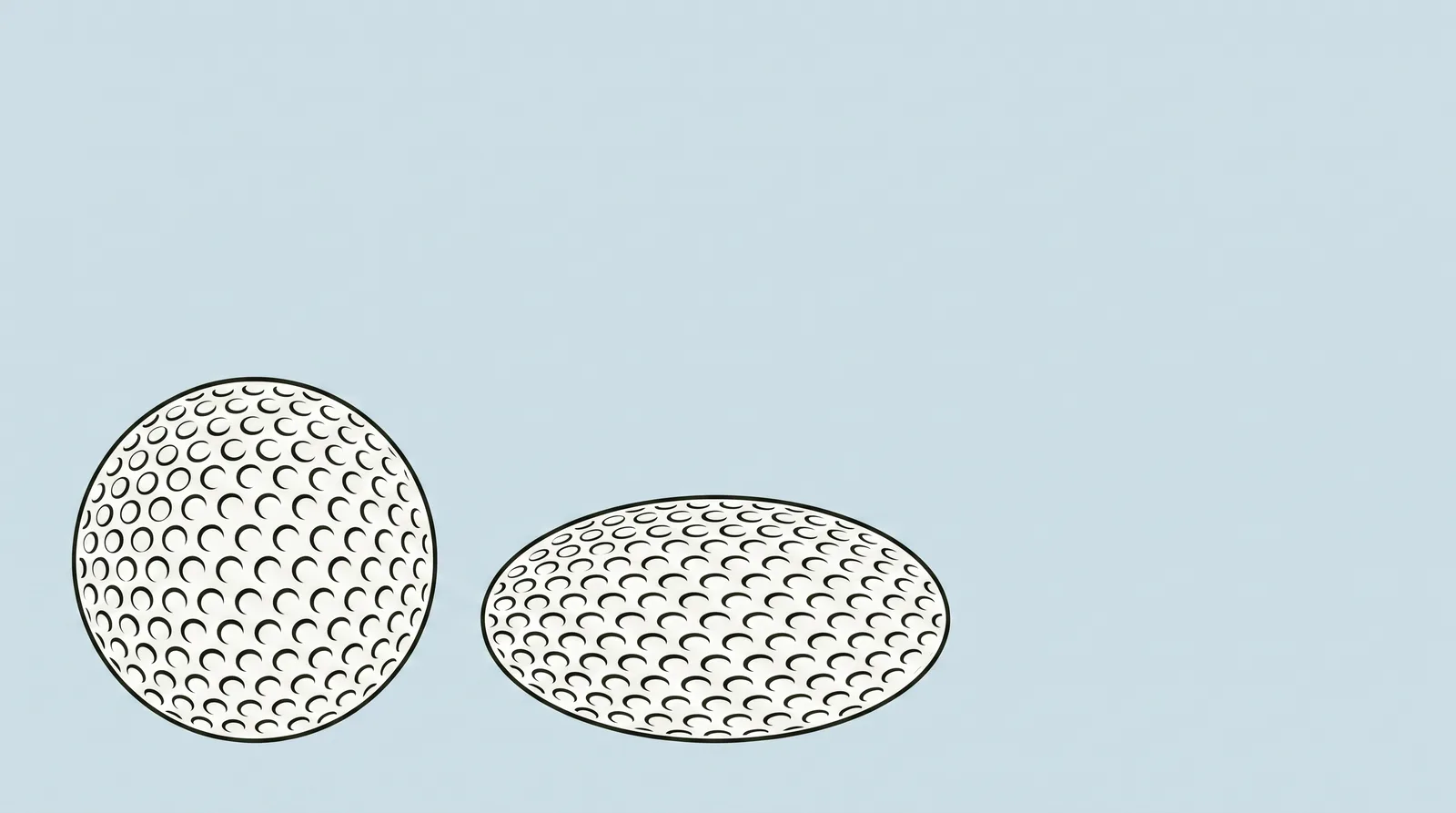
Search for a compression chart and you will find dozens, all confident, many disagreeing with each other by ten points on the same ball. There is a reason for that. Compression is measured on at least three different scales, and the makers of the most played balls in golf no longer publish a figure on any of them.
What compression actually measures
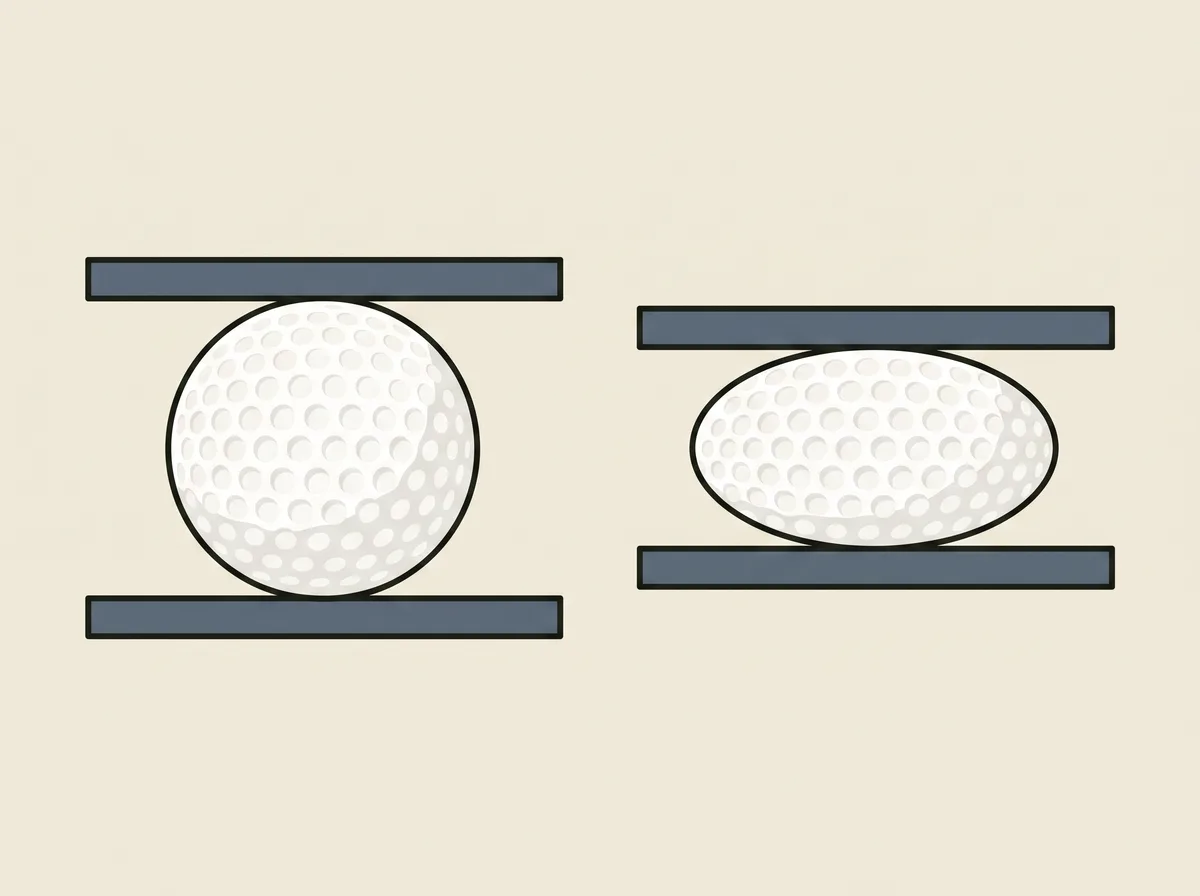
Squeeze a golf ball between two plates and it flattens. Compression is a number describing how much it flattens for a given force, and nothing more than that.
It matters because the same thing happens at impact, far faster and far harder. A driver strike deforms a ball substantially against the face, then the ball springs back and leaves. How readily it gives, and how quickly it recovers, is part of what decides the speed and spin it comes off with.
Ball maker Snell Golf put the working range of the industry scales at roughly 30 to 120, with lower numbers softer. They also make the point that most charts skip: a compression number is relative to the test method rather than a universal physical constant, so a 90 from one lab is not necessarily a 90 from another.
There is no single scale
That is not a criticism of any measurement. It is documented inside the industry's own paperwork. A Callaway golf ball patent describes three separate approaches in the course of specifying the invention.
| Method | What it does | What the number means |
|---|---|---|
| PGA compression | Applies a standard force to the ball's surface | A ball with no deflection rates 200, one that deflects 0.2 inches rates 0 |
| Atti compression | Compresses the ball against a spring-loaded anvil over a fixed travel | An arbitrary value from 0 to 100, with 200 readable as two turns of the dial |
| Riehle compression | Measures deformation directly | Deformation in thousandths of an inch under a load emulating a 200 pound spring constant |
Three scales, three different units, all of them called compression. Some are broadly convertible and none of them is a standard the whole industry reports against. Two honest laboratories can hand you two different numbers for the same ball and neither of them is lying.
Who publishes a figure, and who does not
This is the part that changes how you should read every compression chart on the internet.
| Maker | Flagship ball | Compression published on the maker's own pages |
|---|---|---|
| Titleist | Pro V1 | No |
| Callaway | Chrome Tour | No |
| Srixon | Z-STAR | No |
| TaylorMade | TP5 | Yes, 85, with TP5x at 97 |
| Vice | Vice Pro | Yes, 90, with Vice Tour at 85 |
Three of the biggest names in the category give you nothing. Titleist's own site refuses automated requests, so their absence could not be re-checked directly for this page, but no compression figure appears in the Pro V1 specification anywhere it can be read, which matches what our ball roundup found when it went looking.
So when a chart lists the Pro V1 at a number, that number came from somebody's test rig. It may well be carefully measured. It is not a manufacturer specification, and presenting it as one is how a laboratory result quietly becomes a fact in the reader's mind.
What compression changes, and what it does not
Compression is real. The claims stacked on top of it mostly are not.
| Compression genuinely affects | Compression does not decide |
|---|---|
| How the ball feels at impact, most obviously off a putter | How far you hit it at club golfer speeds |
| The sound the ball makes, which golfers read as feel | How much the ball checks around the green |
| How much the ball deforms on a slower strike | Whether a ball suits your swing speed |
| Ball speed at the margins, alongside core and mantle design | How durable the ball is |
Greenside spin is the one worth separating out, because it is what people are usually shopping for. Spin on a short shot comes from friction between the cover and the groove, which is a property of the cover material rather than of how firm the core is. A soft feeling ball with an ionomer cover will check less than a firm one with a urethane cover, every time.
Feel is the honest case for caring. Snell are explicit that feel is not solely compression, since cover chemistry, mantle design and dimple geometry all contribute, but a lower compression ball does deform more at putter speeds and does feel softer off the face. If you want a particular feel on the greens, this is a legitimate reason to prefer one ball over another, and putting fundamentals will tell you far more about whether it suits you than any chart.

The swing speed rule, and why it is contested
The most repeated advice in golf balls is that swing speed selects compression: slow swings need soft balls, fast swings need firm ones. It is genuinely argued, and it is worth seeing both sides rather than being handed a verdict.
Snell publish bands on their own site, recommending 30 to 60 compression below 85 mph of driver speed, 60 to 90 between 85 and 105, and 90 or above beyond that. They are a ball manufacturer with a designer's background, and that is a considered position rather than a marketing line.
The argument against runs in two parts. First, even a slow clubhead deforms a ball substantially, so the idea that a 90 compression ball is somehow out of reach at 85 mph does not survive contact with the physics. Second, and more awkwardly, the recommendation cannot be followed for most premium balls, because the makers of the balls people actually want to compare do not publish a figure to compare.
Where speed does matter is in what your ball needs to do rather than how firm it is. TrackMan's published benchmarks put the average male amateur, around a 14.5 handicap, at 3,275 rpm of driver spin against 2,545 rpm on the PGA Tour. The average club golfer already spins the driver too much, which points toward a lower spinning ball off the tee regardless of how it feels. If you have never had your speed measured, estimating it from carry distance is a reasonable starting point.
What the rules regulate, and what they leave alone
Golf balls are among the most tightly regulated objects in sport, and compression is not on the list.
The Rules of Equipment require a ball to weigh no more than 1.620 ounces, or 45.93 grams, and to measure no less than 1.680 inches, or 42.67 millimetres, in diameter. It must not exceed the Initial Velocity Standard, must not exceed the Overall Distance Standard for combined carry and roll, and must not be designed to behave differently depending on which way up it sits.
That is four constraints on weight, size, speed and distance, plus symmetry. Nothing about how firm the ball is. A maker can build a ball at 40 compression or 100 and both conform, which is precisely why the specification drifted out of the published sheet without anybody breaking a rule.
The distance ceiling is worth understanding as context. Every ball on sale is built against the same limit, which is why no ball can be meaningfully longer than another, and why the differences that remain are about spin, feel and flight rather than yards.
Choosing a ball without a compression number
Three things are published, checkable and matter more.
Cover material is the first and by a distance the most consequential. Urethane is soft and grips a groove, which is where greenside spin comes from. Ionomer and Surlyn covers are stiff, tougher and spin less. That single difference separates a fifty pound box from a twenty pound one more completely than anything else on the specification sheet.
Layer count is the second. A two-piece ball is a core and a cover and spins low everywhere. A three-piece adds a casing layer so the ball can spin little off a driver and a lot off a wedge, which is the whole reason tour balls exist.
Published spin behaviour is the third. Most makers rate their own balls for long game spin, short game spin and feel, and those ratings describe outcomes rather than laboratory conditions. They are more useful for choosing than a number measured under a press.
Then play one ball for a season. Every yardage you know and every chip you have judged the release on was learned against a specific ball, and wedge distance control depends entirely on that consistency. If you are still losing several a round, beginner ball picks is the sensible place to shop, and none of the premium models belong there yet.
Where the ball sits against everything else you might spend on is worth keeping in proportion. A premium ball returns most where the strike is already repeatable, which is why the sensible order of spending runs lessons, then a proper fitting, then the ball. And if your driver is the club costing you shots, how you set up to it will move more than any box on the shelf.
Key takeaways
- Compression measures how much a ball deforms under a fixed load. Lower deforms more and feels softer, higher resists and feels firmer.
- There is no single scale. Callaway's own patent filings describe PGA compression, Atti compression and Riehle compression, which report different units and different numbers for the same ball.
- Titleist, Callaway and Srixon publish no compression figure for their flagship balls. TaylorMade publish 85 for the TP5 and 97 for the TP5x, and Vice publish 90 for the Vice Pro.
- Any chart listing compression for a Pro V1 or a Chrome Tour is reporting an independent measurement, not a manufacturer specification.
- Compression changes feel and sound, and marginally ball speed. It does not decide greenside spin, which comes from cover friction, or distance at club golfer speeds.
- Whether swing speed should select compression is genuinely disputed. One maker publishes speed bands, others decline to publish the number at all.
- The equipment rules regulate weight, diameter, initial velocity, total distance and symmetry. Compression is not regulated in any way.
- Cover material, layer count and the maker's own published spin ratings are checkable at source and matter more than compression does.
Common questions
What is golf ball compression?
A measurement of how much a ball deforms under a fixed load, expressed as a number on a scale that runs roughly 30 to 120 in the industry's usual usage. Lower numbers describe a ball that gives more and feels softer. Higher numbers describe one that resists and feels firmer.
What compression golf ball should I use?
Not the one a swing speed chart selects for you, particularly if the ball you are considering has no published figure. Choose on cover material first, urethane if you want greenside spin and ionomer if you want durability and low spin, then on how the ball feels off your putter. Both of those you can verify.
Is a lower compression golf ball better for slow swing speeds?
It is genuinely argued. One ball maker publishes bands recommending 30 to 60 compression below 85 mph, while the makers of the most played premium balls publish no figure at all, which makes the recommendation impossible to follow for those models. A softer ball will feel softer at any speed, and that is the effect you can rely on.
Do low compression golf balls go further?
Not reliably. Distance at club golfer speeds is decided far more by launch angle and spin rate than by how much the ball deforms, and every conforming ball is built against the same Overall Distance Standard. A softer ball often feels longer, which is a different thing from being longer.
Why do manufacturers not publish compression any more?
They have never been required to, and the number invites a comparison that flatters nobody. Compression describes one property of a ball built from four or five interacting layers, and a single figure can mislead about how the whole object behaves. Some makers now publish spin and feel ratings instead, which describe outcomes rather than laboratory conditions.
Are golf ball compression charts accurate?
They are accurate about whatever rig produced them and misleading about where the numbers came from. Since most premium balls carry no manufacturer figure, the chart is comparing independent measurements taken on different equipment. Two honest labs can differ by several points on the same ball.
Does compression affect spin?
Barely, around the green. Greenside spin comes from friction between the cover and the club's grooves, which is decided by cover material rather than core firmness. Compression has more influence on full shot spin, and even there the layer structure of the ball does more.
What compression is a Pro V1?
Titleist do not publish one, and never have across their range. Every figure you will find quoted for it came from an independent test rig rather than from Titleist. If you want to choose a ball on a stated compression, the Pro V1 cannot be that ball.
Does a softer golf ball feel softer on putts?
Yes, and this is the effect most golfers can actually detect. At putter speeds the ball barely deforms at all, so what you are feeling is largely the cover and the outer layers against the face. If you are choosing between two balls on feel, roll fifty putts with each rather than reading a number.
Is high compression better for fast swings?
The conventional advice says so and the physics is less clear cut than the advice. A firmer ball tends to spin slightly less off a driver, which suits a golfer who already generates plenty of speed and spin. It is a preference worth testing on a launch monitor rather than a rule worth following blind.
Do the rules of golf limit compression?
No. The equipment rules cap a ball's weight at 45.93 grams, set a minimum diameter of 42.67 millimetres, and impose an initial velocity limit and an overall distance limit, plus a requirement that the ball behaves symmetrically. Firmness is not regulated at all, which is part of why the figure disappeared from spec sheets without anyone breaking a rule.

Tom Ashworth
Tom Ashworth is a PGA Professional who has taught golf since 2012, working mainly with beginners and mid-handicappers at club level in Surrey. He reviews the instruction guides on Learn Golf for technical accuracy before they publish.
Most of his teaching is with players in their first three years of the game, and most arrive having been told too much: six swing thoughts collected from videos, half of them contradicting each other. His approach is to check the grip and the alignment before touching the swing, on the basis that most bad ball flight is decided at address.