Breaking 100 is the first real milestone in golf and the one most often explained badly. The usual advice is to swing smoother and keep your head down, which describes nothing you can measure. Tracked amateur rounds show the gap between a card in the 100s and a card in the 90s as four specific numbers, and none of them is a swing change.
The four numbers that separate the two scores
Shot Scope publishes a set of benchmarks it calls the Shot Scope 6, sorted by the score a golfer usually shoots rather than by handicap, which is convenient because most people know the first and not the second.
| Per 18 holes | Shoots in the 100s | Shoots in the 90s |
|---|---|---|
| Tee shots into trouble | 6.5 | 4.9 |
| Two or more shots to reach the green from inside 50 yards | 4.1 | 3.2 |
| Three putts | 3.2 | 2.3 |
| Missed putts from inside 5 feet | 4.6 | 3.6 |
Every figure comes from Shot Scope's published benchmarks by scoring milestone. Read the two columns side by side and the size of the task changes completely. Each row moves by about one. Not one a hole, one a round.
That is four shots, and four shots is usually the entire margin. The golfer signing for 102 does not need a different swing. They need the same swing to produce one less disaster in four separate places.
The arithmetic of 99
Par on most courses is 72. Bogey on every hole gives you 90. That means a card of 99 allows you nine bogeys, nine double bogeys, and nothing worse anywhere.
Put another way, you are allowed to write a 6 on nine par 4s and a 7 on nine of them and you still break 100. The number that ends the round is not the 6. It is the 8, and the 8 almost never arrives as one catastrophic shot. It arrives as a bad tee shot followed by an ambitious recovery.
Tee shots: the biggest single leak
Six and a half tee shots in trouble means roughly one hole in three starts with a reload, a chip out sideways, or a drop. Shot Scope defines trouble as a lost ball, a hazard, the trees, or anything that forces a positional shot rather than a real one.
The fix is not accuracy in the abstract, which nobody can summon on demand. It is removing the specific piece of trouble that is in range. Stand on the tee and find the thing that costs two shots rather than the thing you are aiming at, then pick the club that cannot reach it.
There is one more pattern worth knowing about yourself. Shot Scope's data on this level of golfer finds that a 25 handicap misses into the right-hand rough 30% of the time off the tee, which is the slice showing up in the numbers. If that is your miss, aiming to allow for it is free and works this weekend, while fixing it takes a winter. Left and right there assume a right-handed golfer, and they swap if you play left-handed.
Inside 50 yards, where the round quietly leaks
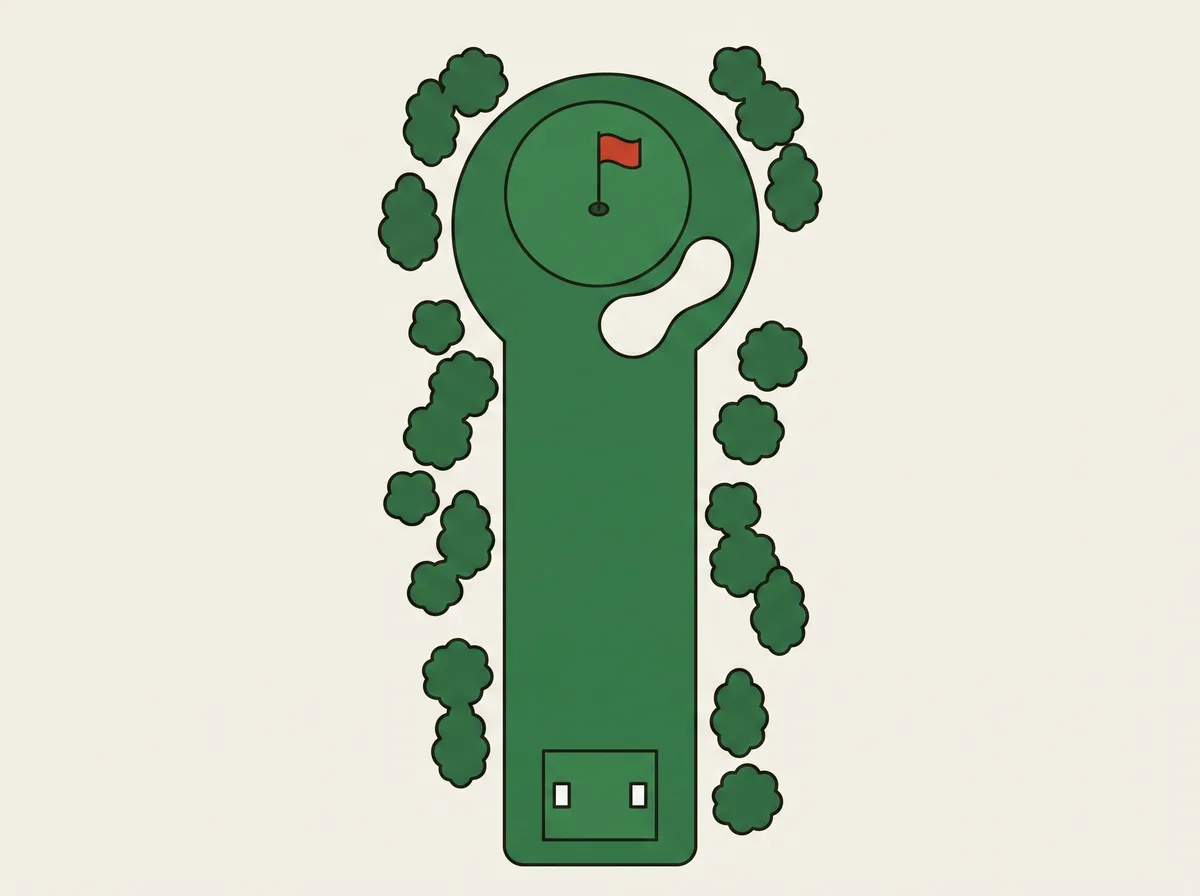
Four times a round, a golfer in the 100s needs two or more attempts to get the ball onto the green from inside 50 yards. That is four shots given away at the distance where the club is doing almost none of the work.
The cause is nearly always the same: the most lofted wedge in the bag, a long backswing, and a deceleration through the ball. A lob wedge is the least forgiving club anybody owns and it is the one most beginners reach for from 30 yards.
The alternative is unglamorous and it works. Take a less lofted club, land the ball on the front third of the green, and let it run. The full technique, including where to put the ball in your stance and how to keep the wrists quiet, sits in how to chip a golf ball.
Getting up and down is not realistic yet and chasing it is a trap. Shot Scope's benchmark has a 25 handicap converting an up and down 24% of the time and a 20 handicap 32%, so three attempts in four end in a dropped shot regardless. Aim at the green, take the bogey, and let the occasional par arrive by accident.
Three putts, and the five-footers underneath them
Three putts and short misses look like two problems and are mostly one. A three putt usually starts as a first putt left too far away, and a missed five-footer is often what a nervous player produces after a bad lag.
The numbers move together in the tracked data. Golfers in the 100s three-putt 3.2 times a round and miss 4.6 putts from inside five feet. In the 90s those become 2.3 and 3.6. One fewer of each.
Distance control is the lever, not the line. From long range, getting the ball inside six feet is worth far more than reading the break perfectly, because Shot Scope's benchmark for a 25 handicap has them holing 83% from inside six feet and only 35% from six to twelve. The gap between those two numbers is where three putts live.
What does not need to change yet
Distance is the thing golfers at this level worry about most and it is the least urgent item on the list. The published gap in driving distance between the two scoring bands is real but modest, and it is covered properly in average driver distance, which also has the breakdown by age.
Greens in regulation is the same story. Golfers in the 100s hit very few, golfers in the 90s hit very few, and neither group is close to a number that would let them play at the flag. The full picture of how far each level actually hits it, and how few greens anybody finds, sits in the golf club distance chart.
Where to spend the practice hour
Practice for this milestone looks nothing like the practice most golfers do, because three of the four leaks happen inside 50 yards.
| Minutes | What | Which number it moves |
|---|---|---|
| 15 | Long putts from 25 to 45 feet, scoring proximity | Three putts |
| 10 | Putts from three and five feet, in sets of ten | Missed short putts |
| 20 | Chips to a landing spot with a 9 iron and pitching wedge | Two shots from inside 50 yards |
| 15 | Full swing, one club, aimed at a target, half of them at 80% | Tee shots into trouble |
Sixty minutes, and the driver never comes out. That will feel wrong, which is exactly why the four numbers above stay where they are for most golfers.
The other half of the job happens on the course rather than the range, and it is a decision rather than a skill. Course management covers how to pick a target that survives your miss.
What comes after
Shot Scope frames the target side of this as a set of ceilings rather than improvements: no more than six troublesome tee shots, no more than four missed greens from inside 70 yards, no more than four three putts and no more than four missed putts from inside five feet, per their guidance on breaking 100. Ceilings are easier to play to than targets, because you know during the round whether you have used yours up.
Once the card is starting with a nine, the bottleneck moves. Greens in regulation and wedge distance control become the constraint, which is the ground covered in how to break 90. Scrambling and proximity come after that, in how to break 80. Both are different problems with different numbers, and neither is worth reading until this one is done.
Key takeaways
- Four numbers separate a round in the 100s from one in the 90s, and each moves by about one per round, not one per hole.
- Par 72 plus nine bogeys plus nine doubles is 99. The card is ruined by the 8, not the 6.
- Tee shots into trouble is the largest single leak at 6.5 a round. Pick the club that cannot reach the trouble.
- After a bad tee shot, the next shot's only job is to get the ball back to somewhere ordinary.
- Four times a round this golfer needs two goes at the green from inside 50 yards. A less lofted club and a landing spot fixes most of it.
- Up and down conversion is 24% at a 25 handicap, so aim at the green rather than the flag and take the bogey.
- Three putts and missed short putts are the same problem. Pace on the long one decides the length of the short one.
- Distance is not the constraint at this level, and the practice hour should not contain a driver.
Common questions
How do I break 100 in golf?
Remove roughly one shot each from four places: tee shots that finish in trouble, chips that need a second attempt, three putts, and missed putts from inside five feet. Tracked amateur data shows that is the entire difference between a round in the 100s and one in the 90s, and none of it requires a new swing.
What handicap is breaking 100?
Loosely a 25 to 28 handicap on a par 72, though the relationship is not exact because a handicap measures your better rounds rather than your typical one. Shot Scope's 25 handicap benchmark averages 4.19 on par 3s, 5.87 on par 4s and 6.98 on par 5s, which comes to about 103 on a standard layout.
How long does it take to break 100?
There is no reliable published figure and anyone quoting one is guessing. What the data does show is that the changes required are decisions and short game repetitions rather than swing rebuilds, so the timescale is set by how often you play and practise rather than by athletic progress.
Should I use a driver if I am trying to break 100?
Only where it cannot reach the trouble on that particular hole. Driver is not automatically the wrong club, since the distance gain is real, but 6.5 tee shots a round in trouble is the single biggest leak at this level, and a shorter club that keeps the ball in play protects the card on the holes where it matters.
What is the fastest way to stop three-putting?
Practise pace rather than line from long range. Score yourself on how many long putts finish inside a three-foot circle rather than on how many drop. Three putts almost always begin as a first putt left too far away, not as a missed second putt.
Do I need lessons to break 100?
They help and they are not required. A coach is worth most on grip and setup, which quietly create swing faults, and on the chipping motion, which is short enough to fix in one session. The course management side of breaking 100 is not really coachable in a lesson bay.
Is breaking 100 a good score?
It is the first genuine milestone, and reaching it means the disaster holes have stopped rather than that the swing has arrived. Comparing yourself with par is not useful at this stage, because par describes what a scratch player is expected to do.
How many greens should I be hitting?
Very few, and worrying about it is a distraction. At this level the tracked averages are low enough that aiming at flags is a losing bet on almost every approach. Aim at the middle of the green, accept two putts, and let the score come from the shots you stop losing.
Why do I shoot 95 one week and 110 the next?
Because both rounds contain broadly the same shots in different proportions. Two extra tee shots in trouble and two extra three putts is a swing of six or seven shots on its own, without your swing having changed at all between the two Saturdays.
Should I play from the forward tees to break 100?
Yes, and it is not a concession. Playing a course longer than your distance supports turns par 4s into three-shot holes and pushes the exact numbers on this page in the wrong direction. Playing the tees that match your driving distance is what the tee options exist for.
Does new equipment help you break 100?
Rarely by itself. Nothing in the four numbers above is limited by equipment, though clubs that are badly wrong for you, particularly a shaft far too stiff, can make a strike problem worse. Fit before new is the sensible order.

Tom Ashworth
Tom Ashworth is a PGA Professional who has taught golf since 2012, working mainly with beginners and mid-handicappers at club level in Surrey. He reviews the instruction guides on Learn Golf for technical accuracy before they publish.
Most of his teaching is with players in their first three years of the game, and most arrive having been told too much: six swing thoughts collected from videos, half of them contradicting each other. His approach is to check the grip and the alignment before touching the swing, on the basis that most bad ball flight is decided at address.