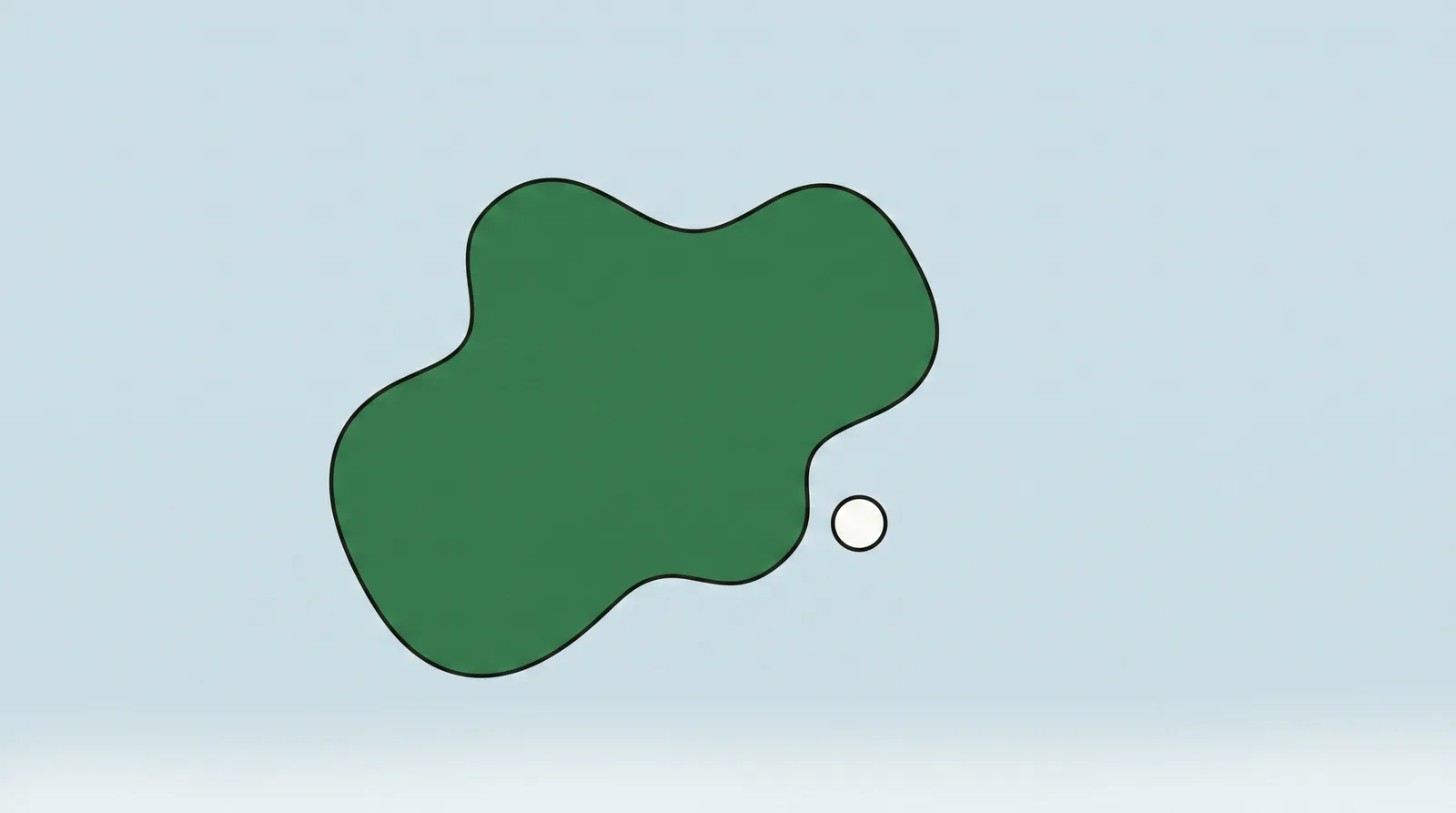
The term water hazard has not existed since 2019, and the rule that replaced it is more generous in ways most golfers never claim. Penalty areas can be dry, they can be enormous, and inside one you may ground your club and move loose impediments freely. The colour of the stakes decides how many ways out you have.
A penalty area is not just water
The definition is broader than the old one. A penalty area is any body of water on the course, whether or not the committee has marked it, including a sea, lake, pond, river, ditch, surface drainage ditch or other open watercourse, "even if not containing water". It is also any other part of the course the committee chooses to define as one.
That second clause is the change. Committees can now mark desert, dense scrub, gorse or a ravine as a penalty area, which is why you will find red stakes around ground with no water near it. Under the old rules those places were simply lost ball country.
Where the committee has not defined the edge of a body of water, the edge is its natural boundary, meaning where the ground slopes down to form the depression that can hold water. A watercourse that is usually dry may instead be defined as part of the general area, in which case it is not a penalty area at all.
Red and yellow, and the one option that separates them
Both colours cost one penalty stroke. The difference is entirely in how many ways you can get back into play.
| Relief option | Yellow | Red | Rule |
|---|---|---|---|
| Play it as it lies, no penalty | Yes | Yes | 17.1b |
| Stroke and distance, replay from the previous spot | Yes | Yes | 17.1d(1) |
| Back-on-the-line, keeping the crossing point between you and the hole | Yes | Yes | 17.1d(2) |
| Lateral, two club-lengths from the crossing point | No | Yes | 17.1d(3) |
Rule 17.1d is explicit that lateral relief exists only for a red penalty area. Taking a two club-length drop beside a yellow one is playing from a wrong place, which adds the general penalty on top of the stroke you already took.
If the committee has not marked or indicated a colour, the definition treats the area as red. That is the generous default, and it is worth knowing on a scruffy municipal course where the stakes have gone missing.
The edge, and why the stakes are the opposite of white ones
This catches people who have just learned the out of bounds rule, because penalty area stakes work the other way round.
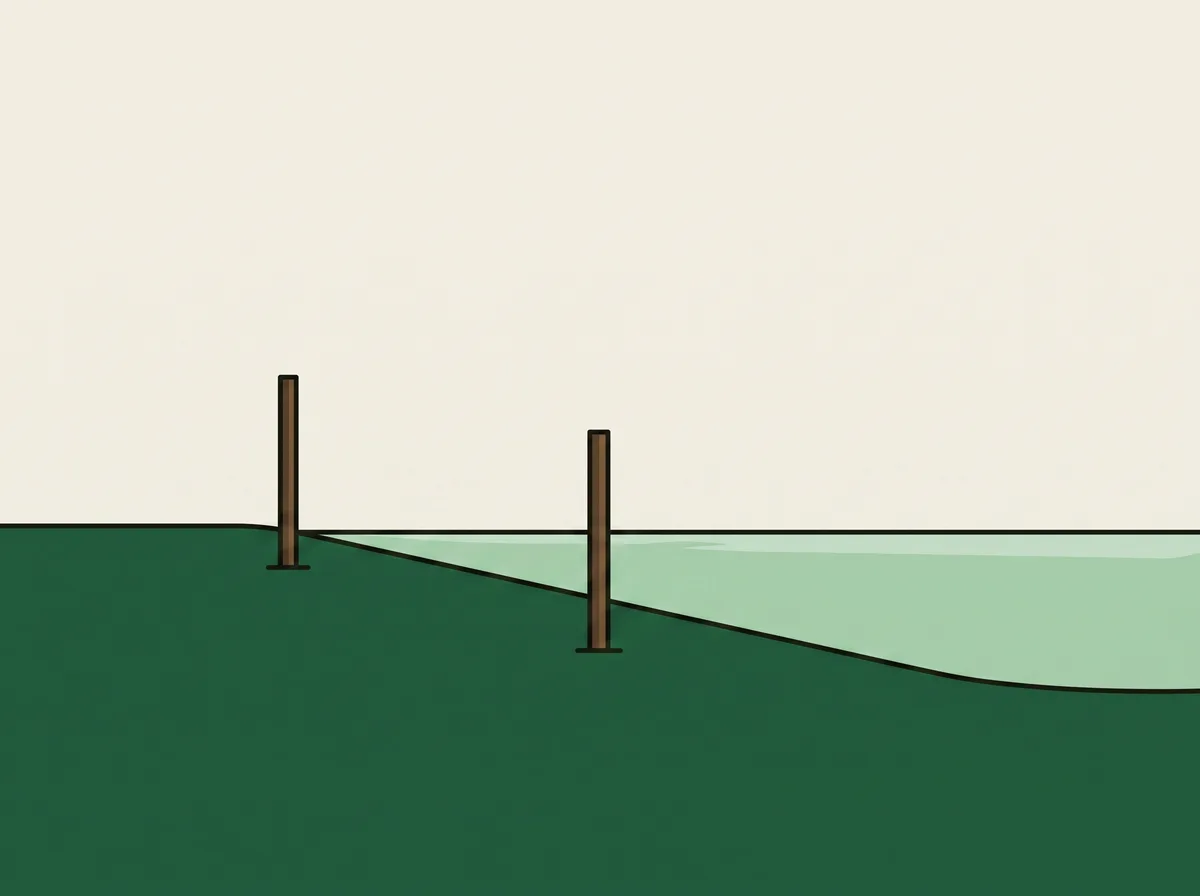
When the edge is defined by stakes it runs along the line between the outside points of the stakes at ground level, and the stakes themselves are inside the penalty area. When defined by a painted line, the edge is the outside edge of the line, and the line itself is in the penalty area. Compare that with a boundary, where the stakes and the line are out of bounds, in the out of bounds rule.
One useful consequence: because they are not boundary objects, penalty area stakes are obstructions. If a red stake is in your way and it lifts out of the ground, pull it out, play, and put it back. Try that with a white one and you have a two stroke penalty.
Your ball is in the penalty area when any part of it touches the ground or anything else inside the edge, or is above the edge. A ball half over the line counts, and here it counts as being in.
Where you measure from
The reference point for both relief options is the estimated point where the ball last crossed the edge of the penalty area. It is not where the ball entered the water, and not the nearest point of the pond to where you are standing.
For back-on-the-line relief you drop outside the penalty area, keeping the crossing point between the hole and the spot where the ball is dropped, with no limit on how far back you go. The spot where the ball first touches the ground creates a relief area one club-length in any direction. It must not be nearer the hole than the crossing point, may be in any area of the course except that same penalty area, and the ball must come to rest in the area it first touched.
For lateral relief off a red penalty area, the crossing point is the reference point, the relief area is two club-lengths, and it must not be nearer the hole. Both drops are made from knee height under Rule 14.3b.
If you do not know where the ball last crossed, Rule 1.3b(2) lets you use reasonable judgment and your estimate stands even if it later proves wrong. If you find out before making a stroke that the reference point was wrong, you must correct it under Rule 14.5.
You are allowed to play it, and to ground your club
This is the biggest practical change from the old water hazard rule and the one still being got wrong on courses every weekend.
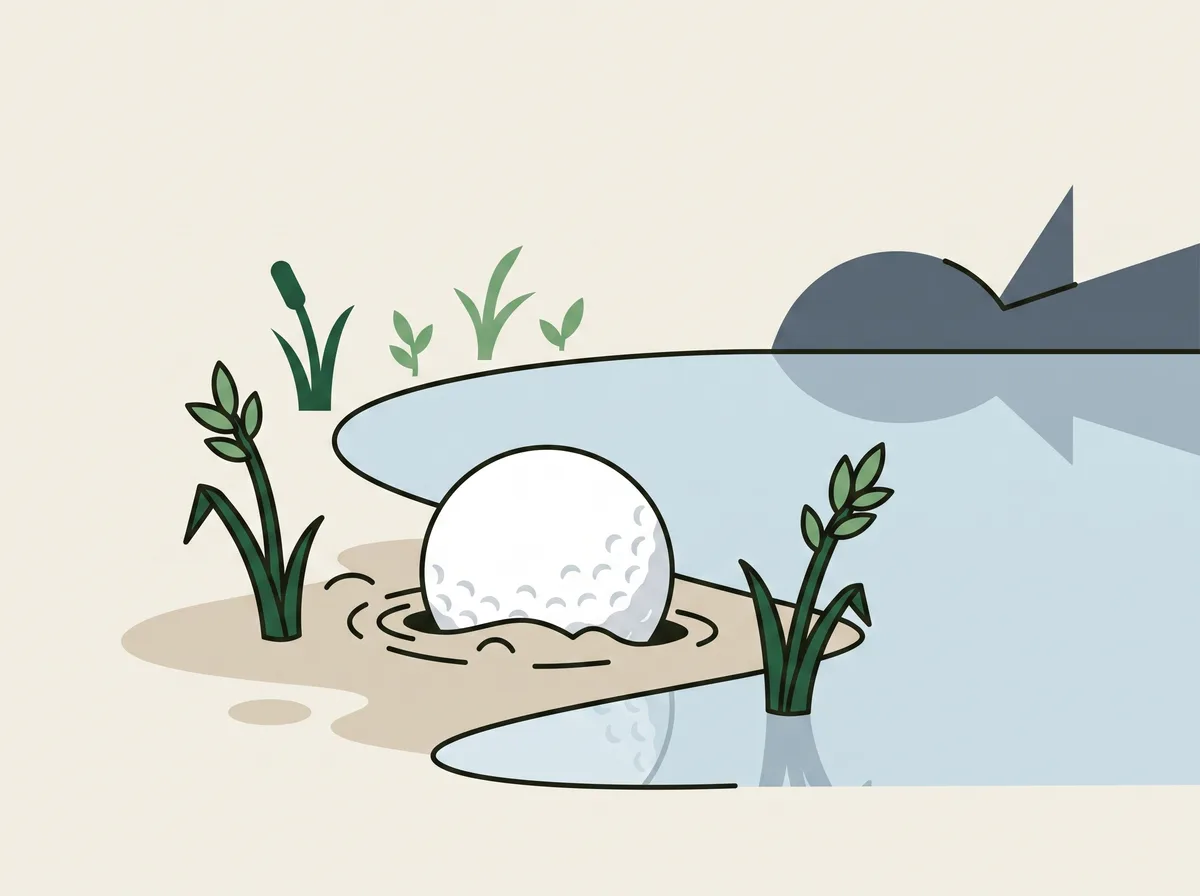
Rule 17.1b states that a ball in a penalty area may be played as it lies without penalty, under the same rules that apply to a ball in the general area, "which means there are no specific Rules limiting how a ball may be played from a penalty area". Ground the club behind the ball. Take practice swings that brush the ground. Move loose impediments: stones, leaves, sticks. Touch the water. None of it is a penalty any more. You may also stand in a penalty area to play a ball lying outside it.
The upshot is that a ball sitting cleanly on the dry bank inside a red line is usually just a golf shot, often off a slope, which is a technique problem rather than a rules one. Playing from uneven lies covers the setup that makes those work.
What you give up by being in one
Rule 17.3 is the trade-off. While your ball is in a penalty area there is no relief for an abnormal course condition, no embedded ball relief, and no unplayable ball relief. You cannot declare a ball unplayable inside a penalty area at all, so the two club-length drop from the ball itself does not exist there. Standing in temporary water inside a red line is simply bad luck.
The single exception is a dangerous animal condition under Rule 16.2. If a snake, alligator or nest of bees is near your ball, you get free relief inside the penalty area or penalty relief outside it. One further modification is worth naming: Rule 25.4m expands the lateral relief area from two club-lengths to four for players who use a wheeled mobility device.
When the ball is not found
This is where penalty areas and lost balls meet, and getting it wrong costs the difference between one stroke and a walk back.
Rule 17.1c allows penalty area relief for a ball you never found, but only when it is known or virtually certain that the ball came to rest in the penalty area. That standard is defined: conclusive evidence, or at least 95% likelihood based on all reasonably available information, counting only what you learn inside the three minute search. If it is merely probable that the ball is in the water, the ball is lost and you owe stroke and distance under Rule 18.2 instead.
Once you put another ball in play under Rule 17, the original is out of play even if it turns up on dry land thirty seconds later.
Committees can also adopt Model Local Rule B-2, which allows lateral relief on the opposite side of a red penalty area at an equal distance from the hole. It is common where an area is narrow and one bank is unplayable, and like every local rule it applies only where the scorecard says so.
For the levels these penalties sit at, what each breach costs has the full table, and how the rulebook is organised covers the five areas. How often you meet penalty areas depends on the type of course you play, and playing away from them is handled in course management. Cutting out water balls is one of the more reliable routes to breaking 100, and a shorter starting list sits in the beginner rules checklist.
Key takeaways
- Penalty areas include any body of water, marked or not, plus anything else the committee defines, including dry ground.
- Yellow gives two relief options. Red adds a third, the two club-length lateral drop. Both cost one penalty stroke.
- An unmarked or unindicated penalty area is treated as red.
- The stakes and lines marking a penalty area are inside it, the opposite of boundary stakes.
- Penalty area stakes are obstructions, so a loose one may be pulled out of your way.
- The reference point for relief is where the ball last crossed the edge, not where it came to rest.
- Back-on-the-line relief has no limit on how far back you go, and the drop point creates a one club-length relief area.
- You may play the ball as it lies, ground your club and move loose impediments inside a penalty area.
- There is no unplayable ball, embedded ball or abnormal course condition relief while the ball is in a penalty area.
- Relief for a ball you never found requires known or virtually certain, not a hunch. Otherwise it is a lost ball.
Common questions
What is the difference between red and yellow stakes?
Both mark penalty areas and both cost one penalty stroke. Yellow gives two relief options: replay from the previous spot, or drop back on a line through the crossing point. Red gives those two plus a lateral drop within two club-lengths of the crossing point.
What happened to the water hazard rule?
It was replaced in 2019 by penalty areas under Rule 17. The change widened what can be marked, removed the ban on grounding your club and moving loose impediments inside the area, and kept the one stroke cost.
Where do I drop after hitting into water?
From the estimated point where the ball last crossed the edge of the penalty area. For a red area you may drop within two club-lengths of that point, no nearer the hole. For either colour you may instead go back on a line through that point, as far back as you like.
Can I ground my club in a penalty area?
Yes. Rule 17.1b applies the same rules as the general area, so grounding the club, taking practice swings that touch the ground, and moving loose impediments are all allowed with no penalty.
Are the stakes inside or outside the penalty area?
Inside. The edge runs between the outside points of the stakes at ground level, so the stakes themselves are in the penalty area. This is the reverse of white boundary stakes, which are out of bounds.
What if the penalty area is not marked with a colour?
It is treated as red, which means all three relief options are available including the lateral drop. An unmarked body of water on the course is a penalty area whether the committee has staked it or not.
Can I declare my ball unplayable in a penalty area?
No. Rule 17.3 removes unplayable ball relief, embedded ball relief and abnormal course condition relief while the ball is in a penalty area. Your options are the ones Rule 17 gives you.
Do I have to see the ball go in to take relief?
You need it to be known or virtually certain, which the rules define as conclusive evidence or at least 95% likelihood from all reasonably available information. If it is only probable, the ball is treated as lost and stroke and distance applies.
Can a dry ditch be a penalty area?
Yes. The definition covers open watercourses even when they contain no water, and committees can define any part of the course as a penalty area. Some dry ditches are instead defined as general area, so check the local rules.
How far back can I go with back-on-the-line relief?
As far as you like. There is no limit, provided you keep the crossing point between the hole and where you drop. The spot where the ball first touches the ground creates a relief area of one club-length in any direction from it.

Tom Ashworth
Tom Ashworth is a PGA Professional who has taught golf since 2012, working mainly with beginners and mid-handicappers at club level in Surrey. He reviews the instruction guides on Learn Golf for technical accuracy before they publish.
Most of his teaching is with players in their first three years of the game, and most arrive having been told too much: six swing thoughts collected from videos, half of them contradicting each other. His approach is to check the grip and the alignment before touching the swing, on the basis that most bad ball flight is decided at address.