Most amateur scorecards are wrong in both directions. Golfers add a stroke for touching a ball they were entitled to lift, then walk out of a bunker having grounded the club without realising it cost two. The penalty structure has exactly three levels, and knowing which level a breach sits at is most of what the rules ask of you.
Three levels, no warnings
There is no half stroke in golf, no first offence discount and no referee's caution. A breach falls into one of three buckets, and the bucket is fixed by the rule that was breached rather than by how much it cost you.
Rule 1.3c(4) governs what happens when you break more than one. Breach several rules, or the same rule repeatedly, with no intervening event in between, and you get a single penalty. Have an intervening event, which usually means making a stroke or becoming aware of the first breach, and then breach again, and you get both penalties.
The other structural point is that penalty strokes are strokes. Rule 3.1c folds them into your score for the hole exactly like a swing, which is why a ball hit into water and dropped costs you the shot you played plus one, and your next swing is your third.
The one stroke penalties
Almost everything that happens to an amateur in a normal round sits here. Note that four of these are relief options you choose, not punishments you are given.
| Situation | Cost | Rule |
|---|---|---|
| Taking relief from a penalty area, any of the options | 1 stroke | 17.1d |
| Ball lost or out of bounds, stroke and distance | 1 stroke | 18.2b |
| Declaring a ball unplayable in the general area | 1 stroke | 19.2 |
| Declaring a ball unplayable in a bunker, staying in the bunker | 1 stroke | 19.3a |
| Lifting or moving your ball at rest when no rule allows it | 1 stroke | 9.4b |
| Taking penalty relief out of a bunker from an abnormal course condition | 1 stroke | 16.1c(2) |
| Playing a wrongly substituted ball | 1 stroke | 6.3b |
| Playing a ball dropped in a wrong way, from inside the relief area | 1 stroke | 14.3b |
Rule 9.4b is the one golfers collect without noticing, and it carries exceptions worth memorising. There is no penalty if you move the ball accidentally while trying to find or identify it, none for accidental movement on the putting green, none while doing something a rule authorises such as marking or measuring, and none if the ball moves after coming to rest against you or your equipment.
The general penalty
Two strokes in stroke play, loss of hole in match play. These are breaches where playing on as if nothing happened would leave you materially better off than the rules intend.
| Situation | Rule | Note |
|---|---|---|
| Playing a wrong ball | 6.3c | Must be corrected before starting the next hole or it is disqualification |
| Touching the sand in a bunker to test it, or grounding the club in front of or behind the ball | 12.2b | Also applies to touching sand on the backswing |
| Carrying more than fourteen clubs | 4.1b | Two strokes for each hole where the breach happened, capped at four for the round |
| Playing from a wrong place | 14.7a | Includes dropping outside the relief area and playing it |
| Improving the conditions affecting your stroke | 8.1a | Flattening grass behind the ball, moving a boundary object, moving tee-markers |
| Starting a hole from outside the teeing area, stroke play | 6.1b | Must be corrected, and the wrong strokes do not count |
| Deliberately deflecting or stopping your own dropped ball | 14.3d | The penalty survives even if you then drop again properly |
| Using equipment that removes a skill essential to the game | 4.3 | A second breach after an intervening event is disqualification |
The fourteen club rule is worth reading closely because the cap surprises people. Rule 4.1b charges two strokes for each hole on which the breach happened, to a maximum of four penalty strokes for the round. In match play the match score is adjusted by one hole for each hole where a breach happened, to a maximum deduction of two holes. If you play fifteen holes with fifteen clubs, you lose four strokes, not thirty. How many clubs to carry covers why fewer is often better anyway.
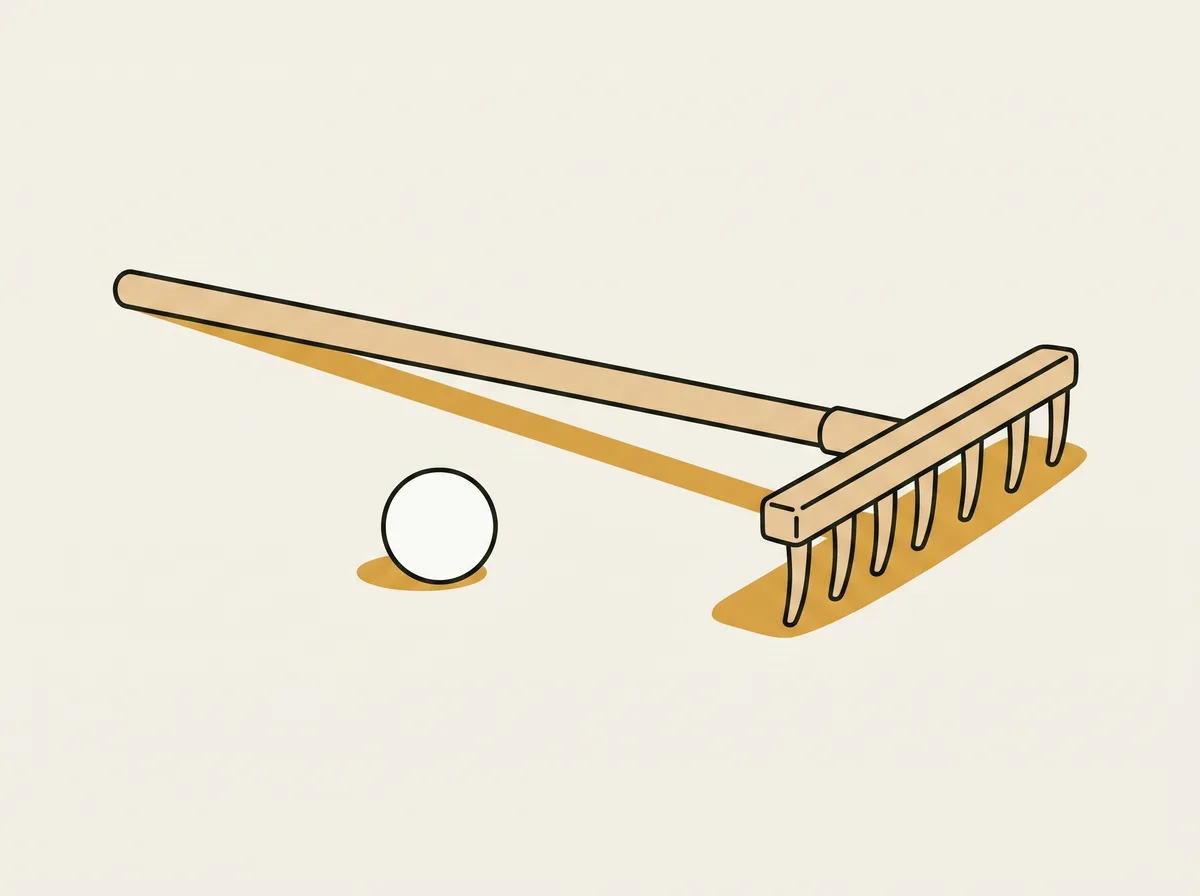
The bunker rules are narrower than the folklore. Rule 12.2b explicitly allows you to dig in with your feet, lean on a club for balance, smooth the sand to care for the course, place equipment down, and even strike the sand in frustration. What it forbids is testing the sand for information, touching sand right in front of or behind the ball with a club, and touching sand on a practice swing or backswing. Once the ball is out the restrictions lift entirely. Technique sits in greenside bunker play.
Disqualification is narrower than it sounds
Disqualification only exists in competition, and the list is short.
Returning a scorecard with a hole score lower than you actually took is disqualification under Rule 3.3b(3). Return a higher score and the higher number simply stands. There is an exception where the player did not know about a penalty when the card went in, in which case the committee adds the strokes instead.
Failing to correct a serious mistake is the other common route. Play a wrong ball or start a hole from outside the teeing area and you get the general penalty and a chance to fix it. Start the next hole without fixing it and the penalty becomes disqualification.
The rest are equipment and conduct: deliberately changing a club's playing characteristics during the round, failing to take an excess club properly out of play, a second equipment breach, or serious misconduct under Rule 1.2a.
Match play counts penalties differently
In stroke play a penalty is arithmetic. In match play it is usually the hole. Because the general penalty is loss of hole rather than two strokes, a single breach can cost you a hole you were winning by three, and there is no partial credit.
Two match play breaches carry disqualification outright: knowingly agreeing to concede holes to shorten a match, and knowingly agreeing to ignore a rule or penalty either player knows applies. Both are covered in Rule 3.2, and both exist because match play is a private contest with no marker checking a card.
What penalties do to your handicap
Penalty strokes count toward your gross score, but the score you post for handicap purposes is capped. Under the Rules of Handicapping every hole is limited to net double bogey, which is par plus two plus any handicap strokes you receive on that hole. A disaster hole where penalties stacked up is trimmed automatically before it reaches your index.
Grinding a triple into a quadruple therefore gains you nothing, and picking up in a casual round is not the sin beginners think it is. Getting a handicap covers what you need to post.
For the structure these penalties sit inside, how the rulebook is organised sets out the five areas and the relief rules. The two biggest sources of amateur penalty strokes have their own pages: out of bounds and stroke and distance and red and yellow penalty areas. If the arithmetic is still new, how a golf score is built covers par and bogey.
Key takeaways
- There are three penalties in golf: one stroke, the general penalty, and disqualification.
- The general penalty is two strokes in stroke play and loss of hole in match play.
- All penalty relief costs one stroke: penalty areas, lost balls, out of bounds and an unplayable ball.
- Lifting or moving your own ball at rest costs one stroke, with four exceptions including accidental movement while searching.
- Carrying extra clubs costs two strokes per hole affected, capped at four for the round.
- Touching the sand to test it or grounding the club behind the ball in a bunker is the general penalty.
- Returning a hole score lower than you took is disqualification. A higher score simply stands.
- Multiple breaches with no intervening event in between produce one penalty, not several.
- Several widely believed penalties do not exist, including hitting the flagstick and playing out of turn in stroke play.
- For the short version aimed at a first season, start with the beginner rules checklist.
Common questions
How many penalty strokes are there in golf?
Three levels. One penalty stroke for minor breaches and all penalty relief, the general penalty of two strokes in stroke play or loss of hole in match play for more serious breaches, and disqualification for the most serious.
What is the general penalty in golf?
Loss of hole in match play and two penalty strokes in stroke play. It covers playing a wrong ball, testing the sand in a bunker, carrying more than fourteen clubs, playing from a wrong place, and improving the conditions affecting your stroke.
Is it a penalty if my ball moves at address?
Not automatically. Under Rule 9.2 a ball is only treated as having moved if that is known or virtually certain, and under Rule 9.4b you are penalised one stroke only if you caused it. Wind and gravity are natural forces and carry no penalty.
Do I get a penalty for touching my ball on the green?
No. Rule 9.4b lists accidental movement on the putting green as an exception, and Rule 13.1b lets you mark, lift and clean the ball deliberately. Replace it on its original spot and play on.
How many strokes is a lost ball?
One penalty stroke, plus replaying from where you last hit, which is why it is called stroke and distance. If you hit your tee shot into trees and cannot find it, your next shot from the tee is your third.
What is the penalty for having 15 clubs?
Two penalty strokes for each hole on which the breach happened, capped at four penalty strokes for the round in stroke play. In match play the score is adjusted by one hole per affected hole, capped at two holes.
Is there a penalty for hitting the flagstick?
No. Rule 13.2a allows you to leave the flagstick in the hole for any stroke including a putt, and there is no penalty if the ball hits it. This changed in 2019 and the old two stroke penalty no longer exists.
Can I be disqualified in a casual round?
No. Disqualification only means removal from a competition, so it has no meaning in a social round with no card returned. The penalty strokes themselves still apply if you are posting the score for handicap.
Do penalty strokes count toward my handicap?
Yes, they count in your gross score, but every hole is capped at net double bogey before the score is used for handicap purposes, so a hole ruined by penalties is trimmed automatically.
What happens if I break two rules at once?
Rule 1.3c(4) gives you a single penalty if the breaches happen with no intervening event between them. If you breach, then have an intervening event such as making a stroke, then breach again, both penalties apply.
Tom Ashworth
Tom Ashworth is a PGA Professional who has taught golf since 2012, working mainly with beginners and mid-handicappers at club level in Surrey. He reviews the instruction guides on Learn Golf for technical accuracy before they publish.
Most of his teaching is with players in their first three years of the game, and most arrive having been told too much: six swing thoughts collected from videos, half of them contradicting each other. His approach is to check the grip and the alignment before touching the swing, on the basis that most bad ball flight is decided at address.