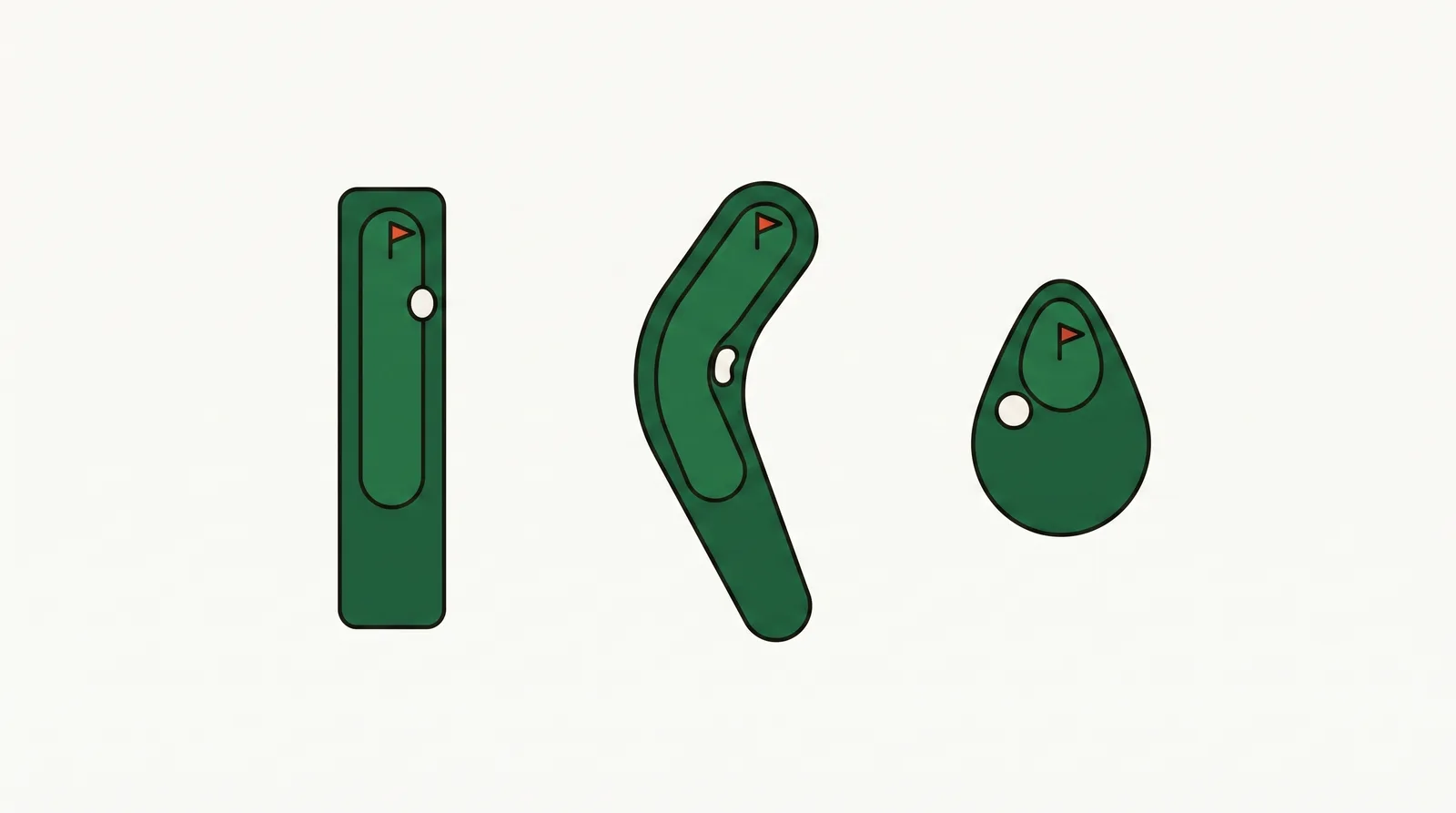
Golfers use the word type to mean two completely different things, and the confusion is expensive. A links course and a parkland course differ in the ground you play off. A municipal course and a private club differ in who can walk on. One tells you how the ball behaves, the other tells you whether you can get a tee time. Here is both, sorted.
Types by terrain
Terrain is the older classification and it is the one that changes your shots. What the ball does when it lands is decided by the ground it lands on, and that varies enormously.
| Type | The land | How it plays |
|---|---|---|
| Links | Sandy coastal ground between beach and farmland, few trees | Firm and fast, wind is constant, the ball runs a long way |
| Parkland | Inland, often manicured, tree lined, softer soil | Softer landings, aerial approaches, defined by trees and water |
| Heathland | Sandy inland soil with heather, gorse and scattered pine | Firmer than parkland, punishing off the fairway, open sight lines |
| Desert | Irrigated corridors cut through arid scrub and rock | Target golf, almost no run off the fairway edges, out of play means gone |
| Mountain | Elevation changes, thin air, dramatic drops | Distance is unreliable, downhill shots carry further, awkward stances |
| Resort or coastal | Purpose built for visitors, wide corridors, scenic framing | Generally more forgiving than the photographs suggest |
Most golf in the United States is parkland or a variant of it. Links courses in the strict sense are rare, and the word gets applied loosely to any treeless course near water, which is why "links style" appears on so many scorecards for courses that are nothing of the kind.
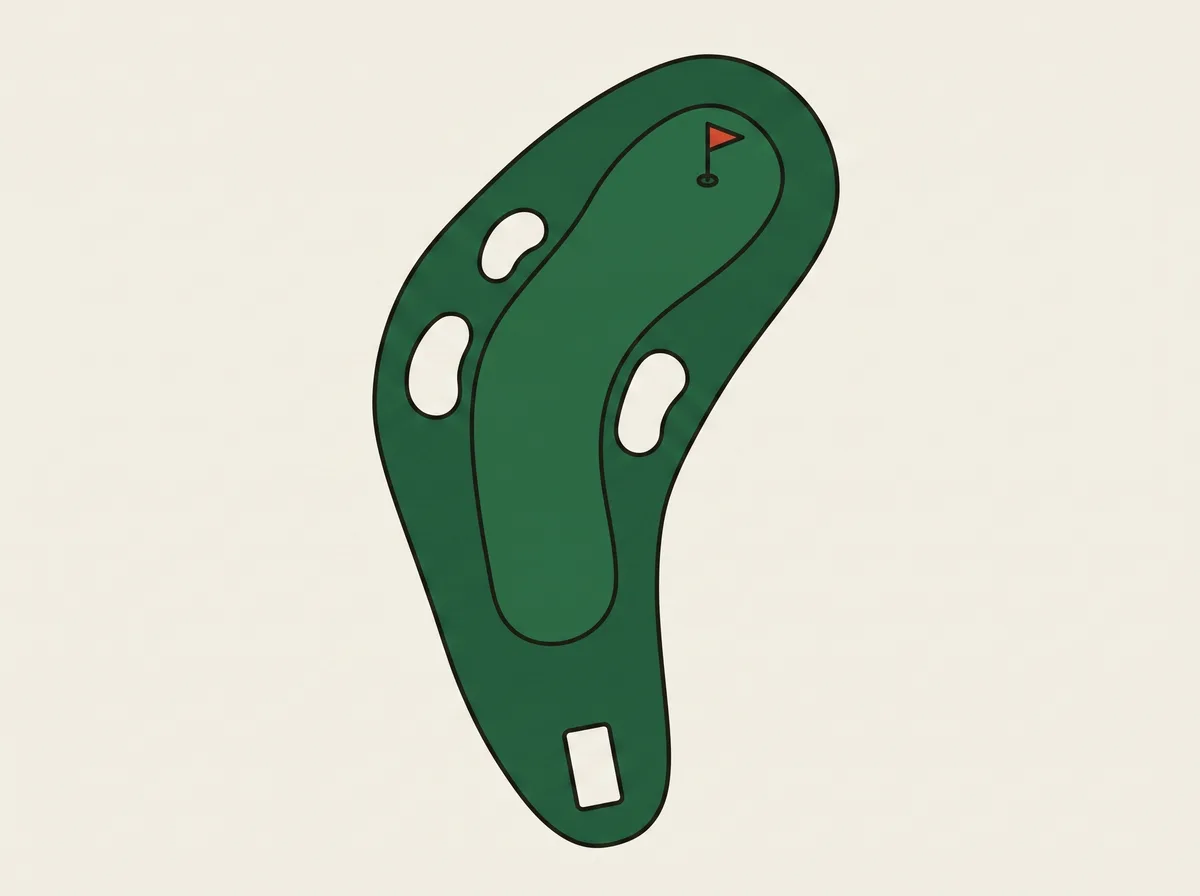
Types by length
Length is the classification that decides how long you will be out and whether the round counts for anything official.
A regulation course is the default, an eighteen-hole layout with a par usually between 70 and 72, mixing par 3s, par 4s and par 5s. Everything else is defined by what it leaves out.
An executive course is shorter, typically par 60 to par 66, weighted heavily towards par 3s with a handful of short par 4s. The name has nothing to do with exclusivity and everything to do with time, because the format was built for people who wanted golf in two hours rather than four.
A par 3 course, sometimes called a short course or pitch and putt, is exactly what it says: every hole is a par 3. Some are 60 yard pitches, others hold full mid-iron holes, and the difference between the two is worth checking before you turn up with a full bag.
A nine-hole course is a regulation layout at half length, and it is the format most beginners should be playing. Nine holes is a real round of golf, it takes half the time, and the comparison with eighteen is in how long a round takes.
Types by access
This is the classification that decides whether you can book, and it is the one that differs most between countries. In the United States the ladder runs roughly like this.
| Type | Who plays | What it costs |
|---|---|---|
| Municipal | Anyone. Owned by a city or county | Lowest green fees in golf, often with a resident rate |
| Daily fee | Anyone. Privately owned, open to the public | Mid-range, varies wildly by course and by day |
| Semi-private | Members plus public tee times, usually off-peak | Members pay dues, visitors pay a green fee |
| Private | Members and their guests only | Annual dues plus a one-time initiation fee |
| Resort | Hotel guests first, public second | Highest single-round pricing, often bundled with a stay |
The private club structure is the one that catches people out, because there are two separate numbers. Dues are the annual running cost. The initiation fee is a separate up-front payment made once on joining, and at many clubs it dwarfs a year of dues. Anyone comparing membership against a season of green fees has to count both, and the arithmetic is in how much golf costs.
Municipal and daily fee courses are where the overwhelming majority of American golf is played, and booking one is straightforward once you know how the tee sheet works, which is covered in how to book a tee time.
The parts every course shares
Whatever the type, the Rules of Golf divide every course into the same five areas. Rule 2.2 sets out the general area plus four specific areas: the teeing area you are playing from, penalty areas, bunkers, and the putting green of the hole you are playing. Everything else, including the fairway, the rough and the trees, is the general area.
That matters because your options when a ball goes somewhere unwelcome depend entirely on which of those five areas it finished in, not on how the course describes itself. The basics are in golf rules for beginners.
Why two par 72s play nothing alike
Par tells you almost nothing about difficulty. Two courses can both be par 72 and be four or five strokes apart for the same golfer, which is why the handicap system does not use par to compare them.
It uses Course Rating and Slope Rating instead. Under the R&A's course rating system, the rating is built from the effective playing length of each hole, adjusted for roll, wind, elevation, altitude, doglegs and forced lay ups, plus ten obstacle factors assessed hole by hole: topography, fairway, green target, recoverability and rough, bunkers, crossing obstacles, lateral obstacles, trees, green surface and psychology.
The Course Rating is the expected score for a scratch player. The Slope Rating expresses how much harder the course gets for a bogey golfer than for that scratch player, and a course of standard relative difficulty has a Slope Rating of 113. A high slope does not mean a great course, it means the trouble punishes a mid-handicapper disproportionately.
Both numbers are printed on the scorecard for every set of tees, and they are also what makes a round postable. A course carrying no Course Rating and Slope Rating cannot be used to build a handicap at all, which rules out most pitch and putt layouts. The rest of that process is in how to get a golf handicap.
Where the strokes actually go, by hole type
Scoring is not spread evenly across a course, and knowing where it concentrates changes which type of course suits you.
Shot Scope analyzed a database of more than 100,000 golfers to compare average scores on par 3s, par 4s and par 5s. Their finding is that par 3s give higher handicaps their best chance of holding a score together, while par 5s produce the widest gap of all, with 2.22 shots separating scratch players from 25 handicaps.
That is the honest argument for executive and par 3 courses as a beginner. The holes where a high handicap bleeds strokes are the long ones, and a course made mostly of short holes removes the part of the game that is currently costing the most. It is also the reasoning behind playing the shorter tees on a full course, which is the first decision in course management.
Playing links golf for the first time
If you ever get to a genuine links, the adjustment is larger than the photographs suggest, and none of it is about swinging differently.
Shot Scope's guide to playing links golf makes the case in three parts. The wind is constant and shifting, so a well struck high shot can balloon or drift into trouble that was never in play on the practice range. The turf is firm and sandy, which punishes anything landing on the green but rewards the tee shot with far more roll than you are used to. And the pot bunkers are deep, steep faced and frequently hidden from the tee.
The practical consequences are all short game. Putt from off the green rather than chipping wherever the ground allows it, and use a low running shot rather than a lofted one, because gusting wind makes the flight of a high pitch impossible to predict. The technique for the low option is in the bump and run.
Which type to play now
Match the course to the golf you have today rather than the golf you are aiming at.
If you have played fewer than ten rounds, a nine-hole or executive course removes almost everything that makes golf slow and demoralizing, and nobody there will be watching. If you can get around in under 110, a municipal or daily fee regulation course from the forward tees is the right home. Once you are breaking 90 consistently, the type stops mattering much and preference takes over.
Whatever you book, the etiquette is identical across all of them, and a private club expects nothing that a good municipal does not. It is set out in golf etiquette, and what to expect on the day is in your first round of golf.
Key takeaways
- Course type means two things: the terrain it is built on, and who is allowed to play it.
- Links means sandy coastal ground, firm turf and wind. Most courses calling themselves links style are parkland.
- Executive courses are par 60 to 66 and built around time, not exclusivity. Par 3 courses are exactly that.
- In the United States, access runs from municipal through daily fee and semi-private to private and resort.
- Private clubs charge annual dues plus a separate one-time initiation fee, and both belong in any comparison.
- Every course is divided by the Rules into five areas, and your options depend on which one the ball is in.
- Par tells you nothing about difficulty. Course Rating and Slope Rating do, and both are on the card.
- A Slope Rating of 113 is a course of standard relative difficulty.
- Par 5s separate good golfers from high handicaps more than any other hole type, which is why short courses suit beginners.
- Links golf is a short game adjustment, not a swing adjustment. Putt from off the green and keep the ball low.
Common questions
What are the main types of golf courses?
By terrain: links, parkland, heathland, desert and mountain. By length: regulation eighteen-hole, executive, par 3 and nine-hole. By access: municipal, daily fee, semi-private, private and resort. Any given course carries one label from each group.
What is a links golf course?
A course built on sandy coastal ground between the beach and farmland, with firm turf, few or no trees, deep pot bunkers and near-constant wind. True links courses are uncommon, and the term is widely misapplied to any open, treeless layout.
What is the difference between links and parkland?
Links is coastal, sandy and firm, so the ball runs and the wind dictates everything. Parkland is inland, softer and tree lined, so approach shots stop faster and trouble comes from trees and water rather than wind and gorse.
What is an executive golf course?
A shorter course, usually par 60 to 66, made up mostly of par 3s and short par 4s. It is designed to be played in around two hours. The name refers to the time saving, not to any kind of exclusivity.
What is a par 3 golf course?
A course on which every hole is a par 3. Lengths vary from short pitch and putt layouts to full mid-iron holes. It is the best value practice in golf for anyone whose scoring problem sits inside 150 yards.
What is the difference between municipal and private golf courses?
A municipal course is owned by a city or county and open to anyone who books. A private club is open only to members and their guests, and joining involves annual dues plus a separate one-time initiation fee.
What does semi-private mean at a golf course?
The course has members who pay dues and also sells tee times to the public, usually outside peak hours. It is a middle ground: cheaper to belong to than a private club, and bookable by visitors when the sheet allows.
Can I get a handicap playing a par 3 course?
Usually not, because most short courses carry no Course Rating and Slope Rating, and scores from unrated courses cannot be posted. Some executive courses are rated, so check the scorecard before assuming either way.
What do Course Rating and Slope Rating mean?
Course Rating is the expected score for a scratch player on that set of tees. Slope Rating expresses how much harder the course plays for a bogey golfer relative to that scratch player. A course of standard relative difficulty rates 113.
Which type of golf course is best for beginners?
A nine-hole, executive or par 3 course, followed by a municipal regulation course from the forward tees. All three remove the long forced carries that cause lost balls and slow play, and none of them will make you feel out of place.
Are resort courses harder than public courses?
Not usually. Resort courses are built to be enjoyed by visiting golfers of every standard, so the corridors tend to be wide and the trouble is often more scenic than penal. The higher price buys conditioning and views rather than difficulty.
Tom Ashworth
Tom Ashworth is a PGA Professional who has taught golf since 2012, working mainly with beginners and mid-handicappers at club level in Surrey. He reviews the instruction guides on Learn Golf for technical accuracy before they publish.
Most of his teaching is with players in their first three years of the game, and most arrive having been told too much: six swing thoughts collected from videos, half of them contradicting each other. His approach is to check the grip and the alignment before touching the swing, on the basis that most bad ball flight is decided at address.